
Blackpoll Warbler Guide
Keep Track of What You See
Create a free Wild Things Guide membership to record this Blackpoll Warbler in My Sightings and build your personal wildlife list.
Join to Add This SightingIntroduction
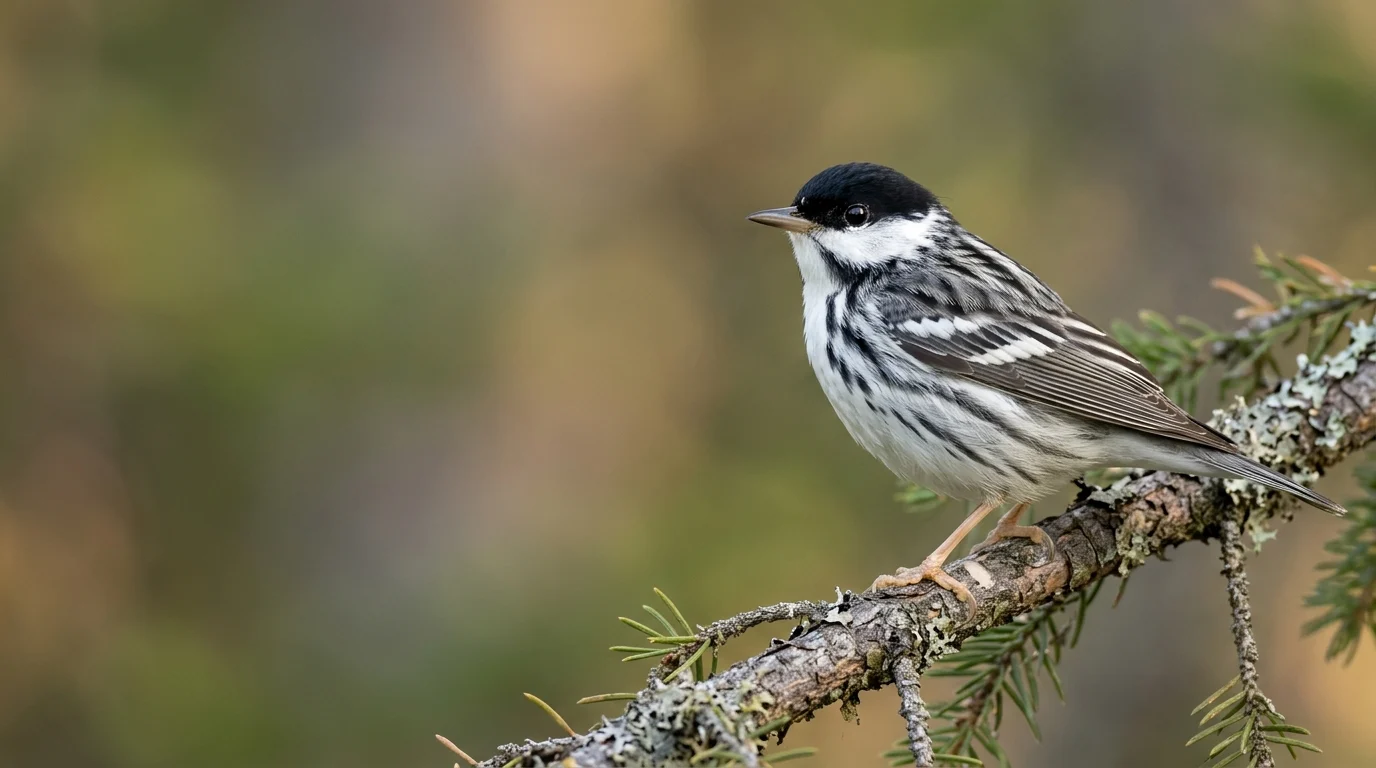
The Blackpoll Warbler (Setophaga striata) is a small, long-winged songbird of North America’s boreal forests. Breeding males are boldly patterned in black and white, but females, immature birds, and fall adults wear subdued greenish plumage that can make them hard to identify. Its pale or yellowish feet, streaked underparts, wing bars, and relatively long wings provide useful clues.
This Warbler is also notable for its migration. Birds breeding across Alaska and Canada move eastward in fall, and many undertake a prolonged flight over the western Atlantic toward the Caribbean and northern South America. The species is most accessible to many observers during spring and fall migration, when it appears in woodlots, parks, coastal thickets, and other places with abundant insects.
The Cornell Lab of Ornithology’s Blackpoll Warbler account provides additional photographs, sounds, and seasonal occurrence information.
Quick Identification
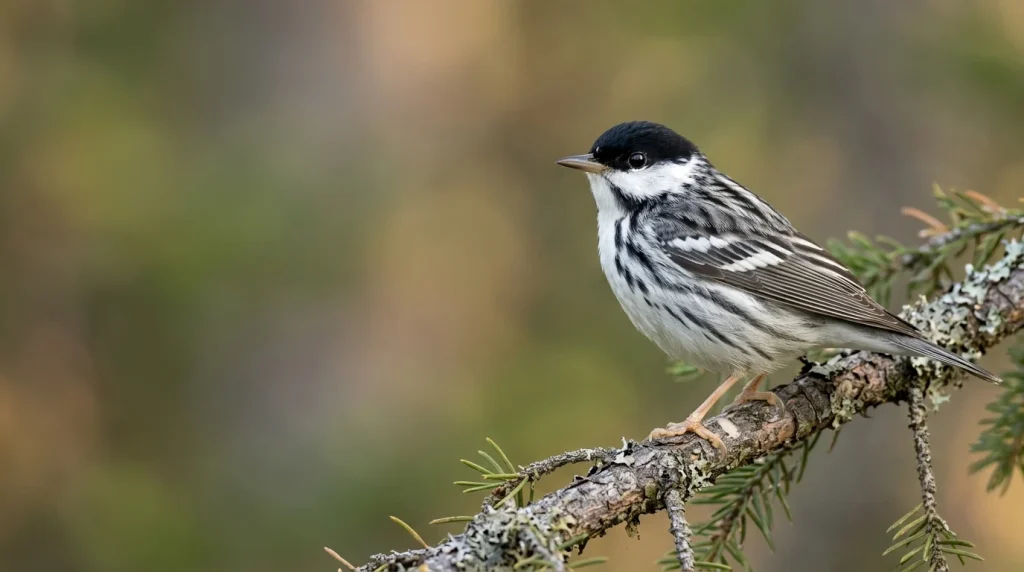
- Breeding male: black cap, white cheeks, black-and-white streaked body, two white wing bars, and pale feet.
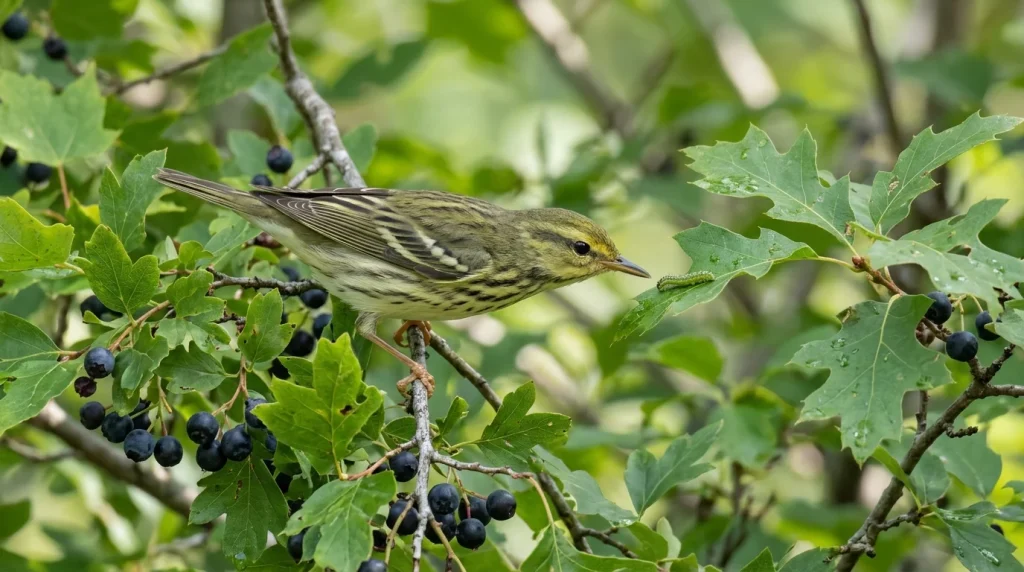
- Female and nonbreeding birds: olive-green to yellow-green above, pale yellowish below, with dark streaks on the sides and breast.
- Feet: often distinctly yellowish or pale, contrasting with darker legs.
- Wings: long and pointed for a wood-warbler, with noticeable primary projection beyond the folded tertials.
- Behavior: actively searches foliage, twigs, and needle clusters, sometimes hovering briefly to take prey.
- Voice: a very high, thin, rapidly repeated series of similar notes.
Appearance
In spring and summer, an adult male Blackpoll Warbler is among the more distinctive wood-warblers. The crown is solid black, the cheeks are white, and a narrow black line or streaking frames the lower face. The back is grayish with heavy black streaks, while the white underparts carry bold black streaks along the breast and flanks. The wings are dark with two white bars, and white patches may be visible in the tail when it spreads.
Females are less contrasting. A typical breeding female has an olive crown and back, a yellowish face and breast, dark streaking on the back and underparts, and two pale wing bars. Individual females vary: some appear relatively bright and yellow, while others are grayer or duller.
Fall males, females, and immature birds can look surprisingly similar. They are generally olive-green above and washed pale yellow below, often brightest on the face, throat, or upper breast. Fine dark streaks usually remain visible on the breast and sides. The undertail coverts tend to look clean and pale. In all plumages, check for pale yellowish feet, although lighting, mud, shadows, and distance can make leg color unreliable by itself.

Size and Wingspan
The Blackpoll Warbler is a medium-sized member of the North American wood-warbler family. Adults are typically about 5.5 inches (14 centimeters) long, with a wingspan near 9 inches (23 centimeters). Body mass changes considerably during migration as birds accumulate and use fat reserves.
Its body is compact, but its wings are comparatively long and pointed. When perched, the primary feathers usually extend well beyond the tertials. This long-winged shape is particularly useful when evaluating a quiet fall bird alongside Bay-breasted, Pine, or other similarly colored warblers.
Range and Distribution
Blackpoll Warblers breed mainly in the northern boreal zone, from Alaska across much of Canada to Labrador and Newfoundland. Smaller breeding populations extend into parts of northeastern North America where suitable cool coniferous forest remains.
During fall migration, many western and central breeders first travel east or southeast across the continent. Large numbers gather in eastern Canada and the northeastern United States before continuing over or along the Atlantic. Their wintering range lies primarily in northern South America, including areas east of the Andes. Spring migration brings birds north through the Caribbean and eastern or central North America, although routes vary among individuals and with weather.

Habitat
On the breeding grounds, Blackpoll Warblers favor boreal coniferous and mixed forests. They are often associated with spruce and fir, including relatively open forest, forest edges, regenerating stands, and areas near bogs or shrubby wetlands. Willows, alders, and other low woody growth may be used where they occur within the broader conifer landscape.
Migrants use a much wider range of habitats. Productive deciduous woods, mixed forest, urban parks, orchards, shelterbelts, coastal scrub, and even isolated patches of trees can attract them. Fall birds often concentrate where berries and late-season insects are plentiful.

Behavior
Blackpoll Warblers usually forage in the middle and upper portions of trees, moving methodically along branches and through foliage. They glean insects from leaves, bark, buds, and conifer needles. A bird may stretch outward, hang briefly beneath a twig, or make a short hovering flight to reach prey.
During migration, they may join mixed-species feeding flocks. They can be less conspicuous than some warblers, especially when feeding high in a dense canopy. Patient observation is often needed to see the feet, flank streaking, and folded wing structure.
Before major fall flights, Blackpoll Warblers feed intensively and build substantial fat reserves. Favorable winds can influence departure, route, and stopover behavior, so numbers at a coastal site may change sharply from one day to the next.
Diet
Insects and other small arthropods make up most of the breeding-season diet. Common prey includes caterpillars, beetles, flies, ants, aphids, wasps, spiders, and insect eggs. The exact mixture depends on local and seasonal availability.
Fruit becomes especially important during late summer and fall. Blackpoll Warblers eat small berries and other soft fruits, which help supply energy during migration. They may alternate between picking fruit and searching nearby foliage for insects.
Vocalizations
The male’s song is extremely high, thin, and easily overlooked by listeners with limited high-frequency hearing. It consists of a rapid series of short, nearly identical notes, sometimes represented as tsi-tsi-tsi-tsi-tsi. The notes generally stay close to one pitch rather than rising or falling dramatically.
The call is brief, sharp, and high-pitched. Because several migrant warblers give thin contact calls, identify a call by combining plumage, shape, behavior, and seasonal context. On the breeding grounds, singing birds may remain near the tops of conifers and can be difficult to locate visually.
Breeding and Nesting
Breeding begins after adults return to northern forests in late spring or early summer. Males sing and defend territories, while courtship and pair formation occur among conifers and nearby shrubs.
The female builds a compact, open cup, commonly in a spruce or fir and often positioned relatively low, although nest height varies. The nest may be supported by branches close to a trunk or concealed in dense foliage. Construction materials include small twigs, bark strips, grasses, mosses, plant fibers, and other fine vegetation; the inner cup is lined with softer material.
A clutch commonly contains about four or five eggs, though smaller or larger clutches can occur. Eggs are generally pale, with brownish or gray markings that may be concentrated near the broader end. Incubation is performed mainly by the female and lasts roughly a week and a half, subject to normal variation.

Young and Development
Blackpoll Warbler chicks hatch helpless, sparsely covered, and dependent on their parents for warmth and food. Both adults bring small insects and other arthropods to the nest. Caterpillars can be particularly useful because they are soft-bodied and relatively easy for nestlings to swallow.
The nestling period usually lasts about a week and a half. Recently fledged young have short tails and less organized plumage than adults. They remain dependent while they improve their flight and foraging skills. Later in summer, juveniles molt into a more complete immature plumage before beginning southward migration.
Where to See
To find breeding Blackpoll Warblers, visit northern spruce-fir forest from Alaska across Canada, particularly where conifers are interspersed with bog edges, Alder, or willow. Listen early in the season for the male’s high, even series of notes. Binoculars are often necessary because singing birds may stay near the canopy.
Farther south, migration provides the best opportunity. Productive spring locations include wooded parks, lake shores, ridges, and forest edges. In fall, check berry-rich coastal thickets, urban green spaces, and woodland patches after a cold front or favorable northwest winds. Scan slowly for a greenish warbler with streaked sides, pale feet, and long folded wings.
Similar Species
- Bay-breasted Warbler: fall birds can be very similar, but usually have dark feet, a buffier or creamier body, limited breast streaking, and sometimes a trace of chestnut on the flanks. Blackpoll generally looks greener and more clearly streaked below.
- Pine Warbler: usually has a heavier bill, less distinct streaking, a plainer face, and darker feet. It can also appear more robust and may forage on trunks or larger branches.
- Cape May Warbler: may show a brighter yellow neck or rump, a sharper facial pattern, and a finer, slightly curved bill. Females and immatures can still require careful study.
- Black-and-white Warbler: breeding males share black-and-white coloration, but Black-and-white Warblers creep along trunks and branches, show strong crown striping rather than a solid black cap, and have dark feet.
- Blackburnian Warbler: dull fall birds may be streaked and wing-barred, but they often retain a yellowish eyebrow, contrasting facial pattern, dark legs, and less uniformly green upperparts.
Conservation
The Blackpoll Warbler is commonly assessed globally as Near Threatened. Although it remains widespread, monitoring has indicated substantial long-term population declines. Its remote breeding distribution makes complete surveys difficult, and trends are not necessarily uniform across the range.
Potential pressures include boreal forest loss or alteration, changes in insect availability, collisions with buildings and communications structures, severe weather during migration, and habitat change on stopover and wintering grounds. Climate-driven changes to northern forests may also affect breeding habitat and the timing of food resources. Protecting large boreal landscapes, maintaining migration stopovers, and reducing nighttime collision hazards can benefit this and many other migratory songbirds.
Field Identification Tips
- Start with season and location. A black-and-white male in northern conifers during spring is straightforward; a greenish fall migrant requires more care.
- Check the feet, not just the legs. Blackpolls often have darker legs with noticeably pale or yellowish feet.
- Look for streaking. Even subdued birds commonly show fine dark streaks on the breast and sides.
- Assess the wings. Long primary projection gives the perched bird a sleek, long-winged appearance.
- Confirm the wing bars. Two pale bars should be visible, though wear and viewing angle affect their prominence.
- Use multiple features. Never rely entirely on foot color, brightness, or a single photograph.
- Listen for the song. On breeding territory, the rapid, very high series of level notes can reveal a bird hidden near the treetops.
Frequently Asked Questions
Why is it called a Blackpoll Warbler?
“Poll” is an older word for the top of the head. The name refers to the solid black crown of the breeding male.
Do all Blackpoll Warblers have black caps?
No. The bold black cap bismainly found in males in breeding plumage. Females, immature birds, and fall males are predominantly olive or greenish and may show little or no black on the crown.
Do Blackpoll Warblers really fly over the ocean?
Many make an extended autumn flight over the western Atlantic from northeastern North America toward the Caribbean or northern South America. Routes and stopovers vary, and weather can strongly affect individual journeys.
What is the best fall identification feature?
No single feature is infallible. The strongest combination is greenish upperparts, pale yellowish feet, streaked underparts, two wing bars, pale undertail coverts, and long pointed wings.
Will Blackpoll Warblers visit feeders?
They are not regular seed-feeder visitors. Native shrubs and trees that support insects or produce small fruits are more likely to attract migrants than conventional feeders.
Are Blackpoll Warblers rare?
They can be locally common during migration or on suitable breeding grounds, but abundance varies by region and year. Despite their broad range, long-term declines are a conservation concern.


