

Black-throated Blue Warbler Guide
Keep Track of What You See
Create a free Wild Things Guide membership to record this Black-throated Blue Warbler in My Sightings and build your personal wildlife list.
Join to Add This SightingIntroduction
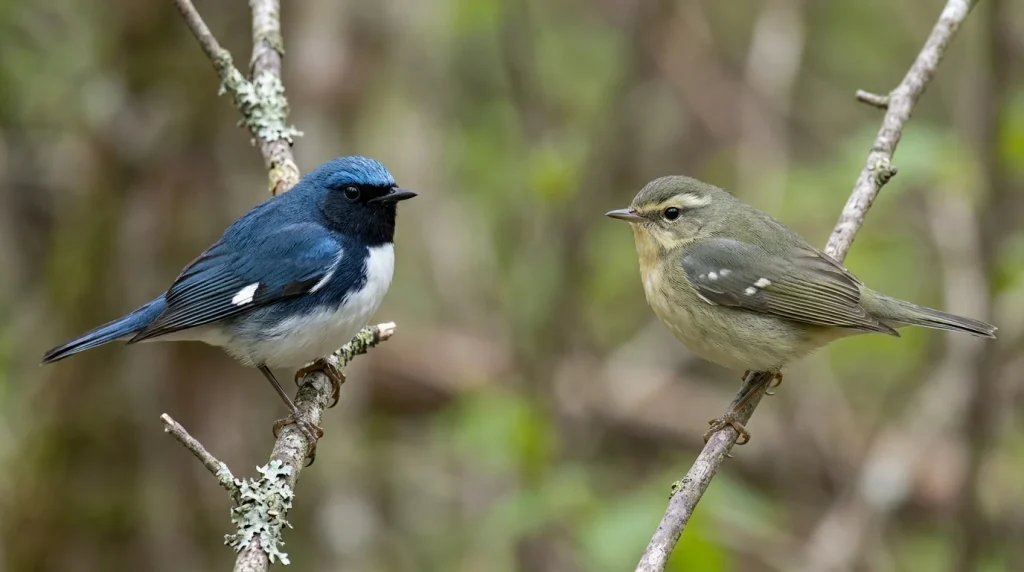
The Black-throated Blue Warbler (Setophaga caerulescens) is a small, migratory songbird of eastern North America. Breeding males are among the most distinctive forest warblers, combining deep blue upperparts, a black face and throat, and clean white underparts. Females look strikingly different: they are mostly olive-colored, with a pale eyebrow and a small white patch on the wing.
This species spends much of its time inside leafy forest vegetation, so identification often depends on brief views, habitat knowledge, and voice. A male singing from the lower or middle canopy may be easier to hear than to see. During migration, both sexes can appear in parks, wooded yards, and other patches of suitable cover.

Quick Identification
- Adult male: Deep blue upperparts, black face and throat, black flanks, white belly, and a conspicuous white wing patch.
- Adult female: Olive-green overall, with a pale eyebrow, muted underparts, and a small but useful white wing patch.
- Shape: Compact woodland warbler with a fine, pointed bill and moderately short tail.
- Behavior: Searches leaves and twigs for insects, often in dense understory or lower canopy foliage.
- Song: A short, buzzy series that typically rises or ends with an upward-inflected note.
- Range clue: A breeder of northeastern forests and the Appalachian region; primarily an eastern migrant.
Appearance
The breeding male has dark bluish to slate-blue upperparts. His face, throat, and sides are black, creating a strong contrast with the white center of the breast and belly. A rectangular white patch at the base of the primaries is visible on the folded wing and is sometimes described by birders as a white “handkerchief.” The bill and legs are dark.
Females are less boldly marked and can initially resemble several other olive-colored warblers. Their upperparts are olive to grayish olive, while the underparts are generally dull yellowish buff or gray-olive. A pale line above the eye gives the face a subtly patterned appearance. Most females show a small white wing patch, although its visibility varies with posture, feather wear, and lighting.
Young males may retain greenish or olive tones while beginning to show blue in the wings, tail, and back. First-year females can be especially subdued. Plumage brightness varies, so the wing patch, proportions, behavior, and location should be considered together rather than relying on color alone.
Size and Wingspan
Black-throated Blue Warblers are small songbirds with dimensions typical of a wood-warbler:
- Length: About 4.3–5.1 inches (11–13 centimeters)
- Wingspan: About 7.5–7.9 inches (19–20 centimeters)
- Build: Compact-bodied, with a slender insect-catching bill
They are much smaller than a Sparrow or thrush but can look relatively sturdy beside the most delicate warblers. Size is difficult to judge in foliage, making plumage and behavior more useful in the field.
Range and Distribution
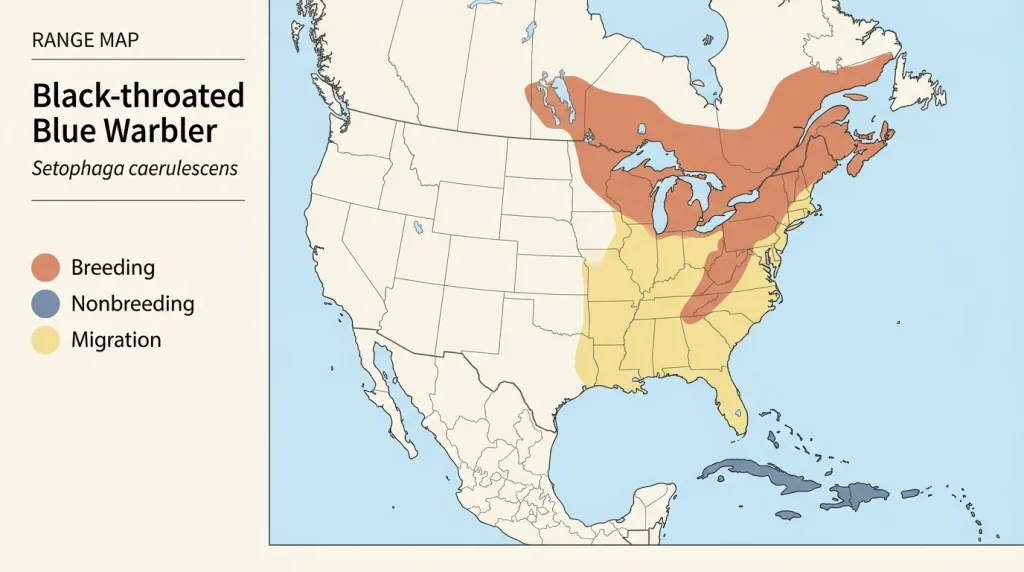
The breeding range extends across parts of southeastern Canada, the northeastern United States, the Great Lakes region, and the Appalachian Mountains. In the Appalachians, breeding birds occur southward into the higher elevations of the southern mountain region. Their distribution is closely tied to extensive deciduous or mixed forest with a well-developed shrub layer.
During spring and fall migration, the species moves through much of the eastern United States. Most birds winter in the Caribbean, particularly on islands of the Greater Antilles, with smaller numbers elsewhere in the region. Individuals occasionally appear outside the expected range, but western records are unusual.
Seasonal maps and additional identification material are available from the Cornell Lab of Ornithology’s Black-throated Blue Warbler account.
Habitat
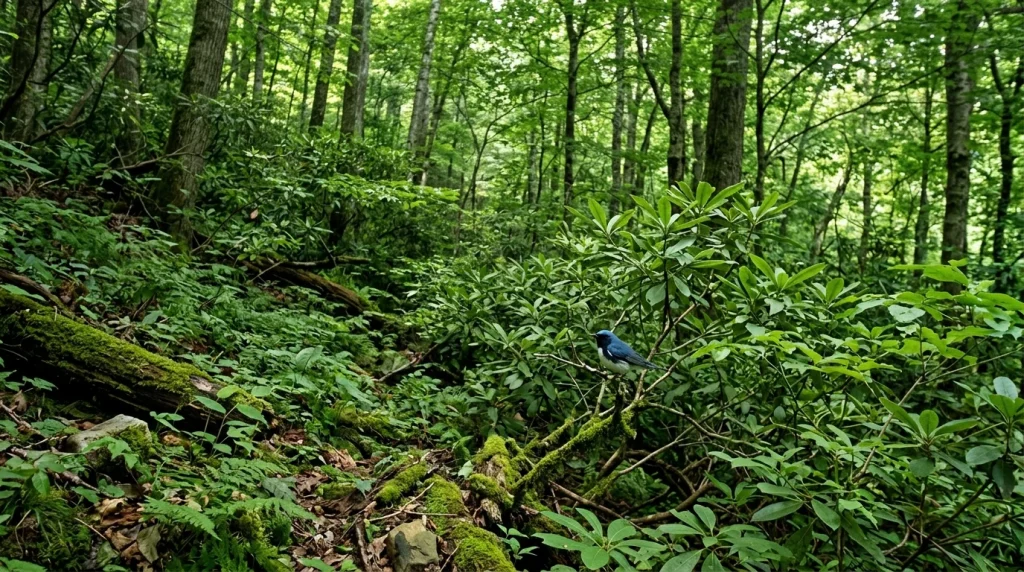
On the breeding grounds, Black-throated Blue Warblers favor mature deciduous and mixed forests with dense vegetation below the canopy. They are often associated with mountain slopes, forested ravines, and areas containing hobblebush, mountain laurel, rhododendron, saplings, or other thick shrubs.
Habitat structure can matter as much as tree species. A closed or nearly closed canopy combined with a leafy understory provides feeding sites, nest concealment, and protected movement close to the ground. In migration, the birds use a wider variety of wooded habitats, including parks, stream corridors, coastal thickets, and shaded residential areas. Winter habitat includes humid and semi-humid woodland, shade-grown plantings, and dense scrub.
Behavior
This warbler usually forages by hopping along branches and inspecting leaves, especially their undersides. It picks insects from foliage and bark and may make short flights to seize moving prey. Compared with warblers that remain high in treetops, it often works at low to middle levels, although its height varies with habitat and season.
Males sing repeatedly during the breeding season, sometimes from partly exposed perches. Both sexes can be difficult to follow once they enter dense vegetation. Outside the breeding season, Black-throated Blue Warblers may join loose mixed-species feeding groups, especially where insects or fruit are concentrated.
Diet
The diet consists mainly of insects and other small arthropods. Common prey includes caterpillars, moths, beetles, flies, true bugs, ants, and spiders. Nestlings are fed soft-bodied invertebrates gathered within the adults’ territory.
Fruit becomes more important during migration and winter, when birds may eat small berries and other soft fruits. The balance between insects and fruit changes with season, locality, and food availability. This flexible diet helps the species use both temperate breeding forests and tropical winter habitats.
Vocalizations
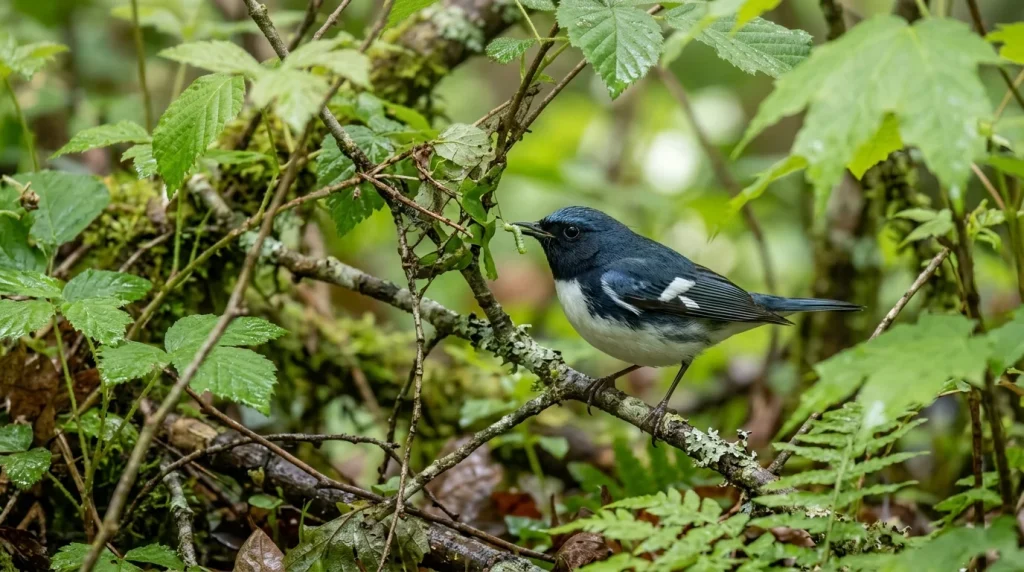
The male’s song is short, slow, and strongly buzzy. It is commonly represented as zoo-zoo-zoo-ZEE, with the final note rising or sounding emphasized. Individual songs vary in note count and delivery, but the upward, wheezy ending is a valuable clue in northeastern and Appalachian forests.
Calls include a short, dry tuk, tik, or chip. These quiet notes are less distinctive than the song and can be confused with calls from other small forest birds. Listening for repeated calls while watching for movement in low foliage is often the best approach.
Breeding and Nesting
Breeding begins after birds return to northern forests in spring. Males establish territories and advertise with repeated songs. The female selects the nest site and constructs a compact, open cup, generally in dense vegetation close to the ground. Low shrubs, saplings, and tangled understory plants provide typical support and concealment.
The nest is built from bark strips, grasses, plant fibers, and similar materials, with a finer inner lining. A usual clutch contains three or four eggs, although clutch size can vary. Eggs are pale, often creamy white, and marked with reddish-brown or darker speckles.
The female incubates the eggs for roughly 12–13 days. The male may bring food or remain active nearby. Brown-headed Cowbirds can parasitize nests by laying an egg for the warblers to raise, though rates differ among landscapes and years.

Young and Development
Both parents feed the nestlings, delivering caterpillars and other small invertebrates. The young grow rapidly and commonly leave the nest about 10–12 days after hatching, before they are fully skilled fliers. Recently fledged birds remain in dense cover and continue to depend on their parents for food.
Juveniles have softer, less contrasting plumage than adult males. Their subdued colors provide camouflage among shaded leaves. Family groups gradually disperse as the young become independent and prepare for southbound migration.
Where to See
During summer, search in large, mature forests of the Northeast and along the Appalachian chain. Mountain trails through deciduous woodland are particularly promising where shrubs form a thick layer beneath tall trees. In the southern Appalachians, elevation can be important because suitable cool forest is concentrated on higher slopes.
In migration, check wooded city parks, lake shores, river corridors, and coastal stopover sites. Walk slowly, listen for calls, and scan shaded foliage below the canopy. Spring males are easier to identify than females, but the female’s white wing patch can be decisive when seen clearly.
Similar Species
- Cerulean Warbler: The male is paler sky-blue, lacks the fully black face and throat, and usually forages higher in the canopy. Females lack the Black-throated Blue Warbler’s compact white wing patch.
- Blackburnian Warbler: Males have a brilliant orange throat and face pattern rather than a solid black throat. Females show yellowish facial markings and prominent wingbars.
- Canada Warbler: Females can look olive above but have yellow underparts, a bold eye-ring, and at least a partial necklace of dark markings. They lack a discrete white wing patch.
- Connecticut Warbler: This larger, ground-oriented warbler has a complete eye-ring and no white wing patch. Adult males have a gray hood rather than blue upperparts.
- Black-throated Green Warbler: Males have a yellow face and olive-green back, while both sexes usually show wingbars instead of one solid white wing patch.
Conservation
The Black-throated Blue Warbler is commonly classified as Least Concern globally. Nevertheless, populations depend on suitable habitat across breeding, migration, and wintering areas. Forest fragmentation, loss of dense understory, browsing by high deer populations, collisions with buildings, and changes to Caribbean winter habitat can reduce habitat quality or survival.
Maintaining large forest tracts and diverse native understory vegetation benefits this species. Bird-friendly window treatments, reduced pesticide use, and protection of migration stopover habitat can also help. Because local trends may differ from the global assessment, regional monitoring remains important.
Field Identification Tips
- Look for the wing patch. The single white patch on the folded wing is useful in both sexes and especially valuable for identifying females.
- Separate color zones on males. Confirm blue above, black on the face and sides, and white through the center of the underparts.
- Check the understory. On breeding grounds, scan leafy shrubs and lower branches before concentrating on the treetops.
- Learn the rising song. The buzzy final note often reveals a territorial male hidden by foliage.
- Use several clues for females. Combine olive plumage, pale eyebrow, wing patch, compact shape, habitat, and range.
- Allow for poor light. A male’s blue back may appear gray or nearly black in deep shade.
Frequently Asked Questions
Why do the male and female look so different?
The species shows strong sexual dimorphism. Males use contrasting blue, black, and white plumage, while females have subdued olive coloration that helps them blend into vegetation, particularly near the nest.
What is the easiest field mark on a female?
The small white patch on the folded wing is usually the most helpful mark. It should be evaluated with the pale eyebrow, olive plumage, fine bill, and expected eastern range.
Are Black-throated Blue Warblers common at feeders?
No. They normally find insects and fruit in vegetation and seldom use conventional seed feeders. Native shrubs, pesticide-free foliage, and a safe water source may make a yard more useful during migration.
Do they breed in backyard shrubs?
They usually require forest habitat with a developed understory rather than isolated ornamental shrubs. A property beside a large, suitable woodland is more likely to support them than a typical open suburban yard.
When is the best time to see one?
Spring migration offers excellent opportunities because males are brightly marked and frequently sing. In the Northeast and Appalachians, summer visits to appropriate breeding forest can also be productive. Fall birds are quieter and may be more challenging to identify.


