
Black-bellied Whistling-Duck Guide
Keep Track of What You See
Create a free Wild Things Guide membership to record this Black-bellied Whistling-Duck in My Sightings and build your personal wildlife list.
Join to Add This SightingIntroduction
The Black-bellied Whistling-Duck (Dendrocygna autumnalis) is a unique and colorful waterfowl species native to the Americas. Unlike typical dabbling ducks, whistling-ducks have unusually long legs, long necks, and a tall, goose-like posture. They were historically known as “tree ducks” because they frequently roost in trees and nest in tree hollows. Today, this noisy, social duck is rapidly expanding its range across the southern and central United States.
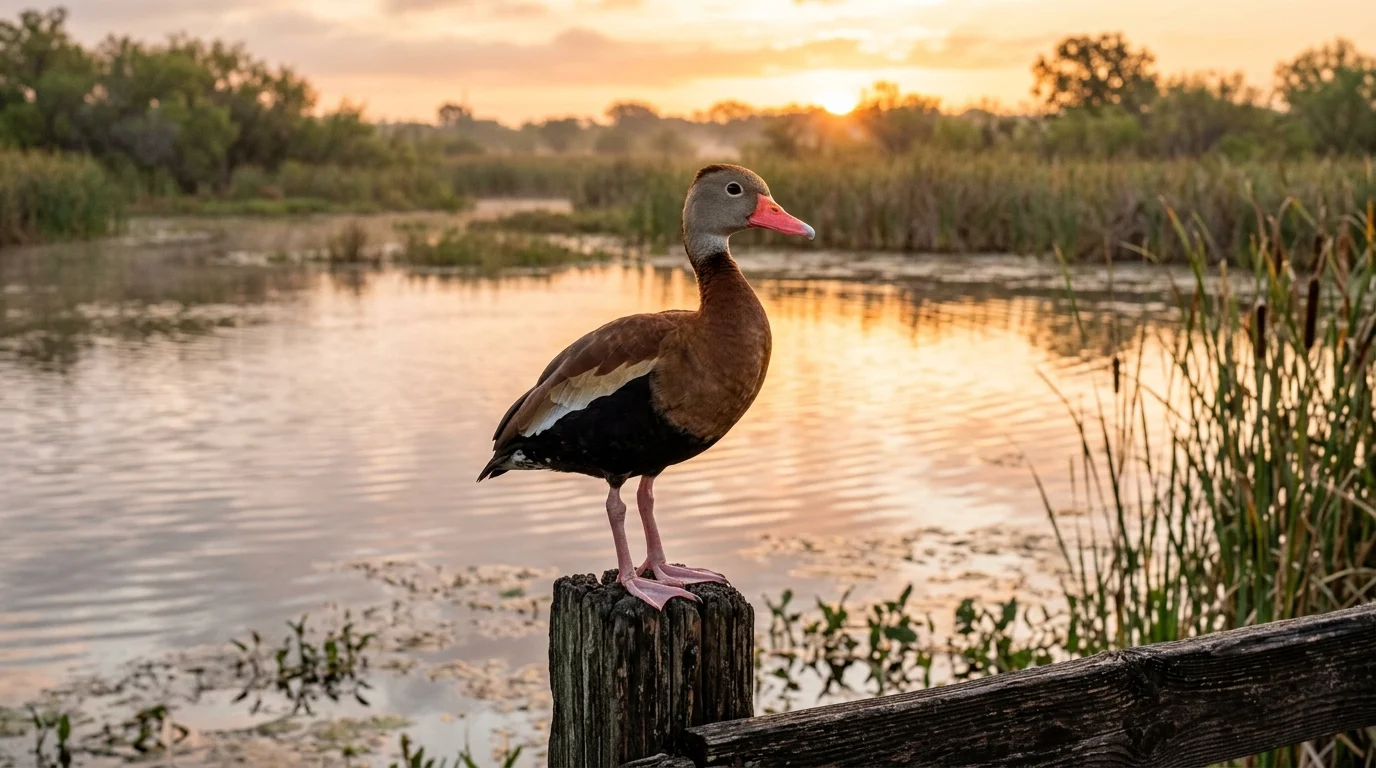
Birdwatchers and casual observers often spot these ducks perched on fence posts, walking through agricultural fields, or gathering in large flocks near shallow ponds. Their bright pink bills, dark bellies, and musical whistling calls make them easy to recognize once you know what to look for.

Quick Identification
When you spot a duck that looks tall, upright, and unusually long-legged, you may be looking at a Black-bellied Whistling-Duck. Here are the primary quick-identification features:
- Bright Pink Bill: A striking, coral-pink bill that stands out even from a distance.
- Long Pink Legs: Bright pink legs and feet that extend noticeably when walking or perched.
- Dark Black Belly: A solid black lower belly and underside that contrasts with a rich chestnut breast.
- Gray Face and Neck: A clean gray face with a thin white ring surrounding the eye.
- Large White Wing Flash: A broad, bright white wing patch that is clearly visible in flight and often visible as a stripe when perched.
Appearance
The Black-bellied Whistling-Duck is a medium-sized waterfowl species with distinctive plumage. Its head features a pale gray face and upper neck, topped with a dark brownish cap that extends down the back of the neck. A narrow white eye-ring gives the eye a large, bright expression. The chest and lower neck are a rich chestnut-brown, which shifts abruptly into a deep black belly and lower flanks.
The wings are a standout feature. When perched, you can often see a broad white stripe along the folded wing. In flight, this white area opens into a bold white wing panel across the upper wing surface, contrasting sharply with dark primary feathers and chestnut coverts. The tail is short and black.
Unlike many duck species where males are brightly colored and females are dull brown, male and female Black-bellied Whistling-Ducks look virtually identical. Juveniles look similar to adults but have duller grayish-pink or gray bills, grayish legs, and a paler, mottled dark belly rather than solid black.

Size and Wingspan
The Black-bellied Whistling-Duck is longer and taller than many common dabbling ducks, though its body mass is relatively moderate.
- Length: 19 to 22 inches (47 to 56 cm)
- Wingspan: 30 to 37 inches (76 to 94 cm)
- Weight: 1.5 to 2.2 pounds (650 to 1000 grams)
Because of their long necks and extended legs, these ducks often look larger in the field than their actual weight suggests. In flight, their feet often extend slightly past their short tail.
Range and Distribution
The Black-bellied Whistling-Duck is widespread across tropical and subtropical regions. Its historic core range extends from northern Argentina and Brazil, up through Central America and Mexico, into South Texas and parts of Florida. However, over recent decades, the species has expanded significantly northward.
Year-round resident populations now inhabit coastal Texas, Louisiana, parts of Mississippi, Alabama, and much of the Florida peninsula. Breeding populations regularly spread farther north into Oklahoma, Arkansas, Tennessee, the Carolinas, and occasionally even into Midwest states like Missouri, Illinois, and Ohio during the spring and summer months.

Habitat
Black-bellied Whistling-Ducks prefer warm, shallow freshwater environments surrounded by open land or scattered trees. Common habitats include:
- Shallow freshwater marshes and ponds
- Golf course ponds and suburban retention basins
- Flooded agricultural fields, especially rice paddies and cornfields
- Lakeshores lined with trees or cattails
- Wooded swamps and wet pastures
They are highly adaptable birds that frequently thrive near suburban developments, farm ponds, and livestock pastures where shallow water and grain sources are nearby.

Behavior
Black-bellied Whistling-Ducks are highly social birds that spend much of their time in flocks ranging from a few dozen to several hundred individuals. They are mostly nocturnal or crepuscular foragers, meaning they are especially active at dusk, dawn, and during the night.
Unlike typical diving or dabbling ducks, whistling-ducks spend much of their time walking comfortably on land or standing high on tree branches, fence posts, and barn roofs. They walk upright, resembling a small goose. When resting, they often assemble on dead trees or wooden structures near water.
Diet
The Black-bellied Whistling-Duck is largely herbivorous, eating seeds, aquatic plants, and cultivated crops. They forage by walking through flooded fields, wading in shallow water, or occasionally dabbling with their heads submerged.
- Cultivated Grains: Rice, corn, sorghum, and wheat.
- Wild Plant Seeds: Smartweeds, grasses, sedges, and water lilies.
- Invertebrates: Snails, insects, spiders, and small crustaceans (eaten in smaller amounts, especially by growing chicks).
Their habit of visiting agricultural fields at night in large flocks sometimes brings them into fields where waste grain remains after harvest.

Vocalizations
Rather than quacking like typical ducks, whistling-ducks earn their name from their high-pitched, multi-note whistling calls. Their most common vocalization is a clear, musical, three- to four-note whistle often described as pe-chee-chee-chee or waa-a-a-wheee.
They produce these calls frequently in flight as flocks move between roosting sites and feeding grounds. They also call to communicate with pair members or warn the flock of potential danger.
Breeding and Nesting
Black-bellied Whistling-Ducks form strong, long-term monogamous pair bonds, unlike many ducks where the male leaves after mating; male whistling-ducks stay with the female and share nesting and chick-rearing duties equally.
They are primarily cavity nesters. Natural nest sites include large hollows in hardwood trees such as oaks, willows, and cypress. They also readily adopt wooden nest boxes provided for Wood Ducks. If tree cavities are scarce, they will occasionally nest on the ground hidden in tall grass or brush.
Females lay a large clutch, typically 10 to 16 eggs. However, multiple females sometimes lay eggs in a single nest—a behavior known as “egg dumping.” These communal nests, or dump nests, can contain 30 to 40 eggs, though fewer hatch successfully.

Young and Development
Incubation lasts approximately 26 to 31 days and is shared by both the male and female. Ducklings are precocial, meaning they hatch fully covered in down and can walk and feed themselves almost immediately.
Shortly after hatching, ducklings jump out of the nest cavity—sometimes from heights of 10 to 30 feet—and tumble safely to the ground or water below. Both parents lead the young ducklings to nearby shallow water with abundant vegetation. The parents actively defend and guard the brood until the young reach flight age at about 8 to 10 weeks old.
Where to See
To see Black-bellied Whistling-Ducks in North America, visit warm, wetland-rich regions in the southern United States. Exceptional locations include:
- South Texas: Wildlife refuges such as Santa Ana National Wildlife Refuge and Laguna Atascosa National Wildlife Refuge.
- Texas and Louisiana Gulf Coast: Coastal marshes, rice fields, and wildlife management areas.
- Florida: Central and southern lakes, agricultural areas, and urban parks with open retention ponds.
Check fence lines, telephone wires, snag trees, and shallow marsh edges near agricultural fields in the late afternoon and evening.
Similar Species
While the Black-bellied Whistling-Duck is distinct, field observers should be aware of a few similar species:
- Fulvous Whistling-Duck: Shares the long-legged, long-necked shape but has a warm tawny-buff head and underparts, a blue-gray bill, dark legs, and lacks the bright black belly and large white wing patch.
- Muscovy Duck (Wild/Feral): Much larger with dark plumage, but lacks the whistling-duck’s bright pink bill, light gray face, and chestnut breast.
- Wood Duck (Female): Also uses tree cavities and shares similar wooded wetland habitats, but is smaller and darker, with a dark bill, short legs, and distinct white eye patches.
Conservation
Conservation authorities list the Black-bellied Whistling-Duck as a species of concern; assessment data available through the Cornell Lab of Ornithology show its total population is healthy and rapidly expanding northward across North America.
Artificial duck nest boxes designed for waterfowl management have provided additional nesting opportunities, supporting population growth. Wetland conservation and responsible agricultural water management remain key to preserving their foraging habitats.
Field Identification Tips
When trying to confirm a sighting in the field, keep these simple steps in mind:
- Check the posture: Look for a standing duck with long pink legs perched high on a post, branch, or fence.
- Look for the pink bill: The coral-pink bill stands out sharply against the gray head.
- Observe the bird in flight: Look for a bright, broad white stripe running across the top of the wing.
- Listen for whistles: Listen for high-pitched, musical whistling calls rather than traditional duck quacks.
Frequently Asked Questions
Do male and female Black-bellied Whistling-Ducks look different?
No. Unlike many North American ducks where males are colorful and females are brown, male and female Black-bellied Whistling-Ducks have identical plumage and colors.
Why are they called whistling-ducks?
They are named for their distinctive vocalization: a clear, multi-note whistling call rather than a traditional duck quack.
Do Black-bellied Whistling-Ducks nest in trees?
Yes. They prefer natural tree cavities or artificial nest boxes, though they will occasionally nest on the ground if tree cavities are unavailable.
Why are Black-bellied Whistling-Ducks seen further north than before?
This species has been expanding its geographic range northward over recent decades, likely driven by climate trends, adaptable feeding habits in agricultural fields, and the availability of nest boxes.


