
Barrow’s Goldeneye Guide
Keep Track of What You See
Create a free Wild Things Guide membership to record this Barrow’s Goldeneye in My Sightings and build your personal wildlife list.
Join to Add This SightingIntroduction
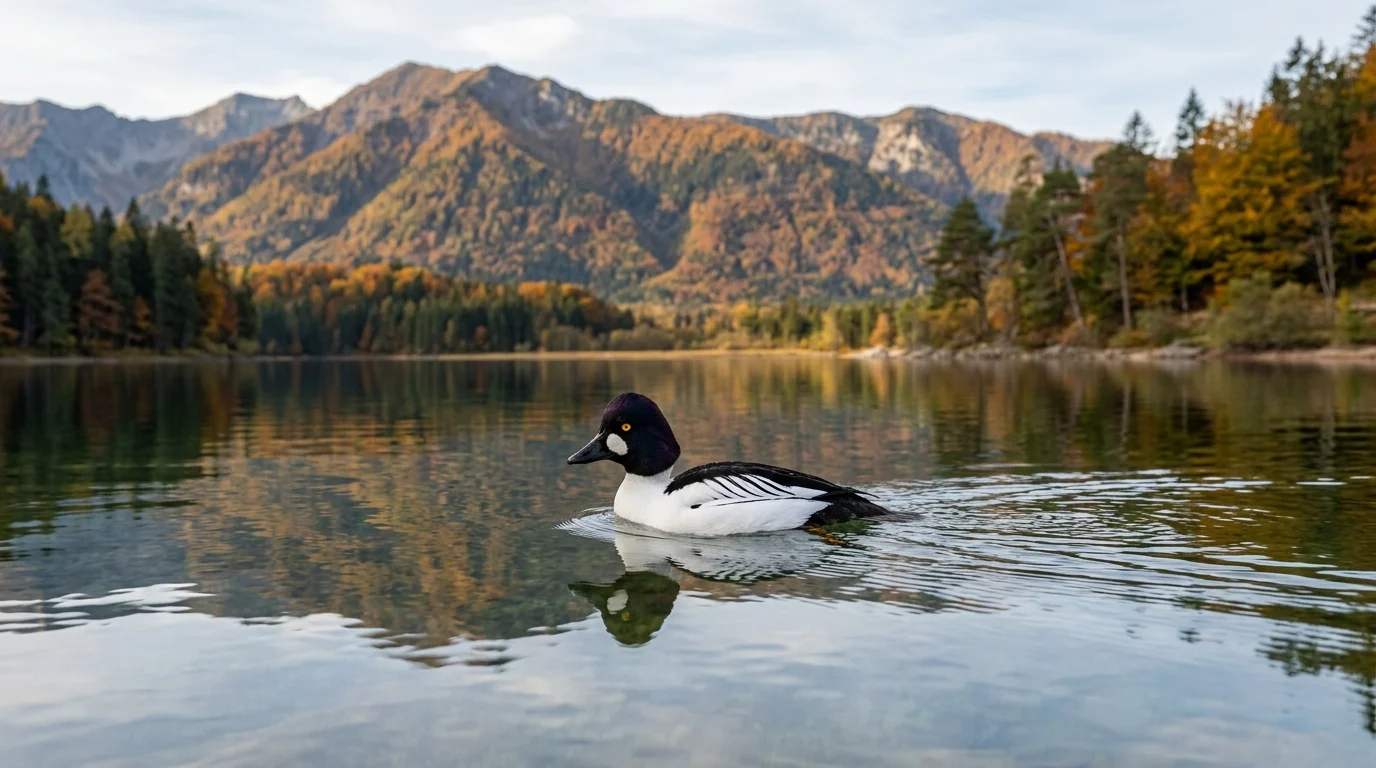
The Barrow’s Goldeneye (Bucephala islandica) is a striking medium-sized diving duck native to North America and small parts of Iceland. Known for its bold black-and-white plumage, bright yellow eyes, and distinctive head shape, this bird is a thrilling sight for birdwatchers and naturalists. It belongs to the sea duck subfamily and shares the genus Bucephala with the closely related Common Goldeneye and the smaller Bufflehead.
While often confused with the Common Goldeneye, the Barrow’s Goldeneye has unique physical traits and behavior that set it apart. It thrives in cold, clean waters, nesting in tree cavities near forested lakes in summer and moving to coastal bays and ice-free rivers in winter. Detailed observations from the Cornell Lab of Ornithology show that this species relies on mature, undisturbed boreal forests for breeding, making it an important indicator of forest and wetland ecosystem health.

Quick Identification
When observing a diving duck in cold northern waters, use these rapid field marks to identify an adult male Barrow’s Goldeneye:
- Facial Patch: A white, crescent-shaped patch located between the eye and the bill.
- Head Profile: A steep, almost vertical forehead leading to a flat-topped head with a slightly bushy crest at the back.
- Head Color: A dark head that shows a purplish gloss in good light.
- Upperparts: A dark back with a series of small white rectangular spots along the shoulder (scapulars).
- Eye Color: Vivid golden-yellow eyes that stand out against the dark head.
Appearance
The adult male in breeding (alternate) plumage is dramatic and easy to recognize once you know what to look for. Its dark head shines with a deep purple gloss under bright sunlight. The white facial crescent curves upward in front of the dark bill. The chest, belly, and flanks are clean white, while the back and tail are deep black. Along the sides of its back, a row of white square patches creates a distinctive pattern that separates it from other sea ducks.
The adult female has a much softer, camouflage-friendly appearance. She sports a dark chocolate-brown head, a pale grayish-white body, and a grey back. Her bill is mostly bright orange or yellow during the breeding season, though the amount of yellow can vary by individual and season. Her eyes are light yellow, though not quite as bright as the male’s.
In late summer, adult males enter an eclipse plumage while molting their flight feathers. During this temporary phase, males look similar to females, with dull brown heads and greyish bodies, though they often retain a faint, pale shadow of the facial crescent near the bill.

Size and Wingspan
The Barrow’s Goldeneye is a medium-sized duck with a compact, sturdy build and a relatively large head.
- Length: 16 to 19 inches (41 to 49 cm)
- Wingspan: 26 to 30 inches (66 to 76 cm)
- Weight: 21 to 46 ounces (600 to 1300 grams)
On average, adult males are noticeably larger and heavier than females. Their stocky build and short neck give them a buoyant, heavy-headed profile when resting on the water’s surface.
Range and Distribution
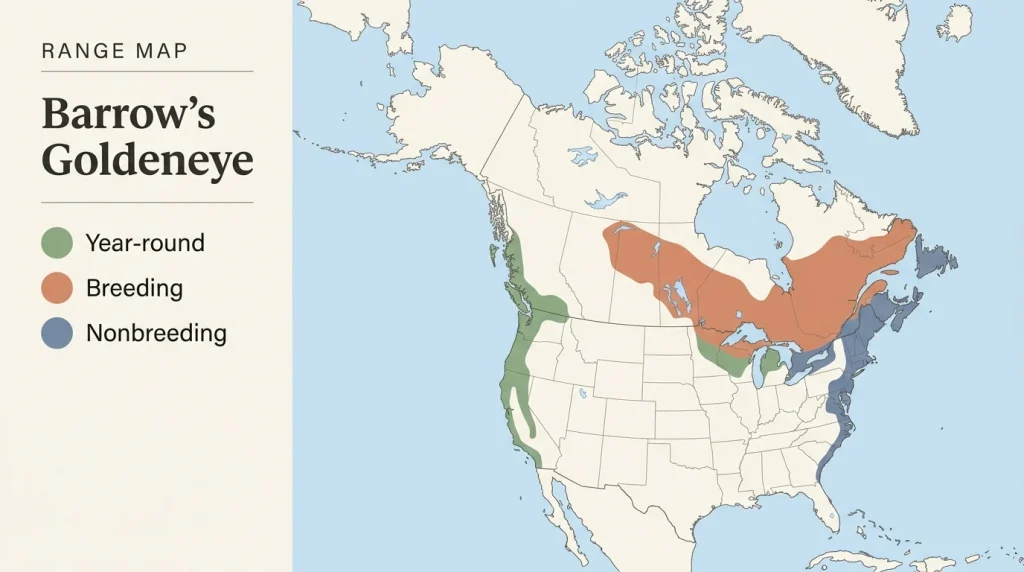
The Barrow’s Goldeneye’s global distribution is split into three main populations, with the vast majority living in western North America.
The western population breeds from Alaska and Yukon south through British Columbia, extending into the Rocky Mountains of Montana, Wyoming, and northern California. Most of these birds winter along the Pacific Coast, from southern Alaska down to central California, or on open rivers in the interior West.
A smaller, geographically isolated eastern population breeds primarily in Quebec and the Labrador Peninsula. These eastern birds spend their winters in the St. Lawrence River estuary and along parts of the Atlantic Coast in Atlantic Canada and Maine.
A third tiny, non-migratory population lives year-round in Iceland, where the species nests near spring-fed rivers and volcanic lakes. Rare vagrants occasionally appear in northern Europe or further south in North America during harsh winters.
Habitat
During the spring and summer breeding season, Barrow’s Goldeneyes prefer high-altitude subalpine lakes, alkaline ponds, and quiet forested lakes surrounded by mature coniferous timber. They require nearby trees with natural cavities or old woodpecker holes big enough to shelter a nesting duck.
In winter, the species shifts to ice-free marine and freshwater environments. Preferred winter habitats include sheltered coastal fjords, rocky ocean bays, tidal estuaries, and fast-flowing rivers where strong currents keep the water open even in freezing temperatures.

Behavior
Barrow’s Goldeneyes are strong, active divers. They feed by diving beneath the surface and using their webbed feet to push themselves toward the lakebed or seafloor. Dives usually last between 15 and 45 seconds in shallow to moderately deep water.
In flight, their swift wingbeats create a distinct, high-pitched whistling sound. This musical whirring noise is loud enough that birdwatchers often hear an approaching goldeneye before seeing it, earning the species the nickname “whistler.”
During winter and early spring, males perform elaborate courtship displays on the water. A displaying male pumps his head, stretches his neck upward, flips his head backward onto his back, and kicks up a spray of water with his feet while producing squeaking calls to attract females.
Diet
The diet of the Barrow’s Goldeneye consists mainly of aquatic animals, making it primarily a carnivore.
- Aquatic Invertebrates: Amphipods, freshwater shrimp, crayfish, caddisfly larvae, dragonfly nymphs, and water beetles make up most of their summer diet on freshwater lakes.
- Mollusks and Crustaceans: In winter coastal marine waters, they feed heavily on blue mussels, small clams, snails, and crabs.
- Fish and Spawn: They routinely consume small fish and fish eggs, particularly salmon roe in western rivers during spawning runs.
- Plant Material: They occasionally eat small amounts of aquatic plants, seeds, and pondweeds, though animal prey makes up the vast majority of their food intake.
Vocalizations
Barrow’s Goldeneyes are mostly silent for much of the year, but they become vocal during courtship and when defending breeding territories.
During courtship displays, males make a soft, low grunting sound followed by a sharp, squeaky ka-KEEER call. Females respond with a raspy, low-pitched gack or garr call when alarmed or when calling to their young. The most frequent sound associated with this duck is not a vocal call, but the sharp whistle produced by the male’s flight feathers cutting through the air.
Breeding and Nesting
Barrow’s Goldeneyes are cavity nesters. Because they cannot excavate their own holes, they rely on existing cavities created by large woodpeckers, such as the Pileated Woodpecker, or natural decay hollows in mature trees. They also readily use human-made wooden nest boxes placed near suitable lakes.
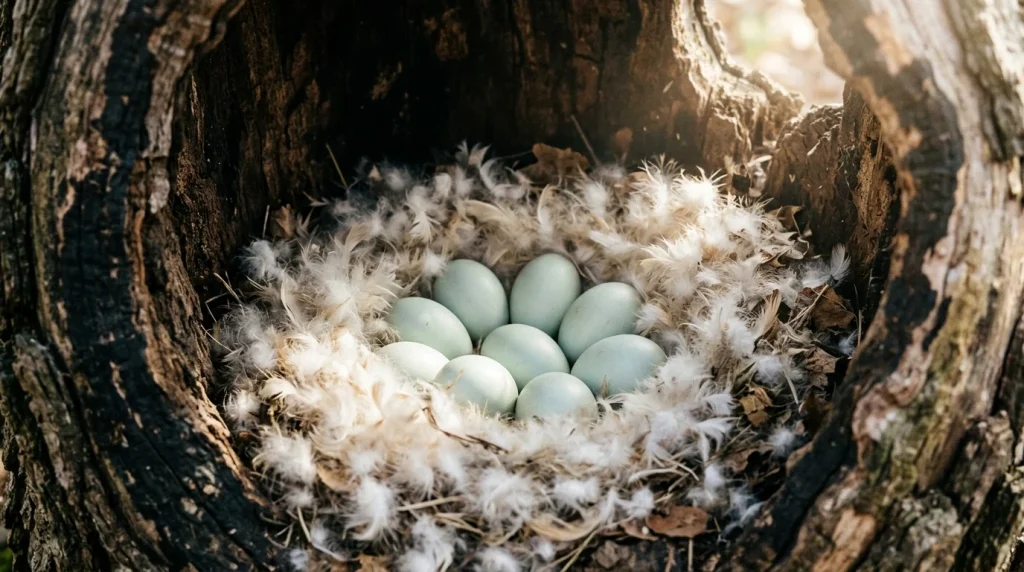
The female chooses the nest site, anywhere from ground level to 50 feet high in a tree, often at the water’s edge or up to half a mile away. She does not build an elaborate stick nest; instead, she lays her eggs directly on wood chips at the bottom of the cavity and lines the nest with soft down plucked from her own breast.
A typical clutch contains 6 to 12 pale bluish-green or olive-green eggs. The female incubates the eggs alone for about 30 days while the male deserts the territory to join other males in molting areas.
Young and Development
Barrow’s Goldeneye ducklings are precocial, meaning they hatch fully covered in black-and-white down and can walk, swim, and feed themselves almost immediately.
About 24 to 36 hours after hatching, the mother duck stands at the base of the nest tree and calls softly to her brood. The tiny ducklings leap out of the entrance hole, falling many feet to the forest floor or water below. Thanks to their light weight and soft down, they rarely suffer injuries during the jump.
The mother leads her ducklings to water right away, where they begin diving for aquatic insects. Sometimes, female goldeneyes adopt or steal ducklings from neighboring broods, forming large combined groups called “crèches” that can include dozens of young ducks cared for by a single female. Young goldeneyes learn to fly at about 8 to 9 weeks old.
Where to See
Finding a Barrow’s Goldeneye depends on the season and location:
- Yellowstone National Park (Wyoming): Excellent year-round viewing on high mountain lakes and open rivers like the Firehole and Madison Rivers during winter.
- Puget Sound and Salish Sea (Washington): Great wintering spot to observe large flocks along sheltered marine shorelines and harbors.
- Interior Lakes of British Columbia: Ideal summer breeding habitat where pairs can be spotted on small forested lakes.
- St. Lawrence River Estuary (Quebec): The best region in eastern North America to find the isolated eastern population during winter months.
Similar Species
Distinguishing the Barrow’s Goldeneye from similar waterbirds requires close attention to head shape and plumage patterns:
- Common Goldeneye: The male Common Goldeneye has a round white patch (rather than a crescent) on a greenish head, a gently sloping forehead, and more white on its sides and back. Females are very hard to distinguish, but female Common Goldeneyes usually have a yellow-tipped bill rather than a fully yellow or orange bill.
- Bufflehead: Considerably smaller than the Barrow’s Goldeneye. The male Bufflehead has a large, wedge-shaped white patch covering the entire back of its head rather than a small crescent near the bill.
- Hooded Merganser: Has a similar dark body and white chest, but has a long, thin serrated bill and a fan-like crest that can be raised or lowered completely.
Conservation
Globally, the Barrow’s Goldeneye is classified as Least Concern because of its large total population in western North America. However, the isolated eastern North American population is considered a species of Special Concern in Canada because it is small (estimated at fewer than 10,000 individuals).
Key threats include logging of old-growth forests, which destroys old cavity trees needed for nesting. Oil spills in coastal wintering zones, heavy metal contamination from mining runoff, and climate change affecting high-altitude lakes also pose ongoing challenges for local populations.
Field Identification Tips
To confidently identify a Barrow’s Goldeneye in the field, keep these quick tips in mind:
- Look at the head shape: look for a high, steep forehead that creates a boxy, flat-topped profile.
- Check the male’s facial mark: a distinct vertical white crescent in front of the eye indicates a Barrow’s, whereas a circle indicates a Common Goldeneye.
- Examine the black back: look for a row of neat white square spots along the male’s shoulder.
- Listen for flying birds: a high-pitched, loud whistling sound from the wings strongly suggests a goldeneye flying overhead.
- Use a spotting scope: because these ducks often rest far offshore or in the middle of large mountain lakes, high magnification helps reveal subtle head shapes and bill colors.
Frequently Asked Questions
Q: Why is it called Barrow’s Goldeneye?
A: The bird was named in honor of Sir John Barrow, a 19th-century British government official and promoter of Arctic exploration.
Q: How can I tell a female Barrow’s Goldeneye from a female Common Goldeneye?
A: Check the bill and head shape. Female Barrow’s Goldeneyes usually have a steeper forehead, a boxier head shape, and an all-yellow or mostly orange bill in late winter and spring, compared with the Common Goldeneye’s yellow-tipped bill.
Q: Do Barrow’s Goldeneyes migrate long distances?
A: Most western populations make relatively short migrations, moving from high-altitude inland lakes down to nearby coastal bays or low-elevation ice-free rivers for the winter.
Related Guides


