
American Kestrel Guide
Keep Track of What You See
Create a free Wild Things Guide membership to record this American Kestrel in My Sightings and build your personal wildlife list.
Join to Add This SightingIntroduction
The American Kestrel (Falco sparverius) is North America’s smallest falcon, a colorful hunter often seen on roadside wires, fence posts, and exposed branches. Its pointed wings, long tail, and habit of hovering over open ground make it especially rewarding to identify. Despite its small size, this is an accomplished predator of insects and small vertebrates. Learning its face pattern and sex-specific plumage helps separate it from larger falcons and similarly sized songbirds.
Quick Identification
- Shape: Slim, roughly jay-sized falcon with pointed wings and a relatively long, narrow tail.
- Face: Two prominent dark vertical marks on each pale cheek.
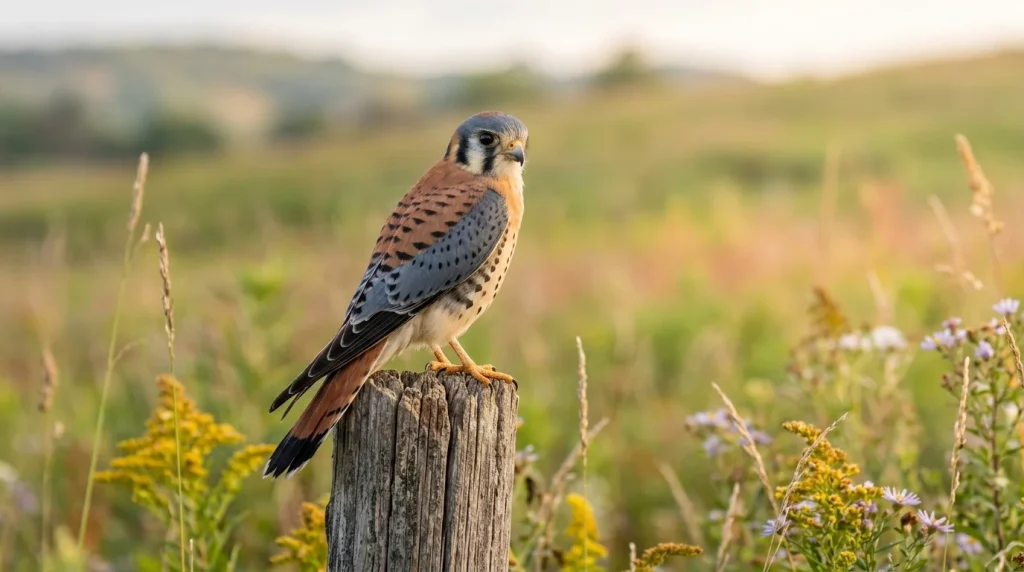
- Color: Rusty back and tail; males have blue-gray wings, while females have rusty, dark-barred wings.
- Behavior: Watches from exposed perches, pumps its tail, and sometimes hovers into the wind.
- Setting: Grasslands, farmland, roadsides, and other open landscapes.
Appearance and Field Marks
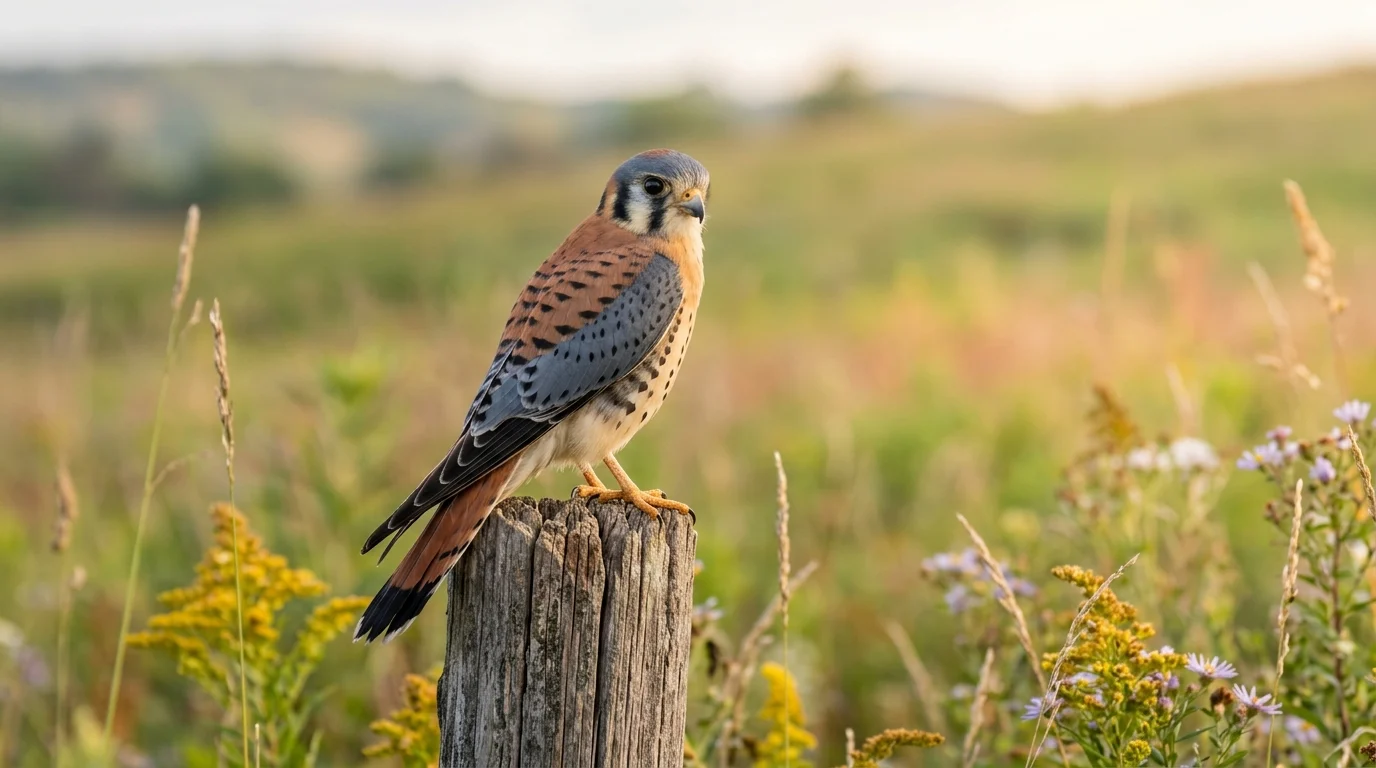
American Kestrels combine a small head, short hooked bill, rounded chest, and tapered falcon wings. Their pale faces carry a dark mark beneath the eye and another farther back on the cheek. These paired markings are particularly helpful when the bird is perched sideways.
The crown is generally blue-gray, often with a rusty central patch. The back is rusty with dark barring, and the underparts range from whitish to warm buff with variable dark markings. Yellow legs and a yellow cere—the fleshy area at the bill’s base—may be visible at close range. Backlighting can hide nearly all these colors, so confirm shape and behavior as well.
Male and Female Differences
Unlike many North American raptors, male and female American Kestrels usually differ conspicuously in plumage.
- Male: Blue-gray upperwings with dark markings; a mostly rusty tail with a broad black band near its tip; usually spots rather than heavy streaks below.
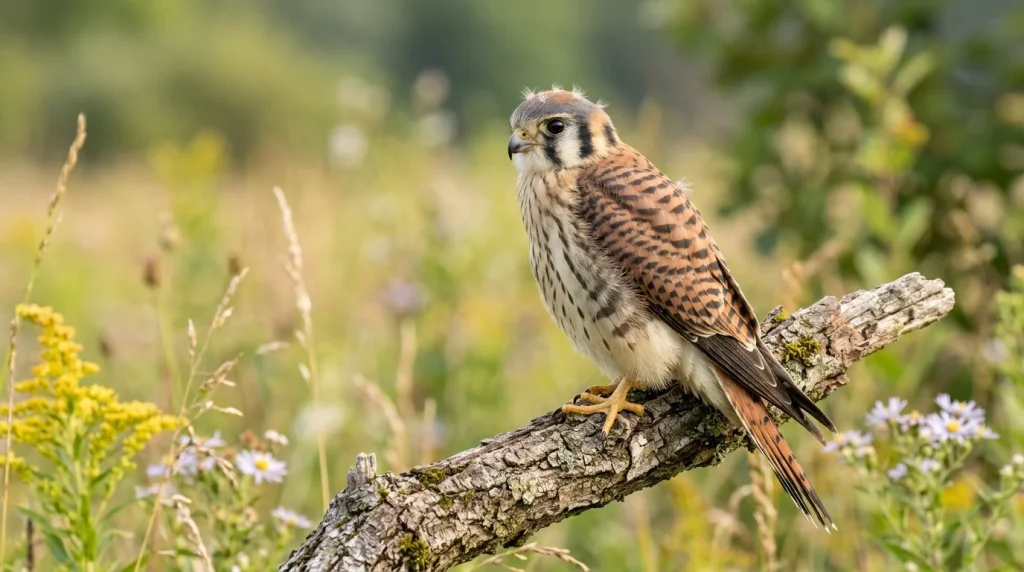
- Female: Rusty upperwings with dark barring; numerous dark bands across the rusty tail; generally stronger streaking on the breast and belly.
Females average larger, but size overlaps and is unreliable without direct comparison. Use wing and tail patterns before judging body size.

Size and Wingspan
- Length: About 22–31 cm (9–12 in).
- Wingspan: About 51–61 cm (20–24 in).
- Weight: Roughly 80–165 g (2.8–5.8 oz), varying with sex, population, and condition.
A kestrel is approximately the length of a large Jay but has a different silhouette: pointed wings, a hooked bill, and a streamlined body. It generally looks smaller and more delicate than a Merlin, though distant size estimates can be misleading.
Range and Distribution
The American Kestrel has an extensive New World range, from Alaska and Canada through the United States, Mexico, Central America, and much of South America. It also occurs on many Caribbean islands. Distribution is patchy where dense forest or unsuitable terrain limits open hunting habitat.
Across North America, it breeds widely wherever open ground and suitable nest cavities occur. Northern populations are largely seasonal, while many birds farther south remain year-round. The Cornell Lab of Ornithology’s American Kestrel guide provides a useful range map and additional identification photographs.

Habitat
Look for a combination of open hunting ground, scattered elevated perches, and nesting cavities. Suitable habitats include prairies, pastures, agricultural fields, desert grasslands, orchards, and open woodland edges. Kestrels also use parks, vacant lots, and some suburban or urban settings.
Short or patchy vegetation makes prey easier to detect and capture. A landscape may offer excellent feeding opportunities yet lack breeding kestrels if mature cavity-bearing trees or appropriate nest boxes are absent.

Migration
American Kestrels are partial migrants: some populations migrate, while others remain near their breeding areas. Birds from Alaska, Canada, and colder northern regions generally move south for winter, reaching milder parts of the United States, Mexico, and Central America.
Migration timing varies with latitude and weather. Watch for passage in spring and late summer through autumn, especially along ridges and coastlines. Females often migrate earlier in autumn than males, although local patterns vary.
Flight Style
Kestrels alternate quick wingbeats with short glides. The wings are pointed, but the bird often looks lighter and less forceful than a Merlin. During migration, kestrels may also soar.
Hunting birds sometimes face into the wind and hover with rapid wingbeats, a fanned tail, and a comparatively steady head. They then drop toward prey or shift to another position. Hovering is a useful clue, not proof by itself: other raptors can hover or hold position in strong wind.
Diet and Hunting
Large insects, including grasshoppers, crickets, and beetles, are important prey, especially in warm weather. Kestrels also take mice, voles, small birds, lizards, and other small animals as locally available. Diet changes with season and habitat.
A typical hunt begins on a wire or post. The kestrel scans the ground, drops onto prey, and often carries it back to a perch. It may also hunt while hovering or catch insects in flight. Like other falcons, it uses its feet to seize prey and its bill to help dispatch it.

Voice and Calls
The best-known call is a sharp, repeated killy-killy-killy or klee-klee-klee. It can sound excited, piercing, and surprisingly loud for such a small bird. Calls are common around territorial encounters, courtship, and nest defense.
Pairs and young also make softer vocalizations. A repeated call can draw attention to a kestrel overhead, but you can confirm visually where other falcons are.
Breeding and Nesting
American Kestrels nest in cavities rather than building stick nests. They use old woodpecker holes, natural tree cavities, building recesses, and suitably designed nest boxes. Eggs rest on existing debris or the cavity floor, usually without added nest material.
A typical clutch contains four or five eggs, generally cream to buff with brown or reddish markings. The female does most of the incubation, while the male contributes and supplies food. Incubation lasts about a month. Usually one brood is raised, although replacement clutches and occasional second broods occur. Observe nest sites from a distance and avoid opening occupied boxes without appropriate authorization and training.

Young and Development
Newly hatched kestrels are downy and dependent on brooding and food deliveries. The female initially spends considerable time tending them, while the male provides much of the prey. Both parents provision growing young.
Young usually leave the cavity at around four weeks old, though development varies. They remain dependent on their parents afterward as they learn to fly and hunt. Juveniles already resemble their respective adult sexes, making age harder to determine than sex. A short tail, lingering down, and persistent begging can help identify a recent fledgling.
Where to See
Scan utility wires and fence lines beside open fields, particularly where grassland meets scattered trees. Wildlife refuges, prairie preserves, agricultural valleys, and open parklands are productive places to search. In winter, a kestrel may repeatedly use the same hunting territory.
Use binoculars before approaching, and watch long enough to see a hunting attempt or tail movement. Stop only at legal, safe pullouts; never watch from a traffic lane or enter private land without permission.
Similar Species
- Merlin: Usually stockier and darker, with powerful flight, a dark banded tail, and less distinctive facial markings. Lacks the kestrel’s rusty back and paired cheek marks.
- Peregrine Falcon: Much larger and heavier-bodied, with a broad dark cheek mark. Juveniles are brown and streaked, but proportions remain different.
- Sharp-shinned Hawk: Has rounded rather than pointed wings and a long banded tail; lacks the kestrel’s face pattern.
- Mourning Dove: Can resemble a kestrel on a wire at a distance, but has a tiny straight bill, small head, and long, sharply tapered tail.
Conservation
The IUCN classifies the American Kestrel as Least Concern globally, reflecting its broad range and large overall population. That status does not mean every population is secure: monitoring has documented substantial declines in parts of North America.
Potential pressures include habitat change, loss of nesting cavities, pesticide exposure, and reduced prey availability, but their relative importance remains under study. Protecting open habitat and mature cavity trees can help. Well-managed nest-box programs may increase nesting opportunities locally, but boxes alone cannot address every cause of decline.
Field Identification Tips
- Start with habitat and silhouette: a small, long-tailed falcon over open ground.
- Look for two dark marks on the side of the pale face.
- Check for a rusty back and tail, allowing for poor light.
- Use blue-gray versus rusty upperwings to distinguish males from females.
- Confirm tail pattern when the bird turns or spreads its tail.
- Treat hovering and tail pumping as supporting clues, not stand-alone identifications.
Interesting Facts
- The older name “Sparrow hawk” refers to this falcon, not a true hawk.
- Kestrels sometimes cache surplus prey for later use.
- Dark markings on the back of the head can resemble false eyes; their function is not fully settled.
- Females sometimes dominate males in competition for winter hunting areas, contributing to differences in habitat use.
Frequently Asked Questions
Is an American Kestrel a hawk or a falcon?
It is a falcon, belonging to the family Falconidae and order Falconiformes.
Do American Kestrels eat birds?
Yes, but insects and small mammals are often important foods. The balance depends on season and local prey availability.
Will they use a backyard nest box?
Sometimes, if the surrounding landscape offers open hunting habitat, a box in densely wooded or heavily built-up surroundings is less likely to attract them.
Does hovering identify a kestrel with certainty?
No. Confirm pointed wings, a rusty tail, and facial markings; several other raptors can hover or remain nearly stationary in wind.


