
American Chestnut Guide
Keep Track of What You See
Create a free Wild Things Guide membership to record this American Chestnut in My Sightings and build your personal wildlife list.
Join to Add This SightingTree Name
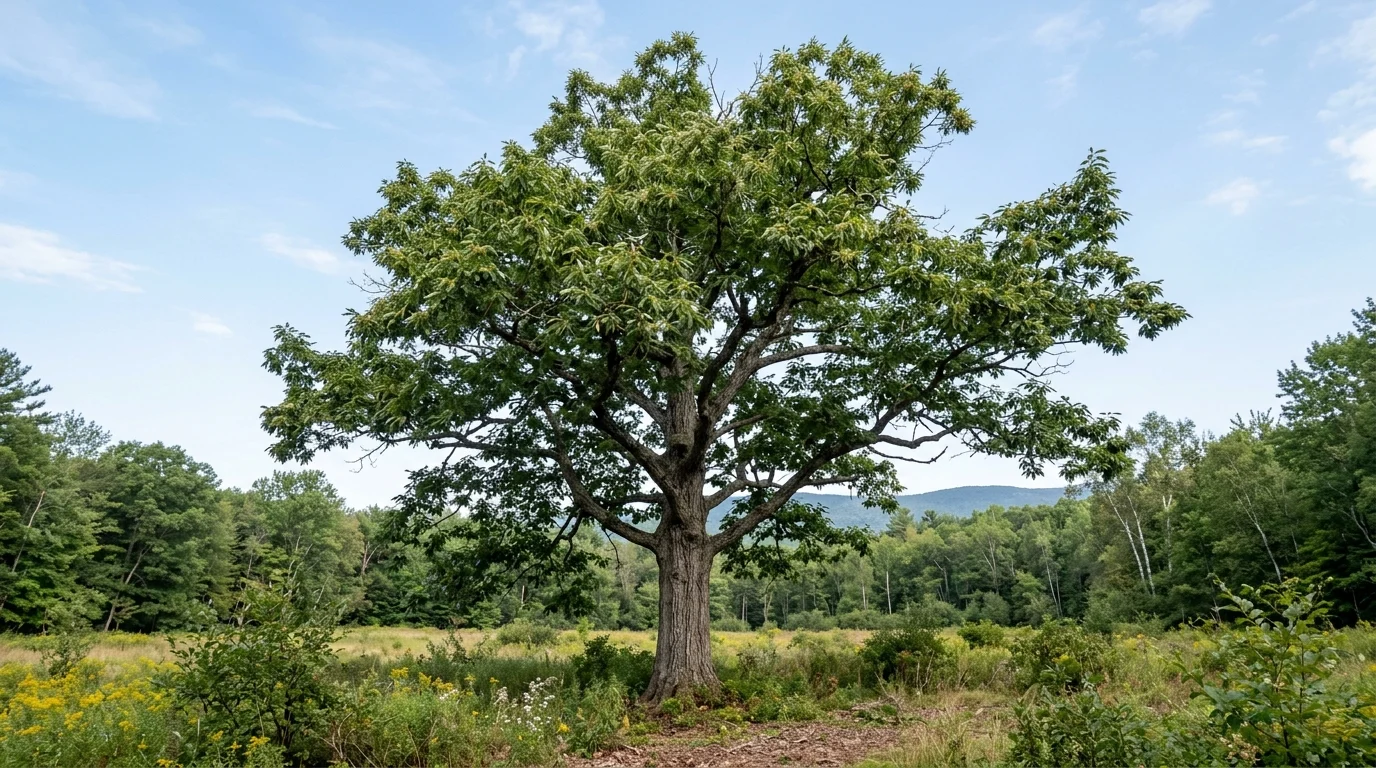
American chestnut (Castanea dentata) is a deciduous tree in the beech family (Fagaceae). Once a major canopy tree in eastern North American forests, it now survives chiefly as small trees and recurring stump or root-collar sprouts following the spread of chestnut blight. Finding one usually means looking below the canopy rather than searching for a towering forest giant.
Identification rests on a combination of long, sharply toothed leaves, relatively hairless twigs, and, when present, extremely prickly nut burs. Large planted chestnuts require extra care: they may be Asian species, European chestnut, or hybrids.

Quick Identification
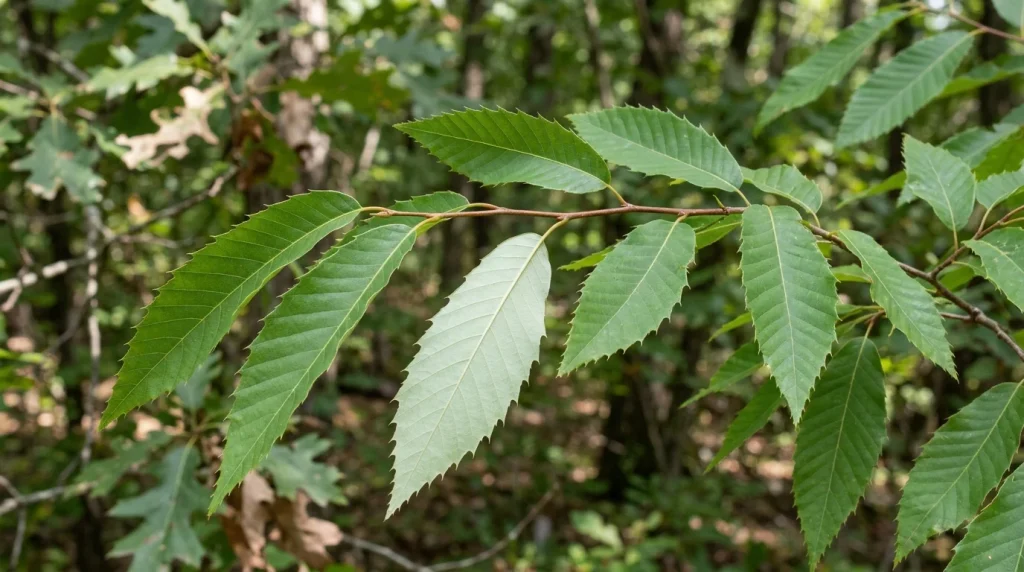
- Leaves: Alternate, simple, usually 5–8 inches (13–20 cm) long, narrow-oblong to lance-shaped, with a pointed tip and coarse, forward-pointing teeth.
- Veins: Strong, nearly parallel side veins run directly toward the marginal teeth.
- Leaf underside: Usually pale green and essentially hairless when mature; check several fully expanded leaves.
- Fruit: A densely spiny bur, commonly about 2–3 inches (5–8 cm) across including spines, usually enclosing three nuts.
- Present-day form: Often a cluster of slender sprouts beside a dead stem, particularly on well-drained eastern woodland slopes.
Appearance
Before blight, mature American chestnuts commonly reached 60–100 feet (18–30 m), with some substantially taller. Forest-grown trees developed long, straight trunks and relatively high crowns. Open-grown specimens formed broader, spreading crowns, sometimes roughly 40–70 feet (12–21 m) wide.
Most wild individuals encountered today are much smaller, often shrubs or saplings below 20 feet (6 m). A patch of stems may arise from one surviving root system rather than represent many seedlings. Repeated stem death can create an uneven thicket containing living shoots, dead poles, and old stubs.
The leaves tend to look thinner and less leathery than those of Chinese chestnut. Their coarse, bristle-tipped teeth give the margins a conspicuous sawlike outline. Sun exposure and shoot vigor change leaf size; don’t treat oversized sprout leaves as a separate identifying feature.
Bark, Twigs, and Buds
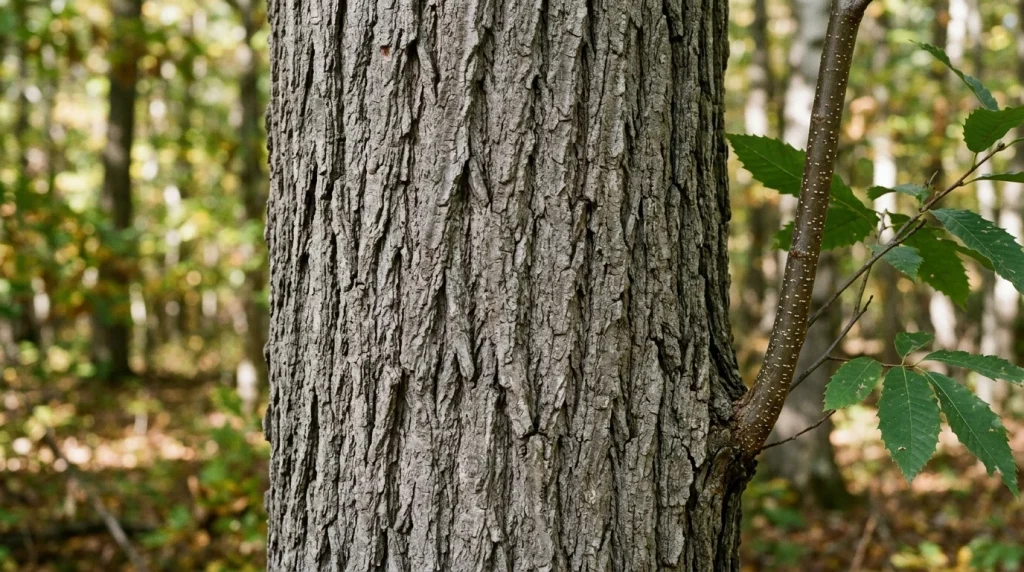
Young bark is relatively smooth and gray to brown, sometimes with visible pale lenticels. Older bark becomes gray-brown and develops long ridges and furrows; these may wind or interlace along the trunk. Bark alone is not a dependable identification tool, especially on small sprouts.
Current twigs are slender, reddish-brown to brown, and generally hairless or nearly so. Small, alternate buds are brown, somewhat pointed, and often sit at an angle to the twig. The terminal-looking bud may actually be a lateral bud near the shoot tip.
Inspect suspicious stems for blight cankers: sunken or swollen areas, cracked bark, orange fungal structures, or dead foliage above a girdled section. Sprouts frequently develop below damaged tissue. Similar injuries have other causes, so an abnormal patch of bark does not confirm chestnut blight on its own.
Range and Habitat
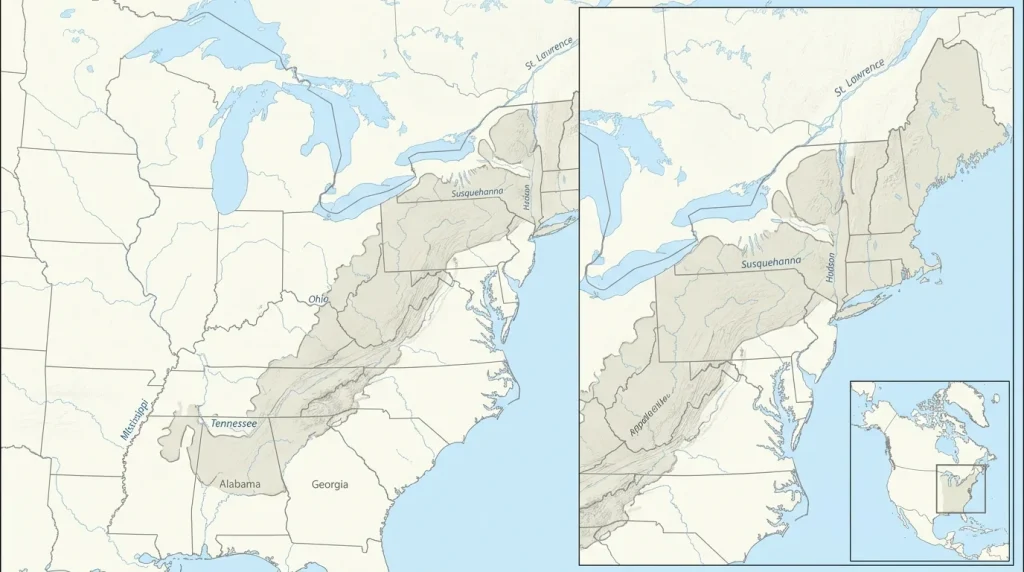
The historical native range extended from southern Maine and southern Ontario south through the Appalachians to Georgia and Alabama, with western portions reaching the Ohio and Tennessee valleys and northeastern Mississippi. Its distribution was not uniform; abundance varied with terrain, soils, and forest history.
It occurs on well-drained slopes, ridges, and upland woods, especially on acidic soils. American chestnut grew with oaks, hickories, maples, and other hardwoods. It generally performs poorly in persistently waterlogged ground, although it is not restricted to the driest ridges.
Today, surviving sprouts remain scattered through much of the former range. Trees outside it are usually planted or descended from plantings. The U.S. Forest Service’s American chestnut silvics account provides detailed background on its native distribution and ecology.
Flowers, Fruit, Nuts, or Cones
American chestnut flowers after leaf-out, generally in June or July, depending on location. Long, creamy-white male catkins make a flowering crown conspicuous and produce a distinctive odor. Small female flowers occur near the bases of some flowering catkins. Both sexes occur on the same tree.
Pollination involves insects and wind. A second compatible chestnut generally improves the prospect of filled nuts; an isolated tree may produce burs containing poorly developed or empty nuts.
By early to mid-autumn, the burs turn brown and split into valves. Their dense, sharp spines warrant gloves. A typical bur contains three shiny brown nuts, each with a pale attachment scar and a pointed, slightly hairy tip. The center nut is often flattened on two sides, while outer nuts have a rounded outer face. Nut number and shape vary.

Wildlife Connections
Chestnuts once provided abundant autumn food for squirrels, chipmunks, deer, bears, wild turkeys, and other wildlife. Rodents carried and cached nuts, sometimes dispersing seeds that escaped later consumption. Losing the tree greatly reduced this food source across many eastern forests.
No single leaf reliably separates every American chestnut from every hybrid. Combine foliage, twig hairiness, buds, fruit, and planting history.
Living foliage supports insects, while flowers attract insect visitors. Dead stems contribute small cavities, decaying wood, and habitat for decomposers. However, a patch of short, repeatedly blighted sprouts does not replace the ecological structure or nut production of a mature chestnut stand.
Seasonal Identification
- Spring: Look for unfolding alternate leaves and vigorous shoots around older dead stems. Wait for leaves to expand before judging hairiness and proportions.
- Summer: Fully developed, sharply toothed leaves offer the best routine clues. Flowering trees may carry conspicuous pale catkins.
- Autumn: Foliage usually turns yellow to yellow-brown. Search beneath fruiting trees for spiny burs and nuts, remembering that wildlife removes nuts quickly.
- Winter: Use alternate buds, slender twigs, branching pattern, and persistent bur remains on the ground. Leafless sprouts are difficult to identify confidently without photographs or material from another season.

Human Uses and History
Indigenous peoples and later rural communities gathered chestnuts for food. They ate the sweet, starchy nuts roasted, cooked, dried, or ground. Unlike oil-rich walnuts and hickories, fresh chestnuts contain substantial moisture and spoil readily unless handled appropriately.
The wood was relatively light, easy to work, and naturally decay-resistant, making it useful for fencing, buildings, furniture, and utility poles. Bark and wood also supplied tannins for leather production. Reclaimed chestnut lumber remains a reminder of the tree’s former abundance.
Chestnut blight, first recognized in New York City in 1904, spread through the range during the early twentieth century. Its arrival transformed forests and disrupted livelihoods tied to nut harvests and timber.
Conservation and Threats
Chestnut blight is caused by the introduced fungus Cryphonectria parasitica. It infects bark and forms cankers that can girdle stems. The root collar often survives and sends up new shoots, but those shoots commonly become infected before developing into large, reliably fruiting trees.
Another serious threat is Phytophthora root rot, particularly in warmer parts of the range. Deer browsing, drought, competition, and habitat loss can further hinder establishment.
Restoration efforts include finding surviving trees, conserving genetic diversity, breeding for disease resistance, and testing trees under forest conditions. Approaches and regulatory status continue to evolve. A large, healthy tree is worth investigating, but size alone does not prove inherited resistance: it may have escaped infection or be a hybrid.
If you find a promising tree, photograph the whole plant, both leaf surfaces, twigs, and any burs. Record the location privately and contact a regional chestnut conservation program. Do not remove bark or collect reproductive material without permission.
Similar Species
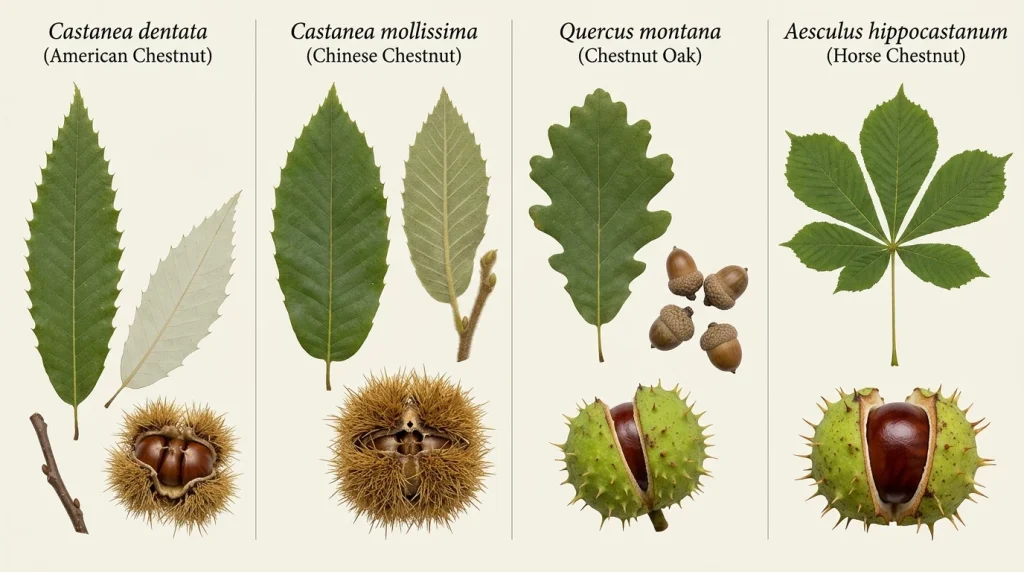
- Chinese chestnut (Castanea mollissima): Commonly planted for nuts. Leaves are often broader and thicker, with conspicuous hairs beneath; young twigs are frequently hairy. These tendencies are useful, but variability and hybridization complicate identification.
- Japanese chestnut (Castanea crenata): Often has smaller, relatively narrow leaves with finer teeth and hairs or scales beneath. Use several characters rather than leaf size alone.
- European chestnut (Castanea sativa): Can strongly resemble American chestnut. Leaf bases, twig traits, and mature fruit may help, but expert review is often appropriate for planted trees.
- Allegheny chinquapin (Castanea pumila): Usually a shrub or small tree with smaller leaves, often whitish-hairy beneath. Its smaller burs normally contain one rounded nut.
- Chestnut oak (Quercus montana): Has rounded marginal teeth rather than slender, sharp teeth, and produces acorns instead of spiny burs.
- Horse chestnut (Aesculus hippocastanum): Has opposite, palmately compound leaves and leathery capsules with fewer spines. Its seeds are poisonous and are not edible chestnuts.
Interesting Facts
The species name dentata refers to the conspicuously toothed leaves. American chestnut remains present across much of its old range even though its former canopy role has largely disappeared—a distinction between biological survival and ecological recovery.
Repeated resprouting also makes age misleading. A slender stem may be young while the underground system supporting it is much older. Stem height therefore tells little about how long that individual has occupied a site.
Frequently Asked Questions
Is American chestnut extinct?
No. Many survive as sprouts, and scattered larger trees persist. What has largely vanished is the widespread population of mature, reproducing canopy trees.
Can I identify it from one leaf?
You can make a preliminary identification, but not reliably rule out all hybrids. Photograph several mature leaves, their undersides, and the twigs; include fruit when available.
Can I plant one?
Yes, but disease remains a major limitation. Choose well-drained soil, protect young trees from browsing, and obtain clearly documented planting stock. For restoration projects, seek regional advice about provenance and disease-testing claims.
Are the nuts edible?
Properly identified American chestnuts are edible, usually cooked. Never eat an unfamiliar nut based only on its brown shell; horse chestnuts and buckeyes are unsafe substitutes.


