
American Bittern Guide
Keep Track of What You See
Create a free Wild Things Guide membership to record this American Bittern in My Sightings and build your personal wildlife list.
Join to Add This SightingIntroduction
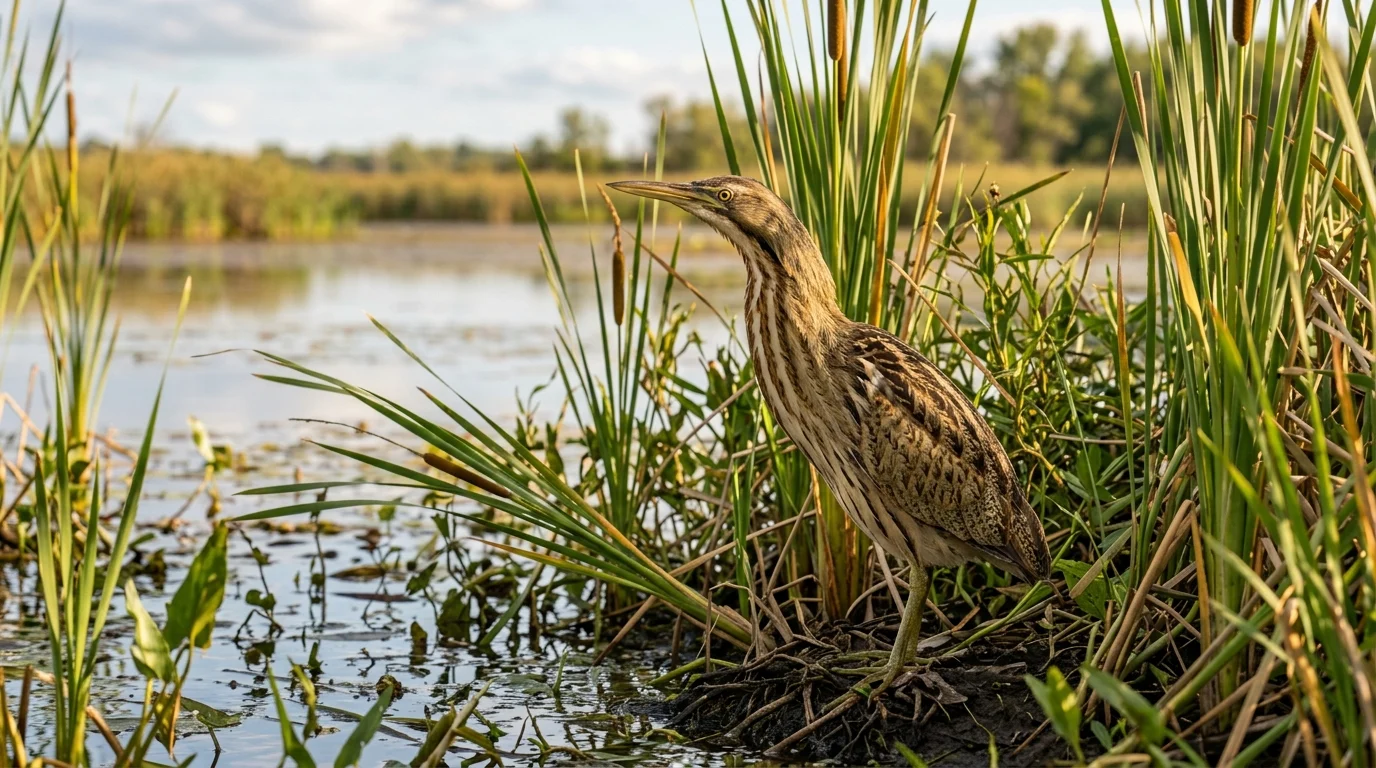
The American Bittern (Botaurus lentiginosus) is a medium-sized heron renowned for its incredible camouflage and secretive lifestyle. Inhabiting dense freshwater marshes across North America, this cryptically patterned bird spends most of its life hidden among cattails, bulrushes, and tall sedges. Rather than taking flight when approached, the bittern relies on its streaked brown and tan plumage to blend seamlessly into the surrounding vegetation. When threatened, it often adopts a famous freeze posture, extending its neck and pointing its bill straight up toward the sky while gently swaying to match the movement of wind-blown reeds.
Though rarely seen in the open, the American Bittern’s presence is often betrayed in early spring by its extraordinary vocalization. The bird produces a deep, resonant, booming pump-like sound that can carry over a mile across open marshland. Field records documented by the Cornell Lab of Ornithology show how this unique acoustic signature makes the species an iconic sound of healthy North American wetlands, even when physical sightings remain challenging.
Quick Identification
Recognizing an American Bittern requires focusing on key field marks, posture, and subtle visual cues:
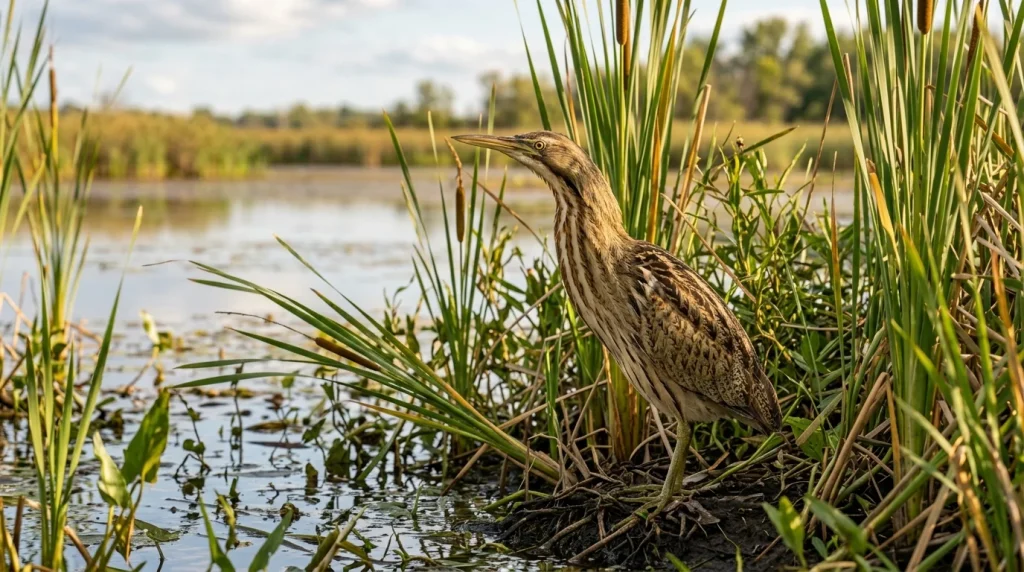
- Body Shape: A stocky, thick-necked marsh heron with short legs relative to long-legged egrets.
- Plumage: Warm brown and buff overall, with fine mottling and bold vertical streaking on the neck and breast.
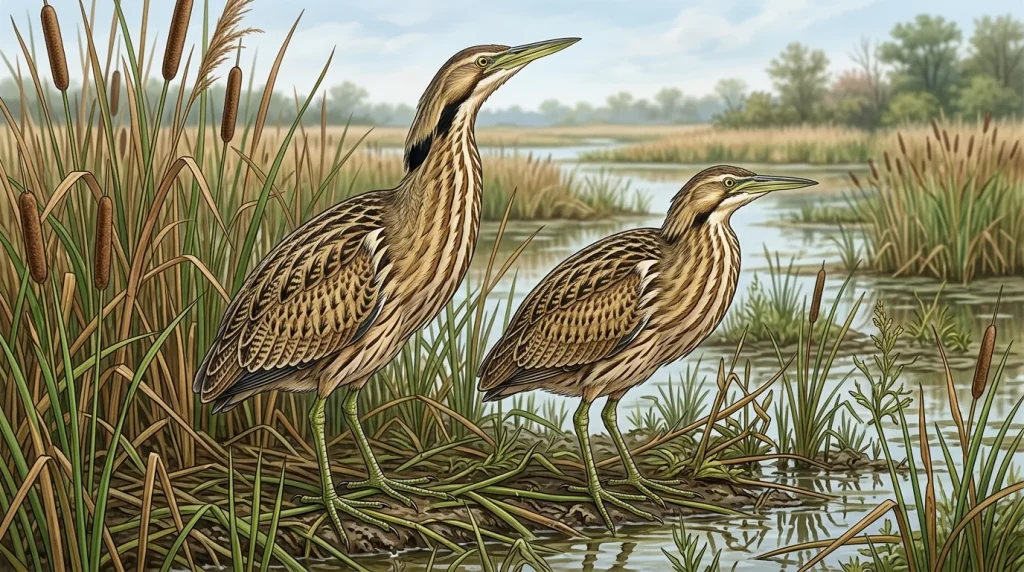
- Neck Stripe: A prominent, long blackish or dark brown patch running down the upper neck.
- Flight Markings: In flight, the dark blackish wingtips and trailing flight feathers contrast strongly with warm brown upperwing coverts.
- Key Posture: Stands rigidly motionless with its long bill pointed straight up to mimic marsh stems.
Appearance
The American Bittern’s overall plumage is a masterpiece of natural concealment. The upperparts are rich brown, finely freckled and vermiculated with black, tan, and dark gold. Its throat and chest feature bold, vertical dark-brown and creamy-white stripes that run continuously down its underside. These streaks break up the bird’s outline when it stands among tall, dried grasses.
One of the most diagnostic adult features is a long, dark brownish-black stripe extending along each side of the neck. This black neck patch develops fully in adults and clearly separates this species from juvenile night-herons. The crown is dark brown, contrasted by a pale buff line running above the eye (supercilium) and a pale cheek area.
The bill is heavy, straight, and sharp, displaying a yellowish hue with a darker ridge along the top culmen. The eyes are bright yellow, shifting slightly toward orange during the peak breeding season. The legs and feet are pale yellowish-green, equipped with long toes that spread weight evenly across mud and floating vegetation.
Size and Wingspan
The American Bittern is a medium-sized wading bird, noticeably larger than a Green Heron or Least Bittern, but significantly smaller and stockier than a Great Blue Heron.
- Length: 23 to 33 inches (58 to 85 cm)
- Wingspan: 36 to 45 inches (92 to 115 cm)
- Weight: 13 to 38 ounces (370 to 1072 grams)
Males are generally larger and heavier than females, though plumage markings are essentially identical between sexes. When crouching in marsh cover, the bittern can appear compact and small, but when fully extended in defensive posture, it reveals its true length and surprisingly broad neck.
Range and Distribution
The American Bittern is native to North America, occupying a wide range that shifts seasonally according to water availability and frozen marsh conditions. During the spring and summer breeding season, its range spans across central and southern Canada, extending south into the northern half of the United States from New England west through the Great Lakes, Northern Plains, and Pacific Northwest.
In late autumn, northern populations migrate south to escape freezing waters that limit hunting opportunities. The winter range includes the coastal Atlantic and Gulf Coast states, the southern interior United States, California, Mexico, Central America, and parts of the Caribbean. In mild coastal regions and interior wetlands where water remains open year-round, local populations may remain resident year-round.

Habitat
American Bitterns are strict wetland specialists. Their survival depends on extensive, undisturbed shallow freshwater systems with rich emergent vegetation. Typical habitats include:
- Freshwater cattail and bulrush marshes
- Sedge meadows and wet prairies
- Bogs, fens, and vegetated pond margins
- Shallow, slow-moving vegetated river deltas
- Brackish coastal marshes during winter migration
The species prefers habitats with stable, shallow water levels—typically ranging from a few inches to knee-deep—where emergent plants grow thick enough to provide cover but sparse enough to allow slow, quiet wading while stalking prey.

Behavior
The American Bittern’s behavior is defined by caution, stealth, and deliberate movement. It is a solitary bird that avoids open spaces, preferring to travel along narrow channels or through dense thickets of vegetation. When moving, it walks with slow, calculated steps, placing each foot carefully to avoid splashing or rustling dead stalks.
When startled or aware of an observer, the bittern’s primary defense mechanism is to freeze rather than flush. It stretches its neck upward, tilts its long bill perpendicular to the ground, and aligns its body vertically. The vertical streaking on its breast perfectly mirrors surrounding cattail leaves. Remarkably, the bird slowly sways back and forth in rhythm with the wind blowing through the reeds. If you get close, it flies up awkwardly with heavy, rapid wingbeats before quickly settling back into cover a short distance away.
Diet
As an opportunistic predator, the American Bittern hunts by standing motionless in shallow water or moving at an agonizingly slow pace. It impales or snaps up prey with a rapid, lightning-fast strike of its sharp bill. Its varied diet consists mainly of small aquatic and semi-aquatic animals, including:
- Small fish (sticklebacks, minnows, sunfish)
- Amphibians (frogs, tadpoles, salamanders)
- Crayfish, crabs, and aquatic invertebrates
- Water snakes and small lizards
- Mice, voles, and shrew species found along wetland edges
- Dragonflies, water bugs, and large beetles

Vocalizations
The American Bittern produces one of North America’s most unusual avian sounds. Males produce it during the spring breeding season to establish territory and attract mates; the booming call is commonly described as a heavy “pump-er-lunk” or “oonk-a-lunk.” This deep, mechanical sound resembles the rhythmic stroke of an old-fashioned hand-operated water pump or a heavy stake being driven into mud.
To produce this resonant sound, the male inflates its esophagus with air using specialized neck muscles, expanding its throat into a balloon-like shape before forcefully expelling the air in three to five repeated gulps. This low-frequency call travels vast distances through dense marsh vegetation. When startled up close, both sexes may emit a harsh, raspy croak or squawk as they take wing.
Breeding and Nesting
Breeding begins in early spring shortly after birds arrive on northern marsh territories. Unlike many heron species that nest in noisy communal colonies in trees, the American Bittern is a solitary nester that builds its nest on or near the ground in deep wetland vegetation.
The female assumes complete responsibility for nest construction, incubation, and chick care. She selects a hidden site over shallow water or soggy soil and weaves a sturdy, flat platform from dead reeds, cattails, sedges, and grasses. The structure is built up several inches above water level to protect the eggs from sudden flooding. A typical clutch consists of 2 to 6 buff-olive or brown eggs that blend closely with the dry nest material.

Young and Development
Incubation begins after the female lays the first few eggs and lasts approximately 24 to 28 days. Because incubation starts before the clutch is complete, eggs hatch asynchronously over several days, resulting in chicks of varying sizes within the same nest.
Newly hatched chicks are downy, olive-buff, and completely dependent on the female. She feeds them by regurgitating partially digested fish, frogs, and aquatic insects directly into their beaks. The nestlings grow rapidly and learn to extend their necks into a Miniature freeze posture when threatened. By two to three weeks of age, young bitterns begin wandering away from the nest platform into surrounding vegetation. They become fully fledged and capable of flight around 7 to 8 weeks after hatching, then disperse independently.
Where to See
Finding an American Bittern requires patience, timing, and an eye for subtle movement along marsh edges. The best time to search is early morning or late evening in spring and early summer, when males call actively. Key locations include national wildlife refuges and state conservation areas containing expansive, high-quality freshwater marshes.
Promising locations to observe American Bitterns include:
- Klamath Basin National Wildlife Refuges (Oregon/California)
- Horicon National Wildlife Refuge (Wisconsin)
- Montezuma National Wildlife Refuge (New York)
- Ottawa National Wildlife Refuge (Ohio)
- Anahuac National Wildlife Refuge (Texas, wintering)
Focus your search on quiet marsh edges, shallow mudflats near reed borders, and opening channels. Look for a vertical shape that seems slightly out of place among upright cattail stalks, or scan flying birds for the characteristic brown wings with starkly contrasting dark tips.
Similar Species
Several wetland species share space or traits with the American Bittern, but careful examination reveals key differences:
- Least Bittern: Much smaller (roughly half the size), with contrasting smooth black or chestnut back, bold buff wing patches, and a sleek, unstreaked appearance.
- Juvenile Black-crowned Night-Heron: Heavily spotted with white teardrop spots across the upperwing coverts rather than fine vermiculation; lacks the long, solid dark neck stripe and contrasting blackish flight feathers.
- Juvenile Yellow-crowned Night-Heron: Longer legs; a darker greyish-brown body with small white dots on the upperparts; a shorter, heavier bill; and lacks vertical chest streaking and dark neck patches.
- Green Heron: Noticeably smaller, with dark greenish-blue back, deep chestnut neck, bright yellow or orange legs, and lacking broad brown vertical neck streaking.
Conservation
Globally, the International Union for Conservation of Nature (IUCN) classifies the American Bittern as Least Concern because of its wide geographic distribution. However, local and regional populations across central and eastern North America have declined noticeably over the past half-century.
The main threat to this species is habitat loss and degradation from wetland drainage, agricultural conversion, urban development, and invasive plants such as purple loosestrife and reed canary grass, which choke out natural marsh diversity. Environmental habitat guidelines from the U.S. Fish and Wildlife Service emphasize preserving continuous, high-quality freshwater marsh complexes and maintaining stable water levels to protect nesting territories for marsh-dependent species.
Field Identification Tips
When trying to confirm an American Bittern in the field, keep these concise summary points in mind:
- Check for a warm brown, heavily streaked marsh bird crouching at the water’s edge.
- Look for a prominent dark brown or blackish wedge running down the upper neck.
- Watch whether the bird freezes with its bill pointed straight up, then becomes alarmed.
- In flight, look for broad brown wings with distinctly dark, blackish outer flight feathers.
- Listen for a deep, rhythmic, three-note mechanical booming call resonating from deep within reed beds.
Frequently Asked Questions
Why does the American Bittern sway back and forth?
The American Bittern sways to match surrounding cattails and reeds swaying in the wind. By mimicking the motion of natural vegetation, it enhances its camouflage and helps it avoid detection by predators or prey.
Is the American Bittern a rare bird?
While not classified as globally endangered, the American Bittern is elusive and hard to spot. Because it inhabits dense vegetation and stays hidden, it often seems rarer than it is, though habitat loss has caused genuine local declines in many regions.
Do male and female American Bitterns look different?
No, male and female American Bitterns share identical plumage features, including warm brown streaking and the dark neck patch. However, males are, on average, slightly larger and heavier than females.
How can you tell an American Bittern from a juvenile night-heron in flight?
In flight, an American Bittern shows a strong contrast between its warm brown wing coverts and dark blackish flight feathers. A juvenile night-heron displays more uniform brown wings covered with white spots and lacks this clean, two-toned contrast on the upperwing.


