

Western Meadowlark Guide
Keep Track of What You See
Create a free Wild Things Guide membership to record this Western Meadowlark in My Sightings and build your personal wildlife list.
Join to Add This SightingIntroduction
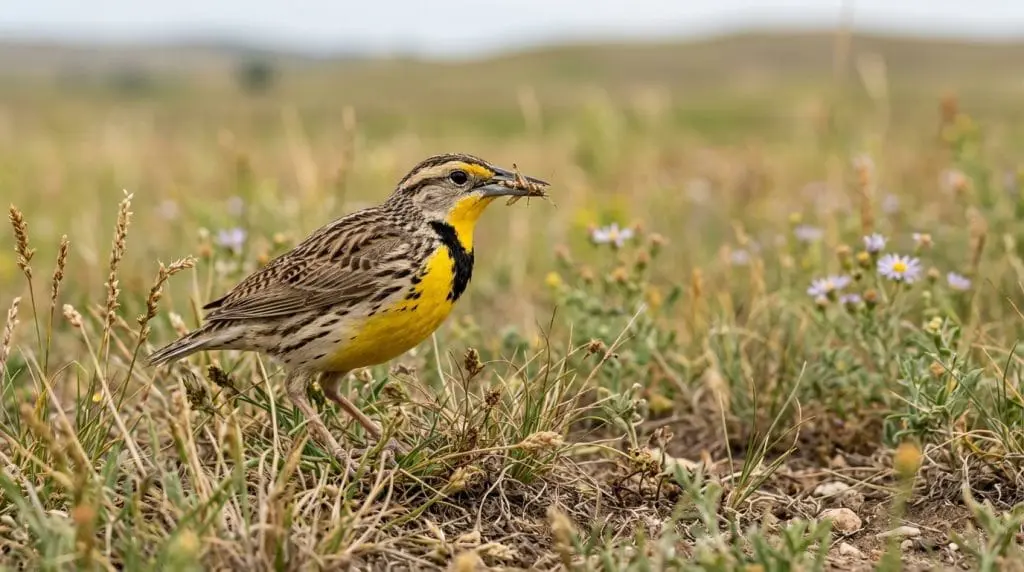
The Western Meadowlark (Sturnella neglecta) is a familiar grassland songbird of western and central North America. Its bright yellow underparts, bold black chest mark, brown-streaked back, and rich, flute-like song make it conspicuous during spring and early summer. Despite its name and ground-dwelling habits, it is not a true lark. It belongs to the blackbird family, Icteridae, along with orioles, grackles, and cowbirds.
Western Meadowlarks spend much of their time walking through grass, where their patterned upperparts provide effective camouflage. A singing bird perched on a fence post may be easy to identify, but a silent meadowlark in winter or in an area shared with Eastern Meadowlarks can require closer study. The Cornell Lab of Ornithology species account offers additional recordings and regional information.

Quick Identification
- Medium-sized, stocky songbird with a fairly long, pointed bill.
- Bright yellow throat and underparts, especially vivid in breeding adults.
- Bold black V-shaped mark across the upper breast.
- Brown, buff, and black streaking across the crown, back, and wings.
- White outer tail feathers, often visible when the bird flies or lands.
- Usually found walking in open grassland or singing from a low post.
- Song typically consists of clear, descending, flute-like notes and bubbling phrases.
Appearance
An adult Western Meadowlark has a rounded body, short neck, strong legs, and a long, sharply pointed bill. The throat, chest, and much of the belly are yellow, with a large black V or crescent crossing the breast. The sides and flanks are whitish to buff with dark streaks. Above, the bird is intricately patterned in brown, black, and pale buff, allowing it to disappear against dry grass and soil.
The head shows a pale central crown stripe, dark lateral crown stripes, a pale or yellowish eyebrow, and a dark line through the eye. The tail is relatively short and contains white outer feathers that flash in flight. Males and females look broadly similar. Males average somewhat brighter and may have a darker, more extensive breast mark, but plumage alone does not always allow reliable sexing. Juveniles are duller, with a reduced or incomplete black bib and heavier streaking across the underparts.

Size and Wingspan
Western Meadowlarks are larger and heavier-bodied than most sparrows but smaller than an American Robin. Adults are roughly 6.3–10.2 inches (16–26 centimeters) long, with individual and regional variation contributing to the broad published range. Their wingspan is about 16 inches (41 centimeters).
In the field, shape can be more useful than an exact measurement. Look for a compact bird with a level-backed stance, sturdy legs, a pointed bill, and broad, rounded wings. Its flight often consists of quick wingbeats alternating with brief glides. The white edges of the tail can be conspicuous as the bird moves away.
Range and Distribution
The Western Meadowlark occurs across much of western and central North America. Its breeding distribution extends through portions of southern Canada, the Great Plains, the western United States, and parts of the Midwest. The species also occurs south into Mexico. Its eastern boundary overlaps locally with that of the Eastern Meadowlark, especially across the central United States and parts of the Great Lakes region.
Migration varies by latitude and weather. Many birds in mild areas remain near their breeding range throughout the year, while northern and high-elevation populations generally move south or to lower elevations for winter. Seasonal movements can bring loose flocks into agricultural land and open valleys where the species was less noticeable during summer.
Habitat
Western Meadowlarks favor open country with grasses or other low vegetation. Typical settings include native prairie, grazed pasture, hayfields, weedy field edges, dry meadows, open shrub-steppe, and some lightly cultivated land. They usually avoid dense forest, closed shrubland, and heavily developed areas.
Suitable habitat generally combines ground-feeding areas with occasional elevated song perches. They frequently use fence posts, utility wires, isolated shrubs, and small rocks. Breeding birds also require enough grass cover to conceal a ground nest, although vegetation that is extremely tall or dense may be less suitable than a varied grassland structure.
Behavior
Most foraging takes place on the ground. A meadowlark commonly walks through vegetation, pauses to inspect the soil, and probes with its bill. When alarmed, it may crouch among the grass before flushing in low, direct flight. Birds often land on a post or drop back into cover some distance away.
During the breeding season, males sing from exposed perches and defend territories through song, displays, and chases. Outside the nesting period, Western Meadowlarks may gather in loose flocks, sometimes alongside blackbirds, starlings, or other open-country species. They remain wary and frequently move away before a person approaches closely.
Diet and Hunting
The diet changes with season and food availability. In spring and summer, Western Meadowlarks eat many insects and other small invertebrates, including grasshoppers, crickets, beetles, caterpillars, ants, spiders, and insect larvae. These protein-rich foods are especially important when adults are feeding nestlings.
Seeds and waste grain become more prominent during fall and winter. Meadowlarks collect food from the surface, probe into soil and plant litter, and sometimes use a technique called gaping: the bird inserts its closed bill into soil or vegetation and opens it to expose hidden prey. They rarely behave like regular feeder birds, although they may forage in nearby fields or beneath seed-bearing plants.
Vocalizations
The male’s song is one of the most useful identification clues. It is typically a sequence of clear, mellow whistles followed by more complex, descending, or bubbling notes. Individual songs vary, and a male may use several song patterns. The overall effect is fluid and musical rather than a series of plain, separated whistles.
Calls include low, rough chuck or check notes and a rattling sound often given during flight or agitation. Song is particularly valuable where Western and Eastern Meadowlarks overlap. Even there, caution is appropriate: meadowlarks can learn unusual variations, and visual appearance alone may not settle every identification.
Breeding and Nesting
The female chooses a concealed nest site on the ground, often in a shallow depression beneath clumped or overhanging grass. She constructs a cup of dry grasses and may weave surrounding vegetation into a partial or complete roof. Some nests have a short grass-lined entrance path. The domed structure can be extremely difficult to see from above.
A typical clutch contains about three to seven eggs, commonly around five. The eggs are pale, often white, with brown, reddish, or purplish spots and scrawls. The female performs most or all incubation, which usually lasts about two weeks. Males may mate with more than one female in a territory, while both parents can participate in feeding young. One or two broods may be attempted depending on region and conditions.

Young and Development
Newly hatched meadowlarks are helpless, sparsely covered with down, and dependent on adults for warmth and food. Parents deliver insects frequently as the nestlings grow. Young birds usually leave the nest after roughly 10–12 days, before they are strong, accomplished fliers.
Recently fledged meadowlarks hide in nearby grass and continue to receive food from adults. This vulnerable ground-based period makes disturbance, mowing, uncontrolled pets, and vehicles potential hazards. A fledgling found in suitable habitat should generally be observed from a distance unless it is clearly injured or in immediate danger.
Where to See
Search open grasslands early in the morning from spring through midsummer, when males are most likely to sing from conspicuous perches. Quiet rural roads through prairie, pasture, sagebrush country, and agricultural valleys can be productive. Scan fence lines and utility wires, then check the ground below for additional birds.
In winter, examine stubble fields, weedy pastures, and open ranchland for small flocks. A spotting scope can help because meadowlarks are often distant and easily disturbed. Remain on established roads or trails, avoid entering active fields without permission, and never approach a suspected nest.
Similar Species
The Eastern Meadowlark is the principal identification challenge. It has nearly the same yellow underparts, black breast mark, streaked upperparts, pointed bill, and white outer tail feathers. Western Meadowlarks often appear paler above, with a yellower malar area beside the throat, while Eastern Meadowlarks tend to show whiter cheeks and stronger dark head patterning. These differences are subtle, variable, and affected by lighting.
Voice is usually the best field character. Western Meadowlark songs are generally rich, fluted, and complex; Eastern Meadowlark songs are commonly clearer, simpler sequences of whistles. Where ranges overlap, record the song if possible and use several features rather than relying on one plumage mark.
Horned Larks and some large sparrows may also occur in the same habitat, but they lack the meadowlark’s combination of a long bill, yellow breast, bold black V, and flashing white outer tail.
Conservation
The Western Meadowlark is commonly classified as Least Concern globally, but that category does not mean all populations are stable. Long-term monitoring has documented declines in parts of its range, consistent with broader losses among North American grassland birds.
Important pressures include conversion of native prairie, intensive agriculture, development, pesticide exposure, invasive plants, and poorly timed mowing or haying during nesting. Conservation measures include protecting large grassland areas, maintaining varied vegetation, delaying disruptive work until after nesting where practical, and using grazing systems that retain adequate cover. Preserving uncultivated field margins can also provide feeding and nesting opportunities.
Field Identification Tips
- Begin with habitat: an open pasture or prairie is much more likely than woodland or dense brush.
- Check the breast: look for bright yellow crossed by a strong black V.
- Watch the tail: white outer feathers often show best when the bird flushes.
- Study the face: note the eyebrow, eye line, cheek color, and dark crown stripes.
- Listen carefully: song is often the strongest clue for separating Western and Eastern Meadowlarks.
- Use multiple characters: plumage varies with age, season, feather wear, and light.
- Document uncertain birds: photographs and audio recordings are especially helpful in overlap zones.
Frequently Asked Questions
Are Western Meadowlarks true larks?
No. They are members of Icteridae, the New World blackbird family. True larks belong to a different family, Alaudidae.
Do Western Meadowlarks migrate?
Some do. Northern and high-elevation birds are more likely to move south or downslope, while many populations in milder regions remain throughout the year.
Can males and females be distinguished?
Males average brighter, with a stronger black breast mark, but the sexes overlap considerably in appearance. Behavior during the breeding season may provide better clues than plumage alone.
Do Western Meadowlarks visit bird feeders?
They are not regular feeder visitors. They normally forage on the ground in open fields for insects, seeds, and grain.
What is the best way to separate Western and Eastern Meadowlarks?
Listen to the song and combine it with face pattern, upperpart coloration, location, and habitat. Avoid identifying a difficult bird from a single photograph or one minor plumage feature.
Why is a meadowlark singing from a fence post?
During the breeding season, males use elevated perches to broadcast songs that advertise territory and attract mates. Fence posts provide prominent substitutes for natural shrubs or rocks.


