
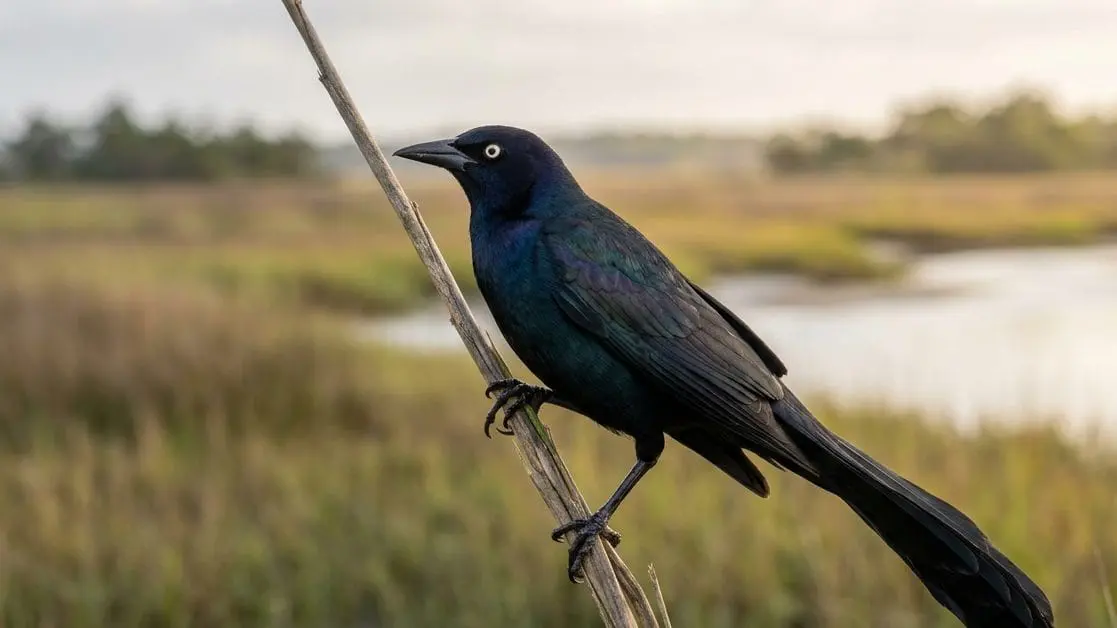
Boat-tailed Grackle Guide
Keep Track of What You See
Create a free Wild Things Guide membership to record this Boat-tailed Grackle in My Sightings and build your personal wildlife list.
Join to Add This SightingIntroduction
The Boat-tailed Grackle (Quiscalus major) is a conspicuous songbird of coastal marshes, beaches, and waterfront developments in the southeastern United States. Large males combine glossy black plumage with a remarkably long, keel-shaped tail. Females are smaller and brown, making the sexes look different enough to confuse an unfamiliar observer.
Although Boat-tailed Grackles often gather around parking lots and outdoor dining areas, their natural center of abundance is the coastal marsh. Their upright posture, long legs, purposeful walk, and varied whistles and clacks make them a familiar presence from the mid-Atlantic coast through Florida and along the Gulf Coast. The Cornell Lab of Ornithology’s Boat-tailed Grackle account provides additional photographs and recordings.

Quick Identification
- Male: Large, long-legged blackbird with glossy blue, purple, or green highlights.
- Female: Smaller than the male, with warm to dark brown plumage and paler underparts.
- Tail: Very long and often held in a deep V or keel shape.
- Bill: Long, straight, and fairly heavy, with a pointed tip.
- Eyes: Pale yellow in many Atlantic populations but dark in several Gulf Coast populations.
- Habitat: Strongly associated with salt marshes, brackish wetlands, beaches, coastal towns, and waterfront parking areas.
- Behavior: Walks confidently on the ground, gathers in noisy groups, and frequently perches in exposed locations.
Appearance
Adult males are imposing blackbirds with elongated bodies, long legs, and tails that may appear almost oversized. In good light, their plumage is not simply black: the head and body can show blue, violet, bronze, or green iridescence. The exact sheen changes with angle, wear, and geography. The bill and legs are black.
Adult females are substantially smaller and lack the male’s glossy black plumage. They are generally dark brown above, with a warmer brown or buff-toned breast and belly. The face may look slightly darker than the underparts. Females retain the species’ long bill and tail, although the tail is proportionally less extravagant than that of a mature male.
Juveniles resemble females at first. Young males gradually acquire darker feathers and may look patchy during molt. Eye color is geographically useful but should not be used by itself: pale-eyed birds are characteristic of much of the Atlantic coast. At the same time, dark-eyed populations occur around parts of the Gulf Coast.

Size and Wingspan
Boat-tailed Grackles show pronounced sexual size differences. Adults are approximately 10.2–14.6 inches (26–37 centimeters) long, with males occupying the larger end of the range. Typical wingspan is about 15.3–19.7 inches (39–50 centimeters).
A male may appear nearly crow-sized when its tail is fully displayed, but it has a narrower body, slimmer bill, and more elongated profile than a crow. Females can be closer to Common Grackles in apparent size, so tail shape, body proportions, plumage, and habitat deserve attention.
Range and Distribution
This species is largely resident along the Atlantic and Gulf coasts of the United States. Its distribution extends from the mid-Atlantic region south through the Carolinas, Georgia, and Florida, then west along the Gulf Coast to southeastern Texas. It is especially widespread in Florida, including many inland wetlands and developed areas.
Most individuals remain within the general region year-round, although they move locally in response to food, breeding conditions, weather, and water levels. Away from the regular range, reports require careful comparison with Great-tailed and Common Grackles.

Habitat
Salt and brackish marshes are characteristic habitats. Boat-tailed Grackles use cordgrass, rushes, mangrove edges, tidal creeks, mudflats, barrier islands, dunes, and coastal scrub. They also occupy freshwater marshes, particularly in Florida.
The species adapts readily to modified environments near wetlands. Marinas, fishing piers, boardwalks, beach parking lots, campgrounds, parks, and shopping centers may support regular flocks. Trees, utility wires, signs, shrubs, and marsh vegetation provide elevated perches from which birds watch for food or rivals.

Behavior
Boat-tailed Grackles spend much of their time walking rather than hopping. They stride over lawns, pavement, mud, and shallow water while probing or picking food from the surface. The long tail may be tilted upward, spread, or folded into a distinct V.
The species is social outside the immediate nesting context. Birds feed in loose groups and may form large evening roosts. Males are conspicuous during the breeding season, when they display from posts, shrubs, or marsh vegetation. A displaying male raises and spreads his tail, fluffs his body feathers, partly opens his wings, and points his bill upward while vocalizing.
Social relationships can be complex. Dominant males may defend display areas containing several nesting females, while other males remain nearby and seek opportunities to mate. Territorial disputes involve posturing, calls, chases, and occasional physical contact.
Diet and Hunting
Boat-tailed Grackles are opportunistic omnivores. Their diet includes insects, spiders, snails, small crabs, crayfish, aquatic invertebrates, seeds, grains, berries, small fish, tadpoles, frogs, and occasionally eggs or nestlings. Human food scraps can become important around busy coastal developments.
Foraging methods vary with setting. A bird may probe wet soil, turn over debris, pull prey from vegetation, wade into shallow water, or seize an item from a hard surface. The species sometimes follows people, livestock, mowing equipment, or other animals that disturb potential prey. “Hunting” is therefore less about aerial pursuit than about flexible searching and quick capture.
Feeding wildlife is not recommended. Dependence on handouts can concentrate birds, encourage aggressive behavior, and expose them to unsuitable foods and vehicle traffic.
Vocalizations
The Boat-tailed Grackle has a varied but often harsh-sounding repertoire. Calls include metallic clanks, hard chacks, nasal notes, rattles, squeaks, and whistles. Displaying males deliver short, emphatic songs that may combine a rising whistle with mechanical-sounding clicks or rattles.
Some calls carry surprisingly well across open marshes. In a crowded colony, overlapping vocalizations create a busy soundscape rather than a conventional melodic chorus. Learning the distinctive whistles and metallic notes can help locate birds hidden by tall vegetation.
Breeding and Nesting
Breeding timing varies with latitude and local conditions, generally beginning earlier in Florida and later farther north. Females perform most or all nest construction. The nest is a bulky open cup made from grasses, marsh plants, leaves, and other fibers, often reinforced with mud or damp vegetation.
Nests are commonly placed low over water or wet ground in cordgrass, rushes, reeds, shrubs, or small trees. In some areas, several females nest within a male’s defended display territory. Placement over water may reduce access for some predators, although nests remain vulnerable to storms, flooding, snakes, mammals, and other birds.

A clutch usually contains two to five eggs, often three. Eggs are generally pale bluish, grayish, or greenish and marked with brown, black, or purplish blotches and scrawls. Appearance varies, so eggs should never be identified without considering the nest, adults, location, and habitat.
Young and Development
The female incubates the eggs for roughly two weeks. Newly hatched chicks are helpless and dependent on adults for warmth and food. The female supplies most direct care, bringing insects and other protein-rich items to the nest.
Nestlings develop rapidly and typically leave after about two weeks, sometimes before they can fly strongly. Recently fledged birds may hide in marsh vegetation while adults continue feeding them. Observers should avoid approaching occupied nests: disturbance can expose young to weather or predators and may cause premature fledging.
Where to See
Productive locations include national wildlife refuges, coastal state parks, marsh boardwalks, causeways, fishing access points, estuaries, and waterfront parks. In Florida, almost any wetland-edge community can produce sightings. Along the Carolinas and Georgia, search tidal marshes and barrier-island developments. On the Gulf Coast, inspect marshes, beaches, and coastal parking areas.
Early morning is often best for active feeding and display, while late afternoon can reveal groups moving toward communal roosts. Scan exposed posts, utility wires, palmettos, shrubs, and the tops of marsh plants. Listen for whistles and hard metallic notes when tall vegetation blocks the view.
Similar Species
Great-tailed Grackle: This close relative overlaps locally, especially near the western Gulf Coast. Great-tailed Grackles are more strongly associated with open inland towns, agricultural land, and developed landscapes, although habitat overlap occurs. Males often look longer-legged and flatter-headed, but structure varies with posture. Evaluate voice, range, eye color, and habitat together.
Common Grackle: Common Grackles are smaller and shorter-tailed. Adult males often show a contrasting iridescent head and bronzy body, rather than the Boat-tailed Grackle’s larger, more uniformly dark appearance. Common Grackles are widespread inland and are less closely tied to coastal marshes.
Fish Crow and American Crow: Crows are heavier-bodied, with broader wings, shorter tails relative to body size, and thick bills. They lack the grackle’s strongly keeled tail and sexual plumage difference.
Red-winged Blackbird: Female Red-wings are smaller and heavily streaked. Males show red-and-yellow shoulder patches and have much shorter tails.
Conservation
The Boat-tailed Grackle is commonly classified as Least Concern globally. It remains locally abundant and benefits from some human-altered environments. Adaptability around towns, roads, and recreational sites should not, however, be mistaken for complete security.
Coastal wetland loss, development, altered hydrology, pollution, severe storms, and rising sea levels may reduce nesting and foraging habitat. Marsh-dependent populations can be particularly vulnerable when suitable vegetation is squeezed between advancing water and hardened shorelines. Protecting tidal wetlands, maintaining natural buffers, and reducing litter benefit this species and many less adaptable marsh birds.
Field Identification Tips
- Start with habitat: A very large grackle in a southeastern salt marsh is a strong candidate.
- Check the tail: Look for exceptional length and a deep V or keel when the tail is folded.
- Allow for sex differences: Glossy black males and brown females belong to the same species.
- Watch movement: Boat-tailed Grackles walk with long strides and often hold the bill slightly elevated.
- Use eye color cautiously: Regional populations differ, and lighting can make pale eyes look dark.
- Listen: Metallic clanks, squeaks, and rising whistles can separate these birds from crows and other blackbirds.
- Document overlap zones: Where Great-tailed Grackles occur, photograph the profile and tail and record vocalizations if possible.
Frequently Asked Questions
Why is it called a Boat-tailed Grackle?
The name refers to the male’s long, V-shaped or keel-like tail, which can resemble the hull of a small boat when viewed end-on.
Are Boat-tailed Grackles aggressive?
They can be assertive around food and during breeding disputes, but they generally avoid direct conflict with people. Problems are more likely where birds receive regular handouts.
Do all Boat-tailed Grackles have yellow eyes?
No. Many Atlantic coast birds have pale yellow eyes, while populations in parts of the Gulf Coast have dark eyes. Eye color is a regional clue rather than a universal field mark.
Are they the same as Great-tailed Grackles?
No. They are closely related species with similar males and females. Boat-tailed Grackles are more strongly centered on Atlantic and Gulf coastal wetlands, while Great-tailed Grackles occupy a much broader array of inland and developed habitats.
Do Boat-tailed Grackles migrate?
Most are resident or make relatively short regional movements. Seasonal shifts may occur as birds respond to food, water levels, nesting conditions, or severe weather.
Can Boat-tailed Grackles swim?
They commonly wade in shallow water but are not specialized swimming birds. They usually forage along shorelines, marsh edges, mudflats, and flooded vegetation.


