

Western Grebe Guide
Keep Track of What You See
Create a free Wild Things Guide membership to record this Western Grebe in My Sightings and build your personal wildlife list.
Join to Add This SightingOne of the Western Grebe’s most famous traits is its spectacular courtship display. During the spring breeding season, pairs perform a synchronized water dance called “rushing.” They lift their bodies completely out of the water and sprint side by side across the lake surface with their necks arched. Beyond this famous display, the Western Grebe is an expert fisher and a devoted parent that carries its newly hatched chicks on its back. This guide provides a practical field reference to help you identify, understand, and locate the Western Grebe in the wild.
Quick Identification
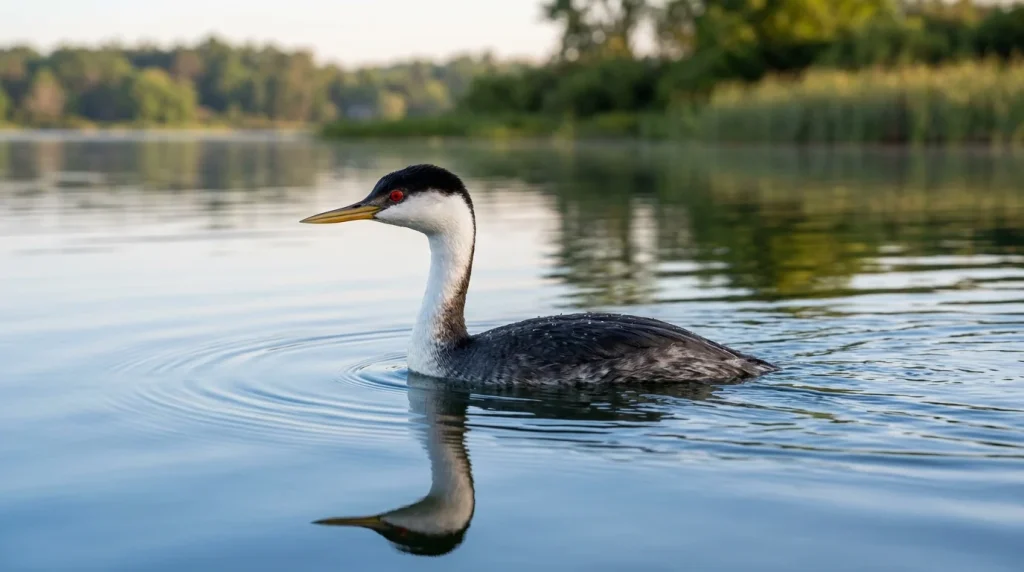
When observing a distant waterbird on a lake or bay, look for these quick identification clues to confirm a Western Grebe:
- Overall shape: Large waterbird with a long, thin white neck and a sleek, dark body sitting low in the water.
- Head pattern: Black cap on top of the head extends downward to enclose the bright red eye.
- Bill: Long, slender, pointed bill with a dull greenish-yellow or olive-yellow color.
- Facial pattern: Pure white throat and cheeks contrasting sharply with the dark cap.
- Voice: A loud, two-note call that sounds like kree-kree.
Appearance
The Western Grebe is designed for high efficiency in aquatic environments. Its body is long and streamlined, with legs set far back. This leg placement makes walking on land clumsy, but it turns the bird into a swift, agile swimmer underwater.
The upper body, including the back, wings, and rear neck, is dark slate-gray to charcoal black. The underside, including the foreneck, breast, and belly, is pure satin white. The contrast between dark top and white bottom gives the bird a clean, elegant look. The head features a distinct black crown that extends down past the bright red iris. The long, spear-like bill is dull yellow to greenish-yellow, helping distinguish it from close relatives. Because the legs are set so far back, grebes lack visible tails, giving their rear end a rounded, soft appearance while swimming.

Breeding and Nonbreeding Plumage
Unlike many duck species, the Western Grebe does not undergo a dramatic change in appearance between seasons, but key subtle differences exist:
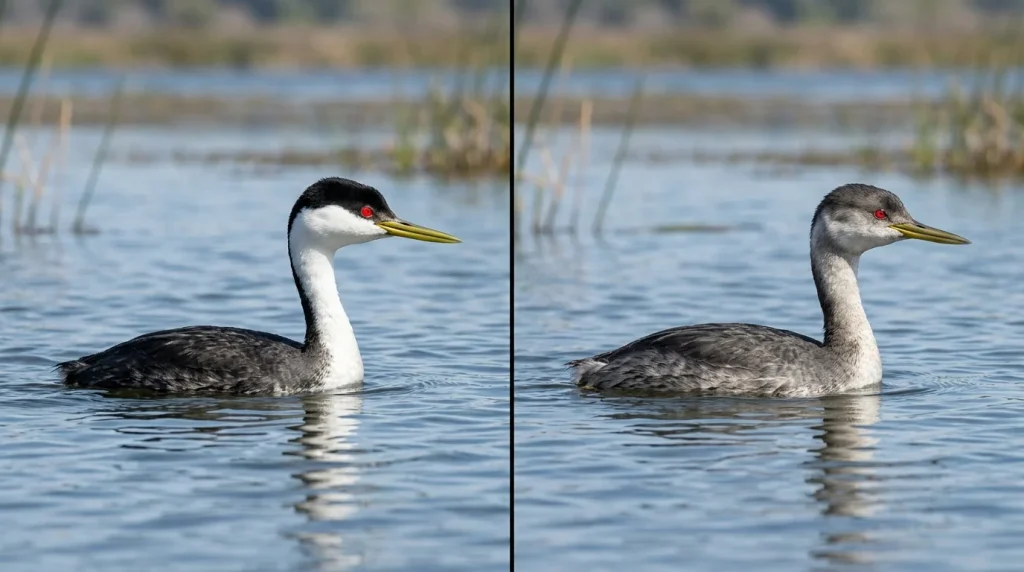
- Breeding Plumage (Spring and Summer): The black cap on the head is deep charcoal or jet black, with crisp boundaries along the face. The dark cap clearly surrounds the red eye. The yellow bill is bright, and the contrast between the white throat and black crown is sharp and vivid.
- Nonbreeding Plumage (Fall and Winter): The overall body feathers become slightly duller gray rather than jet black. The edges of the black cap may appear somewhat softer or dustier, but the dark patch still extends around or below the red eye. The sides of the neck may show a subtle gray wash rather than pure white.
Size and Wingspan
The Western Grebe is the largest grebe species in North America, tied in size with its twin species, Clark’s Grebe. Detailed measurements from the Cornell Lab of Ornithology outline its general dimensions:
- Length: 22 to 30 inches (56 to 76 cm)
- Wingspan: 30 to 38 inches (76 to 97 cm)
- Weight: 2.4 to 4.0 pounds (1,100 to 1,800 grams)
In the field, it looks noticeably larger and has a longer neck than a Mallard or a Pied-billed Grebe, resembling a small swan or loon when resting on open water.
Range and Distribution
The Western Grebe is native to western North America, shifting between inland freshwater systems and ocean coasts depending on the season:
- Breeding Range: Inland freshwater lakes and large marshes across western Canada (Alberta, Saskatchewan, Manitoba, British Columbia) down through the western United States, including Washington, Oregon, California, Idaho, Montana, Utah, and Nevada.
- Winter Range: Pacific Coast from southern Alaska and British Columbia down to central Mexico. Significant populations also winter on ice-free inland lakes and reservoirs in the southwestern United States and central Mexico.
- Migratory Routes: They move mainly at night in flocks between inland breeding lakes and coastal wintering grounds.

Habitat
Habitat selection depends strictly on the time of year:
- Breeding Habitat: Large freshwater lakes, impoundments, and quiet river deltas with extensive stands of emergent vegetation, such as tules, bulrushes, and cattails. These plants provide vital materials and shelter for building floating nests.
- Nonbreeding Habitat: Coastal marine environments, including sheltered ocean bays, estuaries, and sounds. They can also be found on large, open, ice-free freshwater lakes, reservoirs, and deep brackish lagoons during winter.

Behavior
The behavior of the Western Grebe is tailored for water life:
- Diving and Foraging: They dive from the surface, sliding smoothly underwater without splashing. They compress their feathers to squeeze out trapped air, making them less buoyant so they can stay submerged easily while hunting.
- Flight: Because their wings are relatively small compared to their body size, they need a long running start across the water and rapid wing flapping to take off. Once airborne, they fly with fast wingbeats, holding their long neck stretched straight forward and legs trailing behind.
- Courtship Display: Spring courtship involves synchronized routines. During the “rushing” display, two birds lean forward, raise their crests, and sprint side by side across the water surface for up to 30 feet. Another routine, the “weed dance,” involves both birds rising breast-to-breast out of the water while holding tangled aquatic plants in their bills.
Diet
Western Grebes are specialized fish hunters. Their diet consists primarily of small to medium-sized fish, complemented by other aquatic animals:
- Primary Foods: Fish such as minnows, herring, perch, smelt, sculpins, and carp.
- Secondary Foods: Aquatic insects, crustaceans (like crayfish), salamanders, worms, and mollusks.
- Feather Eating: A unique behavior seen in grebes is swallowing their own feathers. The ingested feathers form a dense mat inside the stomach. This mat acts as a filter, protecting the digestive tract from sharp fish bones and allowing bones to stay in the stomach long enough to dissolve safely.

Vocalizations
The Western Grebe uses loud, carrying calls to communicate across wide open water. The primary call is a distinct two-note sound often written as kree-kree or crr-crr. This sharp call carries long distances over marshes. During courtship rituals, they produce soft ticking, chatter, and squeaking sounds. Learning the two-note call is one of the best ways to distinguish the Western Grebe from Clark’s Grebe, which typically utters a single-note call.
Breeding and Nesting
Western Grebes nest in colonies that can range from a few dozen pairs to thousands of birds on a single lake:
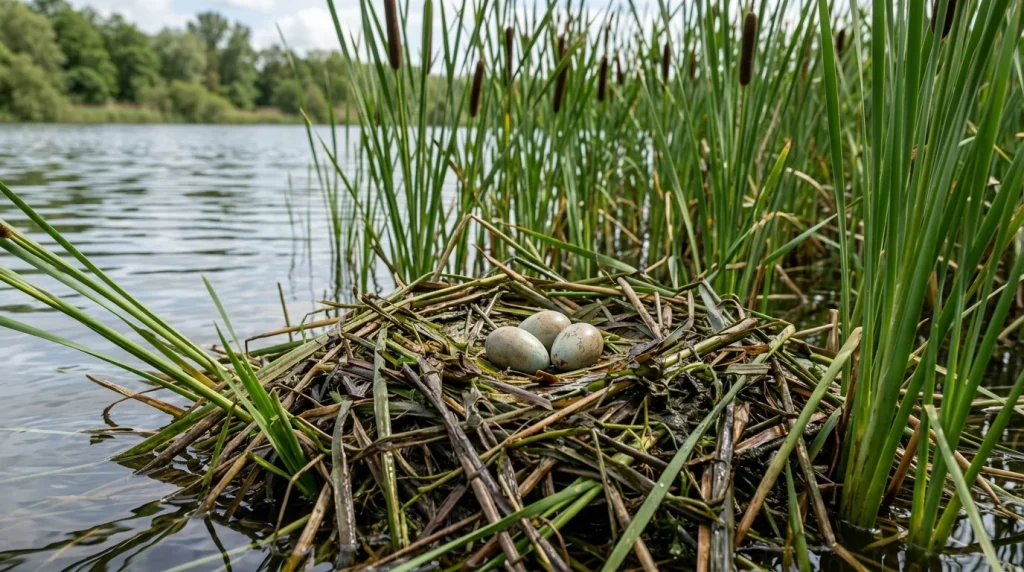
- Nest Construction: Both the male and female build a floating nest made of decaying reeds, rushes, and pondweeds. The platform is anchored to living aquatic plants, so it stays in place while drifting slightly as water levels change.
- Clutch Size: Typically 2 to 4 eggs (occasionally up to 6).
- Egg Appearance: Pale bluish-white when freshly laid, quickly turning stained light brown from decaying nest materials.
- Incubation: Both parents share incubation duties for about 22 to 28 days.
Young and Development
The development of Western Grebe chicks is fascinating and highly social:
- Hatching: Chicks hatch covered in soft gray down. Unlike many bird species, they leave the floating nest almost immediately after hatching.
- Back-Riding: Newly hatched chicks climb onto their parents’ backs and hide beneath the adult’s wing feathers. Adults swim, feed, and even dive with chicks riding securely on their backs.
- Feeding: Parents feed small fish and tiny feathers directly to the chicks on their backs.
- Independence: Young birds begin swimming on their own around 4 weeks of age and become fully independent at about 7 to 9 weeks.
Where to See
To see Western Grebes, visit suitable wetlands during the appropriate season:
- Top Summer Locations: Bear River Migratory Bird Refuge (Utah), Tule Lake and Klamath Basin National Wildlife Refuges (California/Oregon), Upper Klamath Lake (Oregon), and Malheur National Wildlife Refuge (Oregon).
- Top Winter Locations: Puget Sound (Washington), Monterey Bay (California), San Francisco Bay (California), and coastal bays along the southern California coastline.
- Observation Tip: Scan open water with binoculars or a spotting scope. Look near tall reed beds during spring mornings to catch courtship displays.
Similar Species
Telling the Western Grebe apart from similar species requires careful observation of facial features:
- Clark’s Grebe (Aechmophorus clarkii): The closest relative. Clark’s Grebe has white feathering extending above the eye (so the red eye sits in white plumage), a brighter orange-yellow bill, and a single-note kreee call.
- Red-necked Grebe: Smaller, with a thicker yellow-and-black bill, gray cheeks, and a reddish neck during breeding season.
- Horned Grebe & Eared Grebe: Much smaller waterbirds with shorter necks, different bill shapes, and golden head plumes in breeding plumage.
Conservation
The Western Grebe is currently classified as a species of Least Concern globally, but localized populations face serious threats:
- Habitat Loss and Water Levels: Water diversion, coastal development, and fluctuating lake levels during breeding can destroy floating nests or leave colonies high and dry.
- Human Disturbance: Motorboats and personal watercraft near nesting colonies create wakes that capsize floating nests and frighten brooding parents away.
- Environmental Contaminants: As top predators in lake ecosystems, grebes accumulate toxins such as heavy metals and pesticides. Oil spills along wintering coastal waters can also devastate large numbers.
Field Identification Tips
Use this quick checklist when trying to identify a distant grebe on the water:
- Check the eye: Do black feathers surround the bright red eye? If yes, it is a Western Grebe. If the eye sits completely in white feathering, it is a Clark’s Grebe.
- Check the bill color: Is the bill dull greenish-yellow or olive? That points to Western Grebe. (Clark’s Grebe has a bright, neon orange-yellow bill).
- Listen to the call: Does it give a two-note kree-kree call? That confirms a Western Grebe.
- Look at the flanks: Western Grebes usually show darker slate-gray sides while swimming compared to the paler gray flanks of Clark’s Grebes.
Frequently Asked Questions
Do Western Grebes walk on land?
Rarely. Their legs are so far back on their bodies that they can barely walk upright. They come onto land or ice only when bad weather or illness forces them.
Why do Western Grebes eat their own feathers?
They swallow feathers so they form a protective lining in their stomach. This mat catches sharp fish bones and keeps them from injuring the bird’s intestines until they fully digest.
How do you tell a Western Grebe from a Clark’s Grebe?
Look at the eyes and bill. Western Grebes have black feathers extending below the red eye and a greenish-yellow bill. Clark’s Grebes have white feathers surrounding the red eye and a bright orange-yellow bill.
Can Western Grebes fly well?
They fly well once in the air during long migrations, but they need a long running start on the water to gain enough speed to take off.


