

Common Loon Guide
Keep Track of What You See
Create a free Wild Things Guide membership to record this Common Loon in My Sightings and build your personal wildlife list.
Join to Add This SightingIntroduction
The Common Loon (Gavia immer) is a strong-swimming waterbird known for its haunting calls and bold summer markings. Although it sometimes appears in general bird or songbird guides, it is not a songbird. It belongs to a separate group of diving birds, the loons.
Across much of northern North America, loons are familiar sights on lakes in summer. In winter, many move to coastal waters and become much plainer. Learning their shape, bill, and diving habits helps you recognize them in every season.
Quick Identification
- Shape: Large, long-bodied waterbird with a thick neck, substantial head, and short tail.
- Bill: Heavy, straight, and pointed, usually held roughly level.
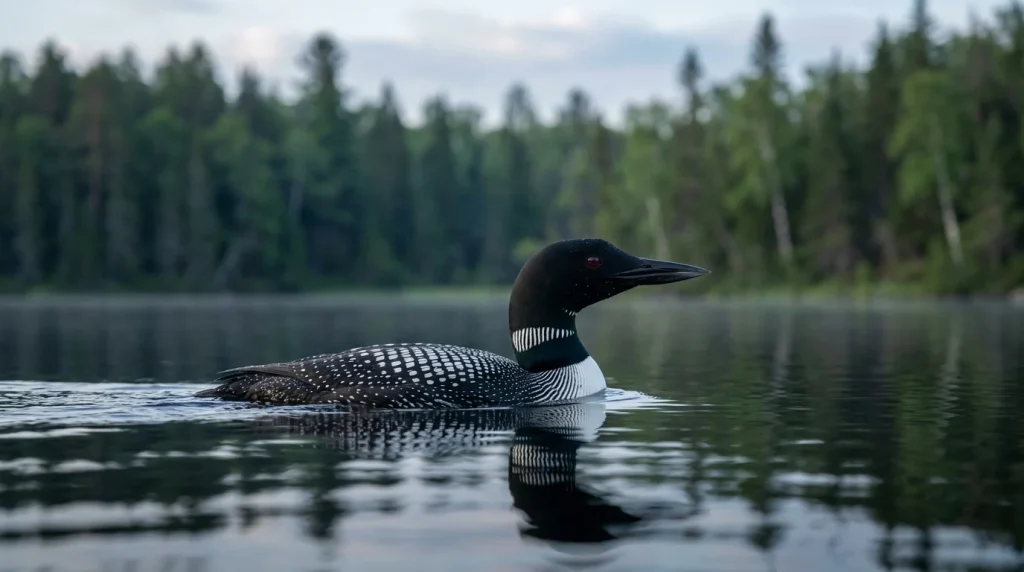
- Breeding adult: Black head, striped neck markings, and a black back patterned with white squares.
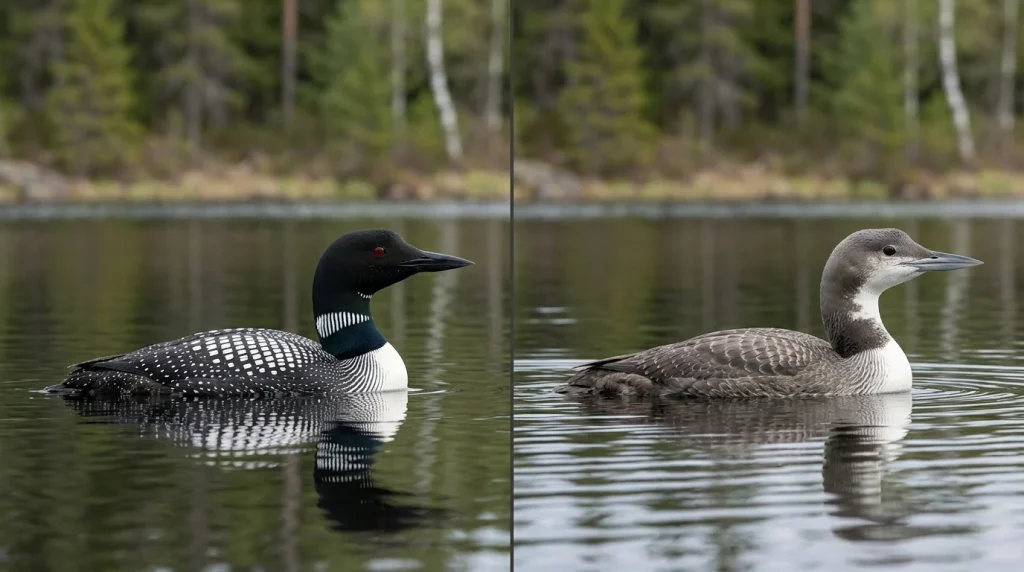
- Winter adult: Gray-brown above and white below, with white on the throat and lower face.
- Behavior: Sits low in the water and dives smoothly, often resurfacing far away.
- Voice: Long wails, laughing tremolos, and carrying yodels on breeding lakes.
Appearance
A Common Loon looks longer and lower in the water than most ducks. Its thick neck and dagger-shaped bill give it a sturdy profile. The forehead often rises noticeably above the bill, though posture changes the outline.
Breeding adults have red eyes, black bills, and dark heads that may shine green in good light. White stripes form neck patches, while rows of white spots and squares cover the upperparts. The belly is white.
Males and females share the same plumage. Males average larger, but size overlaps, so most lone birds cannot be sexed reliably by sight.

Breeding and Nonbreeding Plumage
The striking breeding pattern develops before or during the return to northern nesting waters. After breeding, adults lose the sharp black-and-white pattern and become gray-brown above, with a white throat, chest, and belly.
Winter birds often show an uneven boundary between the dark hindneck and pale front of the neck. White may extend around the eye, but the exact pattern varies with age, molt, and viewing angle. The bill becomes paler and grayer than in summer.
Juveniles resemble winter adults but usually show pale edges on their back feathers, giving a neat, scaly look. During molt, mixed plumage can look patchy rather than matching a field-guide picture perfectly.
Size and Wingspan
- Length: About 26–36 inches (66–91 cm).
- Wingspan: About 41–52 inches (104–131 cm).
Size varies by region and individual. Common Loons are generally larger and heavier-looking than Pacific and Red-throated Loons. Distance over open water can make size misleading, so compare birds swimming near one another whenever possible.
Range and Distribution
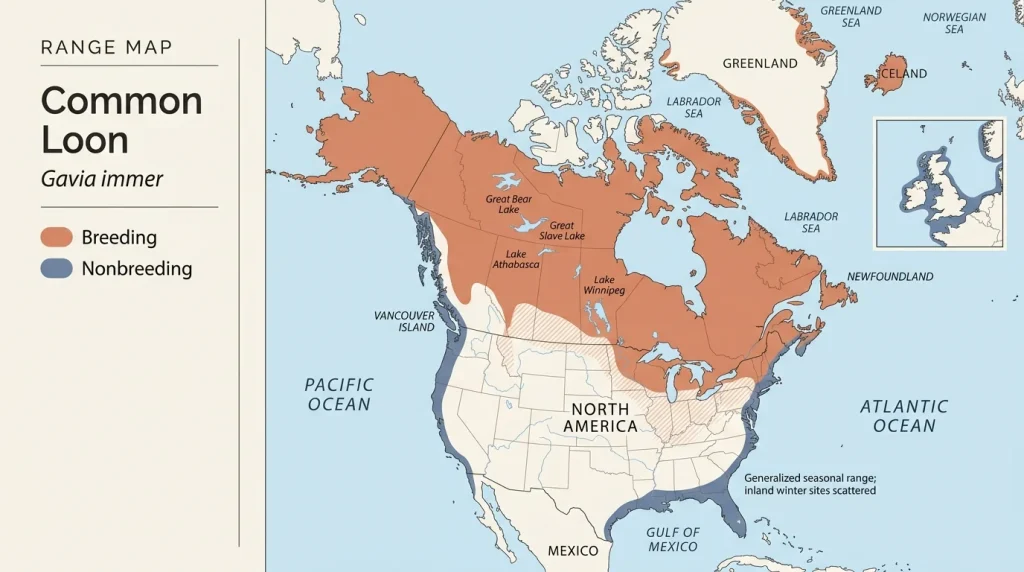
Common Loons breed across much of Alaska and Canada and in the northern United States, including parts of the Great Lakes region and New England. Their breeding range also reaches Greenland and Iceland.
Most winter along the Pacific and Atlantic coasts and the Gulf of Mexico. Some remain on large, ice-free inland lakes and reservoirs. Birds from Greenland and Iceland also winter in the northeastern Atlantic.
During migration, loons may stop on large lakes and reservoirs far from their breeding grounds. Timing varies with latitude, weather, and ice conditions.
Habitat
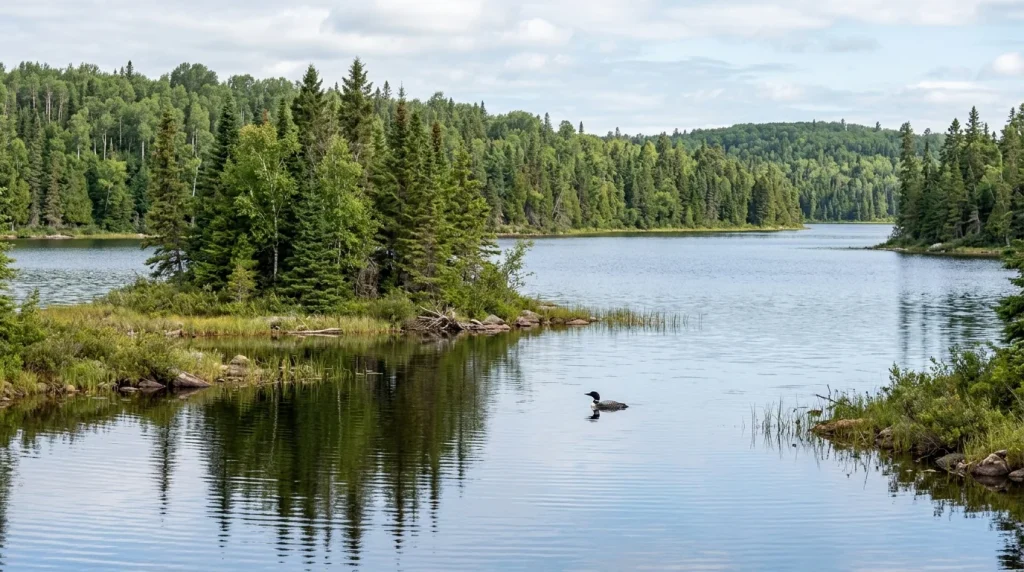
Breeding habitat usually includes clear freshwater lakes with good fish supplies, sheltered nesting edges, and room to take off. Islands, quiet coves, and lightly developed shorelines are especially useful. Some birds use smaller lakes when nearby waters provide feeding opportunities.
In winter, look in bays, sounds, estuaries, and nearshore ocean waters. Loons need productive feeding areas, but they don’t always stay close to land. Wind and waves can make even a large bird difficult to spot.
Behavior
Common Loons dive using powerful feet set far back on the body. This arrangement makes them excellent swimmers but awkward on land. They usually come ashore only for nesting or when something is wrong.
A feeding loon may lower its face into the water before diving. Dives often last around a minute, though their length varies. Follow the direction of travel rather than staring only at the place where the bird disappeared.
Taking flight usually requires a long run across the surface. In the air, loons have rapid wingbeats, an outstretched neck, and feet that project beyond the short tail. Adults replace their flight feathers during winter and are temporarily flightless.
Diet
Fish make up most of the Common Loon’s diet. Prey varies with the waterbody and may include perch, minnows, sunfish, and small marine fish. Loons also eat crayfish and other aquatic animals, especially when these are readily available.
They hunt mainly by sight underwater. They may swallow small prey below the surface; they often bring up larger fish and turn them headfirst before swallowing. Adults feed chicks small prey, offering larger items as the young grow.

Vocalizations
Calls are especially noticeable on breeding lakes, often at night or in calm weather.
- Wail: A long, rising-and-falling call often used to maintain contact.
- Tremolo: A laughing series associated with alarm or excitement; also heard in flight.
- Yodel: A loud territorial call given by males.
- Hoot: A soft call used at close range, including among family members.
Listen to examples from the Cornell Lab of Ornithology before visiting a breeding lake. Avoid playing recordings near territorial birds.
Breeding and Nesting
Pairs defend breeding territories that may include an entire small lake or part of a larger one. Both adults help build a low nest of plant material beside the water. Islands and sheltered shorelines allow easier access and may reduce some predator risks.
The usual clutch is one or two olive-brown eggs with dark markings. Both parents incubate for about 26–29 days. Because the nest sits so close to the water, sudden changes in lake level can flood it or make it difficult to reach.
Watch nesting birds from a distance. An adult that slips off its nest as you approach may be responding to your presence.

Young and Development
Chicks hatch covered in dark down and can swim soon afterward. They leave the nest early and depend on their parents for food and protection. Small chicks often ride on an adult’s back, where they can rest and stay warm.
As they grow, young loons spend more time diving and catching their own food. Flight usually develops at roughly 10–12 weeks. Adults may leave breeding waters before the young, which do not need to follow their parents to migrate.
Where to See
In summer, try quiet lakes in northern Minnesota, Wisconsin, Michigan, Maine, the Adirondacks, or suitable parts of Canada and Alaska. Public overlooks and shoreline trails often provide good views without disturbing families.
In winter, scan sheltered coastal bays, harbors, and large estuaries. Inland reservoirs are worth checking during migration, especially where water remains open.
Use binoculars to locate birds, then a spotting scope to check bill shape and facial patterns. Early light and calm conditions often make identification easier. In a boat, slow down and give adults and chicks plenty of space.
Similar Species
- Pacific Loon: Usually smaller and more slender, with a smaller bill. Winter birds tend to show a cleaner division between the dark hindneck and white foreneck; some show a thin chinstrap.
- Red-throated Loon: Slimmer, with a finer bill often held tilted upward. Winter birds usually have more white on the face and small pale spots above.
- Yellow-billed Loon: Another large loon, mainly associated with the Arctic. Look for its heavier ivory or pale yellow bill, often angled upward. Rare birds farther south deserve careful study.
- Double-crested Cormorant: Has a hooked bill, longer tail, and often a thinner-looking neck. It may perch with wings spread, unlike a loon.
Conservation
The Common Loon is generally listed globally as Least Concern, but that does not mean every local population is secure. Nesting success and population trends vary across its range.
Threats include shoreline disturbance, boat strikes, fishing-line entanglement, swallowed lead tackle, mercury pollution, oil spills, and changing lake conditions. Warming temperatures may affect future breeding habitat.
Help by using nonlead fishing tackle, retrieving discarded line, reducing boat wakes near nests, and keeping clear of loon families. Give nesting islands and marked protection areas plenty of space.
Field Identification Tips
- Start with shape: Look for a long, low body, thick neck, and strong pointed bill.
- Check bill angle: A roughly level bill supports Common Loon, but posture alone is not enough.
- Match the season: Expect bold checks in breeding plumage and plain gray-brown upperparts in winter.
- Use several marks: Combine size, head shape, bill thickness, and neck pattern.
- Wait for another view: Diving, glare, and waves can hide key features.
Frequently Asked Questions
Is the Common Loon a duck?
No. It belongs to the family Gaviidae and order Gaviiformes. Ducks belong to a different bird order.
Can Common Loons walk on land?
Only awkwardly. Their rear-set legs suit swimming, not walking. Never force a stranded loon toward water; contact a wildlife rehabilitator for advice.
Do Common Loons mate for life?
Pairs may reunite for several years, but partnerships can change. Returning to a familiar territory is an important part of their breeding behavior.
Why did the loon disappear underwater?
It was probably feeding, though loons also dive to avoid threats. Scan a wider area and give it time to surface rather than moving closer.


