Viceroy Butterfly Guide
Keep Track of What You See
Create a free Wild Things Guide membership to record this Viceroy Butterfly in My Sightings and build your personal wildlife list.
Join to Add This SightingIntroduction
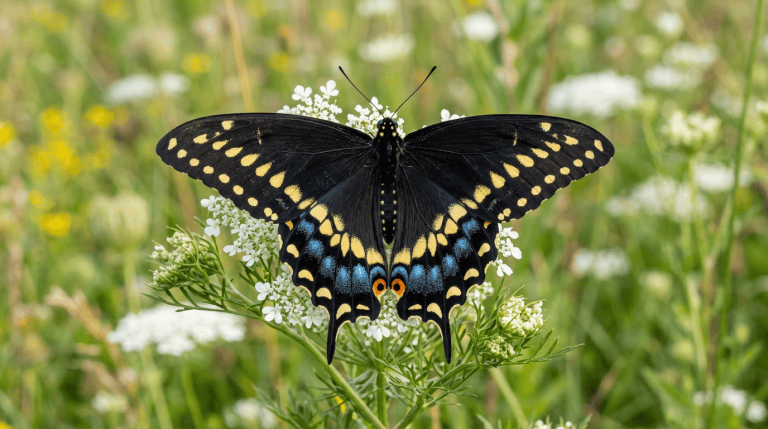
The Viceroy butterfly (Limenitis archippus) is an orange-and-black North American butterfly best known for resembling the Monarch. A dark line crossing each hindwing usually identifies the Viceroy, although size, flight style, location, and other markings should also be considered.
The Viceroy Butterfly belongs to the brush-footed butterfly family, Nymphalidae. They are closely associated with willows, poplars, and related trees rather than milkweeds. Caterpillars feed on foliage in the willow family and disguise themselves as bird droppings. Additional photographs and regional records are available from Butterflies and Moths of North America.
Quick Identification
- Upperwing color: Bright orange to reddish orange with heavy black veining.
- Key field mark: A curved black line crosses the veins of each hindwing beyond the middle of the wing.
- Wing borders: Broad black margins contain small white spots.
- Underside: Similar to the upper surface but generally paler, with the hindwing line still visible.
- Wingspan: Usually about 63–81 mm (2.5–3.2 in).
- Flight: Often quicker and more erratic than a Monarch’s flight, with short glides between rapid wingbeats.
Males and females look much alike in ordinary field observation. Some southern and southwestern populations can be darker, reflecting geographic variation and resemblance to locally common milkweed butterflies such as the Queen.

Caterpillar Identification
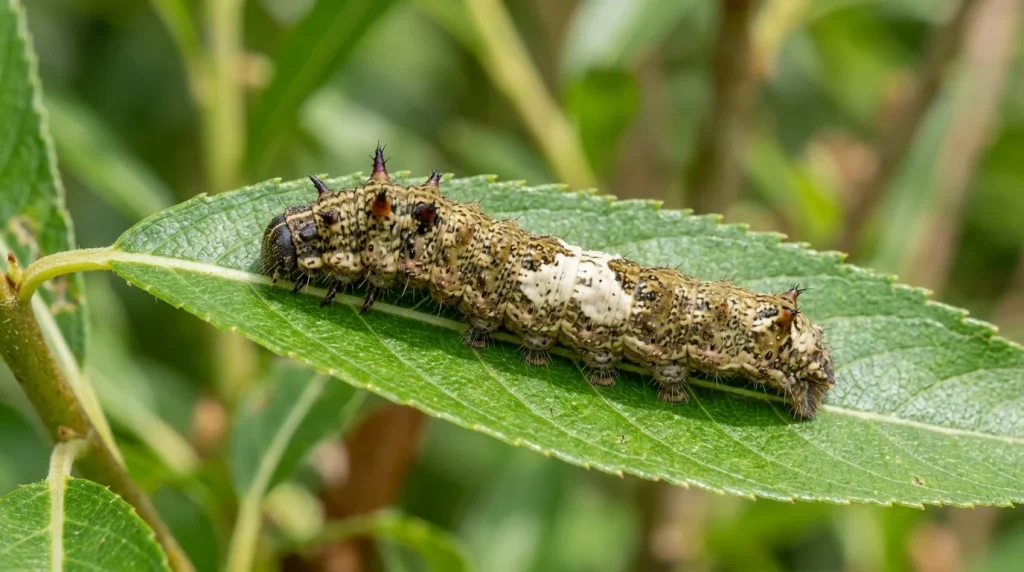
The mature Viceroy Butterfly caterpillar is mottled brown, olive, cream, and white. Its irregular outline and contrasting patches create a convincing bird-dropping disguise. A pair of branched, dark projections rises behind the head, while smaller bumps and a swollen thoracic region contribute to its rough appearance. The caterpillar lacks the long, flexible black filaments found on Monarch larvae.
Young Viceroy Butterfly larvae begin near the tip of a willow or poplar leaf. They may eat away the blade while leaving portions of the midrib, sometimes extending that midrib with bits of leaf and silk to form a narrow perch. This feeding sign can help reveal a larva that would otherwise be difficult to notice.
Eggs, Chrysalis, or Cocoon
Females generally place eggs singly near the tips or margins of host leaves. A newly laid egg is small, rounded, and pale green to yellow-green, with a textured surface. It darkens as the larva develops.
Like other butterflies, the Viceroy Butterfly forms a chrysalis rather than a cocoon. The chrysalis hangs head-down from a silk pad and is angular, mottled brown, cream, gray, and sometimes olive. A prominent hump and pale patches strengthen its resemblance to a damaged leaf or bird dropping. It is normally attached to vegetation near the host plant.
Life Cycle
The Viceroy Butterfly life cycle proceeds through egg, larva, chrysalis, and adult. After hatching, the caterpillar passes through several growth stages, or instars. It feeds primarily on willow-family foliage, incorporating defensive plant compounds that may make the larva and adult less palatable to some predators.
In colder parts of the range, a young caterpillar constructs a winter shelter called a hibernaculum. It trims and rolls part of a leaf, secures the shelter with silk, and attaches the leaf stem firmly to the twig. The caterpillar spends winter inside and resumes feeding when leaves emerge in spring.
The Viceroy Butterfly may produce one or two generations near the northern edge of their range and two or more in warmer regions. Timing varies with latitude, elevation, weather, and local host-plant growth.
Range and Distribution
The Viceroy Butterfly occurs across much of southern Canada and the contiguous United States, extending south into Mexico. It is widespread in eastern and central North America and more localized in parts of the West, where suitable riparian habitat can be separated by extensive dry or mountainous terrain.
Distribution of the Viceroy Butterfly should not be interpreted as uniform occupancy. Viceroys are concentrated where larval host trees and moist, sunny edge habitat occur. Regional observations compiled by the University of Michigan’s Animal Diversity Web provide further natural-history context.

Habitat
Typical habitat includes stream banks, river corridors, pond margins, wet meadows, marsh edges, open woodland, roadsides, and sunny forest openings. Willows are especially important around wetlands and waterways. Cottonwoods, aspens, and other poplars can support populations in both lowlands and upland openings.
Adults often patrol linear edges rather than remaining deep inside closed forest. A productive site usually combines host trees, sunny resting places, shelter from strong wind, and flowers or other adult food sources.
Adult food sources
The Viceroy Butterfly visits a range of flowers, including milkweeds, thistles, asters, goldenrods, dogbanes, Joe-Pye weeds, and other seasonally abundant nectar plants. Flower use varies across the range.
Viceroys may also obtain moisture and minerals from damp soil. At times they feed on tree sap, overripe fruit, dung, or carrion. These behaviors are normal for many brush-footed butterflies, though they are not observed equally often in every population.
When and Where to Look
Adults are generally active from late spring through summer, continuing into autumn in warmer areas. Southern populations may appear earlier and remain active longer. Look on warm, bright days along willow-lined streams, wetland borders, and flower-rich roadsides.
Watch for an orange butterfly making quick flights between shrubs, low branches, or exposed perches. Viceroys frequently rest with their wings spread, offering a clear view of the black hindwing line. Caterpillars are best sought on young willow or poplar leaves, especially where feeding has left an exposed midrib.
Is It Harmful?
The Viceroy Butterfly is not dangerous to people or pets. It does not sting, bite, damage buildings, or infest stored food. Caterpillars consume leaves, but ordinary populations rarely cause meaningful injury to established host trees. Pesticide treatment is neither necessary nor advisable for a few larvae on landscape willows or poplars.
Conservation and Ecological Importance
The Viceroy Butterfly species is commonly regarded as globally secure and is not federally listed as threatened or endangered in the United States. Nevertheless, local populations can decline when wetlands are drained, streamside vegetation is cleared, or insecticides eliminate larvae and nectar insects.
Viceroys serve as prey for birds and other wildlife while participating in a complex warning-color relationship with Monarchs, Queens, and related butterflies. Evidence indicates that Viceroys themselves can be distasteful, making the relationship closer to mutual protective resemblance than simple imitation by a harmless species.
How to Attract or Support It
- Retain locally native willows, cottonwoods, aspens, or other suitable willow-family trees where space and soil conditions permit.
- Plant native flowers that bloom from late spring through fall.
- Avoid broad-spectrum insecticides, including spraying plants while caterpillars are present.
- Preserve sunny, structurally varied vegetation beside ponds, streams, ditches, and wet meadows.
- Leave some fallen leaves and natural stems around host plants, while following appropriate garden and fire-safety practices.
Choose host plants suited to the region; some willows grow rapidly, spread by roots, or require consistently moist soil. A local native-plant organization or extension service can help identify manageable species.
Similar Species
Monarch: Usually larger and lacking the Viceroy’s black transverse line across the hindwing. Monarchs tend to glide more extensively. Male Monarchs also have a distinct black scent patch on a vein of each hindwing.
Queen: Typically darker chestnut-brown, with fewer heavy black veins on the upper wing. Some southern Viceroys are dark enough that the hindwing line and border pattern become especially important.
Red-spotted Purple: A close relative with black or blue-black wings and iridescent blue scaling rather than a Monarch-like orange pattern. Hybrids and intermediate-looking individuals can occur where related Limenitis forms meet, so unusual butterflies may not match a simple field-guide image.
Interesting Facts
- The common name refers to a viceroy, a rank below Monarch, reflecting thebutterfly’ss resemblance to the Monarch.
- A caterpillar secures its overwintering leaf shelter with silk so the leaf remains attached after autumn leaf fall.
- The chrysalis continues the bird-dropping disguise used by the larva.
- Geographic color variation may improve resemblance to different milkweed butterflies in different regions.
- The species is closely tied to waterside trees even though adults may wander well beyond wetlands.
Frequently Asked Questions
How can I tell a Viceroy Butterfly from a Monarch?
Look for the curved black line running across each Viceroy hindwing. Viceroys are also generally smaller and often use a quicker, less buoyant flight, but the hindwing line is the most useful single field mark.
Do Viceroy caterpillars eat milkweed?
No. Their principal hosts are willows, poplars, cottonwoods, and related members of the willow family. An orange adult nectaring on milkweed is not evidence that its caterpillars use that plant.
Where does the Viceroy spend winter?
Across colder portions of its range, it usually overwinters as a young caterpillar inside a rolled-leaf shelter attached to a host-tree twig. Winter behavior may differ in warm southern regions.
Are Viceroys poisonous?
“Poisonous” is too simple a description. Host-derived compounds can make Viceroys unpalatable to some predators, but defensive chemistry varies with larval food plants and other conditions. They pose no poisoning risk through ordinary human contact.
Can I handle a caterpillar or chrysalis?
Brief accidental contact is not considered harmful, but handling can injure the insect or break its silk attachment. Observing and photographing without touching is safer.