Varied Thrush Guide
Keep Track of What You See
Create a free Wild Things Guide membership to record this Varied Thrush in My Sightings and build your personal wildlife list.
Join to Add This SightingIntroduction
The Varied Thrush (Ixoreus naevius) is a striking songbird of western North America’s cool, shaded forests. Its bold breast band, orange markings, and haunting, sustained whistles make it distinctive, although it often remains concealed beneath dense conifers. At roughly the size of an American Robin, this Thrush spends much of its time on or near the ground, where it searches through leaf litter for insects and other small invertebrates.
Varied Thrushes breed mainly from Alaska through western Canada into the Pacific Northwest. In fall and winter, many move south or to lower elevations. A few wander far beyond their usual range, producing much-discussed sightings across central and eastern North America.

Quick Identification
- Overall shape: A sturdy, robin-sized thrush with a rounded head, straight bill, and fairly long legs.
- Male: Dark blue-gray above with vivid orange eyebrows, throat, underparts, and wing markings; a broad black band crosses the breast.
- Female: Similar pattern but softer and browner, with a gray-brown breast band and muted orange underparts.
- Behavior: Walks or hops on the forest floor, frequently tossing leaves aside while feeding.
- Voice: Long, eerie, single-pitched whistles separated by noticeable pauses.
- Best clue: The dark breast band over orange underparts is unlike the pattern of any other regularly occurring North American thrush.
Appearance
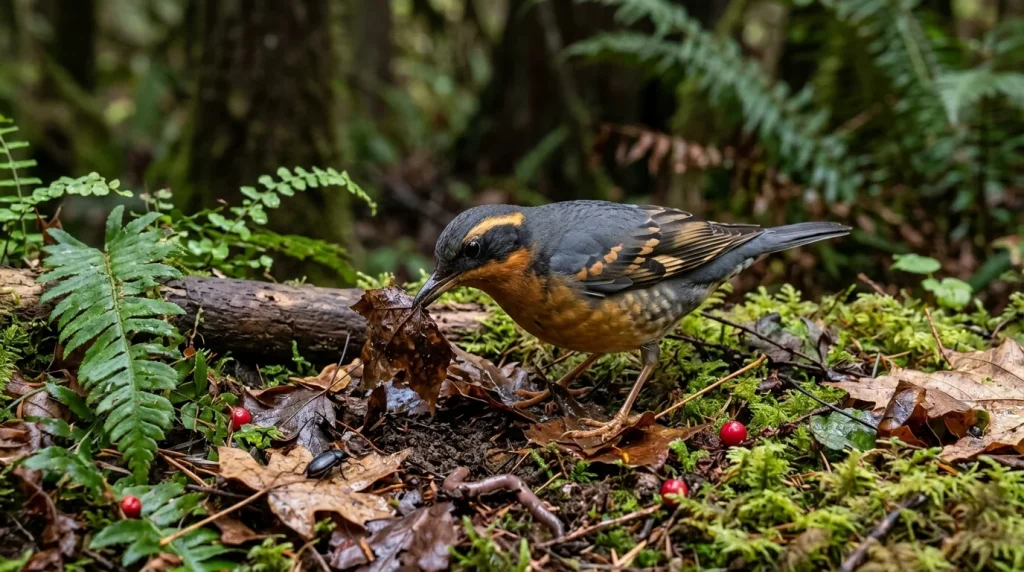
Adult male Varied Thrushes have dark slate-blue to bluish-gray crowns, backs, and tails. A black band crosses the orange breast, while additional dark markings frame the face. The bright orange eyebrow is especially noticeable, extending behind the eye against the darker head. Orange wing bars and scaling contrast with otherwise dark wings.
Females show the same basic pattern but usually appear gray-brown rather than blue-gray. Their facial pattern and breast band are less sharply black, and the orange areas may look buffy or subdued. Individual females vary, and some can be fairly colorful.
Juveniles are browner and more heavily spotted or scaled than adults. Their markings provide camouflage before they develop a more recognizable adult-like pattern. In every plumage, the bird’s compact thrush shape, patterned wings, and suggestion of a breast band are useful clues.

Size and Wingspan
Varied Thrushes measure approximately 7.5–10.2 inches (19–26 centimeters) in length, with a typical wingspan of about 13.4–15 inches (34–38 centimeters). Size overlaps substantially with the American Robin, so proportions and plumage are more useful than size alone.
The Varied Thrush often appears compact and deep-bodied. Its relatively short tail and rounded posture can make it look slightly more stocky than some other woodland thrushes.
Range and Distribution
The core breeding range follows the Pacific side of North America, extending from Alaska and western Canada south through Washington and Oregon into northern California. Breeding distribution is closely associated with cool coniferous and mixed forests, including coastal rainforests and mountain forests.
Seasonal movement varies by region. Northern and high-elevation breeders generally move southward or downslope for winter, while some coastal populations make shorter movements. Wintering birds occur through the Pacific Northwest and California, with smaller numbers reaching the interior West and northern Mexico.
Varied Thrushes occasionally appear far east of their expected range. These wanderers may turn up at wooded parks, fruiting trees, or feeding stations, but their occurrence is irregular and should not be treated as predictable.

Habitat
During the breeding season, Varied Thrushes favor moist, mature coniferous or mixed forest. Typical settings include stands of spruce, hemlock, fir, cedar, or redwood with a shaded understory, fallen logs, moss, and abundant leaf litter. They can also use younger forest when suitable cover and nesting structure are present.
In winter, habitat use broadens. Birds may occur in forest edges, streamside woods, parks, gardens, orchards, and shrubby areas, especially where fallen fruit, berries, or leaf litter provide food. Dense cover usually remains nearby.

Behavior
Varied Thrushes are often quiet and secretive. They spend long periods feeding on the ground beneath trees, alternating between short hops and deliberate pauses. A bird may use its bill to flip leaves or probe damp soil, then freeze upright when disturbed.
Breeding males sing from elevated conifer branches, sometimes choosing a perch near the top of a tall tree. Outside the breeding season, Varied Thrushes are usually solitary or found in loose groups near concentrated food. They may defend productive feeding areas from other Varied Thrushes and similarly sized birds.
Flight is direct and moderately swift, with regular wingbeats. When flushed from the ground, a bird commonly rises into dense branches rather than remaining in the open.
Diet
The diet changes with season and food availability. During spring and summer, Varied Thrushes eat many insects and other small invertebrates, including beetles, caterpillars, ants, spiders, millipedes, snails, and earthworms. Much of this prey is taken from the forest floor.
In fall and winter, berries and fruit become increasingly important. Birds may feed on wild berries, fallen apples, and other soft fruits. They also take seeds and acorns. At feeding stations, some individuals eat scattered seed or suet crumbs, although they are more naturally attracted to ground-level food and nearby cover.
Vocalizations
The male’s song is one of the characteristic sounds of northwestern forests. Each phrase is generally a single, sustained, slightly buzzy whistle, followed by several seconds of silence. Successive whistles may be delivered at different pitches. The spacious rhythm can make the singer seem farther away than it is.
Calls include short, low notes and harsher alarm sounds. Because the species often sings from a concealed perch, learning the isolated, resonant whistle is one of the most effective ways to detect it. Recordings and additional identification details are available from the Cornell Lab of Ornithology’s Varied Thrush guide.
Breeding and Nesting
Breeding begins after birds return to northern or higher-elevation forests. Males advertise territories by singing, while females undertake most or all nest construction. The nest is usually placed on a horizontal conifer branch, against a trunk, or among dense branching. Height varies considerably.
The female builds a sturdy open cup from twigs, bark, grass, moss, and other plant fibers. Mud or decayed wood may help form the inner structure, which is lined with finer materials. A typical clutch contains about three or four pale blue eggs, often marked with small brownish spots.
The female incubates the eggs for roughly two weeks. Both parents are believed to help feed nestlings. Placing the nest beneath foliage helps conceal the eggs and young from predators and severe weather.

Young and Development
Hatchlings are helpless and depend on adults for warmth and food. Parents deliver insects and other protein-rich invertebrates during the rapid nestling period. Young generally leave the nest around two weeks after hatching, although timing varies.
Recently fledged birds remain in sheltered vegetation while developing stronger flight skills. Their brown, spotted plumage differs from adults’ clean breast pattern and helps them blend into the forest understory.
Where to See
For breeding birds, visit moist conifer forests in Alaska, coastal British Columbia, the Pacific Northwest, or appropriate mountain ranges. Listen at dawn and in the early morning for widely spaced whistles coming from tall trees. Trails beside shaded ravines, streams, and mossy forest floors can be productive.
In winter, search quieter wooded parks, forest edges, berry patches, and areas with fallen fruit from southern British Columbia through California. Scan the ground beneath dense shrubs rather than concentrating only on exposed branches. After storms or cold spells, birds may move into more visible feeding areas.
Similar Species
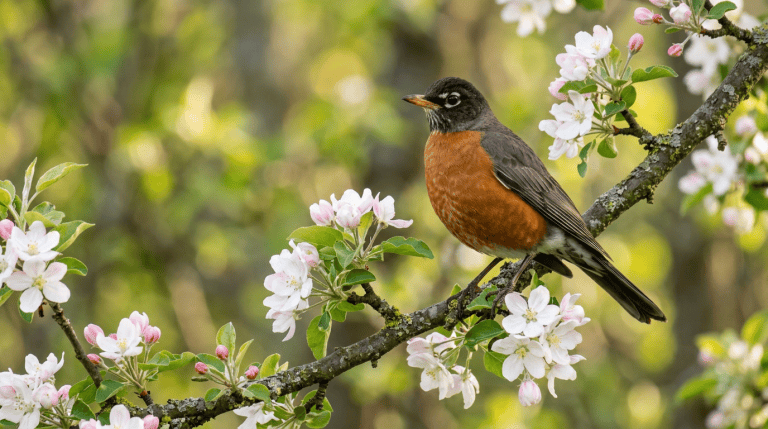
- American Robin: Similar in size and general orange-breasted appearance, but it lacks the Varied Thrush’s complete dark breast band, orange eyebrow, and strongly patterned wings. Robins also tend to use lawns and open ground more readily.
- Spotted Towhee: A male towhee has a dark hood, orange sides, white belly, and white-spotted wings. It lacks an orange eyebrow and has a thick, seed-eating bill rather than a thrush’s straighter, slimmer bill.
- Hermit Thrush: Smaller and browner, with a spotted breast, pale eye ring, and contrasting reddish tail. It does not show a solid breast band or orange wing markings.
- Redwing: This Eurasian Thrush is a rare North American visitor. It has a pale eyebrow, rusty flanks, and streaked underparts but no broad breast band.
- Juvenile American Robin: A young robin can be spotted and mottled, but it lacks the Varied Thrush’s orange wing pattern and developing transverse breast band.
Conservation
The Varied Thrush is commonly classified as Least Concern globally by the International Union for Conservation of Nature. However, broad-scale survey data have indicated long-term declines, and abundance can vary noticeably between years.
Loss or alteration of mature, moist forest may reduce breeding habitat, while collisions with windows and other structures pose risks during migration and winter. Maintaining structurally diverse forests, protecting streamside cover, retaining leaf litter, and making windows more visible to birds can help reduce local pressures.
Field Identification Tips
- Start with the breast: Look for a dark horizontal band crossing orange underparts.
- Check the face: Both sexes show a warm orange or buff eyebrow contrasting with a darker head.
- Study the wings: Orange bars or scaling on dark wings support the identification.
- Consider the setting: A robin-sized bird walking through a shaded conifer forest is a stronger candidate than one standing on an open lawn.
- Listen between notes: The long pauses in the song are as useful as the high, sustained whistles.
- Allow for females and juveniles: Not every Varied Thrush is brightly colored; pattern is often more dependable than intensity.
Frequently Asked Questions
Is a Varied Thrush a type of robin?
No. Varied Thrushes and American Robins both belong to the thrush family, Turdidae, but they are separate species in different genera. Their similar size and orange underparts can be confusing.
Why is it called a Varied Thrush?
The name refers to its varied, strongly contrasting plumage. Orange, gray, black, and patterned wing areas produce a more complex appearance than that of many other North American thrushes.
Do Varied Thrushes visit bird feeders?
They occasionally visit feeding areas, particularly in winter. Ground-scattered seed, small suet pieces, fruit, and access to undisturbed leaf litter may attract them, but visits are often irregular.
Are Varied Thrushes rare?
They can be locally common within suitable western forests, yet their secretive habits make them easy to overlook. East of their usual range, they are uncommon to rare wanderers.
How can I identify a female Varied Thrush?
Look for a robin-sized, gray-brown thrush with muted orange underparts, an orange-buff eyebrow, patterned wings, and a dusky band across the breast. The female’s markings are softer than the male’s but follow the same arrangement.