Bicknell’s Thrush Guide
Keep Track of What You See
Create a free Wild Things Guide membership to record this Bicknell’s Thrush in My Sightings and build your personal wildlife list.
Join to Add This SightingIntroduction
Bicknell’s Thrush (Catharus bicknelli) is a secretive songbird associated with cool, wet forests in northeastern North America. During the breeding season, it is best known from dense, wind-shaped conifers on mountains and from certain coastal forests in eastern Canada. It winters mainly in the Greater Antilles, especially on Hispaniola.
This Thrush was long treated as a form of Gray-cheeked Thrush, and the two remain extremely difficult to separate by appearance alone. Habitat, location, season, measurements, and voice are often more useful than any single plumage mark. A detailed species account is available from the Cornell Lab of Ornithology.
Quick Identification
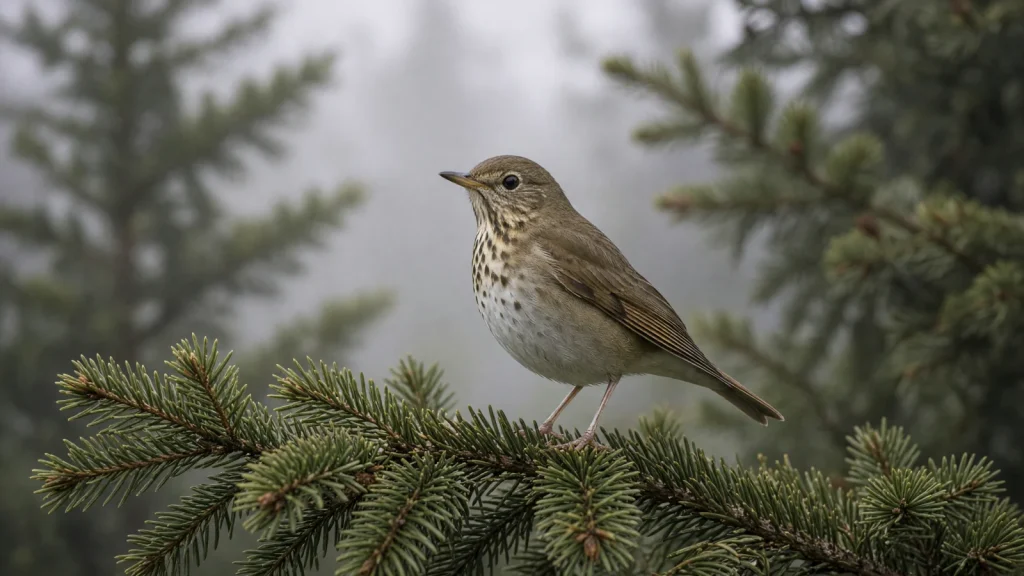
- Overall shape: Small, compact woodland thrush with a relatively short tail, thin bill, and upright stance.
- Upperparts: Plain olive-brown to warm brown, often with a slightly reddish cast on the tail and wings.
- Face: Grayish, with a narrow pale eye ring and subtle buffy lores.
- Underparts: Whitish throat and belly, buff-washed breast and flanks, and dark spots across the upper breast.
- Best clues: Breeding habitat, geographic location, compact structure, warm tones, and vocalizations.
- Major confusion species: Gray-cheeked Thrush, Swainson’s Thrush, Hermit Thrush, and Veery.
Appearance
Bicknell’s Thrush has the understated plumage typical of the genus Catharus. Its crown, back, and scapulars are olive-brown, while the wings and tail can appear warmer or more reddish-brown. Color varies with lighting, feather wear, and individual birds, so warmth alone is not diagnostic.
The face is subdued rather than strongly patterned. A thin, incomplete pale eye ring may be visible, but it does not form the broad buff spectacles typical of Swainson’s Thrush. The cheeks are gray-brown, and the area between the eye and bill may show a faint buff wash. The bill is slender and mostly dark, commonly with pale yellow or pinkish color at the base of the lower mandible. Legs are pale flesh-colored to pinkish.
The throat and central belly are whitish. Buffy shading crosses the breast and extends along the flanks, with dark brown spots concentrated on the throat, upper breast, and sides. The spots often become smaller and less distinct toward the belly.
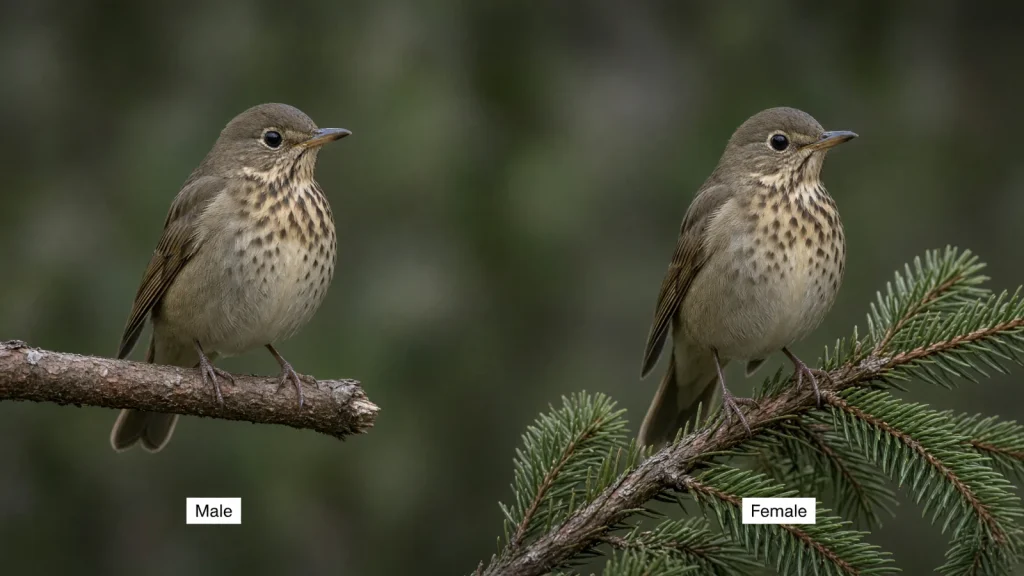
Adult males and females are alike in plumage. Juveniles are more patterned, with buffy spots or shaft streaks on the upperparts and heavier spotting below. Fresh juveniles should not be identified solely by the adult field marks described above.
Size and Wingspan
Bicknell’s Thrush is a small to medium-sized Thrush, generally more compact than an American Robin and close in size to other migratory Catharus thrushes.
- Length: Approximately 16–18 cm (6.3–7.1 in)
- Wingspan: Approximately 25–27 cm (9.8–10.6 in)
- Weight: Commonly around 25–30 g (0.9–1.1 oz)
Its relatively short primary projection, short tail, and compact body may help experienced observers distinguish it from Gray-cheeked Thrush. These differences are subtle and difficult to judge without direct comparison, photographs, or measurements.
Range and Distribution
The breeding distribution is small and fragmented. In the United States, Bicknell’s Thrush occurs primarily in high-elevation forests of New York, Vermont, New Hampshire, and Maine. Important areas include the Adirondacks, Catskills, Green Mountains, White Mountains, and higher terrain in Maine.
In Canada, breeding populations occur in southeastern Quebec, New Brunswick, Nova Scotia, and nearby islands or coastal regions where cool, conifer-dominated forest provides suitable conditions. Unlike the largely montane U.S. population, some Canadian birds breed near sea level in cool maritime settings.
Migration is mostly nocturnal and can bring birds through the northeastern United States and along the Atlantic seaboard. The winter range centers on the Greater Antilles, particularly the forests of Hispaniola, with smaller numbers reported from Cuba, Jamaica, Puerto Rico, and adjacent islands. A silent migrant away from known breeding or winter habitat may be impossible to separate confidently from Gray-cheeked Thrush.

Habitat
On northern mountains, Bicknell’s Thrush favors dense, low, often stunted conifer forest near the upper limits of tree growth. Balsam fir and red spruce are characteristic plants. The birds frequently occupy areas shaped by wind, ice, heavy snow, insect damage, or past disturbance, especially where vigorous young conifers create tangled cover.
In maritime Canada, suitable habitat can include cool coastal spruce-fir forest, regenerating conifer stands, and dense forest on islands or exposed headlands. During migration, the species uses a broader range of wooded habitats and thickets. Winter habitat includes humid broadleaf forest and montane woodland, often where a dense understory remains intact.

Behavior
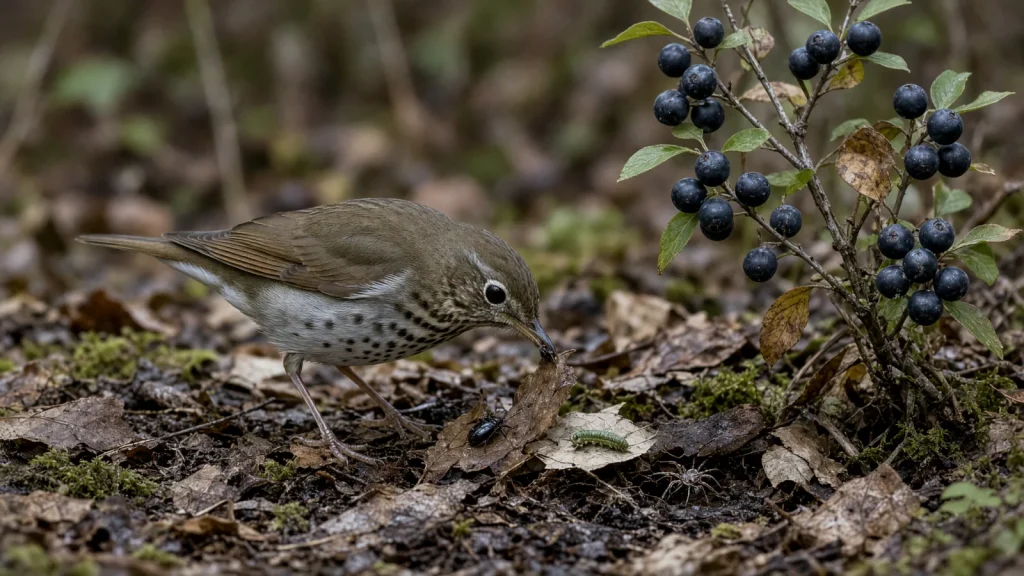
Bicknell’s Thrush spends much of its time on or near the forest floor. It walks or hops through leaf litter, pauses with an alert posture, and makes short flights into low branches. Birds often remain hidden within dense foliage, particularly after sunrise.
Breeding birds may be most active and vocal around dawn and dusk. A singing male sometimes moves to an exposed spruce or fir top, but many songs come from within cover. Outside the breeding season, individuals are generally inconspicuous and may defend small feeding areas.
The species has an unusual and flexible mating system. Females may mate with more than one male, and several males may feed nestlings at the same nest. Relationships vary, however, and not every nesting group has the same structure.
Diet
Bicknell’s Thrush eats insects and other small invertebrates, supplemented by fruit. During the breeding season, prey may include beetles, ants, caterpillars, flies, spiders, and other arthropods found on foliage or in forest litter. The bird often searches by turning leaves, inspecting moss, or making short sallies after visible prey.
Wild fruit becomes important in late summer, during migration, and on the wintering grounds. The species consumes berries and other small fruits from native shrubs and forest plants. The proportions of animal and plant food vary with season and local availability.
Vocalizations
The song is among the most useful identification clues on the breeding grounds. It is a thin, rising or spiraling series of flutelike notes, often ending in a higher, wiry flourish. Individual songs vary, and written imitations do not fully represent their tone.
The gray-cheeked Thrush can sound similar, but its song often seems lower, more even, or less sharply rising. Because both species vary, observers should learn several recordings rather than rely on a single mnemonic. Bicknell’s Thrush also gives a nasal, slightly buzzy call and soft chuck or cluck notes. Distant calls can be confused with those of other thrushes.
Breeding and Nesting
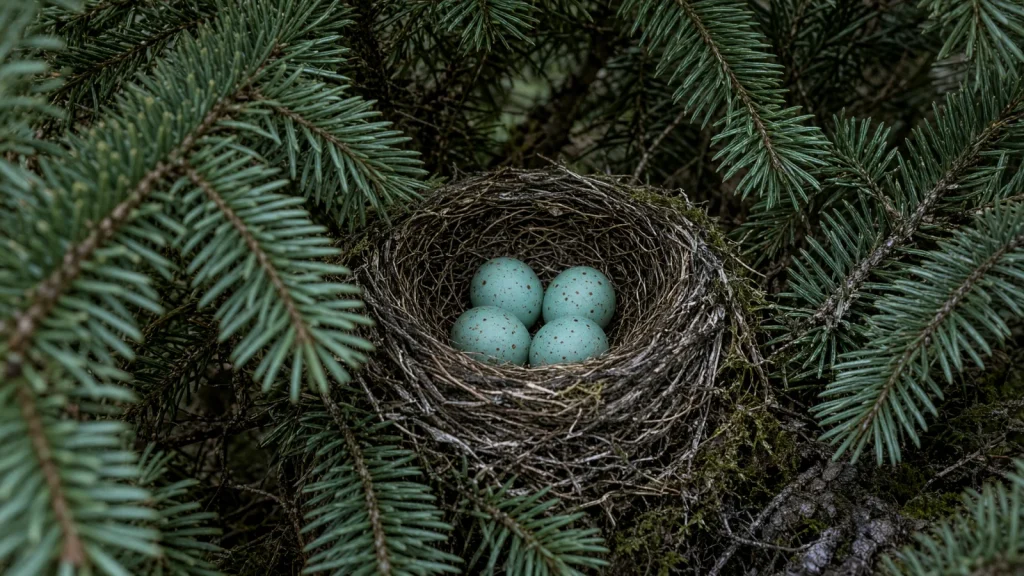
Breeding begins relatively late because snow and cold persist in much of the species’ mountain habitat. The nest is usually placed low in a dense spruce or fir, against a trunk, or within intertwined branches. It is a bulky open cup constructed from twigs, bark strips, grasses, moss, and other plant material, with a finer inner lining.
A typical clutch contains three or four eggs, although smaller clutches occur. Eggs are generally blue-green and marked with brown or reddish-brown spots. The female incubates the eggs for roughly two weeks. Males may provide food during the nesting cycle and commonly help feed the young after hatching.
Mountain weather can expose nests to cold rain, strong winds, and sudden temperature changes. Red squirrels, jays, small mammals, and other predators may take eggs or nestlings. The concealment provided by dense conifers is therefore important.
Young and Development
Nestlings hatch helpless, with limited down and closed eyes. They require brooding and frequent deliveries of insects and other invertebrates. In nests attended by multiple males, several adults may share feeding visits.
Young usually leave the nest at roughly 10–13 days of age, before they can fly strongly. Fledglings remain in dense vegetation and continue to receive food from adults while their flight skills and independence develop. Their spotted juvenile plumage provides camouflage among branches, moss, and dappled forest light.
Where to See
In the United States, accessible opportunities occur in the Adirondacks of New York, the Green Mountains of Vermont, the White Mountains of New Hampshire, and high-elevation forests in Maine. In Canada, birders may encounter the species in suitable parts of Quebec and the Maritime provinces.
Search responsibly from established roads, boardwalks, and hiking trails passing through dense spruce-fir forest. Late May through July is generally the most useful period for detecting singing birds. Arrive near dawn, stop frequently, and listen from forest edges or openings. Fog, wind, running water, and insects can make the quiet song difficult to hear.
Avoid entering dense nesting habitat or repeatedly using playback. Mountain vegetation grows slowly and is easily damaged, while prolonged playback can distract adults during a short breeding season.
Similar Species
- Gray-cheeked Thrush: The hardest species to eliminate. It is often slightly larger, longer-winged, longer-tailed, and a colder gray-brown, but overlap is substantial. Voice, breeding range, measurements, and multiple photographs may be needed.
- Swainson’s Thrush: Usually shows a broader buff eye ring connected to buff lores, producing a spectacled face. It often has a buffier breast and a more olive-toned back.
- Hermit Thrush: Typically has a distinctly reddish tail contrasting with a browner back. It often raises and slowly lowers its tail after landing.
- Veery: Warmer reddish-brown overall, especially on the back, with fewer and weaker breast spots. Its descending, spiraling song is distinctive.
- Wood Thrush: Much larger and more boldly marked, with a bright rusty head and large black spots extending across white underparts.
Conservation
Bicknell’s Thrush is commonly classified as Vulnerable on the IUCN Red List. Its restricted breeding and wintering ranges make it sensitive to habitat loss and environmental change. Forest clearing and degradation on Hispaniola are especially serious concerns because much of the global population winters there.
On the breeding grounds, climate change may reduce cool, high-elevation spruce-fir habitat by allowing warmer-zone vegetation and competitors to move upslope. Severe weather, atmospheric pollution, development, recreational pressure, and changes in forest management may create additional local effects.
Conservation depends on protecting habitat throughout the annual cycle. Priorities include retaining montane and maritime conifer forest, conserving humid Caribbean forest, monitoring populations, and limiting avoidable disturbance around breeding sites.
Field Identification Tips
- Begin with range and date. Determine whether Bicknell’s Thrush is expected at that location and season.
- Evaluate habitat. Dense, high-elevation spruce-fir forest in the Northeast strongly supports identification during summer.
- Listen before looking. A well-heard song is often more informative than a brief view.
- Check the face. Look for a narrow eye ring rather than Swainson’s Thrush’s broad buff spectacles.
- Assess structure cautiously. A compact body and relatively short tail may support the identification but are not decisive on their own.
- Document difficult birds. Record vocalizations and obtain views of the face, wing, tail, and underparts when possible.
- Accept uncertainty. A silent migrant resembling Gray-cheeked Thrush may be best recorded as “Bicknell’s/Gray-cheeked Thrush.”
Frequently Asked Questions
Is Bicknell’s Thrush the same as Gray-cheeked Thrush?
No. They are recognized as separate species, but they are close relatives and remain very similar in plumage. Their breeding distributions, average structure, genetics, and vocalizations differ.
Can males and females be distinguished in the field?
Usually not. Adult males and females have essentially similar plumage. Nest behavior may suggest sex, but appearance alone is generally insufficient.
Why is Bicknell’s Thrush difficult to find?
It has a limited range, occupies dense forest, often sings in dim light, and spends much of its time near the ground. Many breeding locations also require travel into mountainous terrain.
What is the best way to identify one?
Combine a clearly heard song with appropriate breeding habitat, range, season, and supportive plumage or structural features. Avoid basing the identification on color alone.
Does Bicknell’s Thrush visit feeders?
It is not a regular feeder bird. Native fruiting shrubs and healthy, insect-rich forest habitat are more relevant to its natural feeding needs.