Townsend’s Solitaire Guide
Keep Track of What You See
Create a free Wild Things Guide membership to record this Townsend’s Solitaire in My Sightings and build your personal wildlife list.
Join to Add This SightingIntroduction
Townsend’s Solitaire (Myadestes townsendi) is a slender, long-tailed songbird of western North America. Its plain gray plumage can make it seem inconspicuous, but a close look reveals a buff-colored wing patch, a pale eye ring, and white flashes along the outer tail. Its clear, far-carrying song is among the characteristic sounds of mountain conifer forests.
This species belongs to the thrush family, Turdidae, although its upright posture and habit of catching insects from exposed perches can suggest a flycatcher. In winter, Townsend’s Solitaires often move to lower elevations and establish feeding territories around fruiting junipers. The Cornell Lab of Ornithology’s Townsend’s Solitaire account provides additional recordings, photographs, and distribution information.

Quick Identification
- Overall color: Mostly cool gray, sometimes slightly browner on the wings.
- Shape: Slender body, small rounded head, short straight bill, and relatively long tail.
- Face: Complete or nearly complete pale eye ring.
- Wings: Distinct buff or rusty-buff patch across the flight feathers, often visible as a narrow panel on the folded wing.
- Tail: White outer tail feathers that flash conspicuously in flight.
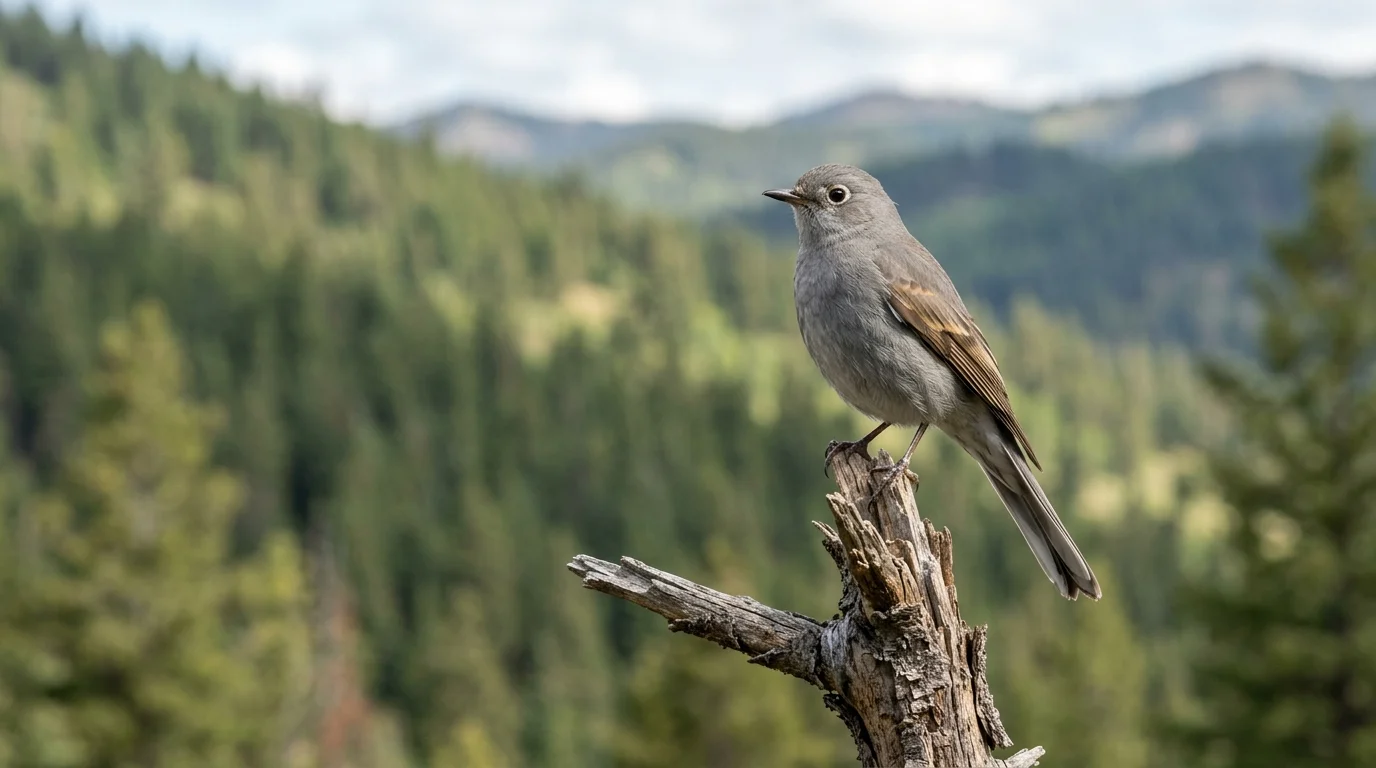
- Posture: Frequently sits upright on an exposed treetop, snag, fence post, or rocky perch.
- Voice: Long, complex song of clear whistles and softly warbled phrases.
Appearance
Adult Townsend’s Solitaires are largely uniform gray, with somewhat darker wings and a paler belly. The pale eye ring stands out on the otherwise unpatterned face. A buffy patch at the base of the flight feathers is one of the best field marks, although it may be partly hidden when the wing is folded. In flight, contrasting white outer tail feathers become much easier to see.
The bill is short, thin, and dark, fitting a diet that combines insects with small fruits. The legs are also dark. Males and females look very similar and generally cannot be separated reliably in the field by plumage alone.
Juveniles are more patterned than adults. Their upperparts show pale spotting or streaking, while the underparts have a scaled or mottled appearance. Young birds gradually acquire the plain gray adult plumage during their first year.

Size and Wingspan
Townsend’s Solitaire is a medium-sized thrush with a narrow profile:
- Length: Approximately 7.9–9.5 inches (20–24 centimeters).
- Wingspan: Approximately 13.0–14.6 inches (33–37 centimeters).
It is longer and more slender than many bluebirds but less bulky than an American Robin. Its long tail contributes noticeably to its total length. Size can be difficult to judge on an isolated mountaintop perch, so proportions, wing pattern, and tail flashes are usually more useful than apparent body size.
Range and Distribution
Townsend’s Solitaire is primarily a bird of western North America. Its range extends from Alaska and western Canada south through the Rocky Mountains, Cascades, Sierra Nevada, Great Basin ranges, and other western mountain systems into Mexico.
Breeding birds are closely associated with mountainous terrain. During fall and winter, many move downslope or travel beyond their breeding areas in search of dependable berry crops. Wintering solitaires may appear in open juniper country, foothills, wooded canyons, ranchlands, and occasionally suburban areas with fruiting ornamental trees.
Some individuals wander well east of the usual range, especially when western berry crops are poor. Such records are irregular, so a gray bird with white outer tail feathers at an eastern juniper stand deserves careful study.

Habitat
During the breeding season, Townsend’s Solitaires favor open montane conifer forest and forest edges, particularly landscapes containing rocky slopes, cliffs, road cuts, stream banks, or exposed root systems. They use pine, fir, spruce, Douglas-fir, and mixed conifer habitats, depending on region and elevation.
The surrounding forest is often relatively open rather than densely closed. Exposed perches provide singing stations and places from which birds can watch for flying insects. Rocky crevices and sheltered banks offer nesting sites.
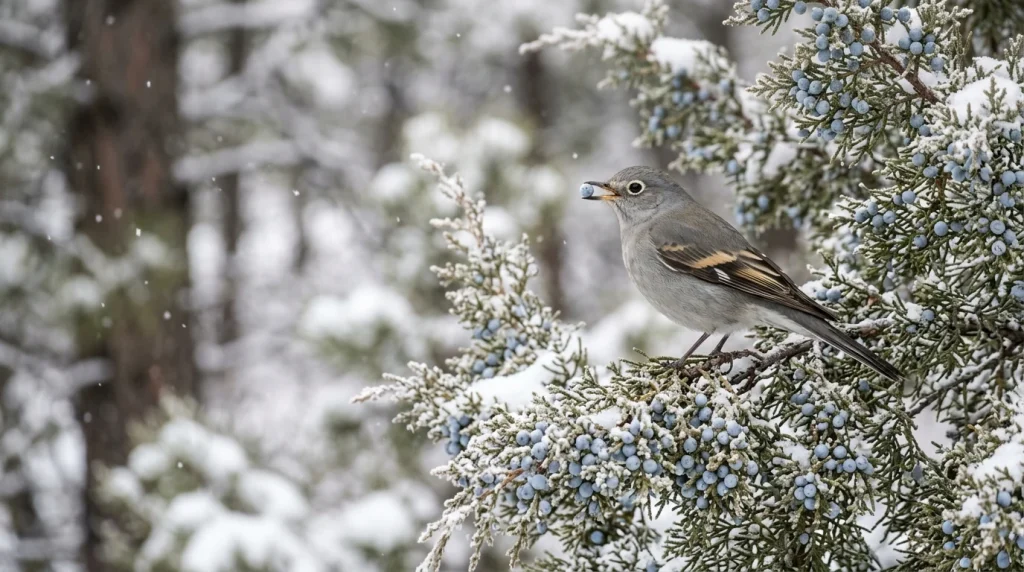
Winter habitat is frequently drier and more open. Juniper woodlands are especially important because their berry-like cones provide a concentrated and persistent food source. A single fruiting tree can support a territorial bird for an extended period.

Behavior
Townsend’s Solitaires are usually encountered alone or in pairs rather than in flocks. They perch conspicuously, often near the top of a dead tree or conifer, holding the body upright and making short flights to another lookout.
During the warmer months, a bird may fly from its perch to capture an insect in the air, then return to the same or a nearby branch. It also drops to the ground or low vegetation to collect prey. Flight is direct and can look somewhat thrush-like, with rapid wingbeats interrupted by brief glides.
Winter behavior is strongly influenced by fruit. A solitaire may defend a productive juniper against robins, bluebirds, waxwings, and other berry-eating birds. Territorial chases, calling, and singing can therefore occur outside the nesting season. This attachment to a particular fruiting tree is a valuable clue for locating the species.
Diet
The diet changes with season and local availability:
- Spring and summer: Flying and ground-dwelling insects, spiders, and other small invertebrates.
- Fall and winter: Juniper fruits, which are often the principal food in colder months.
- Other plant foods: Berries and small fruits from trees and shrubs, including locally available native or ornamental species.
Insect prey is captured by aerial sallies, short ground forays, and gleaning from vegetation. In winter, watch for a bird swallowing juniper fruits whole, then returning repeatedly to the same tree or perch.
Vocalizations
The song is a long, flowing sequence of whistles, warbles, and short trills. Individual phrases may sound slightly disconnected, as though the bird is improvising a series of clear musical notes. The song carries well across open mountain forest and is often delivered from the top of a tall conifer or snag.
Calls include soft, single whistled notes and sharper squeaks or chattering sounds during agitation. Because singing can continue during winter territorial defense, its voice is useful for finding this species in juniper country and on its breeding grounds.
When learning the song, listen for its unhurried delivery and varied phrases. It is generally less repetitive than the song of a bluebird and lacks the strongly patterned phrases of many common woodland songbirds.
Breeding and Nesting
Breeding begins in spring or early summer, with timing influenced by latitude, elevation, and snow conditions. The male sings from prominent perches and helps defend the surrounding territory.
The nest is usually placed low in a protected recess rather than high in a tree. Typical locations include a niche in a rock face, an eroded bank, a road cut, a hollow beneath exposed roots, or a sheltered ledge. Human structures may occasionally provide similar cavities.
The female constructs an open cup using grasses, rootlets, bark strips, moss, and other plant material, with a finer lining inside. A clutch generally contains several pale eggs marked with brown or reddish-brown spotting. The female incubates, while both parents feed the nestlings. Nest placement and clutch details vary, and nests should never be approached closely enough to disturb the adults.

Young and Development
Newly hatched young are helpless and dependent on their parents for warmth and food. Adults bring insects and other invertebrates, which provide the protein required for rapid growth. As their feathers develop, nestlings acquire the spotted, mottled plumage typical of juvenile thrushes.
After leaving the nest, young birds may remain nearby while their flight skills improve. Parents continue feeding them during this period. Their spotted plumage can be confused with juvenile bluebirds or other thrushes, but the slender shape, developing buff wing patch, and white outer tail feathers help indicate Townsend’s Solitaire.
After leaving the nest, fledglings often stay close as they hone their flying skills. During this time, their parents still provide food. While their spotted feathers might resemble those of young bluebirds or other thrush species, the slim build, emerging buff wing patch, and white outer tail feathers are distinctive features of Townsend’s Solitaire.
Where to See
In spring and summer, search open conifer forests in western mountain ranges. Roads through national forests, trailheads near rocky slopes, burned areas with standing snags, and forest edges overlooking valleys can all provide useful access. Stop periodically and listen for song before trying to locate a bird on the highest available perch.
In fall and winter, concentrate on juniper woodlands and berry-rich foothills. Productive viewing locations include:
- Open stands of mature juniper.
- Rocky canyons with scattered conifers.
- Foothill roads bordered by fruiting shrubs.
- Cemeteries, parks, or neighborhoods with junipers and other berry-producing trees.
A quiet wait near a heavily fruiting tree may be more effective than covering a large area. Listen for single whistles, watch exposed treetops, and check any gray bird that repeatedly chases other fruit eaters.
Similar Species
- Mountain Bluebird: Females can be grayish, but they usually show blue in the wings or tail and lack the Solitaire’s buff wing panel and bold white outer tail feathers.
- Western Bluebird: Female Western Bluebirds have warmer brown-gray plumage, blue in the wings and tail, and a more compact shape.
- Northern Mockingbird: Also gray with white wing and tail markings, but it has a longer bill, broader white wing patches, a flatter-headed profile, and more animated tail and wing movements.
- Gray Catbird: Darker overall, with a black cap and rusty undertail coverts. It typically occupies dense shrubs rather than exposed mountain perches.
- Sage Thrasher: Similar in size and gray-brown color, but heavily streaked below, with a longer, slightly curved bill and no buff wing panel.
- Hermit Thrush: Usually has a spotted breast and a contrasting rusty tail. It spends more time on or near the forest floor.
Conservation
Townsend’s Solitaire is commonly classified as Least Concern. It remains broadly distributed across western mountain landscapes, although abundance varies with forest condition, drought, wildfire patterns, winter food supplies, and local development.
Protection of open montane forest, rocky nesting features, and mature juniper woodland benefits the species. Removing fruiting junipers over extensive areas may reduce winter food availability, while disturbance around cliffs, banks, or road cuts can affect nesting birds. Long-term changes in temperature, snowpack, insects, and berry production may also alter seasonal movements and habitat use.
Field Identification Tips
- Start with shape: Look for a slim gray bird with a small head and long tail sitting upright on an exposed perch.
- Check the eye: A distinct pale eye ring is often visible at moderate range.
- Study the folded wing: Search for the narrow buffy patch across the flight feathers.
- Wait for flight: White outer tail feathers can confirm an otherwise difficult identification.
- Use habitat and season: Mountain conifers in summer and fruiting junipers in winter are strong contextual clues.
- Listen before scanning: The extended, flutelike song often reveals a bird perched above eye level.
- Do not rely on gray color alone: Compare wing pattern, tail pattern, posture, bill shape, and behavior.
Frequently Asked Questions
Why is it called a solitaire?
The name refers to the bird’s tendency to occur alone and defend individual feeding territories, especially during winter. It is also related to other solitaire species in the thrush family.
Do male and female Townsend’s Solitaires look different?
No consistent plumage difference is readily visible in the field. Both sexes are mostly gray with a pale eye ring, buff wing patch, and white outer tail feathers.
Does Townsend’s Solitaire migrate?
Some populations and individuals make substantial seasonal movements, while others shift mainly in elevation. Winter distribution is strongly affected by the availability of juniper fruits and other berries.
Why does a solitaire chase birds away from a juniper?
A fruiting juniper can provide food for much of the winter. Solitaires commonly defend these trees against other fruit-eating birds, helping preserve the crop for their own use.
Is Townsend’s Solitaire a bluebird?
No. It is a member of the thrush family and is related to bluebirds, robins, and spotted woodland thrushes, but it belongs to a separate genus. Its nearly uniform gray plumage and buff wing patch distinguish it from North American bluebirds.