
Swainson’s Hawk Guide
Keep Track of What You See
Create a free Wild Things Guide membership to record this Swainson’s Hawk in My Sightings and build your personal wildlife list.
Join to Add This SightingIntroduction
Swainson’s Hawk (Buteo swainsoni) is a long-winged raptor of North America’s grasslands, ranch country, and open agricultural landscapes. Often seen circling above the plains or watching a field from a fence post, it combines the build of a soaring hawk with unusually long, pointed-looking wings. Most populations undertake a remarkable migration to South America. Identification is easiest when you combine wing shape, underwing pattern, habitat, and season rather than relying on plumage color alone.

Quick Identification
- Shape: Slender for a large Buteo, with long wings, relatively narrow wingtips, and a moderately long tail.
- Light adult: Pale belly, dark brown breast bib, and usually a pale throat.
- Underwings: Pale wing linings contrast with darker flight feathers, especially on light adults.
- Soaring posture: Wings often held slightly above horizontal in a shallow V.
- Setting: Open western and central landscapes, frequently near grassland or farmland.
- Caution: Dark adults and streaked juveniles require more attention to structure.
Appearance and Field Marks
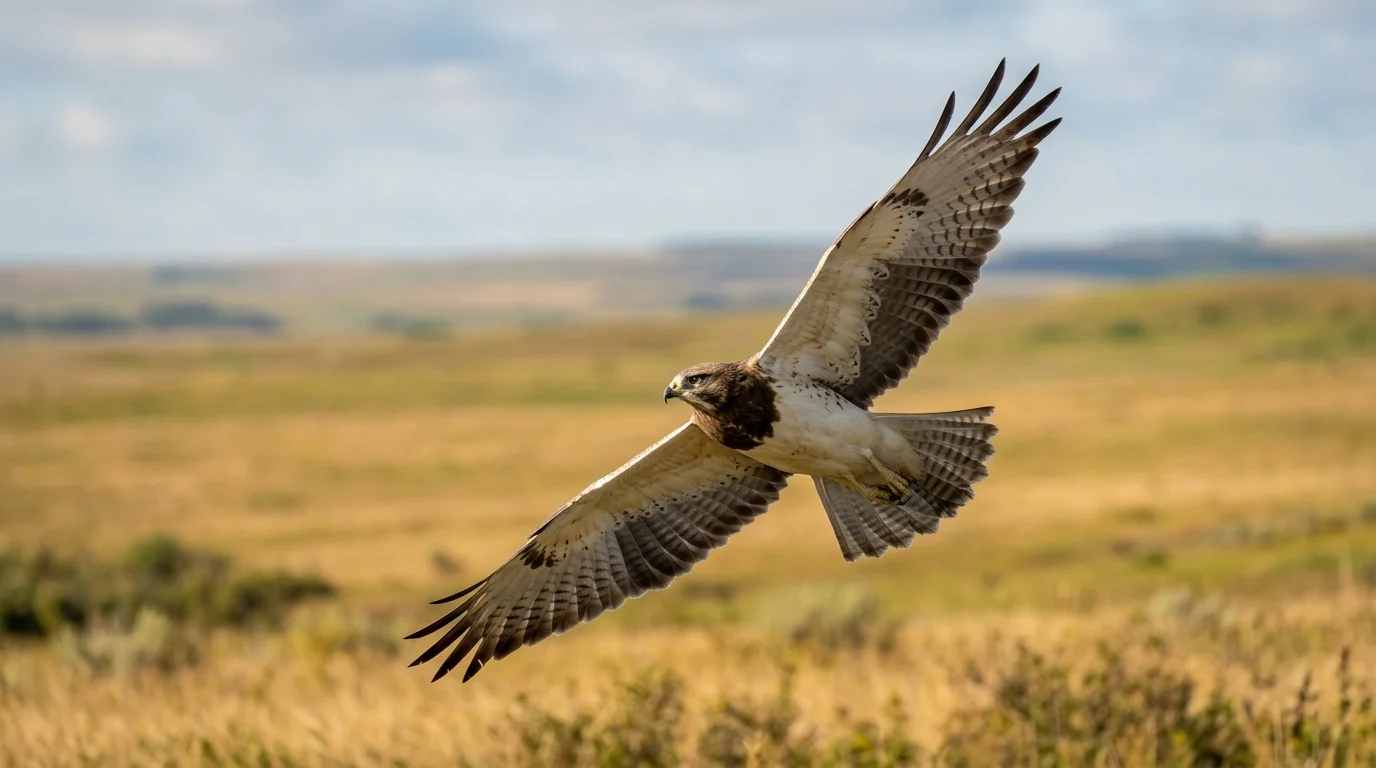
Adult light-morph Swainson’s Hawks have brown upperparts, a brown to gray-brown head, and a dark chest bib above a whitish or cream belly. A pale throat often stands out within the darker head and breast. The tail is grayish brown with narrow darker bands and a broader band near its tip; it is not the brick red of an adult Red-tailed Hawk.
From below, the most useful pattern is the contrast between pale underwing coverts—the feathers lining the front of the wing—and darker flight feathers behind them. This creates a broad, dark trailing portion of each wing rather than an otherwise pale wing marked mainly by isolated dark patches.
Rufous and dark birds can look substantially different. Some have cinnamon underparts; others are almost uniformly dark below. Their wing linings may not show the classic pale contrast. Lighting, wear, and age also affect appearance, so an unfamiliar color pattern does not automatically rule out Swainson’s Hawk.
Male and Female Differences
Males and females share the same basic plumage patterns, and both sexes occur in different color forms. Females average larger and heavier, but size overlaps. Some males appear grayer-headed and some females browner, yet these tendencies are not dependable field tests. Even a perched pair may be difficult to sex unless their behavior or breeding roles provide additional evidence.

Size and Wingspan
- Length: About 43–56 cm (17–22 in).
- Wingspan: About 117–137 cm (46–54 in).
Although broadly comparable in length to a Red-tailed Hawk, Swainson’s usually looks less bulky, with a smaller-looking head and longer, more tapered wings. Distance and posture can distort apparent size, so proportions are generally more useful than an isolated estimate.
Range and Distribution
The breeding range extends across much of western and central North America, from the southern Canadian prairies through the western United States and into northern Mexico. Distribution is patchy where mountains, dense forest, or development interrupt suitable open country. California’s Central Valley supports an important breeding population.
Most birds winter in southern South America, especially Argentina. Much smaller numbers winter farther north, including localized areas of California and Florida. Away from the main range, check seasonal records before assuming that an unexpected hawk is this species. The Cornell Lab of Ornithology’s Swainson’s Hawk account offers a useful range map and identification overview.

Habitat
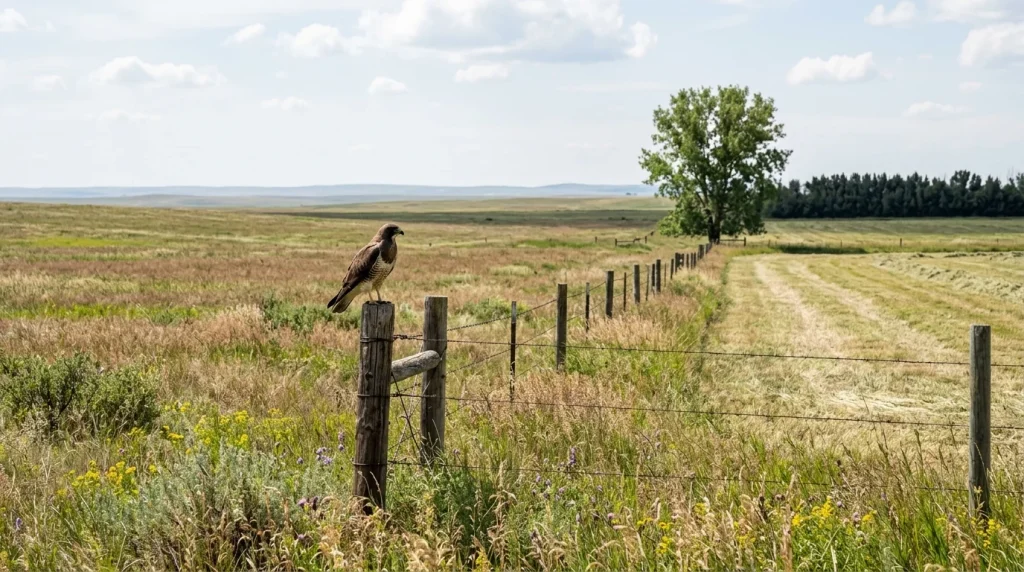
Look for broad, open terrain with low vegetation and scattered nesting trees. Native prairie, sagebrush country, pasture, hayfields, and some croplands can all provide habitat. A lone tree, shelterbelt, or wooded drainage may supply a nest site within an otherwise treeless landscape.
Not all farmland is equally useful. Vegetation height, prey abundance, pesticide exposure, and access to open feeding ground matter. Dense forest and extensive urban development generally offer fewer opportunities.
Migration
Swainson’s Hawk is one of the most accomplished long-distance migrants among North American raptors. Most birds travel overland through Mexico and Central America to South America, using rising warm air to reduce flight energy costs. Large concentrations pass through migration bottlenecks, including Veracruz, Mexico.
Southbound movement is most conspicuous in late summer and fall; northbound passage occurs in spring. Timing varies with latitude and weather. Migrants often gather into circling groups called kettles, then stream onward between thermals. Avoid treating one date as universal across the continent.
Flight Style
Watch for buoyant soaring on long wings held in a shallow dihedral, or V. The outer wings taper more than those of a typical Red-tailed Hawk, though the spread primary tips still form visible “fingers.” In a glide, the wings may flatten or angle slightly backward.
Active flight consists of deliberate flaps interrupted by glides. A banking bird is especially useful: compare its narrow-looking wing profile, small head, tail proportions, and underwing contrast over several viewing angles.
Diet and Hunting
Diet changes markedly with season and location. During breeding, small mammals are important, alongside birds, reptiles, and large insects. Hawks may hunt from poles and fence posts, search while soaring, or drop from low flight toward prey.
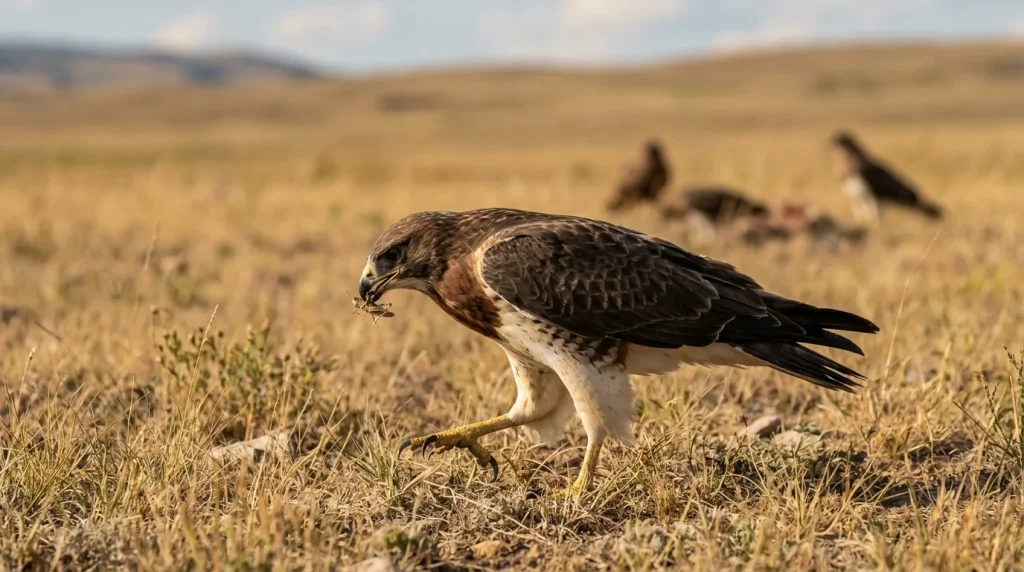
Outside the breeding season, insects can dominate the diet. Grasshoppers and other large insects attract birds to short vegetation, recently disturbed fields, and agricultural operations. Swainson’s Hawks sometimes walk or run across the ground to capture them. Feeding groups can be surprisingly social, but individual birds still compete over food.
Voice and Calls
The typical call is a drawn-out, high, plaintive whistle, often rendered as “kreeee” or “kreeeer.” It is generally less forceful than the familiar raspy scream of a Red-tailed Hawk. Birds may call near nests or during interactions, but many hunting and migrating individuals remain quiet. Use voice as supporting evidence rather than the sole identification feature.
Breeding and Nesting
Pairs usually build a substantial stick nest in a tree, often in a shelterbelt, riparian strip, or isolated grove. Sites need not be deeply wooded; access to nearby feeding habitat is important. They may reuse or refurbish nests, adding fresh green material during breeding.
A typical clutch contains two or three pale eggs, variably marked with brown. Incubation lasts roughly five weeks and is performed mainly by the female, while the male supplies much of the food. For additional nesting and diet details, see the Cornell Lab of Ornithology’s life-history account. Watch occupied nests only from a distance that does not alter the adults’ behavior.

Young and Development
Young hatch covered in pale down and gradually develop brown juvenile plumage. First flights usually occur at about six weeks, although development varies. Fledglings remain dependent on adults while improving their flight and hunting skills.
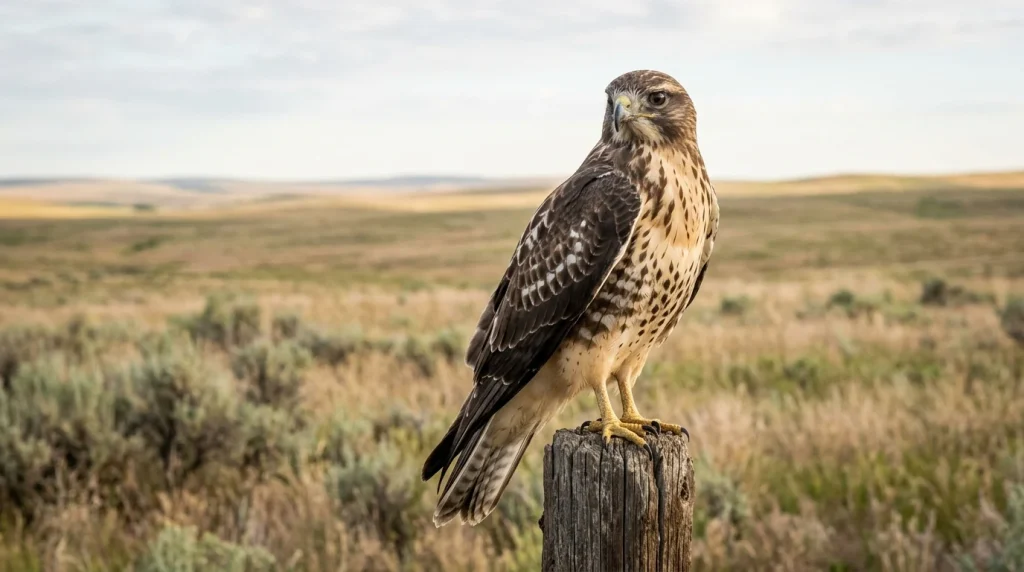
Juveniles commonly have buffy or whitish underparts with dark streaking and spotting rather than the adult’s clean breast bib. Their upperparts may show pale feather edges. Consider shape and wing pattern together; a heavily marked young bird can resemble other immature Buteo hawks.
Where to See
During spring and summer, explore public roads through prairie, ranchland, and irrigated agricultural valleys within the breeding range. Scan roadside poles, isolated trees, fence lines, and freshly cut fields. The Canadian prairies, Great Plains, intermountain valleys, and California’s Central Valley offer good opportunities in suitable habitat.
Midmorning warming often brings birds into the air. During migration, established hawk-watch sites can provide broader views. Stop only where parking is legal and safe, and never enter private fields without permission.
Similar Species
- Red-tailed Hawk: Usually broader-winged and bulkier. Light birds often show dark patagial marks along the underwing’s leading edge and a belly band. Adults usually have a reddish tail.
- Ferruginous Hawk: Generally larger-looking, with a broad head, wide gape, and often very pale underwings. Light adults have rusty legs that can form a V against the belly.
- Rough-legged Hawk: Primarily a cold-season visitor across much of the shared range. Light birds typically show strong dark wrist patches and a pale tail base with a dark terminal band.
- Broad-winged Hawk: Smaller and more compact, with shorter-looking wings. Adults have bold contrasting tail bands. Both species can occur in large migration kettles.
Conservation
Swainson’s Hawk is globally classified as Least Concern, but that does not mean every population is secure. Grassland conversion, loss of nesting trees, changing farming practices, and pesticide exposure can reduce habitat quality or survival.
Major poisoning events on South American wintering grounds in the 1990s demonstrated the species’ vulnerability to agricultural chemicals. International cooperation helped address the implicated pesticide use. Conservation still depends on maintaining safe feeding habitat across breeding areas, migration routes, and wintering grounds.
Field Identification Tips
- Start with proportions: Look for long, tapered wings and a relatively slim body.
- Check the underwing: On light birds, seek pale linings backed by darker flight feathers.
- Assess age and color form: A juvenile or dark bird may lack an obvious adult bib.
- Watch several banks: Backlighting can erase pale areas or exaggerate darkness.
- Use context last: Habitat, season, and flocking support an identification but do not prove it.
Interesting Facts
- A hawk that feeds its chicks small vertebrates may spend much of the nonbreeding season eating insects.
- Migration kettles can contain several raptor species, so identify birds individually.
- Its annual journey connects North American grasslands with South American agricultural landscapes.
Frequently Asked Questions
Do all Swainson’s Hawks have a dark chest bib?
No. It is most distinctive on light adults. Juveniles are usually streaked, while darker birds may show little contrast between chest and belly.
Can you identify males and females by color?
Not reliably. Females average larger, but size and plumage overlap too much for confident sexing of most isolated birds.
Why are several hawks walking in a field?
They may be catching grasshoppers or other insects. Swainson’s Hawks regularly forage on foot, particularly outside the nesting season.
Does every bird migrate to Argentina?
No. Argentina is the principal winter destination, but some individuals winter elsewhere, including small numbers in North America.


