

Gray Hawk Guide
Keep Track of What You See
Create a free Wild Things Guide membership to record this Gray Hawk in My Sightings and build your personal wildlife list.
Join to Add This SightingIntroduction
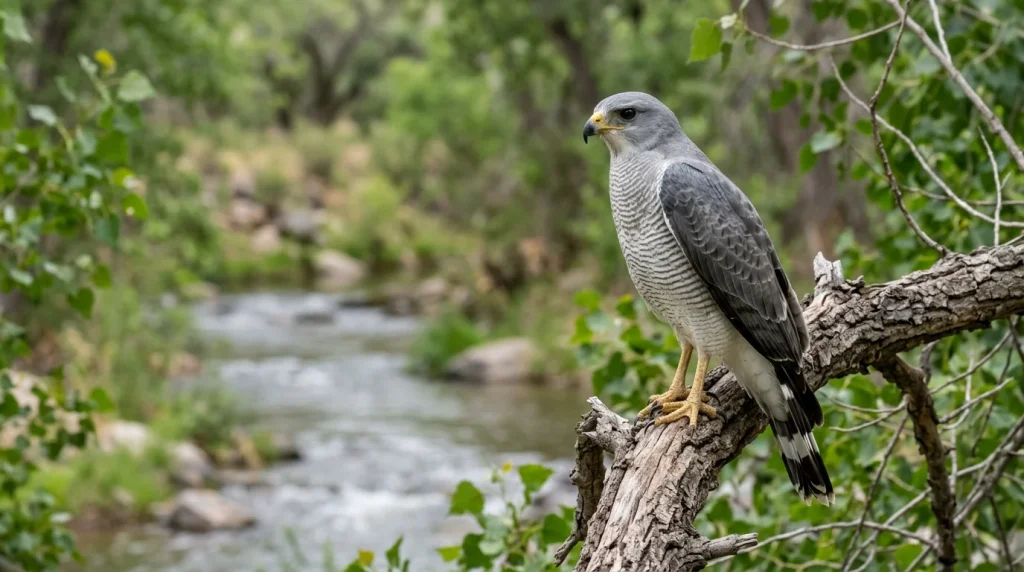
The Gray Hawk (Buteo plagiatus) is a compact woodland raptor best known in the Southwest United States and southern Texas. Adults combine smooth gray upperparts, finely barred underparts, and a striking black-and-white tail. Immatures look surprisingly different: brown above and streaked below.
This species is easiest to learn by habitat, voice, and flight silhouette. A hawk calling from a cottonwood grove beside a desert river may remain hidden for several minutes before circling above the canopy. Patient watching often works better than searching every branch.
Quick Identification
- Adult: Gray head and upperparts, pale underparts with fine gray barring, and a black tail crossed by broad white bands.
- Immature: Brown upperparts, pale underparts with dark streaking, and a brown, dark-banded tail.
- Shape: Relatively small-headed, with short, rounded wings and a fairly long tail for a Buteo.
- Behavior: Hunts from concealed perches and makes quick flights through woodland.
- Setting: Riparian woods, wooded edges, and tropical or subtropical lowlands.
Appearance and Field Marks
An adult’s gray plumage can look almost uniform at a distance. Closer views reveal delicate horizontal barring across the breast and belly. The head and back are comparatively plain, and the legs and cere are yellow. The dark tail, broad white bands, and pale tip provide a strong identification clue when the bird turns or spreads its tail.
In flight, look for pale, finely barred underparts and darker outer flight feathers. The combination matters more than any isolated patch. Strong sun can wash out the barring, while deep shade can make the entire bird look much darker.
Young birds lack the adult’s clean gray appearance. Their pale eyebrow, dark facial markings, streaked underparts, and banded brown tail require careful comparison with other immature hawks.
Male and Female Differences
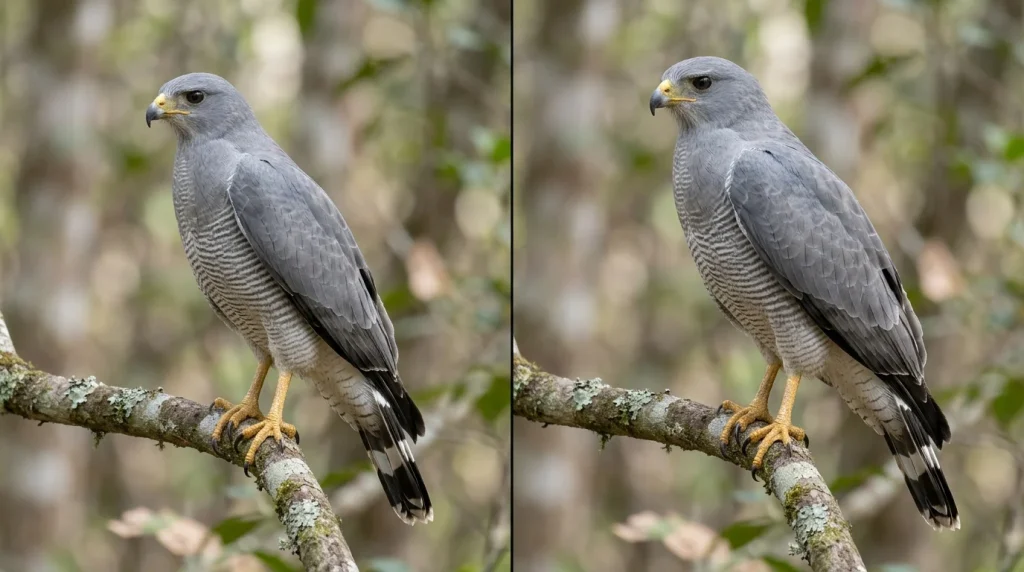
Male and female Gray Hawks have essentially the same plumage. Females average larger and heavier, as in many raptors, but size overlaps and perspective can be misleading.
A lone bird generally cannot be sexed confidently through binoculars. Even paired birds should be assessed cautiously unless size differences are clear or breeding behavior provides additional evidence. Gray tone, breast barring, and tail pattern are not dependable field marks for sex.
Size and Wingspan
- Length: About 46–61 cm (18–24 in).
- Wingspan: Roughly 90–100 cm (35–39 in).
Gray Hawks look smaller and more lightly built than Red-tailed Hawks. Their relatively long tails can make total length a poor guide to apparent bulk. In the field, judge proportions and flight style before relying on an estimated measurement.
Range and Distribution
The Gray Hawk ranges from the southwestern United States and southern Texas through much of Mexico and Central America to northwestern Costa Rica. Its distribution is uneven, following suitable woodland rather than occupying every landscape within that broad outline.
In the United States, southeastern Arizona and southern Texas are the best-established viewing regions. Small numbers also occur in southwestern New Mexico. Birds beyond the usual range need particularly careful documentation.
Older books may combine this species with the Gray-lined Hawk (Buteo nitidus), which occurs farther south. Check which taxonomy a map uses. The Cornell Lab of Ornithology’s Gray Hawk account provides a useful current identification overview.

Habitat
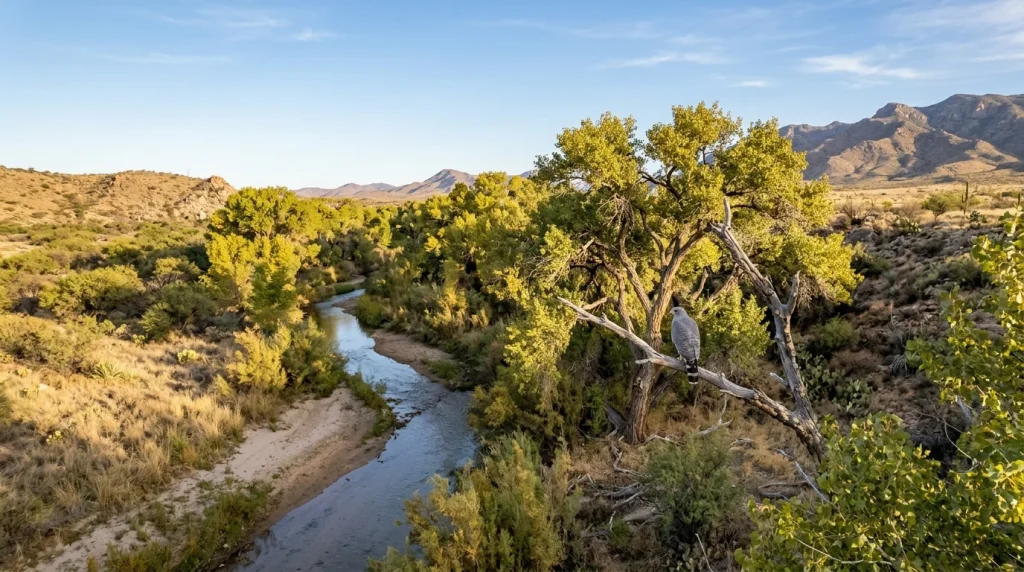
Near its northern range limit, this hawk is closely associated with river corridors containing cottonwoods, willows, mesquite, and other substantial trees. Adjacent grassland, scrub, or open ground supplies hunting opportunities.
Farther south, it also uses tropical deciduous woodland, forest edges, plantations, and other partly wooded landscapes. The recurring pattern combines cover, perches, nesting trees, and accessible prey. It is not simply a desert bird, nor does it require continuous dense forest.
Migration
Gray Hawks are partial migrants. Many birds breeding near the northern edge of the range, especially in Arizona, leave for winter and return in spring. Much of the tropical population is resident, although local movements occur.
Seasonal patterns differ among regions, and occasional birds remain farther north than expected. For a U.S. viewing trip, spring through summer is generally the most reliable period in Arizona; consult recent local reports rather than assuming a site is occupied year-round.
Flight Style
Gray Hawks alternate active wingbeats with glides and can maneuver quickly among trees. Compared with a typical soaring Red-tailed Hawk, they appear more compact-winged and relatively long-tailed.
They also circle above woodland, especially during territorial activity and favorable rising air. A soaring bird may show broad, rounded wings and a spread, strongly patterned tail. During direct travel or pursuit, the same individual can look much more accipiter-like. Observe several wingbeats and turns before deciding on identity.
Diet and Hunting
Lizards are important prey in many areas. Gray Hawks also take snakes, small mammals, birds, frogs, and large insects, with the balance varying by location and availability.
A common hunting method is to watch quietly from a shaded branch, then drop or dash toward prey on the ground or in vegetation. They may shift between perches or pursue prey through openings. A bird sitting motionless within foliage may be actively hunting, not resting. Watch from a distance and leave its approach routes unobstructed.

Voice and Calls
The characteristic call is a clear, carrying whistle, often described as a drawn-out, slightly wavering kleee-ooo or kee-ow. Calls may be repeated, particularly around breeding territories.
Written syllables are only approximations. Listen for the quality, pitch change, and spacing of the notes, then try to locate the bird visually. Other hawks can sound similar at a distance, and young birds give begging calls that differ from the familiar adult whistle.
Breeding and Nesting
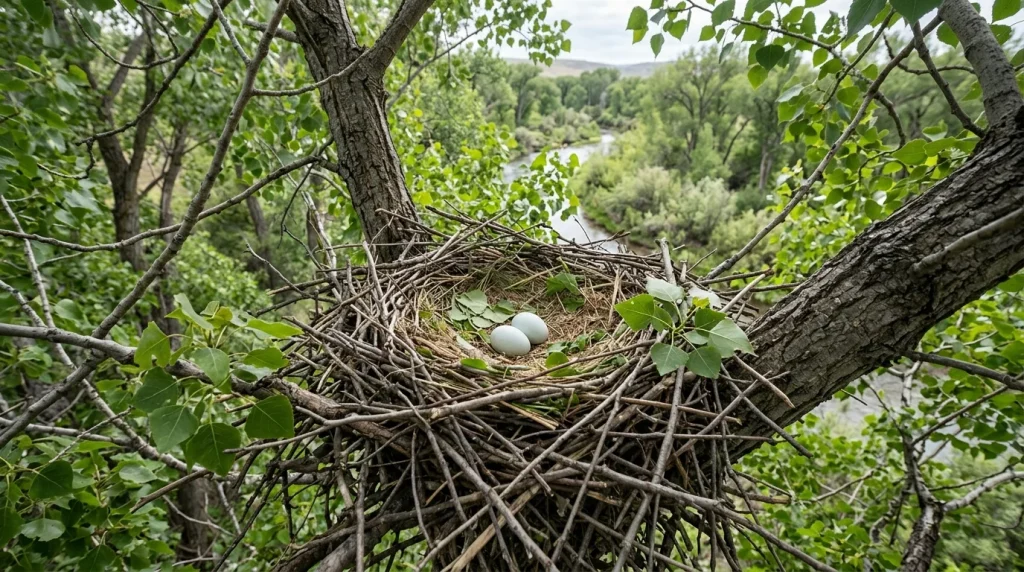
Pairs build a stick nest in a tree, often within riparian woodland in the northern part of the range. The nest is usually well above ground and may be difficult to see through leaves. They can add fresh leafy material during nesting.
A typical clutch contains two or three pale bluish-white eggs, usually unmarked or only lightly marked. The female does most of the incubation, while the male provides much of the food early in the nesting cycle. Incubation lasts roughly a month.
Breeding dates vary geographically. Never approach a suspected nest to confirm its contents; prolonged alarm calling or repeated circling is a reason to retreat.
Young and Development
Chicks hatch covered in pale down and depend on adults for warmth and food. As feathers develop, they acquire the brown, streaked juvenile plumage rather than a Miniature version of the gray adult pattern.
Young generally leave the nest at around six weeks, though timing varies. Recently fledged birds may remain near the nesting area, calling for food and making awkward short flights. Leaving the nest does not mean independence. A fully feathered youngster perched low should usually be left undisturbed while its parents continue caring for it.

Where to See
- Southeastern Arizona: Explore public access along the Santa Cruz and San Pedro River corridors, including suitable woodland around Tubac, Patagonia, and the San Pedro Riparian National Conservation Area.
- Southern Texas: Search wooded river corridors and edges in the Lower Rio Grande Valley and other known local breeding areas.
- Mexico and Central America: Watch lowland woodland edges and riverine forest within the species’ range.
Listen early in the day, then scan above the canopy as the air warms. Check access rules, heat conditions, and current sightings before traveling.
Similar Species
- Red-shouldered Hawk: Adults show rusty underparts and checkered wings rather than clean gray plumage. Immatures can be confusing; translucent crescents near the wingtips, when visible, favor Red-shouldered.
- Cooper’s Hawk: Shares rounded wings and a long tail, but usually looks more strongly accipiter-shaped. Adults have rusty barring below, not the Gray Hawk’s fine gray barring.
- Broad-winged Hawk: More compact and shorter-tailed. Adults usually show brown upperparts and reddish-brown barring below; immatures require attention to proportions and tail pattern.
- Gray-lined Hawk: The closest comparison farther south. Range is helpful, but identification near the Costa Rican range boundary should use a current regional guide.
Conservation
The IUCN classifies the Gray Hawk as Least Concern globally. That broad category does not mean every local population or habitat is secure.
At the northern edge of its range, loss or degradation of riparian woodland can remove nesting trees and hunting habitat. Groundwater depletion, altered river flows, and clearing are relevant concerns. Protecting river corridors and mature woodland benefits this hawk and many other species. Some U.S. areas have seen increases or expansion, but local trends should not be generalized across the entire range.
Field Identification Tips
- Establish age first. Gray adults and brown juveniles demand different comparisons.
- Check the tail. Combine its length, background color, and banding rather than counting bands alone.
- Study the underparts. Adults have fine gray barring, while juveniles have streaking.
- Watch movement. Short-winged woodland agility supports the identification but is not diagnostic.
- Use habitat and voice as support. Neither should replace visible field marks when similar hawks are present.
Interesting Facts
- Despite its agile, woodland-hunting style, the Gray Hawk belongs to Buteo, the same genus as the Red-tailed Hawk.
- Reptiles can be a major part of its diet, making it especially well suited to warm woodland edges.
- The dramatic difference between juvenile and adult plumage can make them seem like different species.
- Historical references to a broadly distributed “Gray Hawk” may include what is now recognized as the Gray-lined Hawk.
Frequently Asked Questions
Are Gray Hawks rare in the United States?
They are geographically localized rather than widespread. You can regularly encounter them in suitable habitat within their southwestern and southern Texas strongholds.
How can I identify a juvenile?
Look for brown upperparts, streaked pale underparts, a marked face, and a relatively long, banded tail. Confirm the combination with shape, location, and comparison species.
Do Gray Hawks eat mostly rodents?
Not necessarily. Lizards often make up an important part of the diet, along with other small vertebrates and occasional large insects.
Can I tell a male from a female by color?
No dependable plumage difference separates them. Females average larger, but most isolated birds should be left unsexed.


