
Snow Goose Guide
Keep Track of What You See
Create a free Wild Things Guide membership to record this Snow Goose in My Sightings and build your personal wildlife list.
Join to Add This SightingIntroduction
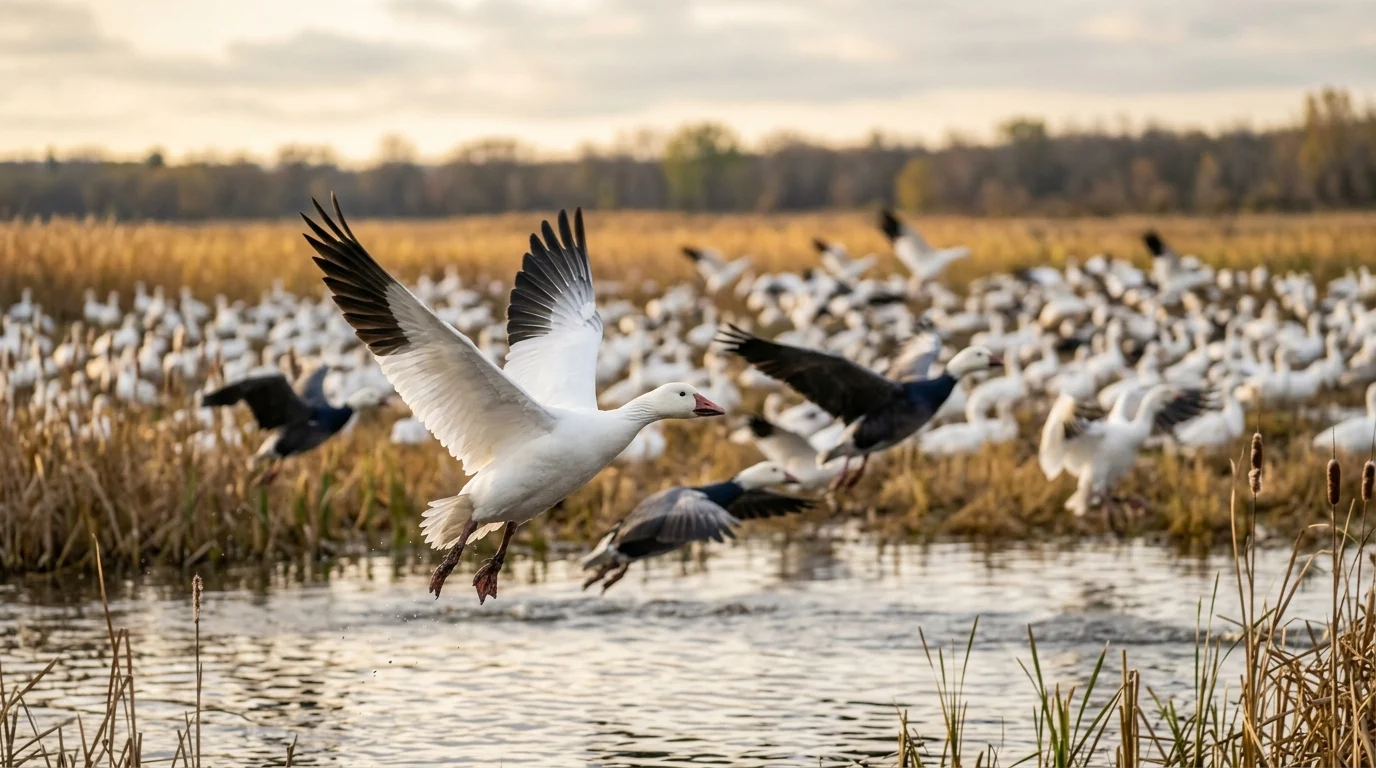
A flock of Snow Geese lifting from a marsh can turn the sky into a swirl of white wings and black tips. The Snow Goose (Anser caerulescens) is a goose, not a songbird. It belongs to the waterfowl family Anatidae, along with ducks and swans.
This Arctic-breeding bird is best known for its large, noisy migration flocks. Most adults are white, but some have dark bodies and white heads. Learning both color forms, along with the bird’s bill shape and flight pattern, makes identification much easier.

Quick Identification
- White form: White body with black outer flight feathers, especially clear in flight.
- Blue form: Dark gray-brown body with a white head and upper neck in adults.
- Bill: Pink, with a dark, curved patch along the cutting edges—the “grinning patch.”
- Legs: Pink in adults; often duller in young birds.
- Shape: Fairly long neck, sturdy body, and a sloping forehead.
- Behavior: Often feeds, rests, and flies in large, noisy groups.
Appearance
Adult white-form Snow Geese are mostly clean white. Their black wingtips may be partly hidden when the wings are folded so that a resting bird can look nearly all white. Rusty staining on the head and neck comes from feeding in iron-rich mud; it is not a separate plumage type.
The blue form, also called the blue morph, belongs to the same species. Adults have white heads, dark bodies, and lighter gray wing areas. The amount of white on the belly varies. White and blue birds can pair and occur together in the same flock.
Males and females look alike, although males average larger. Size overlap makes sexing a lone bird unreliable. Young white-form birds have gray shading on the head, neck, and back, with dull bills. Young blue-form birds are mostly dark and usually lack the adult’s bright white head.

Size and Wingspan
- Length: About 27–33 inches (69–83 cm).
- Wingspan: Roughly 53–65 inches (135–165 cm).
These are useful field ranges rather than strict limits. Snow Geese vary by sex and population. The Greater Snow Goose, associated mainly with eastern North America, averages larger than the Lesser Snow Goose. Both are the same species. Snow Geese are usually smaller than large Canada Geese but noticeably larger than Ross’s Geese.
Range and Distribution
Snow Geese breed across parts of Arctic North America, from Alaska through northern Canada to northwestern Greenland. Some also breed in northeastern Siberia, including Wrangel Island, and migrate to North America.
During migration, they travel through broad areas of Canada and the United States. Wintering areas include the Pacific Coast and inland western valleys, the southern Great Plains, the lower Mississippi Valley, the Gulf Coast, the Atlantic Coast, and parts of Mexico.
Greater Snow Geese mainly use eastern routes, including the St. Lawrence region and Atlantic Coast. Lesser Snow Geese occupy a broader range farther west and through the continent’s interior. Blue-form birds are much more frequent in some central populations than in many western flocks.

Habitat
Breeding habitat is open Arctic tundra, often near ponds, shallow lakes, streams, or coastal marshes. Nest sites usually provide a dry surface with nearby feeding areas.
Outside the breeding season, look for Snow Geese in freshwater wetlands, coastal marshes, shallow lakes, reservoirs, and farm fields. They often roost on water and fly to nearby fields to feed. Harvested grain fields can hold large numbers, especially where safe resting water lies nearby.

Behavior
Snow Geese are strongly social. Flocks may contain hundreds or thousands of birds, with family groups staying close within the crowd. On the ground, many birds feed while others watch with raised heads. If alarm spreads, much of the flock may take off at once.
Flying flocks form lines, loose V shapes, or broad, shifting masses. Birds fly with their necks stretched forward and use steady wingbeats. Near a landing area, they may circle, call, and descend in waves.
Pairs often remain together for many years. Adults also undergo a summer wing molt that briefly leaves them flightless. At that time, access to safe water and open views is especially important.
Diet
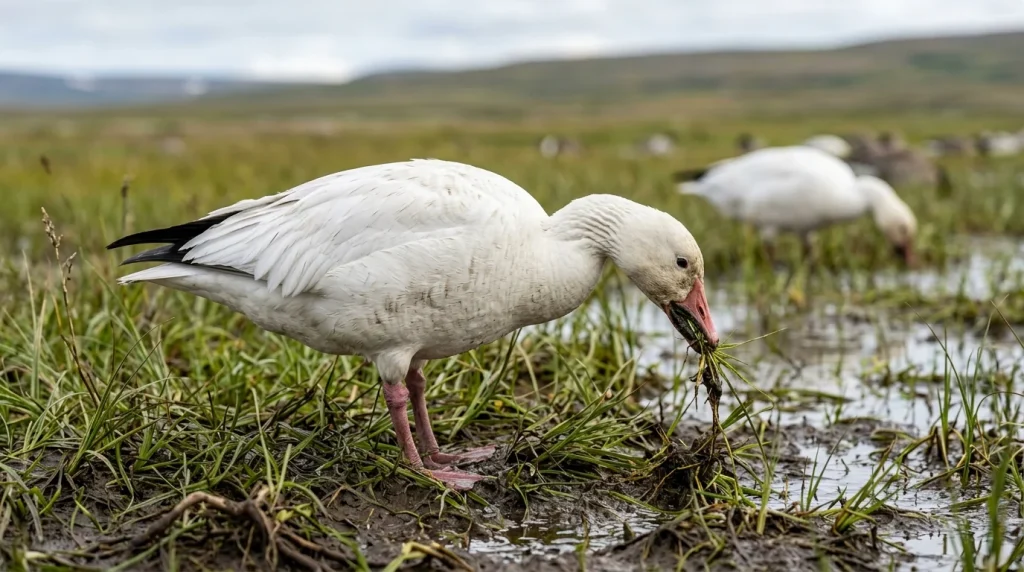
Snow Geese mainly eat plants. Their diet includes grasses, sedges, leaves, stems, roots, and underground plant parts. During migration and winter, they also eat waste grain, including corn, wheat, and rice where available.
Watch how a feeding bird uses its bill. It may nip short plants above ground or pull at roots in wet soil. This digging, often called grubbing, can disturb the ground much more than simple grazing. Birds may feed in shallow water, along marsh edges, or in dry fields, depending on the season and local food.
Vocalizations
The typical voice is a loud, nasal honk, often written as “kowk” or “owk.” Large flocks produce a rolling chorus that you may hear before the birds come into view. Calls tend to sound higher and more nasal than those of large Canada Geese.
Voice is a useful clue, but distance and overlapping calls can be misleading. Compare calls with plumage and shape. The Cornell Lab of Ornithology’s Snow Goose guide provides a useful companion for studying the species’ appearance and sounds.
Breeding and Nesting
Snow Geese usually nest in colonies, sometimes with nests close together. Breeding begins after birds reach their northern grounds and suitable patches become free of snow. Timing varies with latitude, weather, and spring snow cover.
The female makes a shallow ground nest lined with plant material and down. A typical clutch contains about two to six creamy white eggs, which become stained during incubation. The female incubates for roughly 22–25 days, while the male generally stays nearby and helps defend the area.
Arctic foxes, gulls, jaegers, and other predators may take eggs or young. Nesting success can change sharply from year to year with weather, food conditions, and predator activity.

Young and Development
Goslings hatch covered in down, with open eyes, and can walk and swim soon afterward. Once the brood is ready, the parents lead it away from the nest toward feeding areas. The young feed themselves, while both adults guide and guard them.
Young birds grow quickly during the short Arctic summer and usually begin flying at about six to seven weeks old. Families commonly remain together through fall migration and winter. In a feeding flock, a few gray young birds closely following two adults may be one family.
Where to See
Wildlife refuges and wetland viewing areas are often the easiest places to watch Snow Geese without disturbing them. Well-known viewing regions include California’s Central Valley, New Mexico’s middle Rio Grande Valley, the central Great Plains, the Gulf Coast, and the Mid-Atlantic coastal plain.
During migration, southern Canadian prairie wetlands and the St. Lawrence region can hold major gatherings. Exact dates and numbers vary with ice, snow, food, and wind. Check recent refuge reports rather than relying on a fixed calendar date.
Arrive near sunrise to watch birds leave roosts, or visit late in the day as they return. Use a spotting scope from a public overlook. Keep clear of closed areas and private fields, and back away if birds stop feeding and stare toward you.
Similar Species
- Ross’s Goose: Smaller and more compact, with a shorter neck, rounder head, and stubby bill. It lacks the Snow Goose’s broad dark grin, though a thin dark bill line may show. Compare several features, not size alone.
- Canada Goose: Usually has a brown body, black head and neck, and white cheek patch. Its longer-looking neck and deeper voice help separate it from a dark Snow Goose.
- Greater White-fronted Goose: Adults show white around the bill base and dark belly bars. They lack the white head of the blue-form Snow Goose.
- Domestic geese: Some are white with pinkish bills, but they may be bulkier or oddly shaped. A white domestic goose usually lacks the Snow Goose’s crisp black wingtips.
Snow Goose–Ross’s Goose hybrids can show mixed features. For a distant or unusual bird, leaving the identification uncertain is better than forcing a name.
Conservation
The Snow Goose is commonly listed as Least Concern on the IUCN Red List. Several populations increased greatly during the twentieth century, helped in part by abundant agricultural food. Trends still differ by region and population.
In some Arctic areas, heavy grazing and root digging have damaged salt-marsh vegetation and soils, affecting other wildlife. Management has included special hunting measures in certain regions. Abundance does not remove every risk: habitat change, disease outbreaks, and changing Arctic conditions can still affect flocks. Always follow current local hunting and refuge rules.
Field Identification Tips
- Start with the wings. A white goose with black outer flight feathers is a strong starting point.
- Study the bill. Look for a fairly long pink bill and broad dark grin.
- Check the head shape. Snow Geese have a more sloping profile than the round-headed Ross’s Goose.
- Expect both color forms. A white-headed, dark-bodied goose may be a blue-form Snow Goose.
- Compare nearby birds. Shared distance makes size judgments more useful.
- Allow for age and staining. Gray juveniles and rusty-headed adults are normal.
Frequently Asked Questions
Is a blue goose a different species?
No. “Blue goose” usually refers to the blue-colored form of the Snow Goose. White and blue birds can breed together.
Can you tell males and females apart by color?
No. Both sexes can have either color form. Males are on average larger, but most birds cannot be reliably sexed at a glance.
Do Snow Geese stay in snowy places all year?
No. They breed in the Arctic but usually spend winter farther south, using wetlands, marshes, and farm fields.
Should I feed a flock?
No. Let birds find natural food. Feeding can crowd birds together, foul water, and encourage risky approaches to people or roads.


