

Brant Guide
Keep Track of What You See
Create a free Wild Things Guide membership to record this Brant in My Sightings and build your personal wildlife list.
Join to Add This SightingIntroduction
The Brant (Branta bernicla) is a small, dark sea goose closely tied to saltwater shores. Although it may appear in a general bird guide, it is not a songbird: it belongs to the waterfowl family, Anatidae. In North America, look for it feeding in coastal bays, resting on tidal flats, or flying low over the ocean in tight flocks.
Its black head and neck, short bill, white neck markings, and bright white rear make a useful identification pattern. Unlike a Canada Goose, a Brant has no white cheek patch. Knowing the differences between Atlantic and Pacific birds also helps prevent confusion.

Quick Identification
- Shape: Small goose with a plump body, short neck, and small, blunt bill.
- Head and neck: Black, with a small white patch or partial collar on the upper neck.
- Body: Brownish gray to very dark brown, depending on population.
- Rear: Bold white undertail and rump contrast with a black tail.
- Flight: Dark wings, quick wingbeats, and a compact outline.
- Setting: Usually a coastal flock near shallow saltwater, eelgrass beds, or tidal flats.
Appearance
Adult Brant have a black head, bill, neck, and upper breast. The back and wings are brownish gray, often with fine pale feather edges. The legs and feet are black. White markings on the sides of the neck form a broken collar, but their size varies.
Atlantic birds generally have a pale gray belly that contrasts with the black breast. Pacific birds, often called Black Brant, have much darker underparts and usually a broader white neck collar. Their pale flanks can stand out against the dark belly. Some birds from the western Canadian High Arctic show intermediate gray-bellied features, so not every individual fits a simple two-part rule.
Males and females look alike in the field. Males average somewhat larger, but size alone rarely allows reliable sex identification. Young birds initially lack the adult neck patch and show more obvious pale edging on their wing coverts, creating neat bars across the folded wing.

Size and Wingspan
- Length: About 22–26 inches (55–66 cm).
- Wingspan: About 43–47 inches (110–120 cm).
A Brant is much smaller than most Canada Geese and has a shorter neck. It can overlap in size with smaller Cackling Geese. At a distance, its low swimming posture and compact shape may suggest a large duck, but the head, neck, and flock behavior reveal a goose.
Range and Distribution
Brant breed around the Arctic, including northern Alaska, Arctic Canada, Greenland, and parts of Eurasia. North American birds mainly spend the nonbreeding season along the Pacific and Atlantic coasts rather than across the interior.
Pacific birds winter from Alaska south through western coastal waters to Baja California, Mexico. Atlantic birds winter mainly along the eastern United States, with important concentrations from New Jersey through the mid-Atlantic region. Smaller numbers occur farther north or south.
Spring and fall movements connect these coastal wintering areas with Arctic nesting grounds. Inland sightings occur, especially during migration, but they are unusual. The Cornell Lab of Ornithology’s Brant guide provides a useful overview of the species and its range.

Habitat
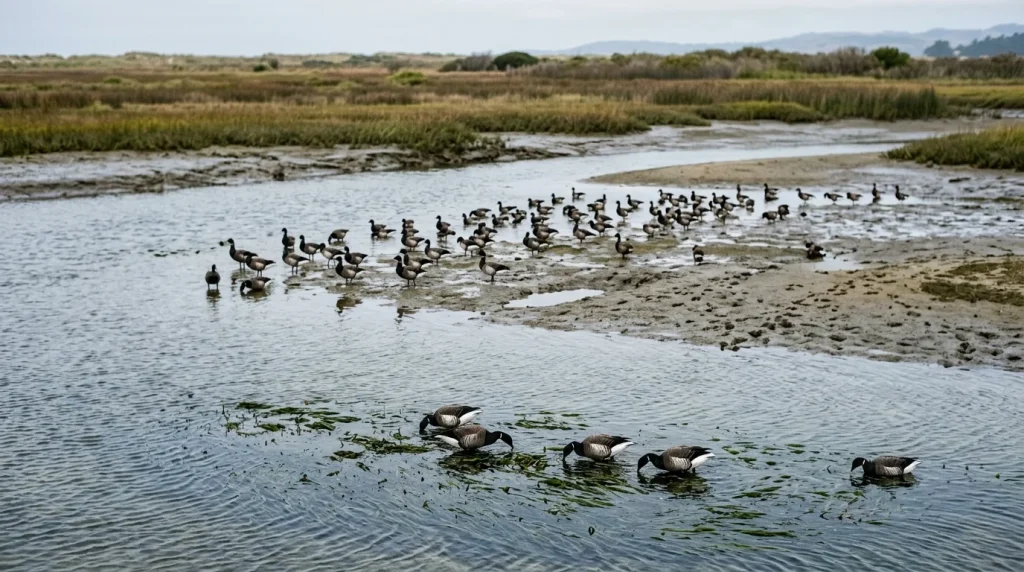
Outside the breeding season, Brant favor sheltered bays, estuaries, coastal lagoons, and shallow marine waters. Eelgrass beds and algae-rich tidal flats are especially important feeding areas. Birds may rest on sandbars, beaches, or open water between feeding sessions.
Some Atlantic flocks also graze on lawns, playing fields, and grassy areas near the coast. This behavior is less typical of the species as a whole than its use of marine feeding grounds.
Breeding habitat includes low Arctic tundra near ponds, coastal marshes, river deltas, and small islands. Nest sites usually offer nearby water and short vegetation for feeding.
Behavior
Brant are strongly social. Outside nesting territories, they gather in flocks ranging from a few birds to many thousands. Feeding groups often move together as the tide changes, shifting between exposed flats and shallow water.
They usually feed by swimming, reaching down, or tipping forward to reach plants. They also walk and graze where suitable vegetation grows. They are not regular diving feeders.
Flying flocks may form loose lines, uneven V shapes, or compact groups. Watch for coordinated turns close to the water. Pair bonds commonly last for years, and family groups often stay together during migration and winter. During the summer wing molt, adults temporarily lose the ability to fly.
Diet
Brants eat mostly plants. Eelgrass is an important food in many coastal areas, along with sea lettuce and other marine algae. On the breeding grounds, they eat grasses, sedges, and other tundra plants.
Food choices vary with location and season. Atlantic birds may use upland grasses, while many Pacific flocks depend heavily on productive coastal plant beds. Small invertebrates may be swallowed incidentally, but animal prey is not their main food.
For birdwatchers, the best clue is often the feeding habitat: a shallow bay with healthy underwater vegetation is more promising than a deep, steep-sided harbor.

Vocalizations
TheBrant’ss usual voice is a low, rolling, nasal call, often written as rronk or crrronk. It is softer and less ringing than the familiar honk of a large Canada Goose.
A flock may produce a steady murmur of overlapping calls while feeding or flying. Listen before approaching a bay overlook; calls can reveal birds hidden behind a sandbar. Like other geese, Brant may hiss during close defensive encounters.
Breeding and Nesting
Brant nest during the short Arctic summer, with timing closely tied to snowmelt and local conditions. They often breed in loose colonies, though spacing varies. Islands and low coastal ground can offer suitable nest sites.
The nest is a shallow ground scrape lined with plant material and down. A typical clutch contains about three to five creamy-white eggs. The female incubates for roughly three to four weeks, while the male stays nearby and helps defend the area.
Arctic foxes, gulls, jaegers, and other predators can take eggs or young. Late snow, flooding, and poor weather may also reduce nesting success. Some pairs nest near defensive birds, such as Snowy Owls, which may discourage certain predators.

Young and Development
Goslings hatch covered in down, with open eyes, and can walk and swim soon afterward. Once dry and ready to move, they leave the nest with their parents and feed themselves on tender plants.
Both parents guide and guard the brood, and the female warms small goslings when needed. Young generally begin flying at about six to seven weeks, though development varies. Families often remain together through their first winter. Look for young birds with pale-edged wing feathers and little or no white neck marking.
Where to See
Plan visits around local seasonal patterns and tides. Falling tides can expose feeding areas, while rising water may bring birds closer to shore. At high tide, look for resting flocks on protected water or sandbars.
- Pacific coast: Boundary Bay, Puget Sound, Humboldt Bay, and Baja California lagoons are useful areas to investigate.
- Atlantic coast: Coastal New Jersey, Long Island, Delaware Bay, and Virginia’s seaside bays can hold wintering flocks.
- Alaska: Izembek Lagoon is a major fall staging area for Pacific Brant.
Use public overlooks and a spotting scope. Keep well back from resting flocks, and check current access rules before visiting refuges or sensitive shoreline sites.
Similar Species
- Canada Goose: Usually larger and longer-necked, with a clear white cheek-and-chin patch. Brant have black cheeks.
- Cackling Goose: Small and short-necked like a Brant, but still shows the white cheek patch. Usually more associated with freshwater and fields.
- Barnacle Goose: Has a large white face, black crown and neck, and strongly patterned gray upperparts. A rare visitor in North America; some sightings involve escaped birds.
- Snow Goose, blue morph: Usually has a white head and a thicker pink bill, unlike the black-headed, black-billed Brant.
Conservation
The Brant is commonly listed as Least Concern globally, but that broad category does not mean every population is secure. Regional trends differ, and poor breeding years can affect the number of young reaching wintering grounds.
Important threats include loss of eelgrass and other feeding habitat, shoreline development, disturbance, and changes to Arctic conditions. Sea-level rise and coastal flooding may affect nesting and wintering areas. Hunting is regulated, with rules that can change by region and year.
Protecting connected coastal feeding and resting sites is essential. Birdwatchers can help by keeping dogs away from flocks and avoiding repeated approaches that force birds to fly.
Field Identification Tips
- Check the face first. A black cheek separates Brant from Canada and Cackling Geese.
- Study the proportions. Look for a small bill, short neck, and compact body.
- Find the white rear. It often stands out even when the neck patch is hard to see.
- Expect regional variation. Atlantic birds are generally paler below than Pacific birds.
- Consider age. A missing neck patch does not rule out a young Brant.
- Use several clues. Shape, voice, habitat, and plumage together are safer than any single mark.
Frequently Asked Questions
Is a Brant a duck or a goose?
A Brant is a goose in the same genus as Canada and Cackling Geese. Its small size and coastal habits can be confusing.
Is Black Brant a separate species?
Most North American references treat Black Brant as the Pacific subspecies of Brant, Branta bernicla nigricans, rather than a separate species.
Do all Brant have white neck collars?
Adults normally have white neck markings, but their extent varies. Young birds initially lack them, and a small patch can disappear from view at some angles.
Can Brant be found inland?
Yes, but they are much less common inland than along the coast. Check unusual birds carefully against Cackling and Canada Geese.


