

Emperor Goose Guide
Keep Track of What You See
Create a free Wild Things Guide membership to record this Emperor Goose in My Sightings and build your personal wildlife list.
Join to Add This SightingIntroduction
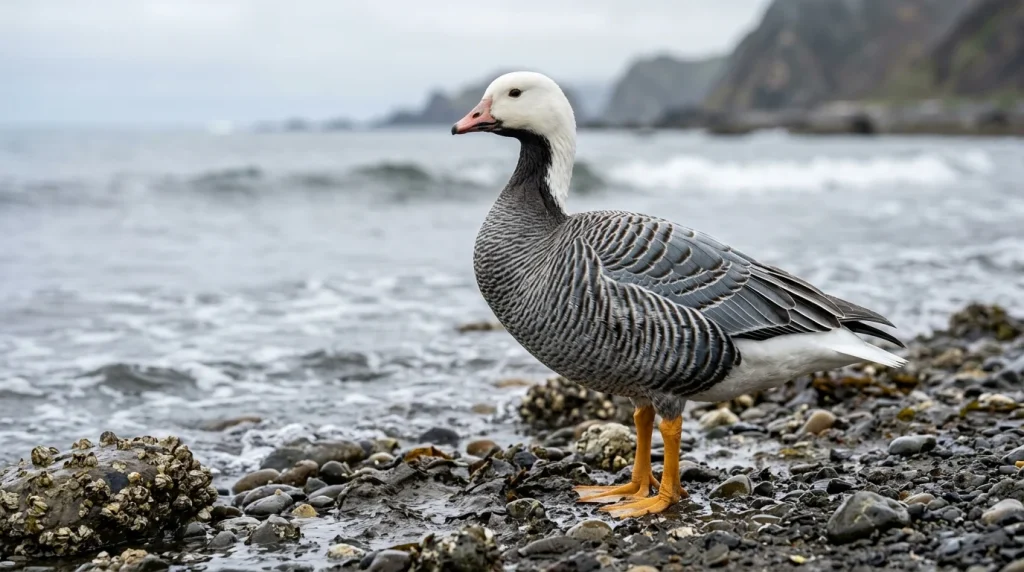
The Emperor Goose (Anser canagicus) is a striking bird of Alaska’s wild coast. Adults combine a white head, dark throat, finely barred gray body, and orange legs. These marks make it fairly easy to identify when seen well, though distance, mud, and flat coastal light can hide important details.
Despite its place in this guide series, the Emperor Goose is not a songbird. It is a waterfowl species in the duck, goose, and swan family (Anatidae). For North American birders, finding one usually means visiting coastal Alaska. Farther south, it is an uncommon to rare visitor that deserves a careful look.
Quick Identification
- Head: White in adults, sometimes stained rusty orange from feeding.
- Neck: White along the back, with a dark chin, throat, and front.
- Body: Blue-gray with fine black-and-white feather edges that create a scaled look.
- Bill: Short and mostly pink, often with darker or bluish areas near the base.
- Legs: Yellow-orange to orange.
- Shape: Stocky, with a thick neck and rounded head.
- Tail: White, especially useful in flight or when the bird spreads its tail.
Appearance
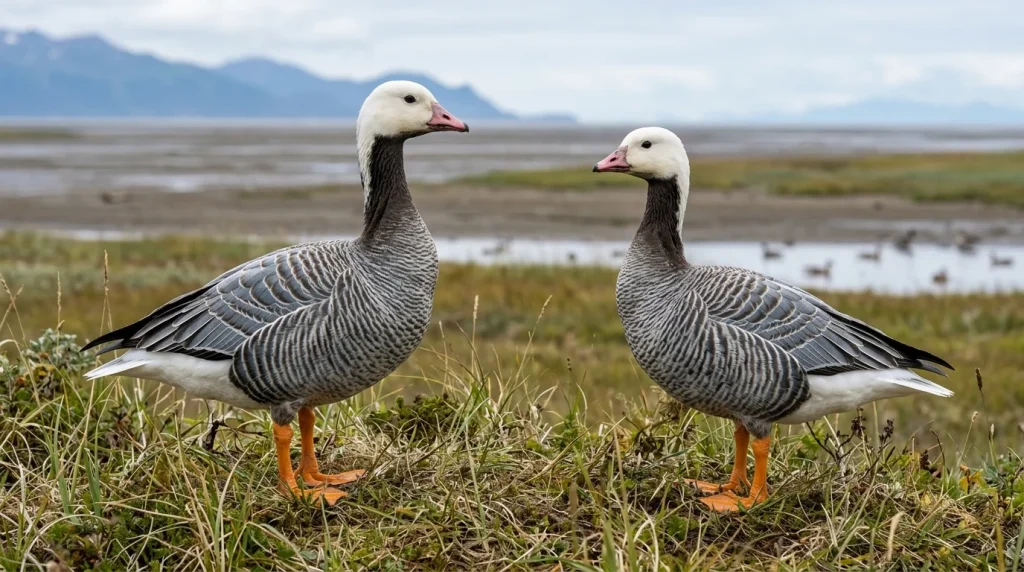
Adult Emperor Geese look pale-headed and dark-bodied. Up close, the body shows neat rows of pale and dark feather edges. From farther away, those details merge into a fairly even gray. The dark front of the neck contrasts sharply with the white head and hindneck.
Males and females have nearly identical plumage. Males average larger, but size alone is not a reliable way to sex a lone bird. Adults keep the same basic appearance year-round rather than changing into a sharply different breeding outfit.
Young birds have dusky heads and necks, making them much less obvious. As they mature, white feathers gradually replace the darker head plumage. Rust-colored staining on an adult’s head comes from its environment, not a separate color form.
Size and Wingspan
- Length: About 26–28 inches (66–71 cm).
- Wingspan: About 47 inches (120 cm).
This is a medium-sized goose with a compact, heavy-bodied build. It is generally smaller and shorter-necked than a large Canada Goose. Its low posture and thick neck can make it appear especially solid beside slimmer waterfowl.
Use measurements as background rather than a strict field test. Posture, distance, and the size of neighboring birds can change how large a goose appears.
Range and Distribution
The Emperor Goose has a limited range around the Bering Sea and nearby North Pacific coasts. In North America, its main breeding area is western Alaska, especially the Yukon–Kuskokwim Delta. It also breeds in northeastern Russia.
Many birds winter along the Alaska Peninsula, Aleutian Islands, and nearby southern Alaskan coasts. Parts of the Russian Far East also hold wintering birds. Seasonal movements often follow shorelines, connecting tundra nesting grounds with coastal feeding areas.
Small numbers occasionally reach British Columbia, Washington, Oregon, or California. Birds far outside the usual range need extra care because Emperor Geese are also kept in captivity, and escapes can occur.

Habitat
Look for Emperor Geese where low tundra meets salt water. During breeding, they use coastal meadows, wet tundra, marsh edges, and areas near ponds, tidal channels, and river mouths. These places provide both nesting cover and nearby food.
Outside the breeding season, they favor sheltered bays, tidal flats, rocky shores, and beaches with exposed marine life. They may rest on gravel spits or gather along quiet shorelines between feeding periods.
Compared with many other North American geese, this species is strongly coastal. Large inland lakes, crop fields, and city lawns are not its usual setting.

Behavior
Emperor Geese often feed and rest in pairs, family groups, or flocks. Their daily movements along the shore may follow the tides as feeding areas become exposed or covered. Birds on open beaches can be watchful and may move away long before a person gets close.
They walk steadily while grazing, pick food from shoreline surfaces, and feed in shallow water. In flight, look for broad wings, a compact body, and the pale head and tail.
After breeding, adults replace their flight feathers and become flightless for several weeks. During this period, quiet coastal areas with food and safe water are especially important.
Diet
The diet changes with season and feeding location. During spring and summer, Emperor Geese eat grasses, sedges, and other tundra plants. They take leaves, shoots, and some roots or underground plant parts.
Along winter shores, they eat marine plants and small animals, including mussels and other shellfish. They may pull food from exposed tidal surfaces or reach into shallow water.
- Breeding grounds: Watch for slow grazing in coastal meadows.
- Winter coast: Watch for birds picking among stones, seaweed, and shellfish beds.
Do not offer bread or other food. Natural feeding behavior is more useful for identification and healthier for the birds.

Vocalizations
The Emperor Goose gives deep, rough honks and shorter cackling notes. Its voice is generally less ringing than the familiar honk of a large Canada Goose. A moving flock may produce a low, uneven chorus as birds keep contact.
Calls can help locate birds before they are visible, but wind and surf often mask them. Treat voice as supporting evidence rather than the only field mark. The Cornell Lab of Ornithology’s Emperor Goose guide offers a useful starting point for comparing identification details.
Breeding and Nesting
Emperor Geese nest on the ground in coastal tundra. The female makes a shallow bowl, usually lined with nearby plant material and down. A nest may sit on a slightly raised patch near water, but placement varies with local conditions.
A clutch often contains about three to six eggs, though larger clutches occur. The eggs are pale cream to whitish and may become stained. The female incubates for roughly 24–25 days, while the male usually remains nearby.
Nesting birds need space. Never approach closely enough to make an adult leave its eggs, and avoid walking through likely nesting cover to locate a nest.

Young and Development
Goslings hatch covered in down and can walk, swim, and feed soon afterward. They leave the nest with their parents rather than staying in it while adults bring food. Both parents help guide and protect the brood.
The young feed themselves, mainly in shallow wet areas and grassy coastal habitat. Adults lead them toward feeding sites and respond to danger with alarm calls or defensive behavior.
Young Emperor Geese generally begin flying at about two months old. Their first feathered plumage includes a dark head so that a family group may include white-headed adults beside much duller young birds.
Where to See
Western and southwestern Alaska offer the best chances. The Yukon–Kuskokwim Delta is a major breeding region, but much of it is remote and requires careful travel planning. Winter visits to suitable shores around the Alaska Peninsula, Aleutian Islands, and Kodiak region can also be productive.
- Check current local sightings before choosing a viewing site.
- Scan sheltered bays, rocky shorelines, and tidal flats with a spotting scope.
- Watch a feeding area through changing tides rather than assuming one quick scan is enough.
- Respect private land, Alaska Native lands, refuge rules, and severe coastal weather.
Similar Species
- Snow Goose: White adults have mostly white bodies and black wing tips. Dark-morph birds can have white heads, but lack the Emperor Goose’s evenly scaled gray body and white tail pattern.
- Greater White-fronted Goose: Adults have a white patch around the bill, not an all-white head. Their bodies are browner, often with dark belly bars.
- Brant: Usually shows a black head and neck with a small white neck marking. Its body lacks the Emperor Goose’s fine, regular barring.
- Cackling Goose: Some forms share a compact shape, but have a black head and neck with a white cheek patch.
Unusual domestic geese and hybrids can confuse identification, especially outside Alaska. Check several features rather than relying on a white head alone.
Conservation
The Emperor Goose is commonly listed as Near Threatened on the IUCN Red List. Its limited range and concentration in particular coastal areas make population monitoring important. Numbers have changed substantially over the past decades, so that single old population figure can be misleading.
Concerns include harvest pressure, disturbance, coastal habitat change, and possible oil contamination in marine feeding areas. Climate change may alter tundra nesting habitat and coastal food supplies. Hunting rules can change with population assessments; consult current regulations rather than assuming harvest is either always closed or always allowed.
Field Identification Tips
- Start with shape: Look for a stocky goose with a thick, fairly short neck.
- Check the neck pattern: Adults combine a white hindneck with a dark throat and neck front.
- Study the body: Fine black-and-white feather edges create a scaled gray surface.
- Confirm supporting marks: Look for a short pink bill, orange legs, and white tail.
- Allow for age and staining: Young birds have darker heads; adults may have rusty-stained faces.
Frequently Asked Questions
Is an Emperor Goose a songbird?
No. It belongs to the waterfowl order Anseriformes and family Anatidae, not the songbird group.
Can you tell males and females apart?
Usually not with confidence from plumage. Males are on average larger, but the sexes overlap in size and look very similar.
Why is the head sometimes orange?
The white feathers can pick up iron-rich stains while the bird feeds. This does not indicate a different species or sex.
Are Emperor Geese found outside Alaska?
Yes. They also occur in northeastern Asia, and occasional wild birds travel south along the Pacific coast of North America. Far outside their usual range, consider captive origin as well.


