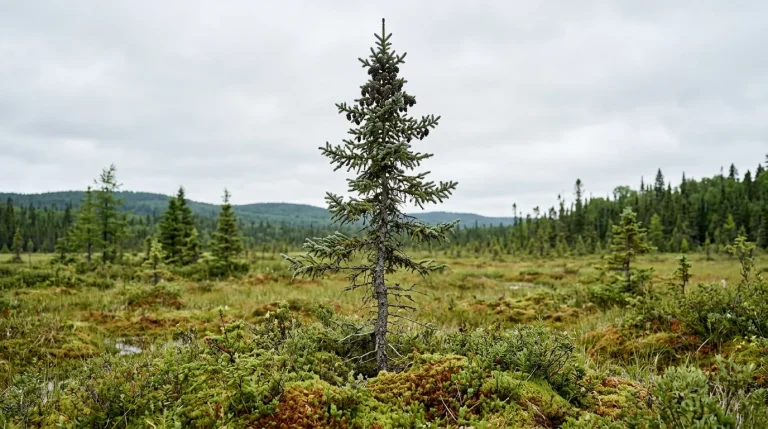
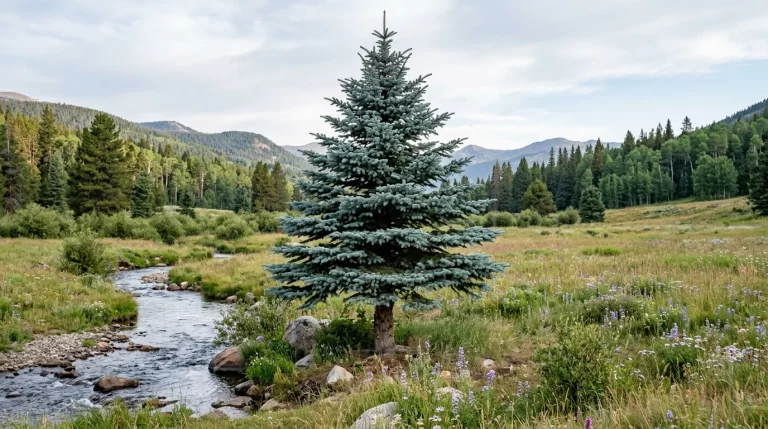
Sitka Spruce Guide
Keep Track of What You See
Create a free Wild Things Guide membership to record this Sitka Spruce in My Sightings and build your personal wildlife list.
Join to Add This SightingTree Name
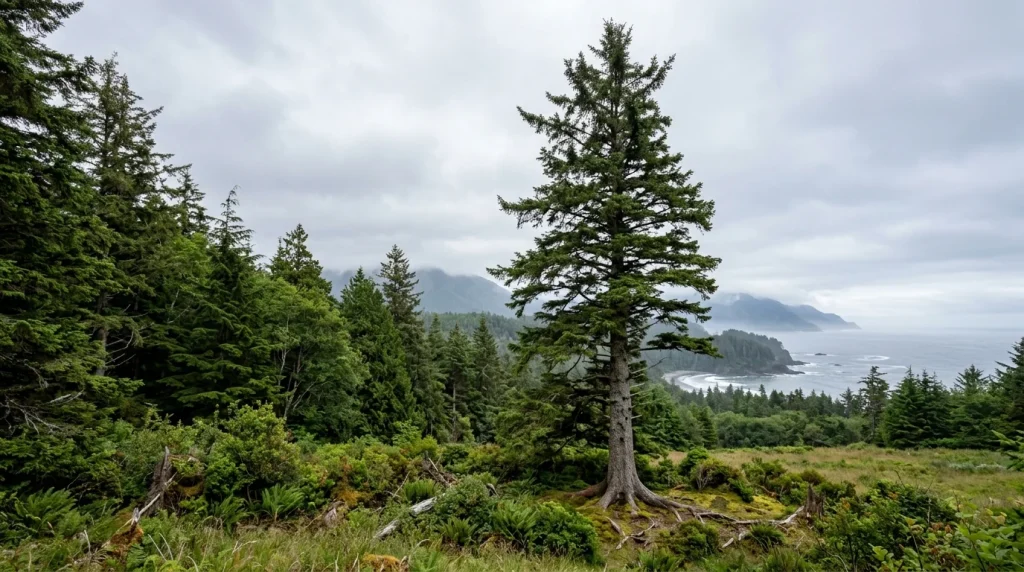
Sitka spruce (Picea sitchensis) is a towering evergreen conifer of NorthAmerica’ss Pacific coast. A member of the pine family (Pinaceae), it thrives in cool, moist forests shaped by ocean weather. Its common and scientific names refer to Sitka, Alaska. Although famous for immense old-growth specimens, it can also appear as a narrow young tree or a wind-shaped evergreen near the shore.
For identification, look beyond size: sharply pointed needles, rough woody needle pegs, and hanging cones with thin, papery scales provide much stronger evidence.
Quick Identification
- Needles: Single, stiff, sharply pointed, usually ½–1 inch (1.5–2.5 cm) long; green above with conspicuous pale bands beneath.
- Twigs: Rough with persistent woody pegs where needles attach.
- Cones: Hanging, slender to oval cylinders, about 2–3½ inches (5–9 cm) long, with thin, wavy-edged scales.
- Bark: Gray to purplish brown, becoming scaly and plated rather than deeply furrowed.
- Setting: Moist Pacific coastal forest, river flats, fog belts, and exposed coastal edges.
Gently touch the side of a low branch rather than gripping it: Sitka spruce needles are distinctly prickly. Confirm that impression with the needle undersides and cones.
Appearance
Mature trees commonly reach roughly 130–230 feet (40–70 m) on suitable forest sites, while exceptional old trees exceed 300 feet (90 m). Trees on exposed headlands or poor soils may remain much smaller. Mature crowns are often approximately 20–40 feet (6–12 m) wide in forest conditions, with considerably broader crowns possible in open-grown trees.
Young trees usually have a pointed, conical crown and regularly arranged branch tiers. Older trees develop long, substantial trunks, irregular crowns, and sometimes buttressed bases. Crowded forest trees lose their shaded lower branches; trees growing in openings may retain foliage nearly to the ground.
Needles spread around the twig but often point outward and somewhat forward. They are flattened into a diamond shape in cross-section rather than consistently square like those of many other spruces. The green upper surface contrasts with two pale stomatal bands beneath, which can give moving foliage a silvery flash.

Bark, Twigs, and Buds
Young bark is relatively smooth and thin. With age, it breaks into small, rounded or irregular scales, often gray-brown with purplish tones. Very large trunks can look heavily textured, but they generally lack the thick, deeply carved ridges typical of old Douglas-fir.
Young twigs are pale brown to yellowish brown and usually hairless. Each needle stands on a short woody projection called a sterigma. When needles fall, these projections remain, making bare spruce twigs feel like tiny rasps. This is a useful spruce clue, though not a Sitka-only feature.
Buds are small, brown, and broadly egg-shaped to somewhat pointed. For practical identification, needle sharpness, pale undersides, twig pegs, and cone scales are more dependable than bud shape alone.

Range and Habitat
Sitka spruce is native to a relatively narrow Pacific coastal belt extending from south-central Alaska, including Kodiak Island, through coastal British Columbia, Washington, and Oregon to northernCalifornia’ss Mendocino coast. It also occupies coastal islands and follows some river valleys inland. It is not a general-purpose spruce of the continental interior.
Look for it in cool, humid forests with abundant rain, summer fog, or reliable soil moisture. Productive stands often occupy alluvial flats and moist lower slopes. It also grows on rocky coastal sites, where wind and shallow soils restrict its size. The U.S. Forest Service’s Sitka spruce species review describes its coastal distribution, habitat, and ecology in greater detail.
Frequent neighbors include western hemlock, western redcedar, red Alder, and, farther south, Douglas-fir. Sitka spruce tolerates maritime exposure and some salt spray, but it does not thrive in seawater-saturated soil. Outside its native range, planted trees need separate consideration.

Flowers, Fruit, Nuts, or Cones
Sitka spruce does not produce true flowers, fleshy fruit, or nuts. It bears separate pollen cones and seed cones on the same tree. Small pollen cones release wind-carried pollen in spring; young seed cones may be reddish or greenish and become pendent as they develop.
Mature seed cones are light brown, usually 2–3½ inches (5–9 cm) long. Their thin scales have wavy, irregularly toothed edges that give the cone a delicate, somewhat ruffled appearance. Unlike Douglas-fir cones, they lack conspicuous three-pointed bracts projecting between the scales.
Cones mature during their first growing season and open to release small winged seeds, mainly from autumn onward. Empty cones may remain on branches for a time or accumulate underneath. Ground cones are useful, but check which trees stand overhead before assigning them to a species.

Wildlife Connections
Sitka spruce seeds feed birds such as crossbills and siskins, as well as squirrels and other small mammals. Cone production varies among years, so food availability is not constant. Insects living on needles, bark, and wood provide another important food pathway.
Large trees offer shelter, nest sites, and complex canopy habitat. In suitable coastal forests, old Sitka spruces may provide the broad, mossy limbs marbled murrelets use for nesting. Dead trees and decaying logs support cavity users, fungi, invertebrates, and forest regeneration.
Fallen trunks also become nurse logs. Seedlings rooting on their moist, elevated surfaces can avoid some competition and waterlogged ground, eventually producing striking rows of trees as the original log decays.
Seasonal Identification
Spring: New shoots emerge with soft, lighter-green needles that later stiffen. Pollen cones and developing seed cones may be visible, although often high in the crown.
Summer: Look for sharp tips and pale undersides on mature needles. Developing cones become easier to distinguish from foliage.
Autumn: Seed cones turn brown and begin releasing seeds. Older inner needles may yellow and drop; the whole crown does not change color like a deciduous tree.
Winter: Green needles, woody twig pegs, scaly bark, and remaining cones still allow identification. Coastal wind can create uneven or flag-shaped crowns, so crown symmetry is not a reliable requirement.

Human Uses and History
Indigenous peoples of the Northwest Coast have long used Sitka spruce materials in regionally distinct traditions. Carefully prepared roots are especially important in basketry and other woven work; wood, pitch, and other parts also have documented uses. These practices belong to specific communities and should not be reduced to one universal method.
Sitka spruce wood combines relatively low weight with strength and useful acoustic properties. Selected wood is valued for guitar, piano, and other instrument soundboards. It also played an important role in early aircraft construction and has been used for lumber, boats, and pulp.
As a landscape tree, it needs substantial room and a suitable climate. On favorable sites, young trees may add about 1–3 feet (30–90 cm) in height annually, sometimes more. Dry heat, limited rooting space, and proximity to buildings make it a poor fit for many yards.
Conservation and Threats
Sitka spruce remains widespread within its coastal range, but its persistence differs from that of old-growth spruce forests. Logging and land conversion have reduced many stands containing exceptionally large trees, abundant deadwood, and complex canopy habitat.
Potential stresses include drought, warming conditions, damaging insects, root diseases, and windthrow. Shallow rooting on wet soils can increase vulnerability when surrounding trees are removed. Spruce aphids and shoot-feeding weevils can be important locally, especially in planted or young stands.
Conservation priorities include retaining old forest structure, protecting streamside forests, and maintaining suitable regeneration conditions. Individual trees can live for several centuries; some exceed 700 years. Longevity varies greatly with site conditions and disturbance.
Similar Species
- Western hemlock: Has softer, flat needles of noticeably unequal lengths, often arranged in flattened sprays. Its leader commonly droops, and its cones are much smaller.
- Douglas-fir: Has softer needles and distinctive hanging cones with projecting three-pointed bracts. Older bark becomes thick and deeply furrowed.
- Engelmann spruce: Usually associated with colder inland or mountain habitats. Its needles are generally more four-sided and more evenly blue-green, but cones and needle dimensions overlap with Sitka spruce.
- White spruce: Typically has more four-sided needles and shorter cones with less ragged-looking scale margins. In coastal-inland transition areas, especially in Alaska and British Columbia, hybridization can blur the distinction.
Sitka spruce and white spruce produce hybrids commonly called Lutz spruce. A tree with intermediate features may not be confidently assignable from a single photograph or needle sample. Use several traits together with location.

Interesting Facts
- Sitka spruce is the tallest spruce species and one of the world’s tallest conifers.
- The pale needle bands contain rows of stomata, pores involved in gas exchange.
- Seedlings established on nurse logs may develop arching roots or elevated bases as the wood beneath them disappears.
- A harshly wind-shaped shoreline tree and a giant straight-trunked forest tree can belong to the same species.
Frequently Asked Questions
What is the best quick identification clue?
Look for stiff, very sharp needles with green upper surfaces and pale undersides, attached individually to woody pegs. Hanging cones with thin, ruffled scales help confirm identification.
Does Sitka spruce lose its needles in winter?
No. It is evergreen and retains multiple age classes of needles. Older needles shed gradually, often becoming more noticeable in autumn or during stress.
Can Sitka spruce grow away from the coast?
Yes, particularly where summers are cool and moisture is dependable. However, a planted tree’s survival inland does not make that location part of its native range.
Is it a good tree for a small garden?
The full-sized species generally is not. Its eventual height, crown, and roots call for a large site. Where space is limited, consider locally appropriate smaller trees or a carefully researched compact cultivar.