

Ross’s Goose Guide
Keep Track of What You See
Create a free Wild Things Guide membership to record this Ross’s Goose in My Sightings and build your personal wildlife list.
Join to Add This SightingIntroduction
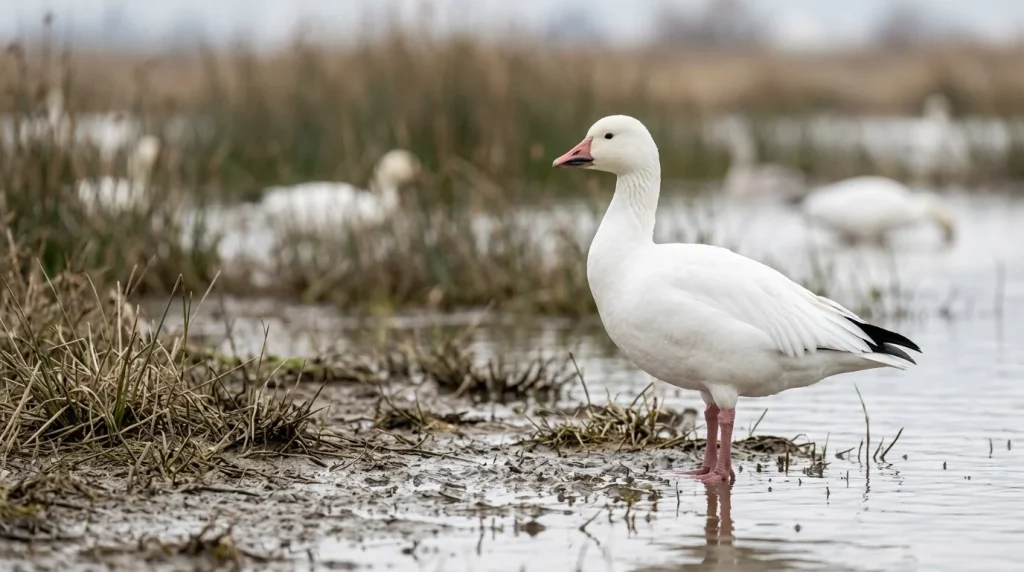
Ross’s Goose (Anser rossii) is a small, mostly white goose that often disappears into much larger flocks of Snow Geese. Finding one means looking closely at head shape, bill size, and body proportions rather than color alone. Its round head and short, stubby bill give it a gentle, almost small-headed duck-like look.
Although it appears in a bird guide, Ross’s Goose is a waterfowl species, not a songbird. It breeds in the Arctic and spends winter around wetlands and open farmland farther south. A spotting scope is especially helpful when searching distant feeding flocks.
Quick Identification
- Adult plumage: White body with black outer flight feathers, most obvious in flight.
- Head: Rounded, with a steep forehead and a short neck.
- Bill: Small, pink, and triangular, without the obvious dark “grin patch” of a Snow Goose.
- Legs: Pink in adults.
- Build: Compact and noticeably smaller than most nearby Snow Geese.
- Best clue: A tiny bill on a rounded head, confirmed with a clear side view.
Appearance
A typical adult is white except for its black primary feathers. On a resting bird, these feathers may show as black tips near the rear of the folded wings. In flight, they form bold black outer-wing patches. The eye is dark, and the bill and legs are pink.
The short bill meets the face along a fairly straight, nearly vertical border. Adult birds may have grayish or bluish, rough-looking bumps near the bill base, especially during the breeding season. These can support an identification but are not always visible.
Males and females have similar plumage. Males average larger, but size overlap makes most birds difficult to sex in the field. Young birds show pale gray shading, especially on the head, neck, and upperparts, with duller bills and legs.
A dark, or blue, form occurs but is very rare. Dark plumage alone cannot identify Ross’s Goose; unusual birds require careful checks for Snow Goose features and possible hybrid ancestry.

Size and Wingspan
- Length: About 59–64 cm (23–25 inches).
- Wingspan: About 113 cm (44 inches).
Ross’s Goose is smaller and more compact than Snow Goose, with a shorter neck and much smaller bill. However, distance, posture, and individual variation can be misleading. Compare birds standing together at roughly the same distance rather than judging an isolated bird.
Range and Distribution
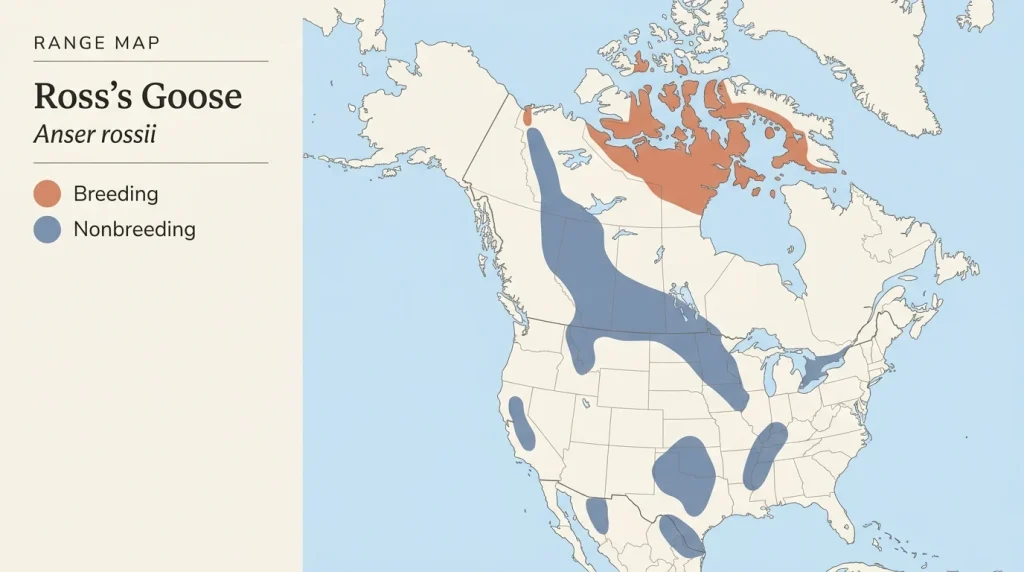
Ross’s Goose breeds mainly in the Canadian Arctic. The Queen Maud Gulf region of Nunavut is a major breeding area, with colonies also occurring elsewhere in Arctic Canada. Its breeding distribution and numbers have expanded since the mid-twentieth century.
During migration, birds move through western and central North America. Important wintering areas include California’s Central Valley, parts of the southern Great Plains and lower Mississippi Valley, and northern Mexico. Smaller numbers appear well outside these main areas, sometimes among Snow Geese in eastern North America.
Local numbers vary with weather, available food, and wetland conditions. The Cornell Lab of Ornithology’s Ross’s Goose range map provides a useful overview of seasonal distribution.
Habitat
On the breeding grounds, Ross’s Geese use open Arctic tundra near shallow lakes, ponds, and marshes. Nesting colonies often occupy islands or other sites with nearby water and low vegetation.
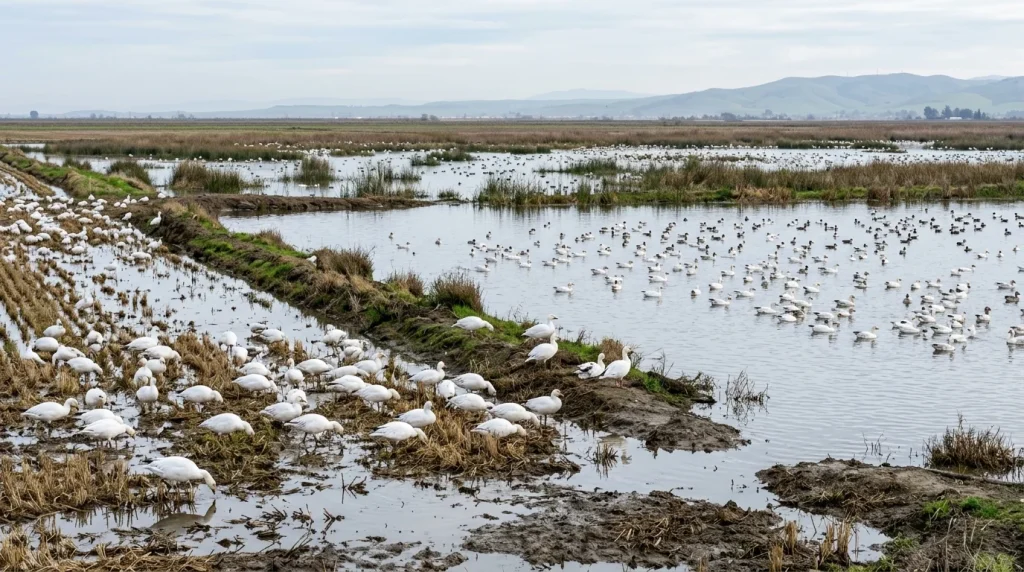
Outside the breeding season, look for them in freshwater marshes, managed wetlands, shallow ponds, and agricultural fields. Flooded rice fields, grain stubble, and short green growth can all attract feeding birds. Safe water for resting and open feeding areas nearby are important parts of their winter landscape.
Behavior
Ross’s Geese are social and often travel with Snow Geese. They feed in busy flocks, walking steadily while clipping plants or picking grain from the ground. Birds frequently move between feeding fields and wetland roosts, though the timing changes with disturbance and local conditions.
In flight, flocks may form lines, loose wedges, or shifting masses. Ross’s Geese can look quick and compact beside larger geese, but flight style alone is unreliable.
Pairs generally form lasting bonds, and family groups may remain together through migration and winter. Watch a small cluster within a flock: repeated close association can reveal a family, although it does not prove every bird belongs to the same species.
Diet
Ross’s Goose eats mainly plant material. Its short bill is well suited to cropping low vegetation.
- Arctic foods: Grasses, sedges, and other tundra plants, including shoots and some below-ground parts.
- Migration and winter foods: Waste grain, rice, green grasses, and wetland vegetation.
- Feeding method: Grazing, picking seeds, and sometimes pulling or digging at plants.
Farm fields can provide abundant food, but their usefulness depends on harvest methods, flooding, and how much grain is left behind.

Vocalizations
The common call is a high, nasal honk or bark, often described as a short “kek” or “kowk.” It tends to sound higher and less deep than a Snow Goose call.
In a large mixed flock, individual voices are difficult to separate. Use sound to draw attention to a possible bird, then confirm it visually. Recordings on the Cornell Lab of Ornithology’s Ross’s Goose sounds page can help you learn the general call quality.
Breeding and Nesting
Breeding begins after birds reach the Arctic, with timing shaped by snowmelt and spring conditions. Ross’s Geese nest in colonies, sometimes alongside Snow Geese. Colonies range from relatively small groups to large concentrations.
The nest is a shallow ground hollow lined with plant material and down. A typical clutch contains about two to six creamy-white eggs, which may become stained during incubation. The female incubates while the male usually stays nearby and helps defend the nesting area.
Incubation lasts roughly three weeks. Arctic foxes, gulls, and jaegers can take eggs or young, and weather strongly affects breeding success. Observe colonies only from a respectful distance; disturbed adults may leave eggs exposed to cold or predators.

Young and Development
Goslings hatch covered in down, with open eyes and the ability to walk. They leave the nest soon after hatching and feed themselves while both parents guide and protect them. Families move toward suitable grazing areas and water.
Young birds generally become capable of flight at around six to seven weeks, though development varies. Adults also replace their flight feathers during summer and are temporarily flightless. Growing goslings and molting adults therefore depend on places that offer both food and safety.
Where to See
For many birders, winter offers the easiest viewing. Search managed wetlands and nearby fields where large flocks of white geese gather.
- California: Sacramento and San Joaquin Valley refuges and flooded agricultural areas.
- New Mexico: Bosque del Apache National Wildlife Refuge and suitable nearby fields.
- Central states: Wetland refuges and grain-growing areas along migration routes.
- Farther east: Snow Goose concentrations, where scattered Ross’s Geese sometimes occur.
Check recent local reports and refuge access notices. Stay on public roads or marked trails, and avoid approaching closely enough to make resting geese lift their heads or move away.
Similar Species
Snow Goose: The main identification challenge. A Snow Goose usually has a longer neck, a larger body, and a longer bill with a curved bill-face border. Its dark cutting edges form an obvious “grin patch.” Ross’s Goose lacks that broad patch, although a thin dark line along the bill can still be visible.
Ross’s × Snow Goose hybrids: Some birds show mixed features, such as a fairly small body but an intermediate bill. You can’t confidently identify every bird. Record several views and leave difficult birds unresolved when necessary.
Domestic geese: White domestic birds are often bulkier, with different body proportions and no matching black-primary pattern. Escaped birds can vary greatly.
Conservation
Ross’s Goose is commonly listed as Least Concern on the IUCN Red List. Its population has increased greatly from historical lows, helped in part by access to agricultural foods and changes in protection and management.
Large concentrations of Arctic-nesting geese can place heavy pressure on tundra plants. Managers monitor populations, habitat effects, and harvest. Wetland loss, disease outbreaks, and changing Arctic conditions remain concerns even for an abundant species. A secure overall status does not mean every colony or wintering area faces the same conditions.
Field Identification Tips
- Find a comparison bird. Look for a compact goose beside a larger Snow Goose.
- Wait for a side view. Check the short bill, steep forehead, and rounded crown.
- Inspect the bill edge. Look for the absence of a broad dark grin patch.
- Use several features. Size or head shape alone can be misleading.
- Document odd birds. Photograph the bill and whole body before deciding about a possible hybrid.
Frequently Asked Questions
Is Ross’s Goose a small Snow Goose?
No. It is a separate species, although the two are closely related and sometimes hybridize.
Can you tell males and females apart by color?
Usually not. Their plumage is alike, and their sizes overlap.
Does every Ross’s Goose have a white body?
No. Young birds may show gray shading, and a very rare dark form occurs.
What is the most useful identification feature?
The very short bill on a rounded head is the best starting point. Confirm it with bill shape, the lack of a broad grin patch, and compact proportions.


