

Red-throated Loon Guide
Keep Track of What You See
Create a free Wild Things Guide membership to record this Red-throated Loon in My Sightings and build your personal wildlife list.
Join to Add This SightingIntroduction
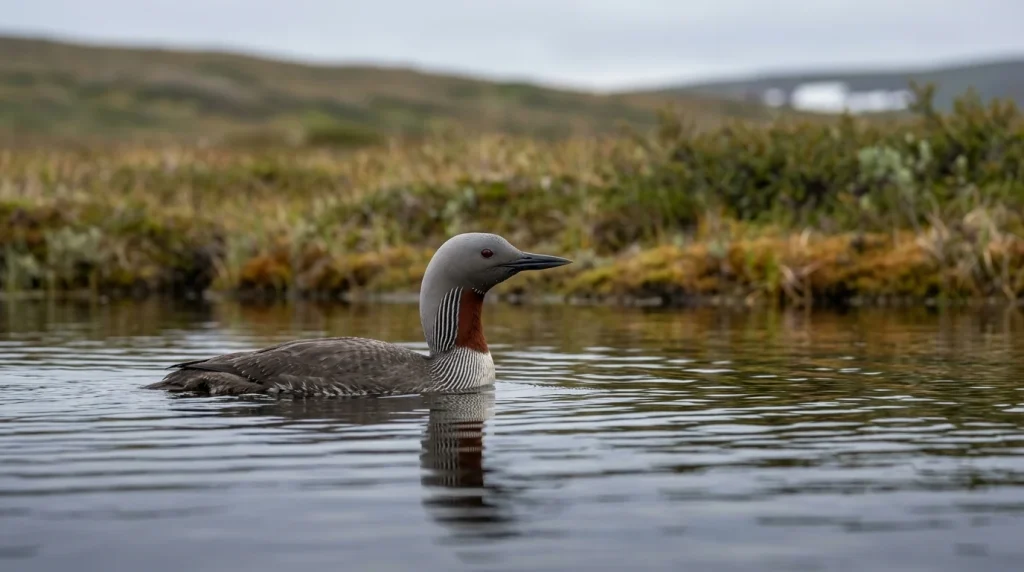
The Red-throated Loon (Gavia stellata) is a slim diving bird of northern ponds and coastal waters. Although it sometimes appears in general bird lists alongside songbirds, it is a loon, not a songbird. Its narrow bill, often tilted upward, is one of its most useful field marks.
In breeding plumage, adults show a rusty-red throat patch. Outside the breeding season, that patch disappears, and identification depends more on shape, posture, and the pattern of white on the neck. This guide focuses on recognizing the species in North America, especially along winter coasts.
Quick Identification
- Shape: Small, slender loon with a narrow neck and relatively small head.
- Bill: Thin and pointed, often held slightly above horizontal.
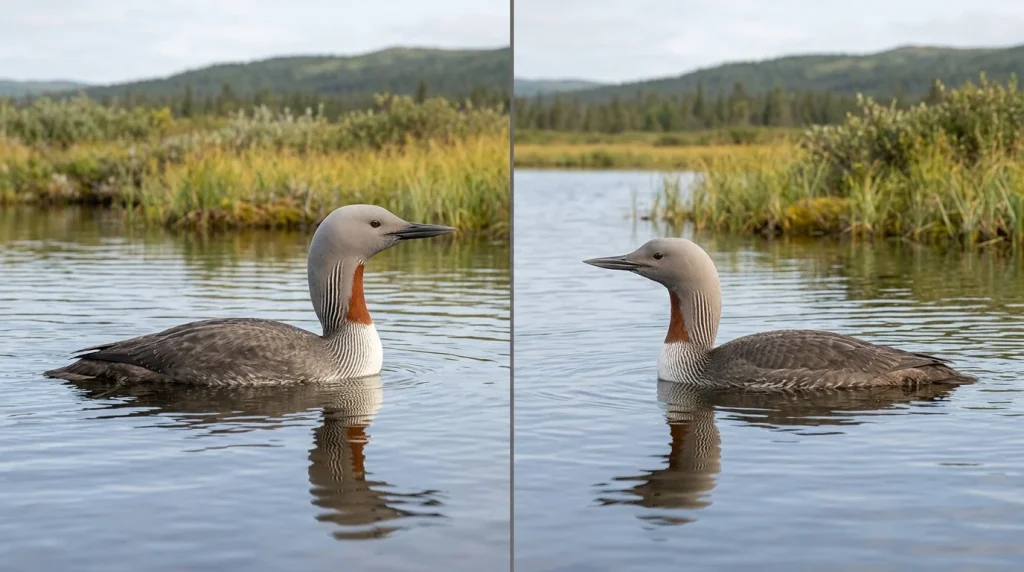
- Breeding adult: Gray head, rusty-red throat, dark back, and fine black-and-white lines on the hindneck.
- Nonbreeding adult: White throat, face, and front of neck; gray crown and nape; finely spotted upperparts.
- On the water: Often floats low, with a smooth, stretched profile.
- Best approach: Combine bill angle, head shape, neck pattern, and size rather than trusting one mark.
Appearance
Red-throated Loons have long bodies, pointed bills, and feet set far back. This build supports strong underwater swimming but makes walking awkward. The thin neck and small head help separate them from the heavier-looking Common Loon.
The bill can look slightly upturned because its lower edge rises toward the tip. The bird also frequently carries its head with the bill raised. That posture is helpful, but it is not constant.
Males and females have similar plumage. Males average somewhat larger, but most lone birds cannot be sexed reliably in the field. Adults have reddish eyes, usually noticeable only at close range.
Breeding and Nonbreeding Plumage
Breeding adults have a soft gray head and neck. The throat patch is deep reddish brown, not bright scarlet, and may look dark from a distance. Fine pale and dark stripes run along the back of the neck. The back is mostly dark gray-brown, without the Common Loon’s bold checkerboard pattern.
Nonbreeding adults are much paler around the face and neck. White usually reaches above and around much of the eye, leaving a gray crown and hindneck. Small pale spots mark the dark upperparts.
Juveniles often show more gray on the face and fore-neck, with a soft, scaly-looking back. Birds in molt may show a mix of seasonal features.

Size and Wingspan
- Length: About 21–27 inches (53–69 cm).
- Wingspan: About 41–46 inches (105–116 cm).
This is the smallest loon regularly found in North America. It is generally smaller and slimmer than a Pacific Loon and clearly less bulky than a Common Loon. Distance, waves, and posture can distort size, so direct comparisons are more useful than estimates of a lone bird.
Range and Distribution
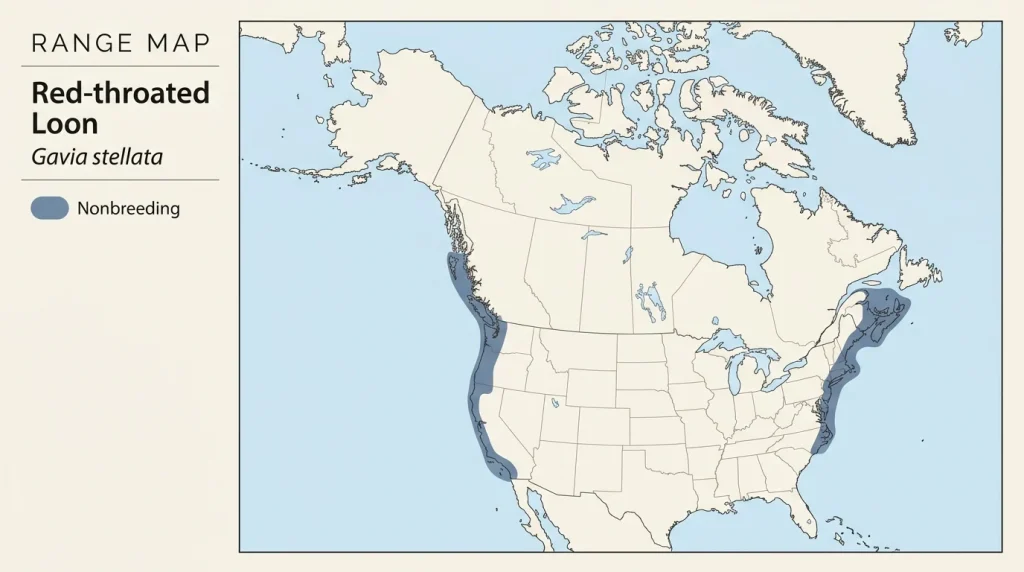
Red-throated Loons breed across the far north of North America, Greenland, Europe, and Asia. In North America, their breeding range includes much of Alaska and northern Canada, with some nesting farther south along the northern Pacific coast.
Most spend the nonbreeding season on saltwater. Look for them along both the Atlantic and Pacific coasts, including parts of the United States. Migration also brings birds through the Great Lakes and other large inland waters, though inland sightings are less predictable. Regional timing varies with weather, ice, and food supplies.
Habitat
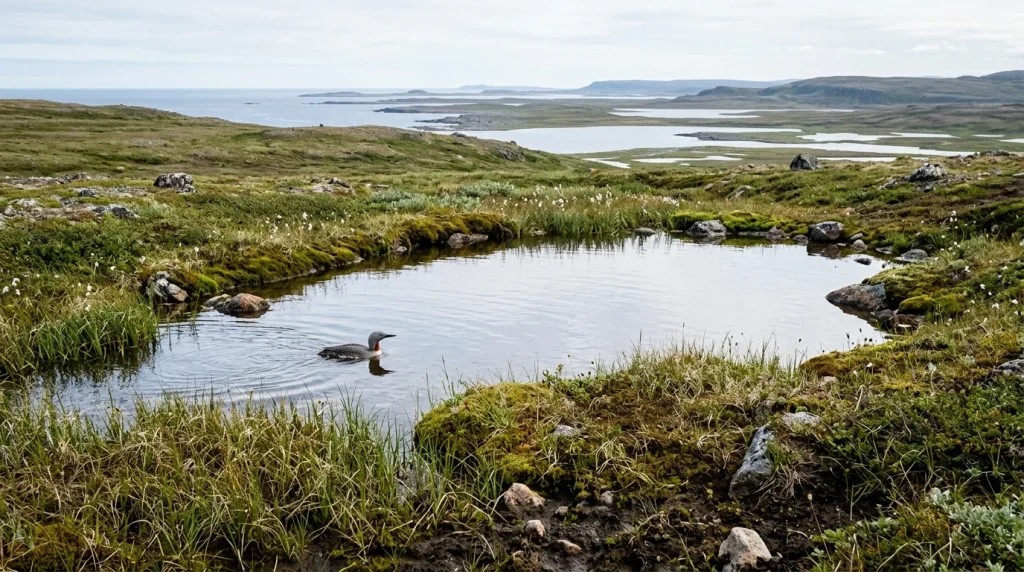
Breeding habitat often consists of small, shallow freshwater ponds in open tundra or coastal lowlands. A nesting pond does not always provide enough fish; adults may fly to nearby lakes or the sea to feed.
During migration and winter, they use bays, estuaries, coastal channels, and nearshore ocean waters. They may gather where currents concentrate small fish. Large lakes and reservoirs provide occasional inland stopovers. Compared with many other loons, they can nest successfully on surprisingly small ponds.
Behavior
Watch for a bird swimming low, looking below the surface, and slipping underwater to pursue prey. Loons propel themselves mainly with their feet while diving. A feeding bird may surface well away from its starting point.
Unlike larger loons, Red-throated Loons can take flight from very small ponds and sometimes from land. Their relatively light build helps them use nesting sites unavailable to heavier species.
In flight, the neck stretches forward, and the feet trail behind. Wingbeats are quick and steady. Birds may feed near one another in winter, but loose groups are more typical than tightly packed flocks.
Diet
Small fish make up most of the diet. The kinds eaten depend on location and may include schooling coastal fish or freshwater species. They also take crustaceans, aquatic insects, and other small water animals.
Adults catch prey underwater, often swallowing smaller items before surfacing. Breeding birds commonly carry fish back to their chicks. Seeing an adult arrive at a tiny pond with a fish does not mean it caught that fish there; feeding trips may extend to nearby coastal waters.

Vocalizations
Red-throated Loons give several rough, carrying calls, including repeated cackling or quacking notes. Pairs also use louder, wailing calls on the breeding grounds. Flying birds may call as they travel between nesting and feeding waters.
They are often quiet on winter coasts, so silence does not help rule them out. The Cornell Lab of Ornithology’s Red-throated Loon recordings are useful for learning the calls before a northern trip. Avoid playback near nesting birds.
Breeding and Nesting
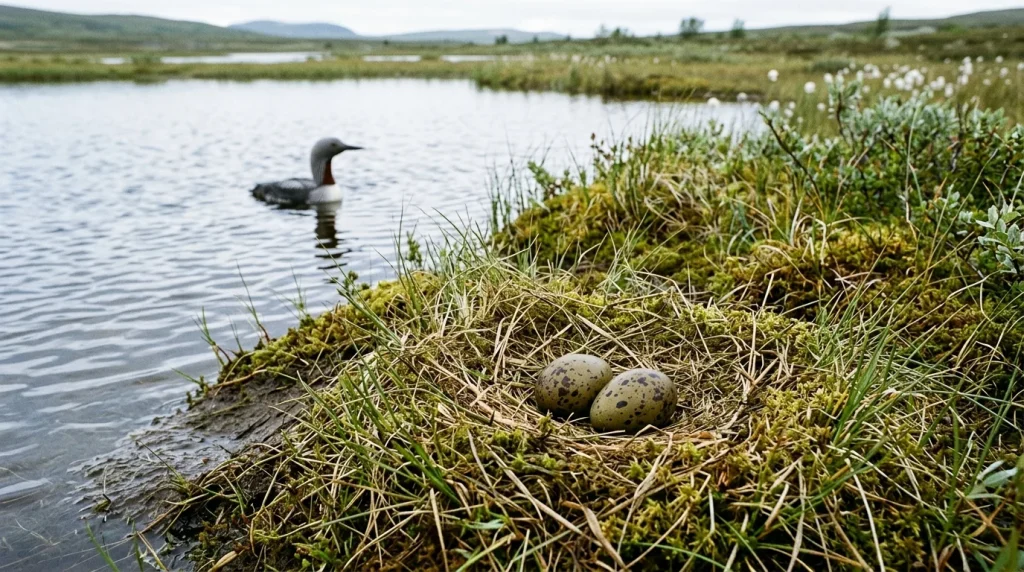
Pairs nest beside freshwater, often on a low bank, small island, or mat of vegetation. The nest is a shallow depression with variable amounts of plant material. Its position at the water’s edge lets the adults slide directly into the pond.
A typical clutch contains two olive-brown eggs marked with darker spots. Both parents incubate, with hatching usually after about four weeks. Both also help care for the young.
Water-level changes can flood or expose nests. Foxes, gulls, and other predators may take eggs or chicks. Give nesting ponds plenty of space, especially when adults appear alert or reluctant to return.
Young and Development
Chicks hatch covered in dark down and can enter the water soon afterward. They remain dependent on their parents for food and protection. Adults first deliver small prey and later larger fish as the chicks grow.
Young birds generally begin flying at roughly six to eight weeks, though development varies. Until then, the nesting pond serves as their nursery even when adults feed elsewhere. Juvenile plumage lacks the adult’s red throat and can remain noticeably dusky around the face and neck.
Where to See
In winter, try public coastal overlooks, sheltered bays, harbor entrances, and beaches with views of nearshore water. Productive North American areas include Pacific Northwest coastal waters, the California coast, and Atlantic sites from New England through the Mid-Atlantic region.
For breeding birds, accessible tundra wetlands in Alaska can offer opportunities without approaching nests. A spotting scope is valuable almost everywhere. Start in calmer water, scan slowly, and wait for diving birds to resurface. Follow local access rules and keep away from sensitive shorelines.
Similar Species
- Pacific Loon: Usually has a straighter, more level bill and a rounder-looking head. In winter, its dark hindneck contrasts sharply with the white front; a faint chinstrap may be visible. Do not rely on that chinstrap alone.
- Common Loon: Larger and heavier, with a thicker bill and broader head. Winter birds often show a pale break in the dark neck area and more dark color around the eye.
- Arctic Loon: Rare in most of North America. It resembles Pacific Loon but may show a white flank patch. Difficult birds need several clear views.
- Western and Clark’s Grebes: Have very long, narrow necks and different head patterns. Their yellowish bills contrast with the Red-throated Loon’s grayish bill.
Conservation
The IUCN classifies the Red-throated Loon as Least Concern globally, but that does not mean every population is secure. Trends differ across its broad range.
Threats include oil pollution, entanglement in fishing gear, disturbance around nesting ponds, and changes in fish supplies. Climate change may alter both northern wetlands and marine feeding areas. Protecting quiet nesting habitat and clean coastal waters benefits this species. Birders can help by keeping their distance and reporting unusual sightings through established monitoring programs.
Field Identification Tips
- Start with shape. Look for a thin neck, small head, and fine bill.
- Watch several postures. An upward bill angle supports identification but is not proof.
- Check the face. Winter adults usually look whiter around the eye than other loons.
- Study the back. Fine pale spotting differs from bold breeding checks.
- Allow for age and molt. Young birds can have dark, confusing neck patterns.
- Be patient. Waves and glare hide important marks; leave uncertain birds unidentified.
Frequently Asked Questions
Is the throat always red?
No. The red patch is part of breeding plumage. Winter adults have white throats, while juveniles often show grayish shading.
Is it a songbird?
No. It belongs to the loon family, Gaviidae, in the order Gaviiformes.
Can it be seen inland?
Yes, especially during migration on large lakes. Most winter along coasts, so inland birds deserve careful comparison with other loons.
Can you tell males and females apart?
Usually not by plumage. Males are on average larger, but size overlaps and rarely settles the question in ordinary field views.


