

Red-tailed Hawk Guide
Keep Track of What You See
Create a free Wild Things Guide membership to record this Red-tailed Hawk in My Sightings and build your personal wildlife list.
Join to Add This SightingIntroduction
The Red-tailed Hawk (Buteo jamaicensis) is one of North America’s most familiar large raptors, seen circling over fields or watching roadsides from elevated perches. Despite its name, the tail is not always visibly red: juveniles have banded brown tails, and some adults differ from the familiar pattern. Reliable identification relies on shape, flight style, underwing markings, and age rather than a single color.
Quick Identification
- Shape: Broad, rounded wings, a substantial body, and a relatively short, wide tail.
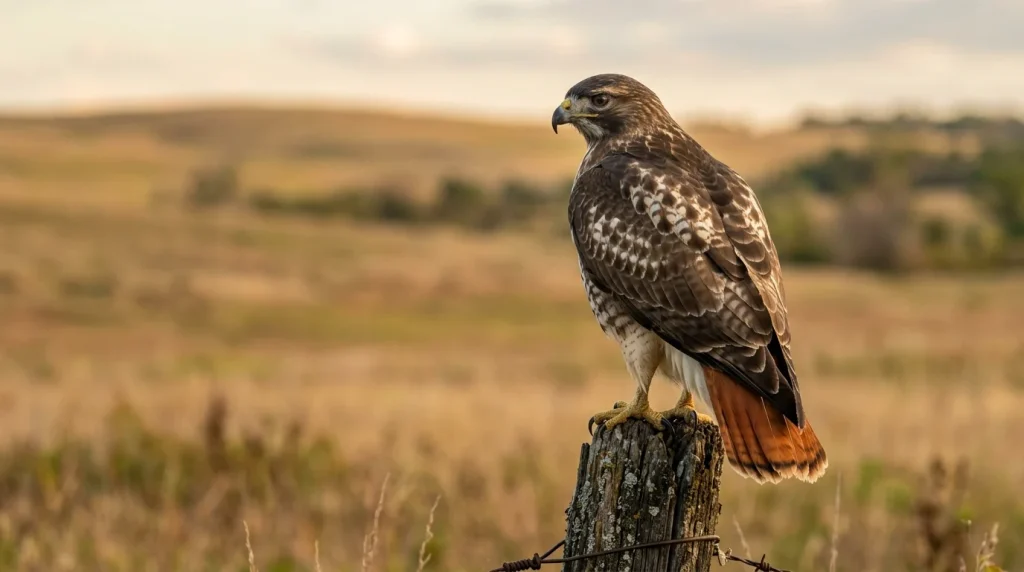
- Typical adult: Brown above, pale below, with a rusty-red upper tail.
- Underparts: Many pale birds show a streaked belly band beneath a cleaner upper breast.
- Underwings: Dark patagial bars along the leading edge between the body and wrist are especially useful on pale birds.
- Behavior: Often perches conspicuously or circles on rising air with few wingbeats.
- Juvenile: Brown tail crossed by multiple narrow dark bands; no solid rusty adult tail.
Appearance and Field Marks
A typical light-plumaged Red-tailed Hawk has a brown head and back, a pale chest, and dark streaks concentrated across the belly. The throat may be pale or dark. Pale mottling on the shoulder feathers can form a broken V on a perched bird’s back, although this is supporting evidence rather than a decisive mark.
On soaring birds, look for the dark patagial bars and the distribution of markings across the belly and flight feathers. The adult’s red tail is most obvious from above; from below it can look pale, pinkish, or nearly colorless in strong light. Many adults have a narrow dark band near the tail tip.
Plumage varies enormously, especially in western North America. Dark and intermediate birds may lack an obvious pale breast or belly band. Harlan’s birds can have unusually patterned, pale, grayish, or mixed-color tails. Some southwestern birds are notably pale. Use several features together, and consult the Cornell Lab of Ornithology’s Red-tailed Hawk identification guide when comparing regional variation.
Male and Female Differences
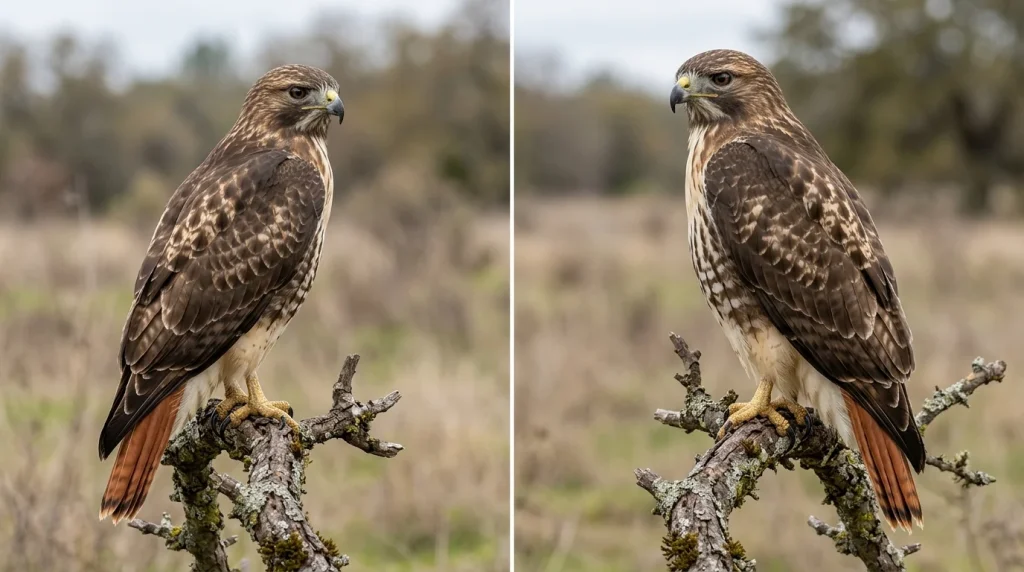
Males and females have broadly similar plumage. Females average larger and heavier, but the sexes overlap in size, and distance or posture can easily mislead an observer. When a breeding pair sits together, a consistent size difference may suggest the female. A lone bird usually cannot be sexed confidently by appearance, and neither tail redness nor belly-band darkness reliably identifies sex.
Size and Wingspan
- Length: Approximately 45–65 cm (18–26 in).
- Wingspan: Approximately 110–145 cm (43–57 in).
- Build: Heavy-bodied, broad-winged, and generally bulkier than a crow.
Size varies with sex and geography. In the field, proportions are usually more useful than an estimated measurement, especially for a solitary bird against an empty sky.
Range and Distribution
Red-tailed Hawks occur across much of North America, from Alaska and Canada through the contiguous United States and Mexico into Central America. Resident populations also inhabit parts of the Caribbean. Breeding reaches well into northern forested regions where suitable openings occur, but the species is not a characteristic bird of the high Arctic.
Northern populations withdraw southward in winter, while many birds farther south remain year-round. Local abundance depends strongly on open hunting ground, prey, and available nesting sites.

Habitat
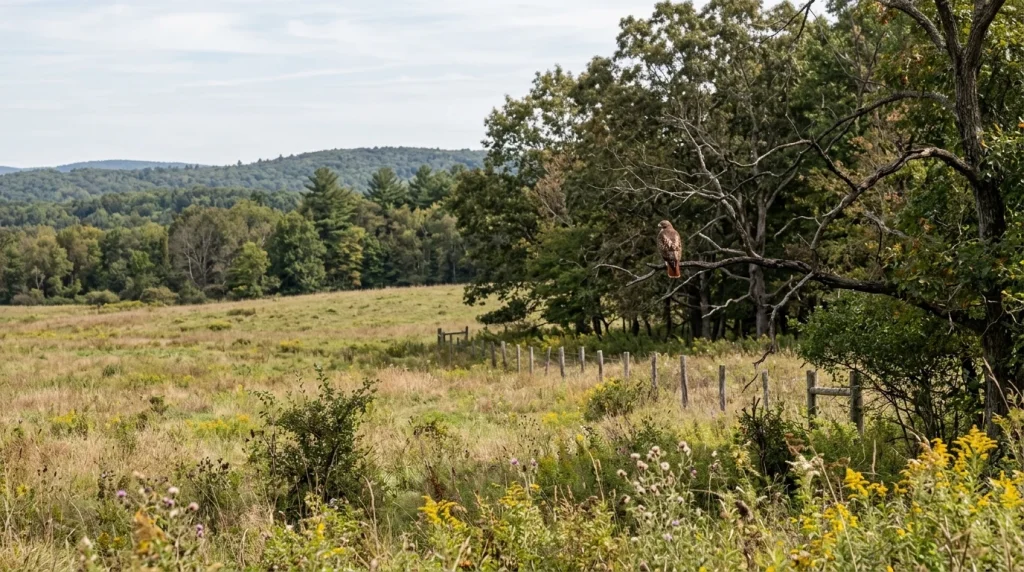
Look for a mixture of open ground and elevated lookout points. Grasslands, pastures, agricultural fields, desert scrub, woodland edges, and open mountain country all provide suitable habitat. Red-tails also use suburban parks, utility corridors, and urban landscapes with nearby hunting space.
They generally favor broken or open landscapes over continuous dense forest. Scattered trees, cliffs, poles, and buildings supply perches and potential nesting locations.
Migration
Migration is partial: some populations travel substantial distances, while others remain near their breeding territories. Northern birds generally move south in autumn and return in spring. Young birds may disperse widely before establishing territories.
During migration, Red-tailed Hawks exploit thermals and ridge lift, sometimes passing hawk-watch sites in considerable numbers. Autumn passage commonly extends later than that of several long-distance migrant raptors. Timing varies with latitude, weather, and population, so local migration reports are more useful than a single continent-wide date.
Flight Style
A soaring Red-tailed Hawk holds its broad wings level or in a shallow V, with the outer flight feathers spread into distinct “fingers.” It frequently circles without flapping, then glides toward another thermal or a hunting area.
Powered flight consists of deliberate, substantial wingbeats. Compared with a Turkey Vulture, it usually looks more compact and less prone to persistent rocking. Brief wind-hovering can occur, but sustained hovering is not its usual hunting method.
Diet and Hunting
Small and medium-sized mammals form much of the diet, including voles, mice, rats, ground squirrels, and rabbits. Birds, snakes, and other available animals supplement the menu, with big regional differences. Red-tails occasionally take carrion.
A common hunting sequence begins on a pole, branch, or fence post. The hawk watches the ground, then drops or glides toward prey and strikes with its feet. It also searches while soaring or flying low over suitable cover. A roadside perch does not necessarily mean a recent kill; a bird may simply be resting or surveying its surroundings.

Voice and Calls
The best-known call is a harsh, descending scream, often rendered as “kreeeeeer.” You may hear it during territorial encounters, courtship, or disturbance near a nest. Young birds give persistent begging calls.
This scream is frequently used in films and television for other raptors, including eagles. A soundtrack is therefore no guide to the identity of the bird shown.
Breeding and Nesting
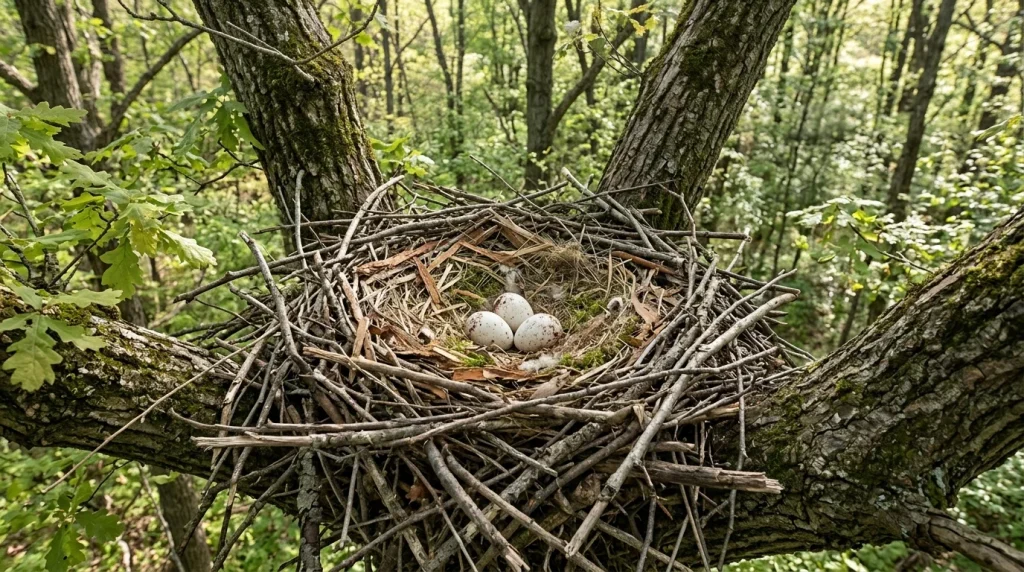
Pairs may maintain territories and reuse nesting areas over several seasons. Courtship can include circling, calling, steep dives, and aerial interactions. The nest is a large platform of sticks, commonly placed high in a substantial tree, but cliffs and human-made structures are also used.
A typical clutch contains two or three eggs, though larger or smaller clutches occur. Eggs are whitish, often with brownish markings. Incubation lasts roughly four to five weeks, with the female doing most of it while the male supplies much of the food. Both adults help raise the young. Watch from a distance and leave if your presence changes their behavior.
Young and Development
Newly hatched chicks are downy and dependent on their parents for warmth and food. They gradually develop brown juvenile plumage and usually leave the nest at around six to seven weeks, although development varies.
Fledglings remain dependent for a period after their first flights and may call repeatedly near the nesting area. Their brown, narrowly banded tails are a key age clue. The red adult tail generally develops during the molt following their first year. A fully feathered youngster on a low branch is not automatically abandoned; observe from a distance before contacting a wildlife rehabilitator.

Where to See
Scan field edges, isolated trees, utility poles, and fence lines from safe public viewpoints. In winter, open agricultural country can be particularly productive. On sunny days, check the sky as rising air encourages soaring.
Migration overlooks along ridges and coastlines offer opportunities to compare several raptors. Use binoculars first, then a scope if you have one. Never stop in traffic, approach occupied nests, or bait hawks for photographs.
Similar Species
- Red-shouldered Hawk: Usually smaller and slimmer, with a more strongly banded tail. Adults have barred reddish underparts; translucent crescents near the outer wing can help in flight.
- Swainson’s Hawk: Longer, more pointed wings. Light adults show a dark chest bib and dark flight feathers contrasting with paler underwing coverts.
- Rough-legged Hawk: Often shows dark wrist patches, a pale tail base, and, on many birds, a broad dark belly patch. More prone to hovering; leg feathering is useful at close range.
- Ferruginous Hawk: Often looks larger, with a broad gape and a pale head. Light adults have rusty feathered legs that can form a dark V against the pale belly.
- Turkey Vulture: Longer wings, a small head, and strongly contrasting dark wing linings and silvery flight feathers; usually holds a more pronounced V and rocks in flight.
Conservation
The Red-tailed Hawk is commonly listed as Least Concern globally and remains widespread. Nevertheless, individuals face vehicle strikes, electrocution, persecution, habitat loss, and poisoning, including exposure to some rodenticides through contaminated prey. Birds can also be exposed to lead when they scavenge contaminated remains.
Protecting open hunting habitat and mature nest trees, reducing unnecessary rodenticide use, and improving hazardous utility infrastructure can help. Widespread abundance does not remove the need to treat local birds responsibly.
Field Identification Tips
- Start with broad wings, a bulky body, and a relatively short tail.
- Check the leading underwing edges for dark patagial bars.
- Assess the belly pattern, but allow for dark and unusually pale birds.
- Look at the tail from above when possible; distinguish juvenile barring from adult coloration.
- Confirm with flight style, location, and comparison with nearby raptors.
Interesting Facts
- The scientific name refers to Jamaica, where the species was first scientifically described.
- The familiar rusty tail is principally an adult feature, not a mark shared by every age.
- Red-tailed Hawks can adapt to cities when hunting areas and suitable nest sites remain available.
Frequently Asked Questions
Does every Red-tailed Hawk have a red tail?
No. Juveniles have brown, banded tails, and some adult populations show considerable variation. Lighting can also hide the red.
Can I identify one by its belly band alone?
Not reliably. Other hawks can show belly markings, and some Red-tailed Hawks have weak or obscured bands. Combine shape, patagial bars, and tail pattern.
Do Red-tailed Hawks eat pets?
Their usual prey is wildlife, especially small mammals. Attacks on pets are uncommon, but keep very small animals supervised outdoors.
Why does one keep sitting beside the highway?
Road verges can provide open hunting ground, while poles and trees offer lookout points. Observe only from a safe, legal stopping place.


