
Red-necked Grebe Guide
Keep Track of What You See
Create a free Wild Things Guide membership to record this Red-necked Grebe in My Sightings and build your personal wildlife list.
Join to Add This SightingIntroduction
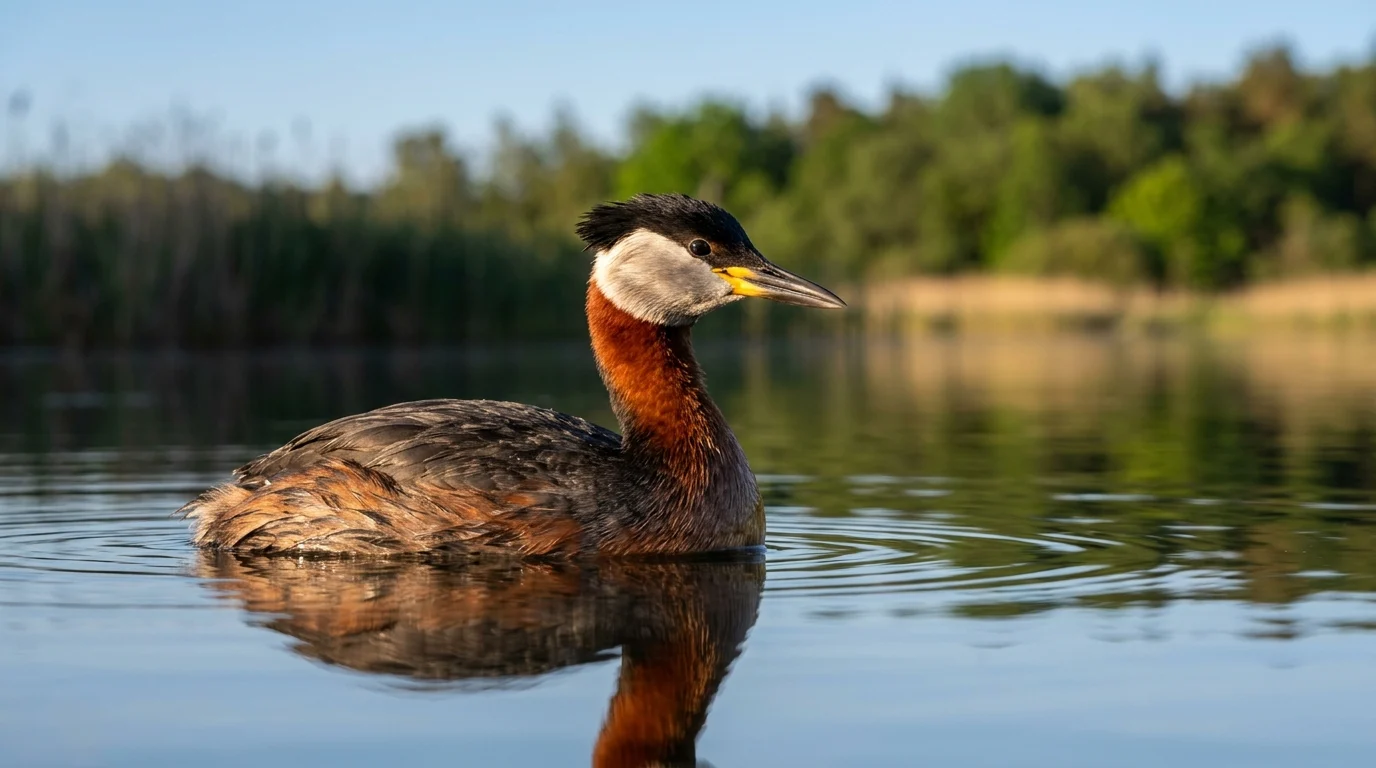
The Red-necked Grebe (Podiceps grisegena) is a mid-to-large aquatic waterbird celebrated for its colorful breeding appearance, dramatic courtship displays, and loud, unusual calls. During spring and summer breeding, adult Red-necked Grebes show a rich rufous-red neck, crisp silvery-white cheeks, and a heavy bill with a bright yellow base. In winter, they adopt subtle gray-and-white plumage suited to open coastal waters and large lakes. Belonging to the grebe family (Podicipedidae), these birds spend nearly their entire lives afloat, coming onto land only during the nesting cycle.
Quick Identification
When observing waterbirds from a distance, look for these key visual markers to identify a Red-necked Grebe quickly:
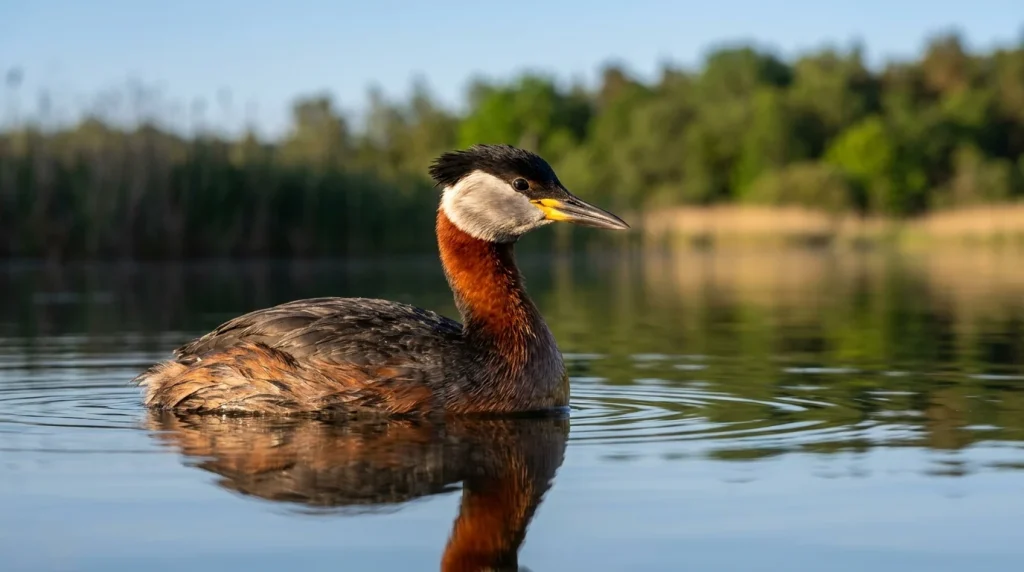
- Body Profile: A mid-sized waterbird riding low in the water, with a stocky body and a moderately long neck.
- Bill Shape and Color: A sturdy, dagger-like bill with a prominent yellow base on both the upper and lower mandibles year-round.
- Head Pattern: Dark cap extending down past the eye, creating a distinct line above silvery or pale gray cheeks.
- Breeding Neck: Rich chestnut-red front and sides of the neck in spring and summer.
- Winter Neck: Subtle, dusky gray-brown neck in fall and winter.
Appearance
The Red-necked Grebe is built for a life spent almost entirely in the water. It possesses a sleek, streamlined torso, a flat-topped head, and strong legs set far back on the body. Instead of webbed feet like ducks, grebes have lobed toes with broad skin flaps that fold on the forward stroke and expand on the backward stroke, acting like efficient underwater paddles.
The head features a dark blackish crown that extends below the eye, giving the bird a somewhat hooded look. The sides of the head are silvery-white to pale gray, creating a sharp line of contrast. The bill is long, thick, and pointed, making it noticeably heavier than the short, thin bills of smaller grebes. The bright yellow color at the base of the bill remains visible year-round and serves as one of the best field marks for species identification.
Breeding and Nonbreeding Plumage
Red-necked Grebes undergo a distinct seasonal transition in appearance between their breeding and wintering seasons.
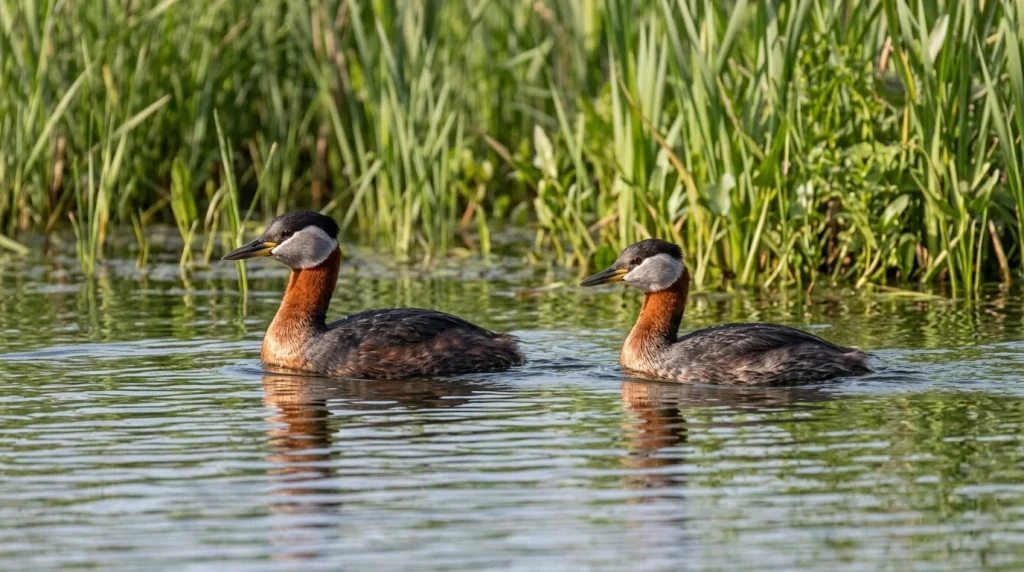
Breeding Plumage: From early spring through mid-summer, adults display striking colors. The front and sides of the neck turn a deep chestnut-red color. The cheeks turn a bright, silvery-white color that contrasts sharply with the dark blackish crown above. Small black feather tufts along the crown can be raised slightly during territorial and courtship displays.
Nonbreeding Plumage: During the autumn molt, the bird drops its reddish neck feathers in favor of a dusky brownish-gray neck. The bright white cheek patch becomes a paler gray, and the overall upperparts fade to a dark slate gray or brownish gray. Despite these color changes, the dark cap still extends past the eye, and the yellow base of the bill remains clear in good light.

Size and Wingspan
The Red-necked Grebe is larger than the Horned Grebe or Eared Grebe, but smaller than the Western Grebe and Great Crested Grebe.
- Length: 17–22 inches (43–56 cm)
- Wingspan: 24–35 inches (61–89 cm)
- Weight: 1.7–3.5 pounds (800–1600 grams)
Because their wing area is small relative to their body weight, Red-necked Grebes must run across the water while flapping their wings vigorously to gain enough speed to take flight.
Range and Distribution
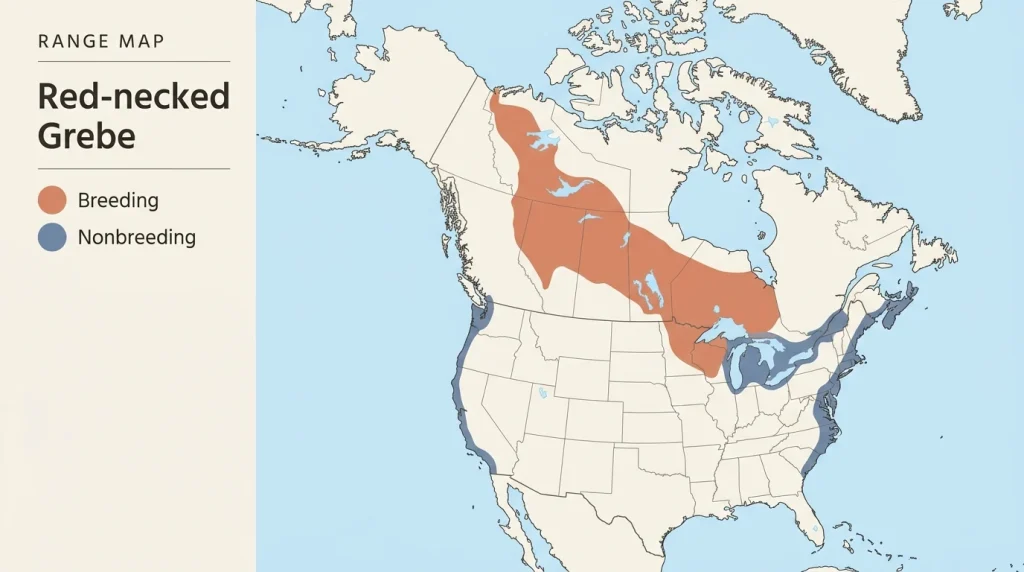
The Red-necked Grebe has a broad range that spans northern regions across North America, Europe, and Asia. In North America, the species breeds across central Alaska, through western and central Canada, and into northern states such as Washington, Idaho, Montana, North Dakota, South Dakota, and Minnesota.
As winter approaches, inland breeding lakes freeze over, prompting these birds to migrate to ice-free waters. Detailed natural history profiles from the Cornell Lab of Ornithology show that North American populations winter along coastal waters from Alaska south to southern California on the Pacific side, from Atlantic Canada south to the Mid-Atlantic coast, and across the Great Lakes.
Habitat
The preferred habitat of the Red-necked Grebe changes with the seasons based on nesting and feeding needs.
Breeding Habitat: During spring and summer, Red-necked Grebes nest in shallow freshwater environments. These include quiet bays on inland lakes, shallow ponds, prairie sloughs, and slow-moving river bends. They need bodies of water with dense stands of emergent plants, such as cattails, bulrushes, and reeds, which provide anchor sites for floating nests and shelter for young chicks.
Nonbreeding Habitat: During winter and migration, the birds move to large bodies of open water. They favor sheltered coastal bays, fjords, ocean estuaries, and marine channels. Inland, they stop on deep, clear freshwater reservoirs and open Great Lakes bays that remain ice-free.

Behavior
Red-necked Grebes are powerful divers and active watercraft. Because their legs sit near the rear of their bodies, walking on dry land is clumsy and difficult, so they avoid stepping onto shore whenever possible. While swimming, they ride low in the water and can voluntarily adjust their buoyancy by squeezing air out of their plumage, leaving only their neck and head exposed when sensing danger.
To capture prey, they perform surface dives, thrusting themselves forward and downward with their lobed feet. Underwater, they turn with agility to pursue fast-moving fish and aquatic insects. Like all members of the grebe family, Red-necked Grebes regularly ingest their own feathers. These swallowed feathers collect in the stomach, forming a fibrous mass that traps sharp fish bones, giving digestive juices time to break them down or allowing the bird to cast up bone-filled pellets safely.
Diet
The Red-necked Grebe is primarily an aquatic predator and adjusts its diet by season and location.
- Fish: Small to medium-sized fish, including minnows, perch, sculpins, sticklebacks, and young salmonids, form the main part of their diet.
- Aquatic Insects: Dragonfly and damselfly nymphs, water beetles, water boatmen, and caddisfly larvae are heavily eaten during the summer.
- Crustaceans: Crayfish, small crabs, and freshwater shrimp are taken frequently in coastal or river habitats.
- Other Aquatic Life: Amphibians (such as tadpoles), aquatic snails, marine worms, and small leeches.

Vocalizations
On their summer breeding lakes, Red-necked Grebes are exceptionally vocal birds. Breeding pairs sing loud duets to establish nesting territory and reinforce their bond. These calls include high-pitched wails, horse-like whinnies, braying sounds, and harsh pig-like squeals that carry long distances across open water, especially at night, early morning, and late evening.
Outside of the breeding season, Red-necked Grebes become almost silent. On wintering coastal waters, observers rarely hear more than an occasional quiet croak or low contact note.
Breeding and Nesting
Red-necked Grebes form strong seasonal pair bonds when they arrive at their northern breeding grounds. Their courtship displays are complex and dramatic, involving synchronized head-shaking movements, side-by-side racing across the water, and
When Red-necked Grebes reach their northern breeding territories, they establish strong pair bonds that last for the season. Their courtship rituals are intricate and theatrical, featuring coordinated head-shaking and racing side by side.

the presentation of aquatic vegetation. Once a pair has formed a bond, they work together to build a floating nest of reeds and other plant materials. Both parents take turns incubating the eggs, which typically number between three and six. After the chicks hatch, they are highly precocial and quickly learn to swim and dive, often riding on their parents’ backs for protection and warmth. This close parental care helps ensure a higher survival rate during the vulnerable early weeks of life.


