Red Crossbill Guide
Keep Track of What You See
Create a free Wild Things Guide membership to record this Red Crossbill in My Sightings and build your personal wildlife list.
Join to Add This SightingIntroduction
The Red Crossbill (Loxia curvirostra) is a compact, nomadic finch specialized for feeding on conifer seeds. Its most distinctive feature is the crossed bill: the upper and lower mandibles curve past one another at the tips, forming a tool that pries apart cone scales. The bird then extracts the exposed seed with its tongue.
Red Crossbills occur across much of North America’s conifer country, but they can be difficult to predict. Flocks move in response to changing cone crops and may appear far beyond their usual strongholds during irruptions. Plumage, bill size, flight calls, location, and associated conifers all help with identification. For photographs, sounds, and current taxonomic context, see the Cornell Lab of Ornithology’s Red Crossbill account.
Quick Identification
- Shape: Stocky, short-necked finch with a fairly large head and deeply notched tail.
- Bill: Thick at the base, with visibly crossed mandible tips.
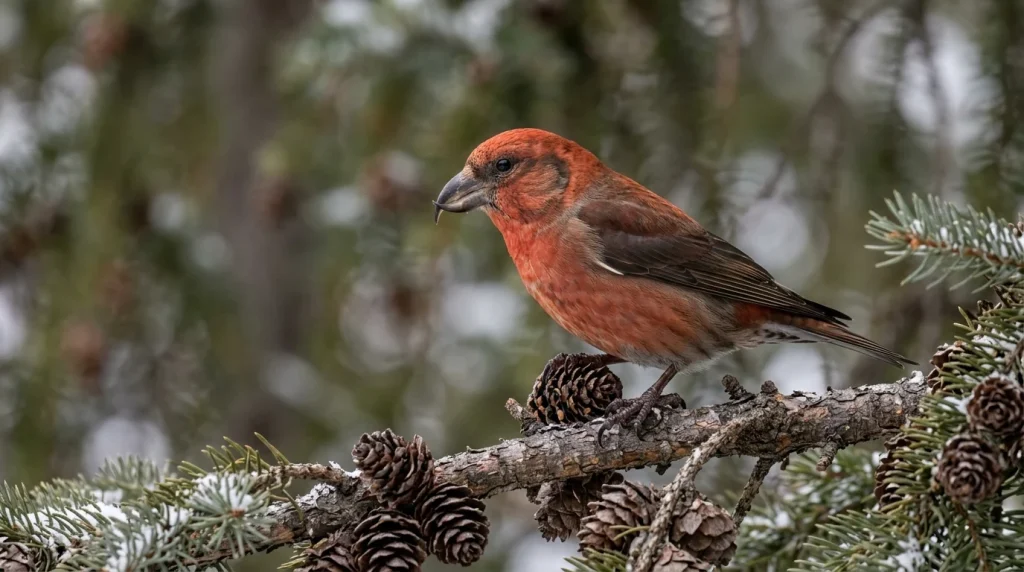
- Adult male: Usually brick red, orange-red, or reddish yellow, with darker brown wings and tail.
- Adult female: Olive, yellow-green, or gray-green, often brightest on the rump and breast.
- Juvenile: Brownish and heavily streaked below; the bill may not look fully crossed immediately after fledging.
- Flight: Strong and undulating, often in compact, calling flocks.
- Setting: Most often found in spruces, pines, firs, hemlocks, larches, or Douglas-firs bearing cones.
Appearance
Red Crossbills have the sturdy body and relatively short legs typical of finches. Their bills vary noticeably in depth, length, and curvature. These differences are associated partly with populations that favor different kinds of conifer cones. Either the upper mandible can cross to the left or to the right; the direction does not indicate sex.
Adult males vary from dull yellow-orange to deep red. Their wings and forked tails are dusky brown and lack the bold white bars of a White-winged Crossbill. Females are generally subdued olive-gray to yellow-green, sometimes with a warmer yellow rump. Individual variation, molt, age, and feather wear can make plumage an unreliable guide to sex in borderline birds.
Young birds are gray-brown or buff-brown with extensive dark streaking across the breast, flanks, and back. As they mature, the bill tips cross, and the streaked juvenile plumage is gradually replaced.

Size and Wingspan
Most adult Red Crossbills measure about 5.5–6.5 inches (14–17 centimeters) long, with a wingspan near 10–11 inches (25–28 centimeters). Size varies among populations, especially in bill dimensions. In the field, the species looks larger-headed and heavier-billed than a Pine Siskin or American Goldfinch but smaller and more compact than a Pine Grosbeak.
Range and Distribution
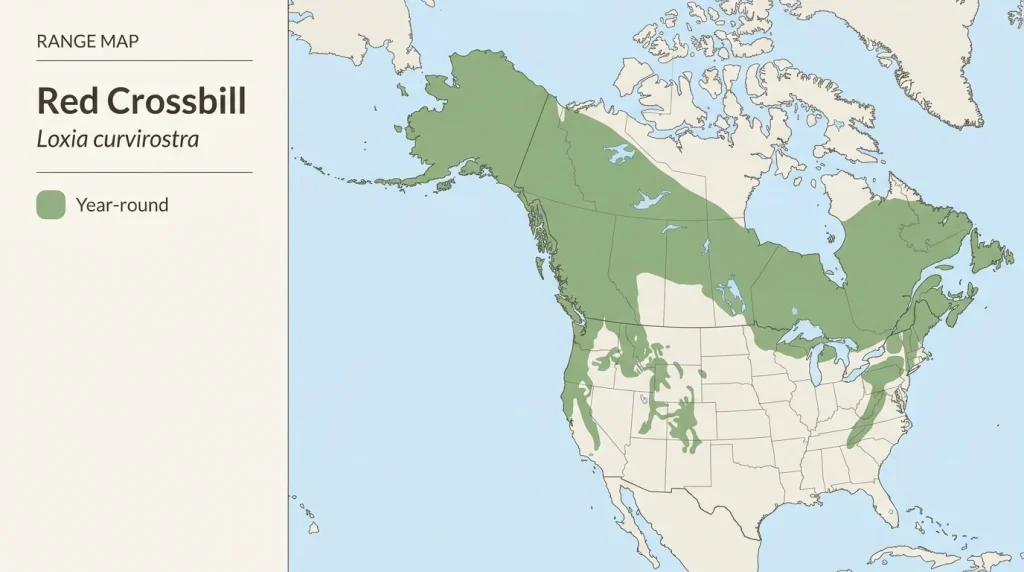
Red Crossbills are widely distributed across the Northern Hemisphere. In North America, they occur from Alaska through much of Canada and south through the western mountains. They also inhabit parts of the Great Lakes region, Northeast, Appalachians, and other areas with suitable conifers.
Their distribution is unusually fluid. When local seed supplies decline, flocks may travel hundreds of miles and appear in lowlands, coastal forests, plantations, parks, or residential areas. A location that hosts many crossbills one winter may have none the next. Seasonal maps should therefore be treated as broad guidance rather than fixed boundaries.
Habitat
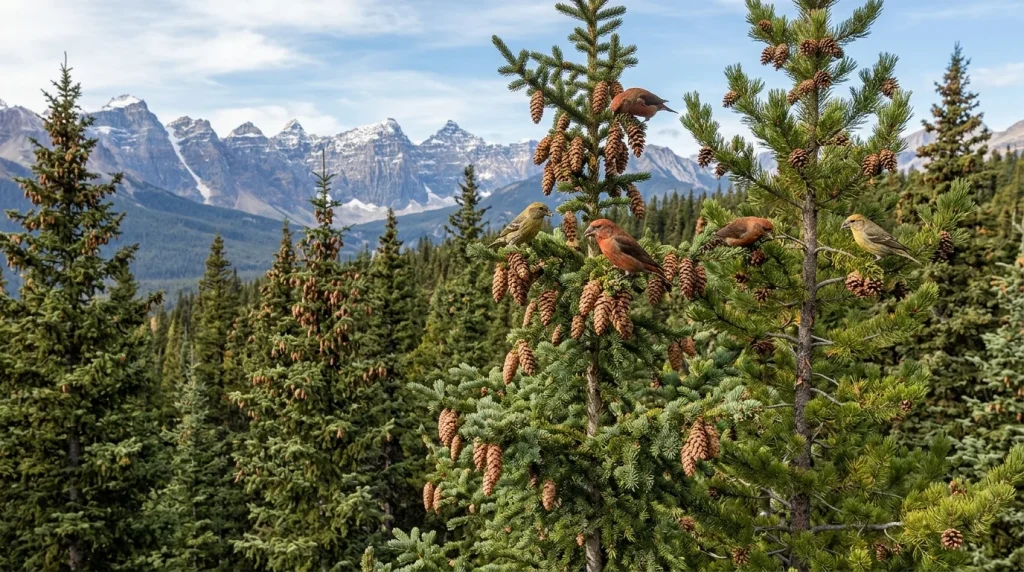
Productive conifer forest is the central habitat requirement. Red Crossbills use boreal spruce woods, high-elevation pine and fir forests, Pacific coastal conifers, open montane woodland, and mixed forests containing cone-bearing trees. They also visit planted conifers in cemeteries, campuses, shelterbelts, and mature neighborhoods during wandering movements.
Habitat use differs by regions and call types. Cone abundance often matters more than forest age or elevation. Birds may feed from the crown of a tall spruce, descend to roadside grit, or visit mineral-rich ground and puddles.
Behavior
Outside nesting periods, Red Crossbills are highly social. Flocks climb through branches or hang at various angles while handling cones. A bird wedges its crossed bill between cone scales, opens the bill to spread them, and removes the seed with its tongue. Discarded cone fragments may fall beneath an active flock.
Crossbills often leave feeding trees together, calling frequently in bounding flight. They may be surprisingly approachable when occupied with a rich cone crop, although observers should avoid standing directly beneath feeding or nesting birds. Flocks sometimes descend to roads for salt or grit, creating a risk of vehicle collisions.
Diet
Conifer seeds dominate the diet. Depending on region and availability, Red Crossbills feed on seeds from spruces, pines, firs, hemlocks, Douglas-fir, and larches. Different bill shapes may make some populations more efficient on particular cone structures.
They also take buds, berries, weed seeds, and occasional insects, especially when feeding young. At feeders, wandering birds may sample sunflower seeds, but feeders are less reliable than cone-laden trees. Fresh water and safe, pesticide-free landscaping can make a property more useful to visiting flocks.

Vocalizations
The most useful field sound is a short, hard flight call, often rendered as kip-kip, jip-jip, or chewt-chewt. Flocks call frequently while passing overhead, sometimes revealing their presence before they are visible. Songs are a loose series of trills, warbles, whistles, and call-like notes delivered from a treetop or during courtship.
North American Red Crossbills include several recognizable flight-call types. Some also differ on average in bill structure, ecological associations, and genetics. Distinguishing them requires good recordings and careful analysis; photographs and geographic assumptions alone are often insufficient. Most field observations are best reported simply as Red Crossbill unless strong supporting evidence is available.
Breeding and Nesting
Red Crossbills can breed in several seasons when an abundant cone crop provides dependable food. Nesting is often associated with late winter and spring, but summer or autumn breeding also occurs. This flexible timing is unusual among northern songbirds.
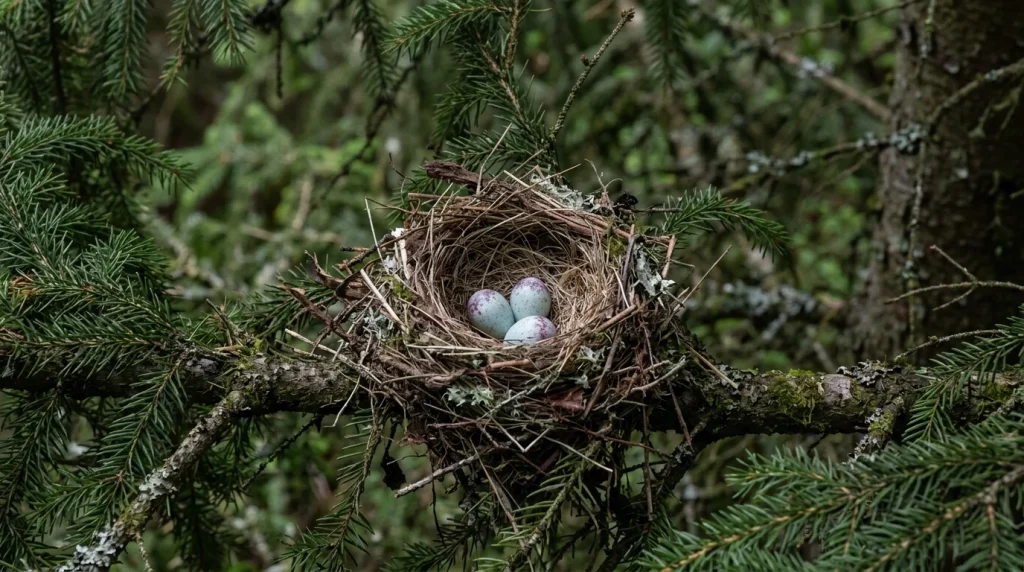
During courtship, the male may sing, flutter near the female, and offer food. The female builds a substantial open cup on a horizontal conifer branch, commonly well above the ground and protected by dense foliage. Twigs, bark, grass, and rootlets form the outer structure; finer plant material, conifer fibers, hair, or feathers may line it.
A clutch commonly contains three eggs, although two to four is possible. The eggs are usually pale bluish or greenish white with darker markings concentrated near the larger end. The female performs most or all incubation, while the male supplies food. Incubation lasts roughly two weeks, with weather and individual variation affecting timing.
Young and Development
Both parents feed the nestlings, primarily by regurgitating softened conifer seeds. Young crossbills generally leave the nest after about two to three weeks. Their mandibles begin relatively straight and cross progressively as the bill grows.
Recently fledged juveniles remain streaked and may follow adults while giving persistent begging calls. Parents continue feeding them until they can open cones effectively. Family groups can merge into larger mobile flocks once the young become more independent.
Where to See
Search wherever conifers are carrying a heavy cone crop. Productive sites include boreal roads, mountain passes, national forests, ski-area margins, mature spruce stands, pine ridges, and Pacific Northwest conifer forests. In irruption years, also check urban plantings and ornamental spruces.
- Scan treetops for small flocks dropping onto cone-bearing branches.
- Listen for repeated, sharp calls from birds crossing overhead.
- Watch beneath feeding trees for falling cone scales.
- Check quiet roadsides carefully, but never stop where traffic or winter conditions make birding unsafe.
- Review recent local bird reports because concentrations can shift rapidly.
Similar Species
White-winged Crossbill: The closest common look-alike has two conspicuous white wing bars, usually a smaller bill, and different call quality. Male White-winged Crossbills tend to look pinkish red, while females often appear more strongly streaked. Very worn or partially obscured wing bars require care.
Cassia Crossbill: This localized southern Idaho species is extremely similar in plumage. It averages larger bills and is best distinguished by range, vocalizations, and careful documentation rather than color alone.
Pine Grosbeak: Larger, longer-tailed, and equipped with a normal, uncrossed bill. Males can be red, but their shape is more elongated, and their flight calls differ.
House Finch and Purple Finch: Red male finches may cause momentary confusion. Both have uncrossed, triangular bills; House Finches are heavily streaked below, while male Purple Finches show a more raspberry-washed appearance.
Conservation
The Red Crossbill is commonly classified as Least Concern globally because of its enormous range and large overall population. That broad assessment can mask regional changes and differences among specialized populations. Dependence on conifer seed crops makes crossbills sensitive to altered fire regimes, intensive forest management, large-scale tree mortality, disease, and climate-driven changes in cone production.
Maintaining diverse conifer forests across elevations and age classes may provide more consistent feeding opportunities. Birders can help by documenting irruptions, recording flight calls, and submitting carefully identified observations to community-science projects. Watch roadside salt-seeking flocks from a safe distance, without encouraging birds to remain in traffic.
Field Identification Tips
- Confirm the crossed bill. A side view is easiest, but the feature may be subtle on juveniles or distant birds.
- Check the wings. The absence of bold white wing bars favors Red Crossbill over White-winged Crossbill.
- Judge structure before color. Look for a stocky finch, large head, deep bill, and notched tail.
- Use behavior. Cone feeding, acrobatic postures, flocking, and frequent flight calls are valuable clues.
- Note the trees. Record the conifer species being used; this can add important ecological context.
- Record calls when possible. A clear audio file is more useful for call-type analysis than a visual description.
- Avoid forcing a call-type identification. Many birds cannot be assigned confidently without high-quality recordings and regional expertise.
Frequently Asked Questions
Why do Red Crossbills have crossed bills?
The crossed tips act as a spreading tool. The bird inserts its closed bill beneath a cone scale, opens it to expose the seed, and uses its tongue to remove the seed.
Are all male Red Crossbills bright red?
No. Adult males range from yellow-orange to deep brick red. Age, molt, diet, feather wear, and individual variation affect their appearance.
Do Red Crossbills migrate?
They are better described as nomadic or irruptive than as conventional long-distance migrants. Their movements follow changing cone supplies and may occur in any season.
Can a Red Crossbill’s call reveal its population?
Sometimes. Distinctive flight-call types can be recognized from suitable recordings, but assigning a type by ear alone is difficult. Call types should not automatically be treated as separate species.
Will Red Crossbills visit feeders?
They occasionally eat sunflower seeds or visit water, but cone-bearing conifers are much more dependable attractions. Their presence at any feeder is often brief and unpredictable.