

Brown-capped Rosy-Finch Guide
Keep Track of What You See
Create a free Wild Things Guide membership to record this Brown-capped Rosy-Finch in My Sightings and build your personal wildlife list.
Join to Add This SightingIntroduction
The Brown-capped Rosy-Finch (Leucosticte australis) is a rugged mountain songbird closely associated with the central and southern Rocky Mountains. It breeds above or near treeline, where lingering snowfields, broken cliffs, and alpine tundra create one of North America’s harshest nesting environments. In winter, flocks descend into mountain valleys, foothills, and occasionally the adjacent plains.
At close range, its combination of a brown crown, dark face, warm brown body, and rosy-pink highlights is distinctive. Identification can be more difficult when birds are distant, mixed with other rosy-finches, or wearing subdued winter plumage. Consider location, head pattern, body color, and the extent of pink.

Quick Identification
- Medium-sized, stocky finch with long wings and a slightly notched tail.
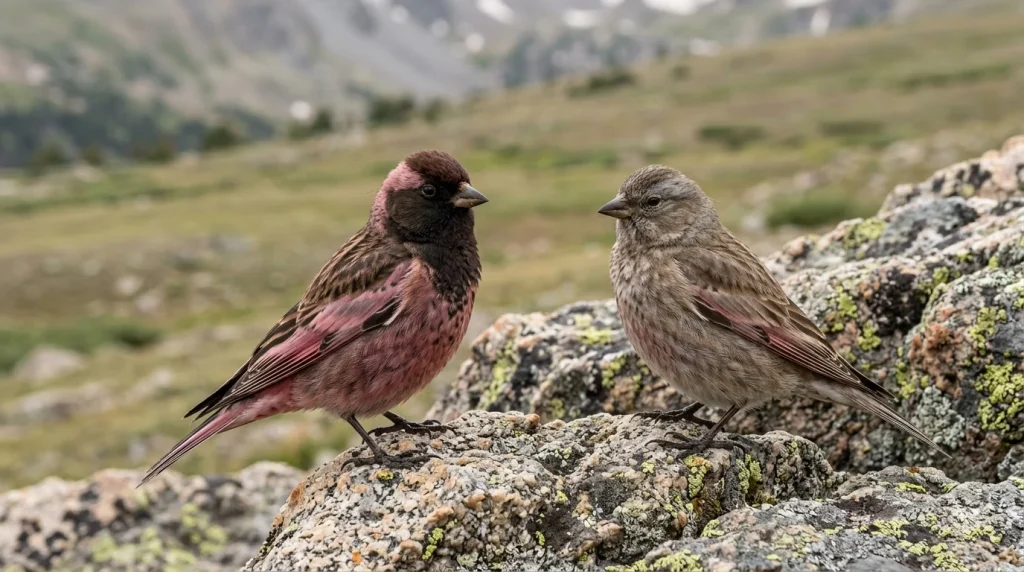
- Adult male has a brown crown, blackish forehead and throat, and pink on the wings, flanks, belly, and rump.
- The female is duller and browner, with less extensive pink and a weaker dark facial pattern.
- Breeding adults have a dark bill; the bill becomes yellowish or horn-colored outside the breeding season.
- Usually found in alpine terrain, at snowfield edges, or in mobile winter flocks.
- Often feeds on the ground with a walking or hopping motion.
Appearance
Brown-capped Rosy-Finches have the compact body, conical bill, and undulating flight expected of a finch. Still, their relatively long wings reflect a life spent moving through exposed mountain terrain. The plumage can look dark chocolate-brown in overcast conditions and warmer cinnamon-brown in direct sunlight.
An adult male in fresh breeding condition typically shows a rich brown crown set behind a blackish forehead and face. The throat may also look dark. Rosy or raspberry-pink feathers appear most strongly on the belly, flanks, rump, wings, and near the base of the tail. Pale feather edges can soften these colors during fall and early winter, while wear may make the spring pattern appear darker and more sharply defined.
Females are similar in shape but usually have a more evenly brown head and body. Their pink areas are reduced and may be easiest to see on the wings, rump, or lower flanks when the bird flies. Individual variation, feather wear, age, and light can make sexing some birds difficult in the field.
Juveniles are comparatively plain. They are brown to gray-brown, often with subtle streaking or pale-edged wing feathers, and generally lack the strong rosy color of adults. Pink develops as the young bird molts into later plumage.
Size and Wingspan
Adults are generally about 5.5–6.3 inches (14–16 centimeters) long, with a wingspan close to 13 inches (33 centimeters). They are larger and more robust than American Goldfinches and most small sparrows, although exact size can be difficult to judge in open alpine landscapes.
Useful structural features include:
- A rounded, deep-chested body.
- A short, stout, seed-cracking bill.
- Long, pointed wings suited to fast flocking flight.
- A medium-length tail with a shallow notch.
Range and Distribution
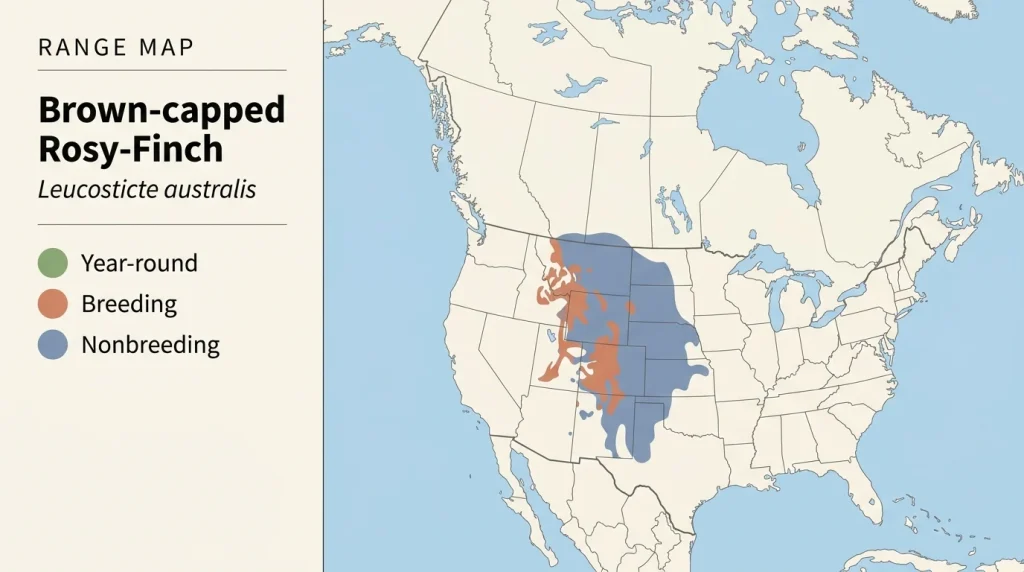
The Brown-capped Rosy-Finch has one of the most restricted distributions of any North American finch. Its core breeding range lies in the high central and southern Rocky Mountains, principally in Colorado, with smaller breeding areas extending into southern Wyoming and northern New Mexico.
Rather than undertaking a long, regular migration, most birds move seasonally in elevation. They occupy alpine breeding areas during summer and descend to lower mountains, valleys, towns, and foothills after heavy snow covers natural food. Winter flocks may wander beyond the normal core range, including onto parts of the western Great Plains, but such appearances can be irregular.
Habitat
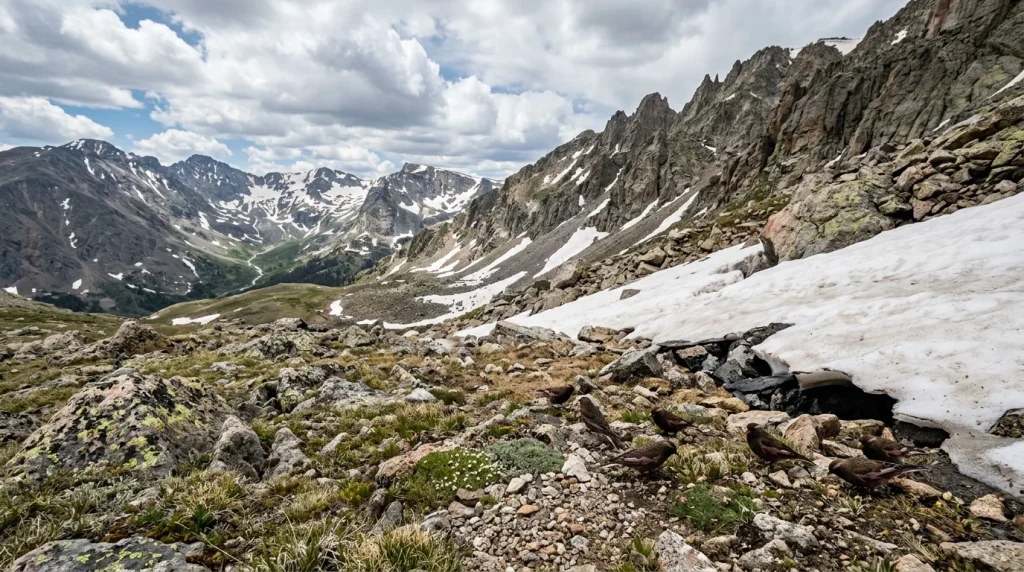
Breeding habitat includes alpine tundra, talus slopes, cirques, cliff faces, rocky ridges, and the margins of persistent snowfields. Vegetation is usually sparse and low, with grasses, sedges, cushion plants, and scattered alpine flowers. Nest sites require protected openings in cliffs, boulder fields, or human structures.
In the nonbreeding season, Brown-capped Rosy-Finches use a wider range of environments. They may feed around open conifer woodland, sagebrush slopes, mountain roads, ski areas, reservoirs, ranchlands, and towns. Even then, they usually favor open ground where wind, traffic, livestock, or drifting snow exposes seeds.
Behavior
Brown-capped Rosy-Finches are highly social outside the nesting season. Flocks may contain a few birds or several hundred and can include Gray-crowned and Black Rosy-Finches. The flock often sweeps over a slope, lands together, feeds rapidly, and rises again in a coordinated burst.
On the ground, individuals walk, hop, and probe among stones or short vegetation. Birds feeding near snowbanks frequently follow the melting edge, where seeds and frozen insects become exposed. In severe weather, they shelter behind rocks, in crevices, or on the protected sides of buildings.
During the breeding season, pairs become more dispersed. Males perform short song flights or sing from exposed rocks, while both sexes travel considerable distances between nest sites and productive feeding areas.
Diet and Hunting
The diet consists mainly of seeds and insects, with the balance changing by season. Seeds from grasses, sedges, weeds, and alpine plants are particularly important during fall and winter. Birds collect them from the ground, low vegetation, wind-scoured patches, and roadside margins.
In summer, adults take more insects and other small invertebrates. They search among tundra plants, capture prey near the ground, and pick windblown insects from snowfields. This protein-rich food is especially important for growing nestlings. Brown-capped Rosy-Finches do not hunt in the manner of aerial insectivores, but they may make short flights after moving prey.
Where feeding birds is permitted, winter flocks may visit platform feeders or consume seed scattered on the ground. Sunflower chips and millet can attract them, although natural food and responsible feeder sanitation remain important.

Vocalizations
The most frequently heard sound is a short, sharp flight call, often rendered as a nasal “chew,” “pew,” or “jeew.” A moving flock may produce a continuous series of these notes as birds maintain contact in wind or poor visibility.
The song is a subdued, rambling sequence of warbles, trills, and call-like phrases. It may be delivered from a rock, during a brief flight, or near a breeding territory. Because wind is nearly constant in alpine habitat, listening for repeated calls is often more effective than waiting for a full song.
Breeding and Nesting
Breeding begins late compared with many lowland songbirds because snow and freezing temperatures persist at high elevations. Courtship and nest building generally occur after alpine conditions moderate, although timing varies with elevation and annual snowpack.
The female constructs a bulky cup of grasses, stems, roots, moss, and similar material, usually lining it with finer vegetation, hair, or feathers. The nest is concealed in a cliff crack, cave-like recess, talus opening, abandoned mine structure, or protected space in a mountain building. Such sites provide shelter from wind, precipitation, and predators.
A typical clutch contains about three to five pale or white eggs. The female performs most or all incubation, while the male commonly brings food. Incubation lasts roughly two weeks. After hatching, both parents usually feed the young, carrying insects and softened seeds to the nest.

Young and Development
Nestlings hatch nearly naked and helpless. Their early development depends on frequent meals and the protection provided by the enclosed nest site. Insects form an important part of their diet, even though adults eat many seeds at other times of year.
Young birds generally leave the nest after approximately three weeks, though development can vary with weather and food supply. Recently fledged juveniles remain dull brown and may follow adults while giving persistent begging calls. Family groups later merge into larger post-breeding flocks before descending from the alpine zone.
Where to See
Colorado provides the most dependable opportunities. In summer, look along safe, publicly accessible routes that reach alpine tundra, especially near rocky slopes, cirques, and lingering snowfields. Birds may also visit high-elevation parking areas, but observers should avoid feeding wildlife where regulations prohibit it.
In winter, check mountain towns, open valleys, reservoirs, roadside seed patches, and well-maintained feeding stations. Flocks move unpredictably, so current local reports are valuable. Scan every rosy-finch flock carefully rather than assuming all members are the same species.
Alpine weather changes rapidly. Carry warm layers, watch for lightning, remain on established routes, and avoid approaching nests or entering unstable talus. The Cornell Lab of Ornithology’s Brown-capped Rosy-Finch account offers additional identification and distribution information.
Similar Species
- Gray-crowned Rosy-Finch: Usually shows a conspicuous gray hood or gray sides to the head surrounding a dark crown and face. Brown-capped lacks the broad gray head pattern and generally looks warmer brown overall.
- Black Rosy-Finch: Much darker and sootier, especially on the breast and back. Its pink wing and belly areas contrast with an otherwise blackish body.
- House Finch: Male House Finches have red concentrated on the forehead, throat, and upper breast, with strongly streaked flanks. They lack the Brown-capped Rosy-Finch’s dark face and pink wing panels.
- Pine Grosbeak: Larger, longer-tailed, and heavier-billed. Males are broadly red rather than brown with localized rosy highlights.
Conservation
The Brown-capped Rosy-Finch is commonly classified as Least Concern globally, but that category does not mean the species is free from risk. Monitoring has indicated substantial concern about long-term population decline, and its limited alpine distribution makes it especially vulnerable to habitat changes.
Climate warming may reduce persistent snowfields, alter alpine plant communities, change insect availability, and shift the timing of breeding resources. Disturbance at nest sites, development in mountain environments, collisions, disease transmission at crowded feeders, and exposure to contaminants may add further pressure.
Helpful actions include protecting alpine habitat, keeping distance from nesting cliffs, cleaning feeders regularly, reporting banded birds, and contributing carefully documented sightings to community-science programs.
Field Identification Tips
- Start with geography and elevation. A rosy-finch high in the Colorado Rockies is more likely to be Brown-capped than one far outside the species’ core range.
- Study the entire head. Look for a brown crown and the absence of the Gray-crowned Rosy-Finch’s broad gray hood.
- Check the body tone. Brown-capped usually appears warm brown rather than charcoal-black.
- Look for pink in several places. The wings, rump, belly, and flanks can all show rosy color, particularly on adult males.
- Do not rely on bill color alone. Seasonal color changes make the bill useful for aging or season, but not for separating rosy-finch species.
- Inspect mixed flocks bird by bird. Different rosy-finch species often feed together, and a single flock can contain multiple plumage types.
Frequently Asked Questions
Is the Brown-capped Rosy-Finch found only in Colorado?
No. Colorado holds most of its breeding range, but the species also occurs in parts of southern Wyoming and northern New Mexico. Winter wanderers may appear farther onto nearby plains.
Why is it called “Brown-capped”?
The name refers to its brown crown, which helps separate it from the gray-headed appearance of the Gray-crowned Rosy-Finch and the much darker Black Rosy-Finch.
Does it migrate?
It mainly performs an elevational migration. Birds move down from alpine breeding grounds during winter, although some flocks also wander considerable horizontal distances.
What does a Brown-capped Rosy-Finch eat?
It eats seeds from grasses, sedges, weeds, and alpine plants, along with insects and other small invertebrates. Insects become especially important during the breeding season.
Can females show pink plumage?
Yes. Females can show pink on the wings, rump, belly, or flanks, but the color is usually less extensive and less saturated than on adult males.
What is the best season to see one?
Summer offers predictable access to breeding habitat where safe alpine roads and trails are available. Winter may produce larger and more accessible flocks, but their locations are less predictable.


