Possumhaw Guide
Keep Track of What You See
Create a free Wild Things Guide membership to record this Possumhaw in My Sightings and build your personal wildlife list.
Join to Add This SightingTree Name
Possumhaw (Ilex decidua) is a native North American holly that sheds its leaves in autumn. Also called deciduous holly or meadow holly, it grows as a large shrub or small tree. Its most memorable feature is a display of red fruits along bare winter branches. Unlike the familiar American holly, possumhaw has neither evergreen foliage nor strongly spiny leaves.
The common name needs care: possumhaw viburnum is a different plant, Viburnum nudum. For field notes, nursery purchases, and wildlife plantings, include the scientific name to avoid confusion.

Quick Identification
- Habit: A branching shrub or small tree, commonly 10–20 feet (3–6 m) tall, sometimes reaching about 30 feet (9 m).
- Leaves: Alternate, simple, and deciduous; usually 1–3 inches (2.5–7.5 cm) long, often widest above the middle.
- Leaf edges: Small, rounded teeth, generally more evident toward the outer half; no prominent holly spines.
- Bark: Thin, gray to gray-brown, and relatively smooth.
- Fruit: Small, rounded red or orange-red drupes borne on female plants, often conspicuous after leaf fall.
- Best combination: Bare, fruit-covered twigs in winter plus alternate, blunt-tipped or short-pointed leaves in the growing season.
No single character is decisive. Check leaf arrangement, leaf shape, fruit attachment, and habitat together, especially when distinguishing other deciduous hollies.
Appearance
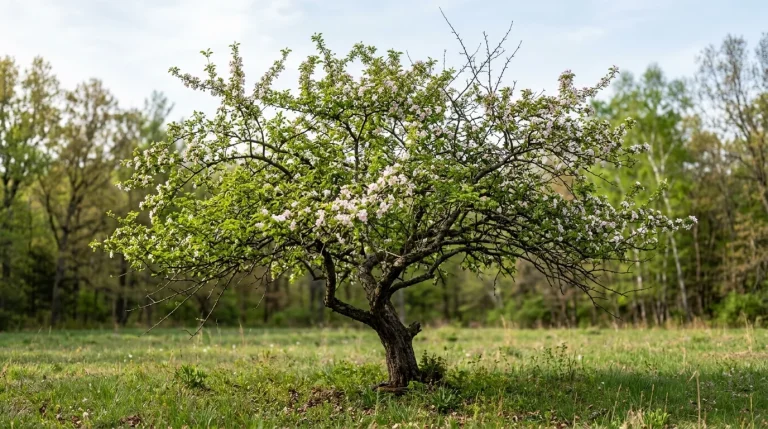
Possumhaw commonly develops several slender trunks and an irregular, rounded crown. Open-grown plants may spread broadly, reaching a mature width of about 10–15 feet (3–4.5 m). In woodland competition, stems tend to be more upright and the crown less full. Old specimens can exceed these everyday landscape dimensions.
The leaves are green above and usually paler beneath, with a short stalk. Their outlines range from elliptical to spoon-shaped or inversely egg-shaped; the narrower end faces the stalk. Tips may be rounded, blunt, or briefly pointed rather than consistently long and tapered.
Look closely at a leafy shoot. The leaves alternate rather than forming opposite pairs, although their concentration on short shoots can make them look clustered. Autumn color is usually yellowish or yellow-green and is often modest. The plant’s strongest seasonal display comes after those leaves drop.

Bark, Twigs, and Buds
Young trunks have light gray to gray-brown bark that remains comparatively smooth. Older stems may show shallow roughening or small scaly areas, but deep, blocky furrows are not a typical identification feature. Pale spots or patches may be lichens rather than distinctive bark markings.
Twigs are slender, becoming grayish with age, and lack thorns. Small buds sit alternately along them; short lateral shoots can carry closely spaced leaves or fruits. In winter, follow one twig from its tip inward to understand this arrangement rather than judging a crowded branch from a distance.
Bark alone is unreliable. A leafless male possumhaw can be difficult to identify confidently without nearby fruiting plants, old leaves, or a return visit during the growing season.

Range and Habitat
Possumhaw is native to the south-central and southeastern United States, extending north into parts of the central Mississippi and Ohio Valley region and south into northeastern Mexico. Its U.S. distribution includes much of Texas and the lower Mississippi Valley, continuing east through portions of the Southeast. It is not naturally widespread across northern or western North America.
Look for it in floodplain woods, stream margins, moist thickets, low woodland edges, and other sites with seasonally available moisture. It also occurs in some upland woods and limestone-influenced settings, so finding it away from standing water is not unusual.
Possumhaw tolerates a broader range of soil conditions than its wetland associations might suggest. Established plants can handle dry periods, but prolonged drought still affects vigor. Full sun generally encourages denser branching and better fruit displays; partial shade is common in natural habitats. The NC State Extension Plant Toolbox profile of possumhaw provides useful additional identification and cultivation details.

Flowers, Fruit, Nuts, or Cones
Small, pale greenish-white flowers appear in spring, usually as the leaves emerge or expand. They occur in small groups at leaf axils and are easy to overlook. The flowers commonly have four petals and attract visiting insects.
Male and female flowers normally occur on separate plants. Female plants bear the familiar fruit when pollination succeeds; male plants do not develop that display. For reliable fruit production in an isolated planting, provide a compatible male possumhaw flowering at the same time. Do not assume that any nearby holly will serve equally well.
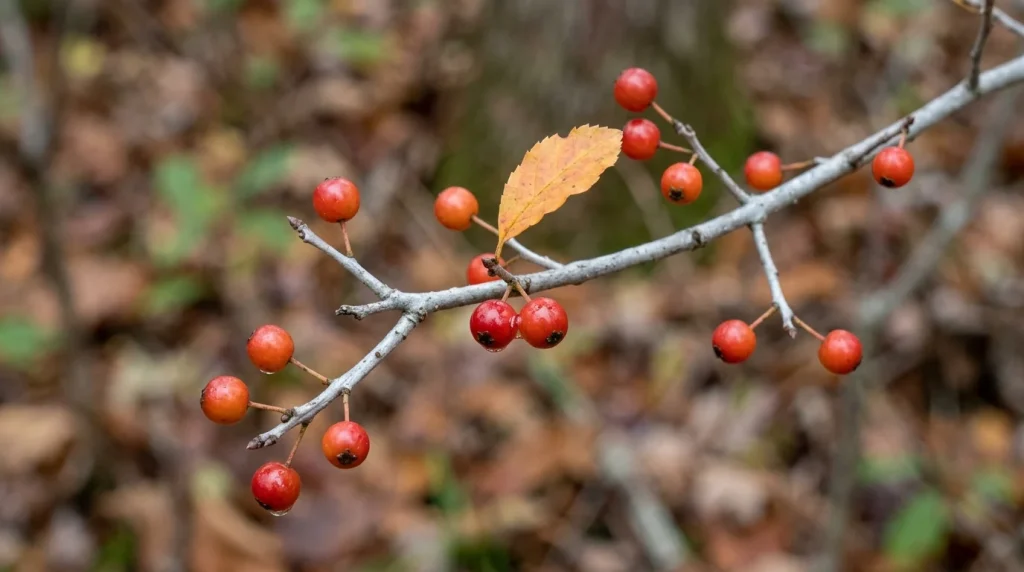
The rounded fruits are roughly 1/4 inch (6 mm) across, sometimes slightly larger. They usually ripen red or orange-red in late summer or autumn and may persist well into winter. Yellow-fruited forms also occur. Botanically, these are drupes containing several hard seed-bearing structures, although they are routinely called berries.
Fruit abundance and persistence vary with pollination, weather, plant condition, and animal feeding. Holly fruits are not human food and can cause gastrointestinal illness if eaten.
Wildlife Connections
Fruiting possumhaw supplies food for birds, including cedar waxwings, American robins, and northern mockingbirds. Feeding may be gradual or sudden: a flock can remove much of a conspicuous crop in a short visit. Birds also disperse seeds away from the parent plant.
The branching crown provides perches and sheltered spaces, especially where possumhaw grows among other shrubs. Spring flowers offer resources to visiting pollinating insects. Its wildlife value therefore extends beyond the winter fruit display, although male plants lack that particular food source.
Persistent fruit does not prove that birds dislike it. Consumption changes with local bird movements, alternative foods, and conditions. Likewise, a tree stripped early in winter is not necessarily unhealthy.
Seasonal Identification
- Spring: Check emerging alternate leaves and small axillary flowers. Flowering plants offer a chance to assess sex before fruit develops.
- Summer: Study the tapered leaf bases, finely toothed edges, and often blunt tips. Female plants may carry inconspicuous green fruits.
- Autumn: Fruit colors up as leaves turn yellow and fall. Some foliage may linger where autumn weather is mild.
- Winter: Red fruits along otherwise bare branches provide the strongest distant clue. Confirm with twig arrangement and the plant’s overall habit.
Do not rule out possumhaw because a specimen lacks fruit. It may be male, immature, poorly pollinated, shaded, or already visited by hungry birds.

Human Uses and History
Possumhaw is valued as a native ornamental, particularly for winter gardens, informal hedges, woodland margins, and wildlife plantings. Fruiting selections are often propagated to preserve their fruit color, habit, or especially showy displays.
Choose a location that accommodates its branching form rather than relying on repeated hard pruning. Light structural pruning can develop a small tree, while retaining several stems suits a naturalistic planting. Heavy clipping may remove flowering and fruiting wood and reduce the winter display.
Nursery-grown plants are preferable to digging wild specimens. Where fruit matters, ask about plant sex and pollination before purchase. Growth is generally described as slow to moderate, but site conditions make a single annual height increment misleading. Reliable species-wide lifespan figures are also limited.
Conservation and Threats
Possumhaw is broadly distributed and is not generally regarded as globally threatened, though abundance varies locally. Clearing floodplain woods, removing thickets, and changing natural drainage can reduce habitat and eliminate established plants.
In gardens, drought during establishment, root damage, unsuitable drainage, and excessive pruning may cause more trouble than any single pest. Scale insects, leaf spots, and other holly problems can occur, but diagnose symptoms rather than treat them automatically.
Protect existing native stands where practical, preserve understory diversity, and use regionally appropriate nursery stock. A mixture of native shrubs and trees supports more seasonal wildlife needs than a planting chosen solely for showy berries.
Similar Species
- Winterberry (Ilex verticillata): Another deciduous holly with red winter fruits. Its leaves are generally more distinctly pointed, with sharper teeth and more conspicuous veins. Leaf undersides are often hairy. Consider several characters because both species vary.
- Yaupon holly (Ilex vomitoria): Has small, alternate leaves with rounded teeth and red fruit, but normally retains its leaves through winter. Its leaf bases are generally less strongly tapered than possumhaw’s.
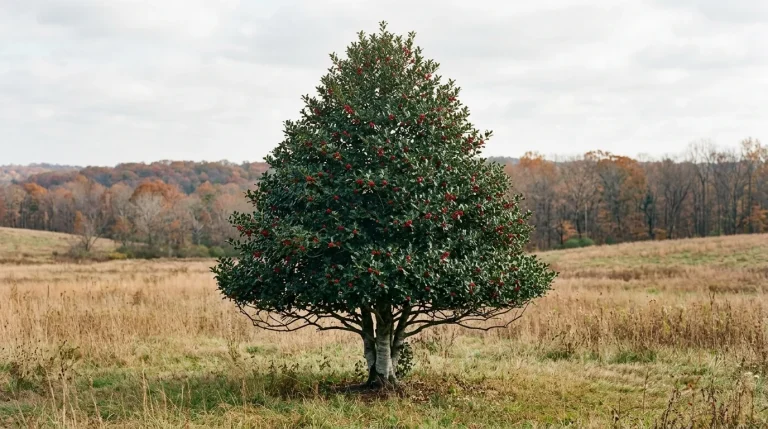
- American holly (Ilex opaca): Usually has evergreen, leathery leaves with conspicuous spine-tipped teeth and eventually becomes a larger tree.
- Possumhaw viburnum (Viburnum nudum): Has opposite leaves, conspicuous clusters of small white flowers, and clustered fruits that change from pink to blue-black. Opposite leaf pairs immediately separate it from Ilex decidua.

Interesting Facts
- The species name decidua refers to leaf shedding—an important distinction within the holly family.
- Leaf loss makes the winter fruit display more visible rather than creating it; the fruits develop earlier.
- A male possumhaw may be visually understated, yet it still contributes to fruit production in nearby female plants.
- Possumhaw shows why “holly” does not necessarily mean evergreen foliage or prickly leaves.
Frequently Asked Questions
Is possumhaw a tree or a shrub?
It can be either. Many wild plants have several stems and a shrubby outline; others develop into small trees. Site conditions, age, and pruning influence the form.
Why does my possumhaw have no berries?
It may be male or too young. Other possibilities include insufficient compatible pollen, poor flowering, shade, weather damage, pruning, or wildlife already eating the fruit.
Are possumhaw berries edible?
Not for people. Treat the fruits as ornamental wildlife food, not a foraging crop, and discourage children and pets from eating them.
Does possumhaw need wet soil?
No. Moist sites are common natural habitat, but established plants can grow in ordinary garden soils and tolerate some drought. Newly planted specimens need dependable moisture while roots establish.
What is the quickest winter identification clue?
Look for a small, gray-barked tree with red fruits along bare, thornless branches. Then check alternate buds and rule out winterberry; fruit color alone is insufficient.