American Plum Guide
Keep Track of What You See
Create a free Wild Things Guide membership to record this American Plum in My Sightings and build your personal wildlife list.
Join to Add This SightingTree Name
American plum (Prunus americana) is a small deciduous tree or thicket-forming shrub in the rose family (Rosaceae). Also called wild plum, it is native to much of North America. Its white spring flowers, toothed leaves, and rounded summer plums make it recognizable, but several related species share these features. Identify it from a combination of leaves, branching, flowers, fruit, and habitat rather than fruit color alone.
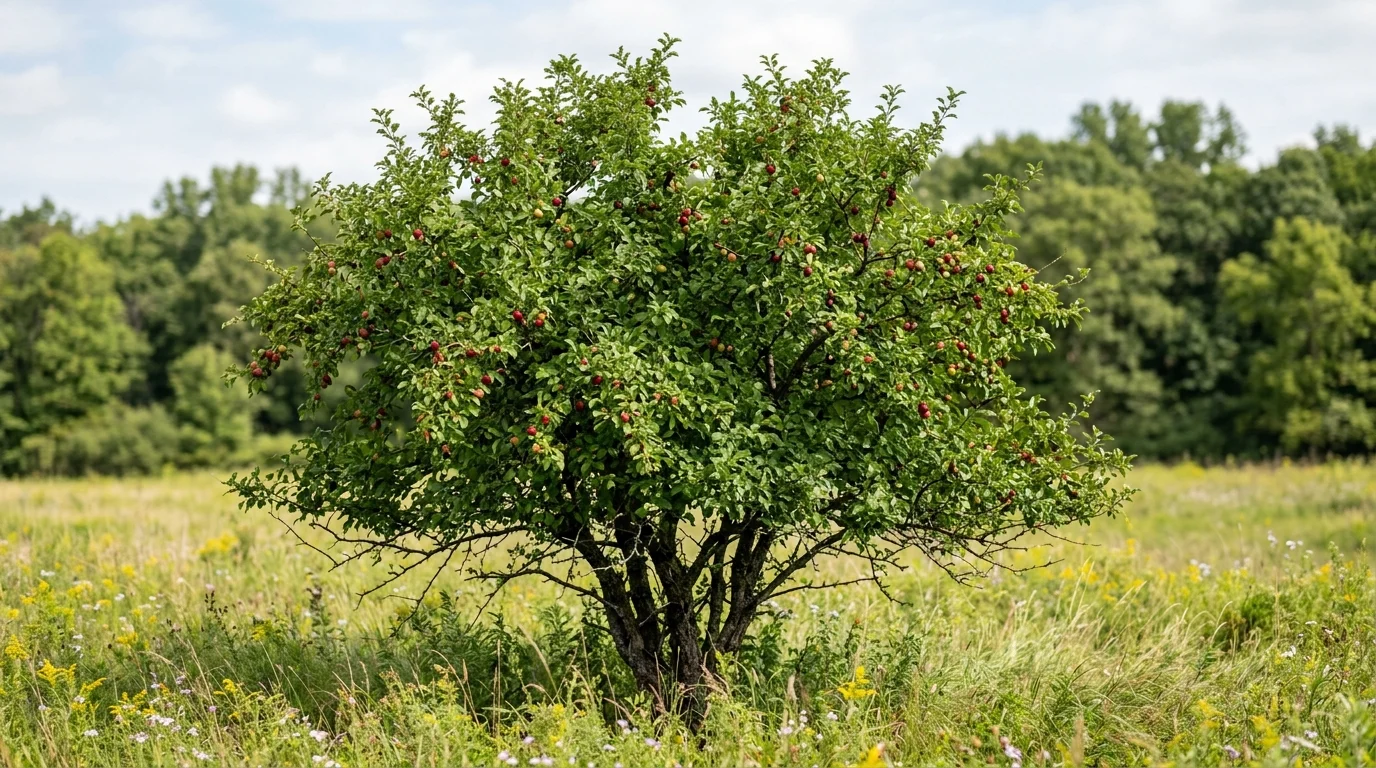
In open country, American plum often appears as a dense island of woody growth along a fence, prairie edge, or drainage. What looks like many separate trees may include shoots connected by spreading roots.


Quick Identification
- Form: Usually 10–25 feet (3–8 m) tall, with a broad, irregular crown; commonly multistemmed and suckering.
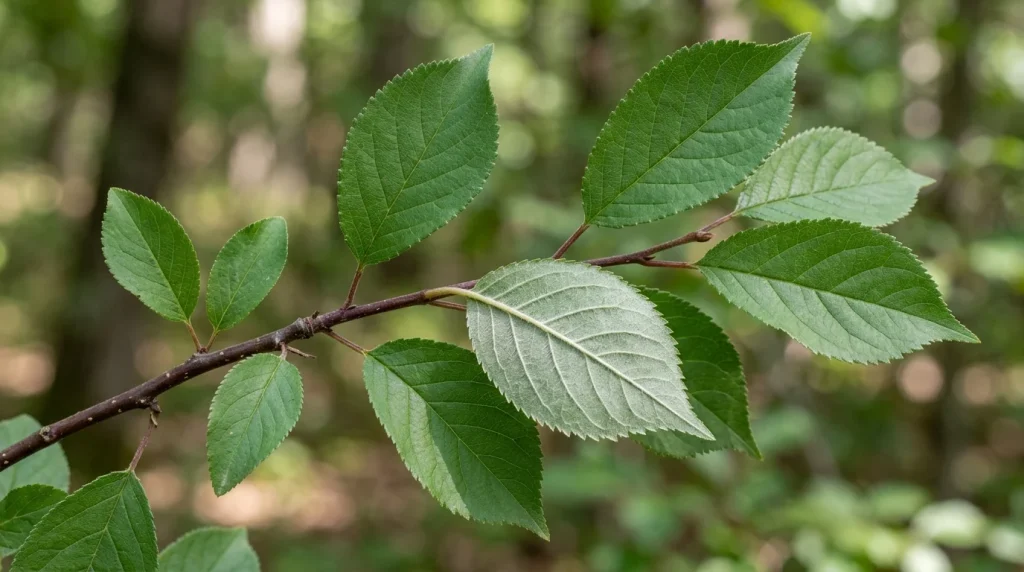
- Leaves: Alternate, simple, broadly oval to obovate, usually 2–4 inches (5–10 cm) long, with pointed tips and conspicuously toothed margins.
- Flowers: White, five-petaled blossoms in small clusters, usually opening before or as leaves emerge.
- Fruit: Round to slightly oval plums, roughly ¾–1¼ inches (2–3 cm) across, ripening yellow, red, or reddish purple.
- Branches: Stiff, sometimes ending in sharp, thornlike tips.
- Best combination: Root-suckering growth, broad sharply toothed leaves, clustered spring blossoms, and relatively large, single-stoned fruit.
Appearance
A mature American plum may have one short trunk, several leaning stems, or a whole colony of stems of different ages. Open-grown specimens develop rounded to spreading crowns, often about 10–25 feet (3–8 m) wide. Individual trees occasionally exceed these dimensions, while exposed or frequently browsed plants remain shrubby.
Leaves are green above and generally paler beneath. Their broadest point may lie near the middle or beyond it, and the blade usually narrows to a distinct tip. Margins have relatively coarse, sharp teeth, sometimes with smaller secondary teeth. The underside can carry hairs, particularly along the veins.
For identification, examine several mature leaves from ordinary shoots. Vigorous suckers may produce unusually large foliage. Alternate leaf arrangement is important: leaves attach singly at successive points along the twig, not in opposite pairs.
Bark, Twigs, and Buds
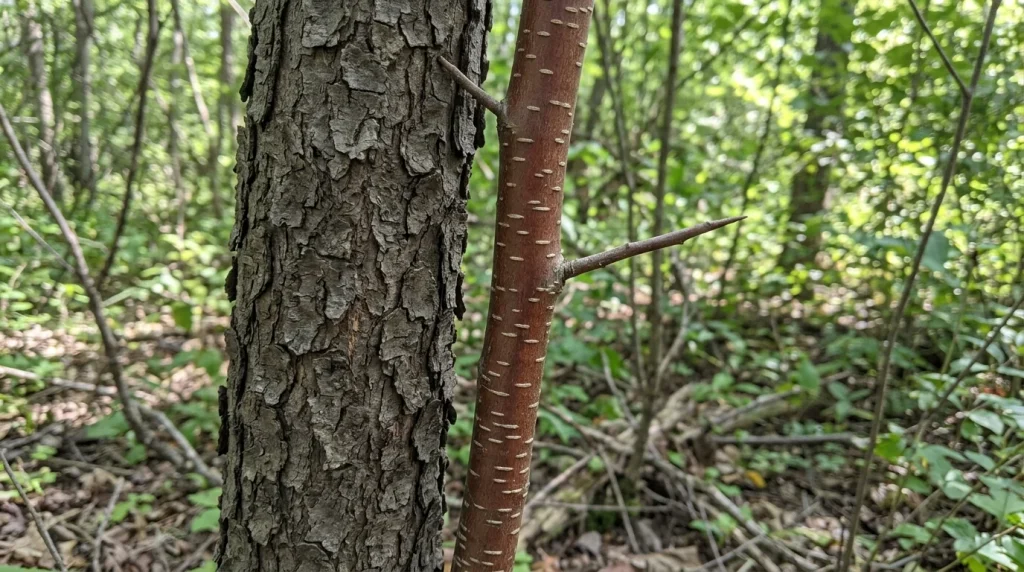
Young bark is fairly smooth and reddish brown to gray-brown, with pale lenticels—the small marks that allow gas exchange. Older trunks become darker and develop irregular scaly plates or shallow fissures. Bark appearance changes substantially with stem age, so it is rarely sufficient for identification on its own.
Twigs are slender to moderately stout, often reddish brown when young. Some short branches become rigid and pointed, making an established thicket difficult to walk through. These thornlike branch tips are variable; their absence does not rule out American plum.
Winter buds are small, scaly, and brown. Flower buds tend to be plumper than leaf buds, and several buds may occur close together on short shoots. Look for this budding pattern alongside old fruit stalks, sharp branchlets, and nearby root suckers.
Range and Habitat
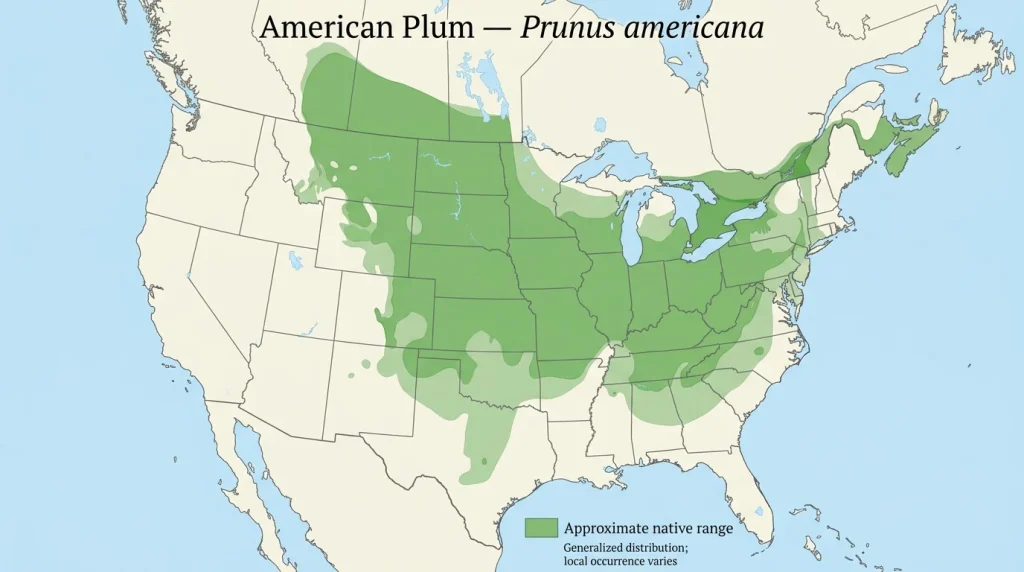
American plum occurs widely across central and eastern North America, with its native range extending into southern Canada and westward into parts of the Great Plains and Rocky Mountain region. Regional boundaries can be complicated by planting, escape, and confusion with other wild plums. Consult a local flora when determining whether a particular stand is indigenous.
Typical habitats include woodland borders, stream terraces, open slopes, old fields, fencerows, and prairie margins. It grows best with substantial sunlight and reasonably well-drained soil, although it tolerates a range of textures and occasional flooding. It is not primarily a tree of deeply shaded forest interiors or permanently waterlogged ground.
The NC State Extension American plum profile provides additional photographs and horticultural identification details.
Flowers, Fruit, Nuts, or Cones
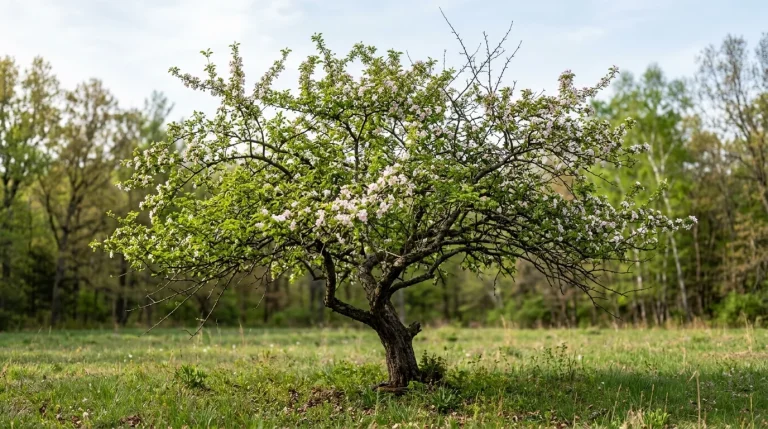
American plum flowers in spring, with timing varying greatly by latitude, elevation, and weather. Each blossom has five white petals surrounding numerous stamens. Flowers are usually about ¾–1 inch (2–2.5 cm) across and occur in small clusters, often two to five together. A flowering thicket can look almost white before its leaves unfold.
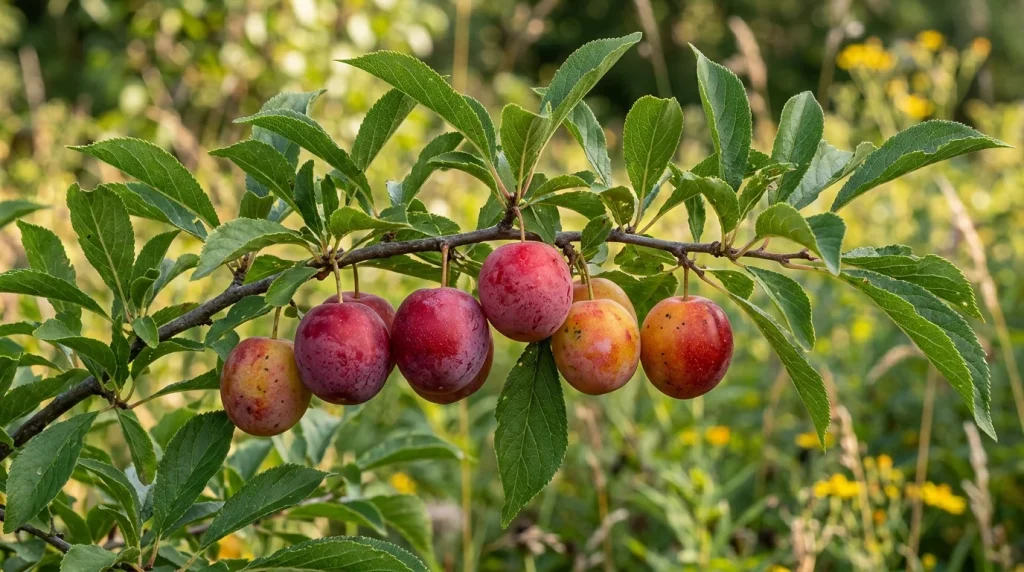
The fruit is a drupe: fleshy tissue surrounds a single hard stone containing the seed. Ripening generally occurs from midsummer into early fall. Color varies among plants and with maturity, so yellow, red, and purplish fruit can all belong to this species.
Ripe flesh ranges from sweet to quite tart, and the skin may be astringent. Fruit size and flavor are not dependable species tests. Late frost, inadequate pollination, insects, and drought can leave an otherwise healthy plant with little fruit.
Wildlife Connections
Spring blossoms provide pollen and nectar to bees and other visiting insects. Leaves support a variety of plant-eating insects, which birds then eat. Native Prunus species are important host plants for numerous moths and butterflies, although the exact insect community varies geographically.
Birds and mammals eat the fruit and can disperse its stones. Dense plum colonies also provide nesting sites, hiding places, and sheltered travel routes for small animals. Their value comes from structure as well as food: a thorny patch offers cover that a closely mown landscape cannot. Deer and rabbits may browse young growth, sometimes heavily enough to alter the plant’s shape.
Seasonal Identification
- Spring: Look for clouds of white blossoms on nearly bare branches. Confirm the small flower clusters rather than the elongated racemes typical of some cherries.
- Summer: Examine broad, sharply toothed leaves and developing plums. Root suckers and stiff branching help distinguish the plant’s overall habit.
- Late summer and fall: Ripe fruit provides the strongest clue when combined with foliage. Leaves generally turn yellow, sometimes with orange or reddish tones; color is variable rather than consistently spectacular.
- Winter: Focus on colony structure, alternate buds, older scaly bark, and occasional sharp branch tips. Without leaves or fruit, identification may remain tentative.
Human Uses and History
Indigenous peoples across portions of the species’ range harvested wild plums for food, including fresh, cooked, and dried preparations. Practices differed among communities. Later settlers also gathered them, and American plum remains useful for preserves, jelly, sauces, and other cooked foods.
Eat only correctly identified, sound fruit, and remove the stones. Do not chew or process the kernels as food. Like other Prunus, American plum contains cyanogenic compounds in parts including seeds and foliage; wilted leaves are a particular concern around livestock. Do not leave fallen branches where animals can browse them.
The species has also contributed to plum breeding and is planted in wildlife borders, shelterbelts, and naturalized landscapes. Allow room for suckering, falling fruit, and sharp branches. It is less suitable immediately beside narrow paths.
Conservation and Threats
American plum is widespread and is not generally regarded as globally threatened, but local populations can disappear when field margins and native shrub patches are cleared. Repeated mowing prevents new stems from establishing, while heavy browsing can suppress regeneration.
Common problems include black knot, which produces swollen black growths on branches, along with leaf diseases, borers, and fruit-feeding insects. Disease pressure varies with climate and site. Avoid moving visibly diseased nursery stock, and seek regional guidance before pruning infected plants.
For restoration, choose locally appropriate planting material where available. Suckering can help stabilize and fill a shrub border, but it requires planning where you must maintain pen grassland or unobstructed access.
Similar Species
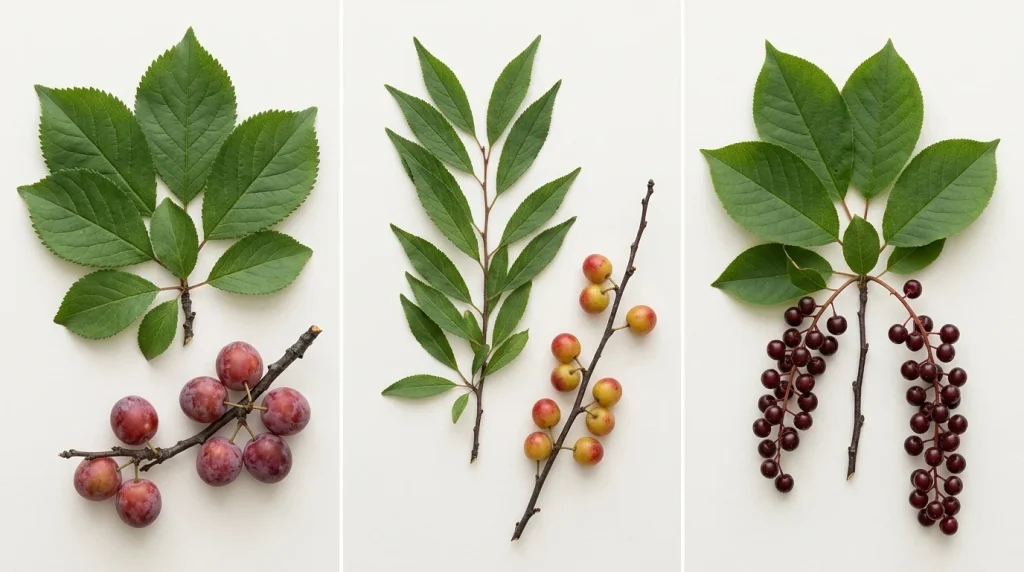
Canada plum (Prunus nigra) overlaps American plum in northern areas and can be difficult to separate. Leaf teeth tend to be blunter and often gland-tipped, while flowers may show pink tones or reddish calyx parts. These distinctions require close examination; use a regional botanical key rather than flower color alone.
Chickasaw plum (Prunus angustifolia), common in the southeastern United States and southern Great Plains, also forms suckering thickets. Its leaves are usually distinctly narrower and smaller, with finer teeth, and its fruit tends to be smaller. Compare several normal leaves rather than one vigorous shoot.
Chokecherry (Prunus virginiana) and black cherry (Prunus serotina) bear flowers and small fruits along elongated racemes rather than producing American plum’s few-flowered clusters and larger plums.
Escaped cultivated plums and hybrids can blur these differences, especially around former homesites. An uncertain tree should remain unidentified rather than be assigned a species from fruit color.
Interesting Facts
- A plum thicket can expand through root suckers without producing seedlings at every new stem.
- Individual trunks are relatively short-lived compared with large forest trees, but replacement stems can keep a colony present much longer.
- The hard object inside a plum is the stone; the actual seed lies within it.
- Plants in one patch may differ in ripening time and flavor, especially when the patch includes genetically distinct individuals.
Frequently Asked Questions
Is American plum a tree or a shrub?
Either description can be correct. A single-stemmed plant functions as a small tree, while suckering plants commonly develop into broad, multistemmed shrub colonies.
How fast does it grow?
On favorable sunny sites, young shoots may add roughly 1–2 feet (30–60 cm) in a growing season. Growth slows with age, shade, drought, or browsing; this is a practical estimate, not a fixed annual rate.
Do I need more than one plant for fruit?
Planting two or more genetically distinct American plums with overlapping bloom usually improves pollination prospects. Several suckers from one parent are not necessarily different pollination partners.
Can I identify it safely from the fruit alone?
No. Check leaves, flower arrangement, branching, and local range as well. For harvesting, confirm the identification and use only sound, ripe flesh, discarding the stones.