Peninsula Newt Guide
Keep Track of What You See
Create a free Wild Things Guide membership to record this Peninsula Newt in My Sightings and build your personal wildlife list.
Join to Add This SightingIntroduction
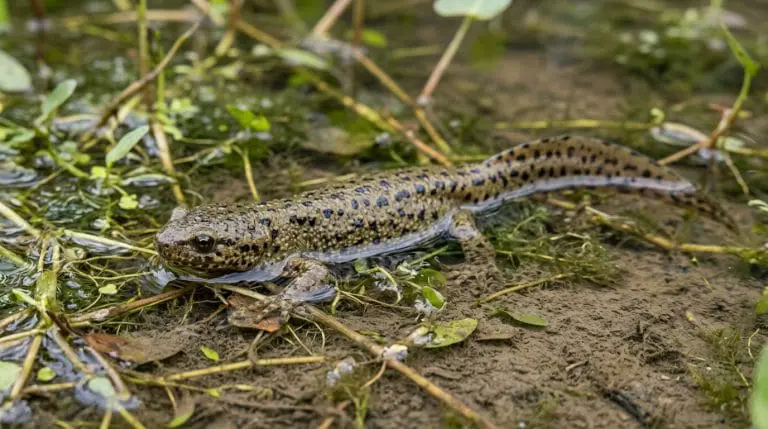
The Peninsula Newt is a regional form of the Eastern Newt found in peninsular Florida. It is generally classified as Notophthalmus viridescens piaropicola, one of several recognized subspecies of Notophthalmus viridescens. Unlike the conspicuously red-spotted Eastern Newts familiar across much of eastern North America, Peninsula Newts are usually plain olive, brown, or greenish above and have few or no bright red side spots.
This small, primarily aquatic salamander inhabits ponds, marshes, swamps, ditches, and other quiet wetlands. Its subdued coloration and habit of moving among submerged vegetation can make it difficult to notice. Identification is easiest when observers combine body shape, belly color, spotting pattern, habitat, and location rather than relying on a single mark.
Quick Identification
- Overall shape: Small, sturdy newt with short legs and a vertically flattened, paddle-like tail.
- Upperparts: Olive green, greenish brown, tan, or dark brown, usually without prominent red spots.
- Underside: Yellow to orange, commonly marked with scattered small black spots.
- Skin: Slightly rough or granular rather than smooth and glossy.
- Typical setting: Shallow, still or slow-moving water with abundant aquatic vegetation.
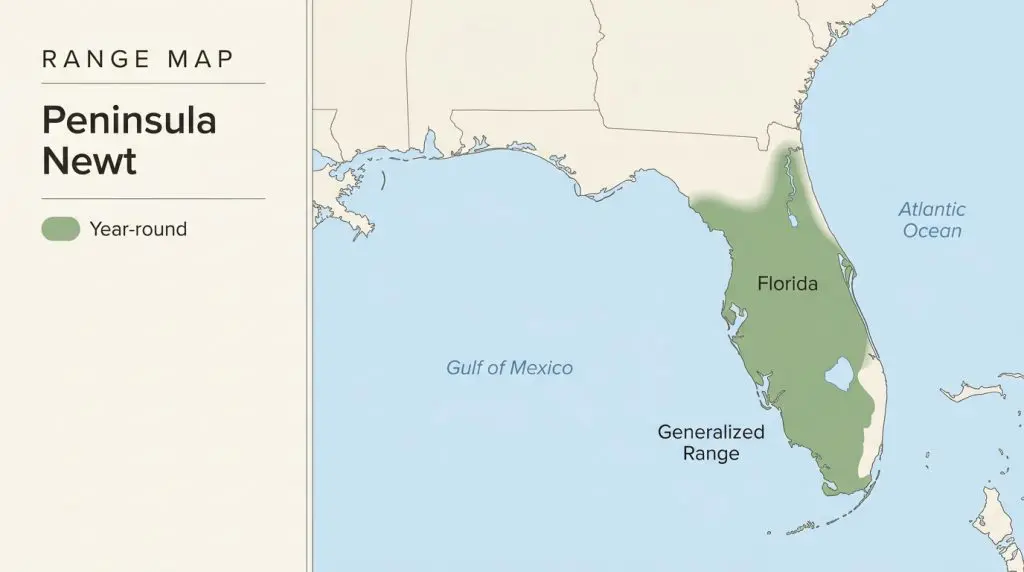
- Range: Restricted to the Florida peninsula, with the northern limits and zones of intergradation not always sharply defined.
Appearance and Field Marks
Adult Peninsula Newts have a compact body, a blunt head, small eyes, and relatively short limbs. The tail is laterally compressed, especially in aquatic adults, and provides much of the propulsion during swimming. There are four toes on each front foot and five on each hind foot.
Dorsal coloration varies with water conditions, substrate, age, and lighting. Individuals may appear olive, gray-green, yellow-brown, chocolate brown, or nearly black. The skin can look lighter immediately after shedding. Bright red, black-bordered side spots—the classic marks of the Red-spotted Newt—are normally reduced or absent, although occasional reddish flecks or faint spots may occur.
The belly is often the most useful field mark. It is yellow, golden, or orange and typically carries small, irregular black dots. The dividing line between the darker back and brighter underside is usually evident along the lower sides. Adult males and females are similar outside the breeding period. Breeding males tend to develop a more swollen cloaca, enlarged hind limbs, dark gripping pads on the legs and toes, and a deeper tail fin.

Size and Measurements
Most adults measure about 2.5–4 inches (6.4–10.2 centimeters) in total length, including the tail. Females may average somewhat larger and heavier-bodied than males, but size alone is not a dependable way to determine sex. Newly transformed juveniles are substantially smaller and may have proportionally narrower tails.
Reliable field weight ranges are not commonly reported for the Peninsula Newt as a distinct subspecies. Adults weigh only a few grams, and mass can change with sex, reproductive condition, hydration, and recent feeding. Length is therefore the more practical field measurement.
Range and Distribution
The Peninsula Newt is endemic to Florida and occurs primarily through the central and southern peninsula. Its distribution approaches areas occupied by other forms of the Eastern Newt farther north, and the boundary should not be treated as a precise line without locality records or genetic evidence.
Within its range, the newt can be locally abundant in suitable fish-poor wetlands yet absent from nearby waters that appear similar. Hydroperiod, aquatic vegetation, water chemistry, predatory fish, and historical connections among wetlands may all influence occupancy. Small or temporary populations can also be overlooked because these newts spend long periods beneath vegetation or bottom debris.
Habitat
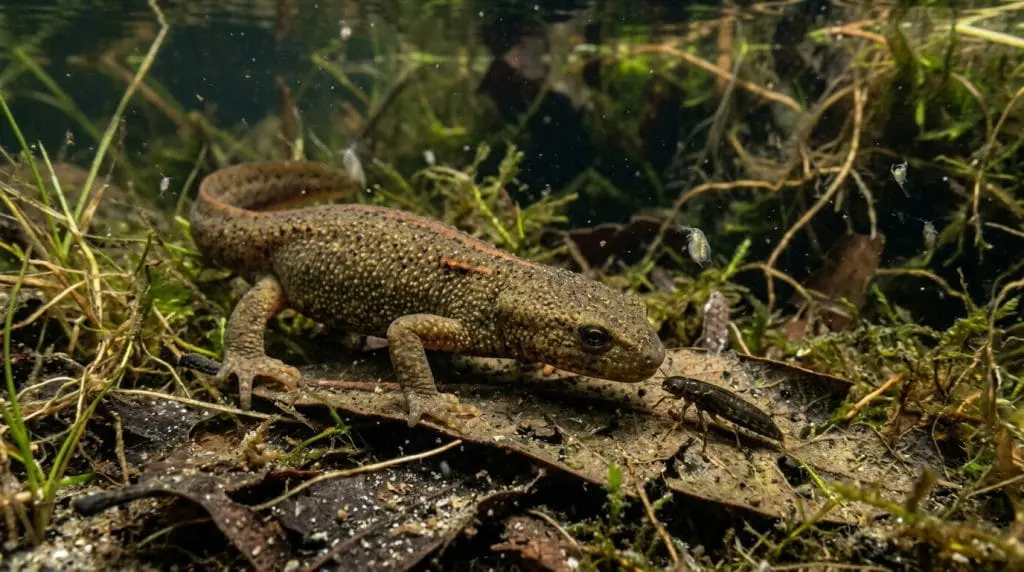
Peninsula Newts favor quiet freshwater habitats, including cypress swamps, marshes, shallow ponds, wet prairies, flooded depressions, roadside ditches, canals, and vegetated lake margins. They are often associated with submerged plants, leaf litter, root mats, and other underwater cover.
Permanent and semi-permanent wetlands may both be used. Waters without large predatory fish can provide especially favorable breeding conditions, although the species is not limited to completely fishless sites. During drought or declining water levels, newts may shelter in damp organic material, beneath cover near the wetland, or in remaining pools. Moist surrounding uplands help maintain connectivity among breeding sites.

Behavior
Adults are largely aquatic and alternate between resting on the bottom, climbing through vegetation, and swimming with side-to-side tail movements. They may rise periodically to the surface for air, even though gas exchange also occurs through the skin and lining of the mouth.
Activity can occur by day or night. Individuals are often easier to see after rain, during cooler weather, or when they enter open patches of shallow water. When threatened, a newt may freeze, retreat into vegetation, swim rapidly away, or arch its body to expose the brighter underside.
Like other Eastern Newts, Peninsula Newts possess toxic skin secretions that discourage many predators. They should not be handled unnecessarily. If handling is required for authorized research or rescue, clean wet hands or powder-free gloves help protect the animal’s permeable skin from oils, chemicals, and abrasions.
Diet and Hunting
Peninsula Newts are opportunistic carnivores. Their diet includes aquatic insect larvae, tiny crustaceans, worms, mites, snails, small clams, and other invertebrates. Larger individuals may consume amphibian eggs, very small tadpoles, or salamander larvae when available. Diet varies with prey abundance and the newt’s size.
Hunting is usually deliberate. A newt moves slowly through vegetation or along the bottom, orienting toward movement and chemical cues before lunging a short distance. Small prey are swallowed whole. Larvae feed on correspondingly smaller organisms, including zooplankton and minute aquatic invertebrates.
Vocalizations
Peninsula Newts do not produce the advertisement calls associated with frogs and toads. No regular, field-identifiable breeding call is known. Any faint clicks or squeaks produced during disturbance are inconsistent and not useful for identification. Visual searches, dip-net surveys conducted under appropriate permits, and nighttime spotlighting are more effective detection methods.
Breeding and Nesting
Breeding occurs in water and may extend through part of Florida’s cooler or wetter seasons, although timing varies with latitude, rainfall, temperature, and wetland conditions. A male courts a female at close range, using body posture, tail movements, and chemical signals. He eventually deposits a spermatophore, a small packet of sperm that the female picks up with her cloaca.
Peninsula Newts do not build nests. The female places eggs individually on aquatic plants or other submerged material, often folding or pressing vegetation around each egg. Spreading eggs among many sites may reduce the chance that a single predator or disturbance will destroy the entire reproductive effort.
Reproduction
Eggs develop underwater and hatch into larvae with feathery external gills, slender bodies, and tail fins. Developmental speed depends strongly on water temperature, food, and hydroperiod. Larvae prey on tiny aquatic organisms while avoiding fish, dragonfly nymphs, aquatic beetles, and larger amphibian larvae.
Across much of the Eastern Newt’s range, larvae transform into bright orange-red terrestrial juveniles known as efts before later returning to water. Peninsula Newts commonly reduce or bypass this conspicuous terrestrial eft stage, remaining aquatic through juvenile development. Life histories can still vary among wetlands, so an apparently terrestrial juvenile should not be rejected solely on that basis.
At metamorphosis, the external gills disappear, and the body takes on the proportions and granular skin of a juvenile newt. Sexual maturity requires additional growth and is influenced by local environmental conditions rather than a single fixed schedule.

Similar Species
Other Eastern Newt subspecies: Red-spotted Newts usually show distinct red spots bordered with black. Central Newts can also have reduced spotting, making geographic location important. Where subspecies meet, intermediate-looking animals are possible.
Striped Newt: This Florida species has two pale yellow or tan stripes running along a darker back. The stripes may be broken, but their lengthwise arrangement differs from the plain-backed appearance typical of a Peninsula Newt. Striped Newts are most associated with ephemeral ponds and surrounding uplands in north-central Florida.
Dwarf salamanders: Dwarf salamanders are more slender, usually have relatively tiny limbs, and possess only four toes on each hind foot. Peninsula Newts have five hind toes and a more robust body with granular skin.
Salamander larvae: Larval mole salamanders and other aquatic larvae retain visible external gills. Adult Peninsula Newts lack external gills and have rougher skin and a yellow-to-orange spotted belly. Sirens and amphiumas are much more elongated and have greatly reduced limbs.
Conservation
The Eastern Newt is commonly assessed as Least Concern at the species level, but the Peninsula Newt is not generally given a separate global conservation category. Broad status should not be interpreted as evidence that every local population is secure.
Wetland drainage, shoreline development, pollution, altered fire and water regimes, severe drought, and fragmentation of surrounding habitat can reduce local populations. Stocking predatory fish into formerly fish-poor ponds may affect eggs and larvae. Road construction and deep, steep-sided drainage canals can also isolate wetlands.
Practical conservation measures include protecting interconnected wetlands, retaining vegetated margins, limiting pesticide and fertilizer runoff, avoiding the release of fish or nonnative aquatic animals, and cleaning and drying field equipment between wetlands to reduce the movement of amphibian pathogens and invasive organisms.
Field Identification Tips
- Confirm that the animal has a newt’s sturdy body, granular skin, short limbs, and flattened swimming tail.
- Look for an olive or brown back with no prominent series of red, black-bordered spots.
- Check the underside only when you can observe it without harmful handling; expect yellow to orange with small black dots.
- Use location cautiously. A newt in central or southern peninsular Florida supports the identification, but northern animals may require closer study.
- Do not confuse an adult with a larva. External gills indicate a larval salamander, not an adult Peninsula Newt.
- Photograph the back, side, tail, and visible underside. Record habitat and exact locality for expert review while avoiding public disclosure of sensitive sites.
- Observe from the water’s edge when possible. Collection and dip-netting may require landowner permission and state or federal authorization.
Interesting Facts
- The Peninsula Newt’s scientific subspecies name, piaropicola, refers to an association with aquatic vegetation.
- Its reduced red spotting and often aquatic juvenile period distinguish it from the classic orange eft seen farther north.
- Newts can regenerate portions of damaged limbs, tails, and some internal tissues, although regeneration is not instantaneous and does not make them immune to injury.
- Toxic skin compounds provide defense, but snakes, turtles, fish, birds, and aquatic invertebrates may still prey on newts or their early life stages.
- Because the animals are quiet and often concealed underwater, a healthy population may be present in a wetland without being obvious to casual observers.