Mourning Cloak Butterfly Guide
Keep Track of What You See
Create a free Wild Things Guide membership to record this Mourning Cloak Butterfly in My Sightings and build your personal wildlife list.
Join to Add This SightingIntroduction
The Mourning Cloak (Nymphalis antiopa) is one of the most recognizable and resilient butterflies in North America. Known in Great Britain as the Camberwell Beauty, this species is famous among naturalists for its unusual life history, long adult lifespan, and striking appearance. Unlike the majority of North American butterflies, which pass the winter as eggs, larvae, or pupae, the Mourning Cloak overwinters as a fully formed adult butterfly tucked into tree hollows, loose bark, or woodpiles. Consequently, it is often the very first butterfly seen flying in late winter or early spring, occasionally emerging on sunny days while snow still covers the forest floor.
Quick Identification
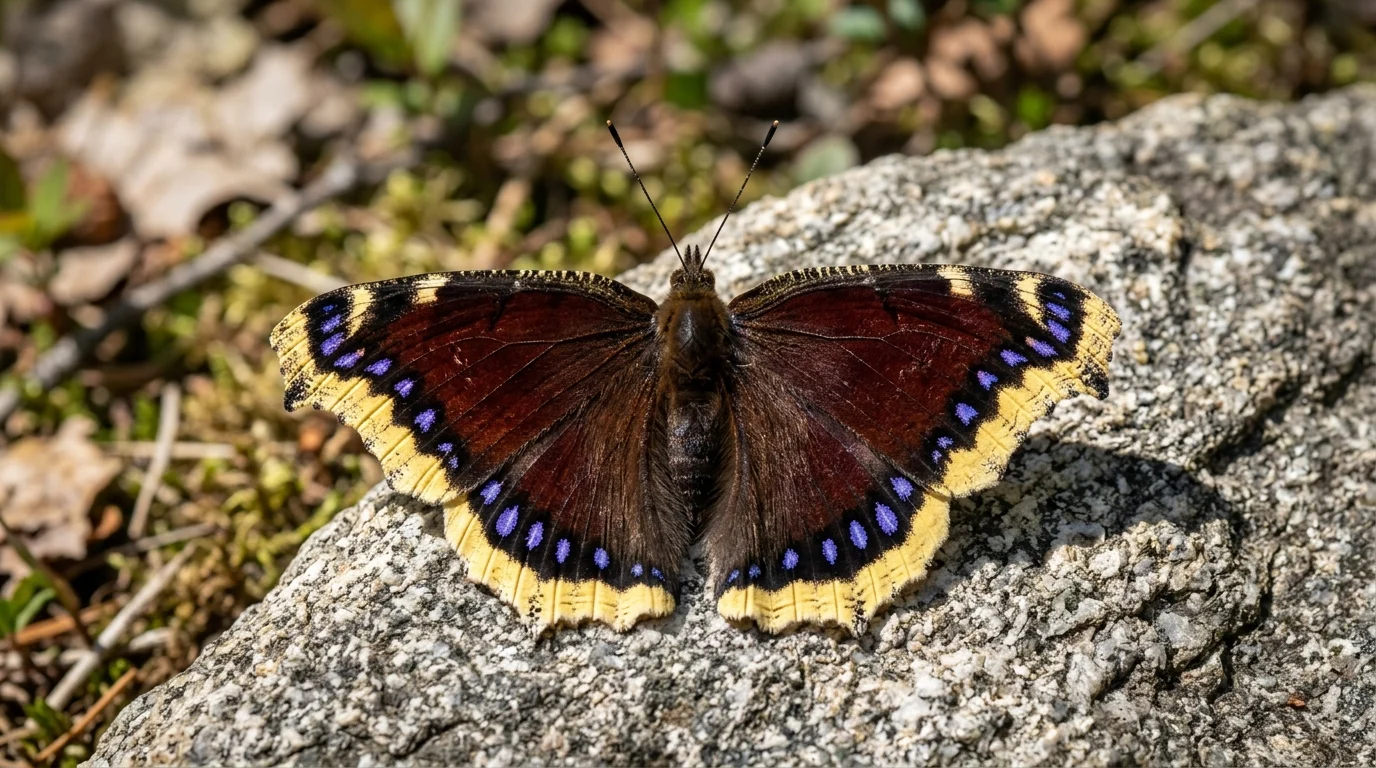
Adult Mourning Cloaks are medium-to-large butterflies with distinctively irregular, scalloped wing margins. The upperside of the wings features a deep, velvety chocolate-brown to maroon mantle. Running along the inner edge of the margin is a striking band of iridescent, bright blue submarginal spots. The outermost border of the wing consists of a broad, ragged band of pale yellow. In overwintered individuals that have survived the winter, this outer border often fades from bright yellow to a dull cream or white. The underside of the wings contrasts sharply, appearing dark gray-black and textured like charred wood or tree bark, providing exceptional camouflage when resting on tree trunks with wings closed.

Caterpillar Identification
The caterpillar of the Mourning Cloak, often called the spiny elm caterpillar, is visually distinct and easily recognized. Mature larvae reach lengths of approximately 2.0 inches (50 mm). The body is predominantly velvety black, densely peppered with minute white speckles that give it a frosted appearance. A conspicuous row of bright reddish-orange spots runs down the middle of the back. The body is covered in prominent, branched black spines (scoli) that extend along the top and sides. The prolegs are a contrasting reddish-brown to orange color. Young caterpillars feed gregariously in communal silk webs on host tree branches before dispersing in their final instars.
Eggs, Chrysalis, or Cocoon
Female Mourning Cloaks lay their eggs in tight, ring-like clusters encircling small twigs of host plants. The eggs are initially pale yellow or amber and turn darker as development progresses. Upon pupation, the caterpillar forms a chrysalis suspended head-down from a silk button attached to a stem or sheltered structure. The chrysalis is angular and rugged, measuring about 1.0 to 1.2 inches (25–30 mm) in length. Its coloration ranges from wood-brown to ash-gray, often featuring sharp horn-like projections at the head end and subtle metallic gold or silver tips on the abdominal tubercles, mimicking a dead leaf or dry bark twig.

Life Cycle
The life cycle of the Mourning Cloak is notably long compared to most temperate butterflies, with individual adults surviving up to 10 to 11 months. Overwintered adults emerge from sheltered diapause in early spring to mate. Females deposit egg clusters on host twigs, and larvae hatch within several weeks. Caterpillars feed intensely through early summer before pupating. Fresh adults emerge in early to mid-summer. After a brief period of feeding on tree sap and fruit, adults often enter a period of summer dormancy known as aestivation during the hottest weeks of July and August. They re-emerge in early autumn to feed heavily and build energy reserves before seeking winter shelter in rock crevices, tree cavities, or under loose bark.
Range and Distribution
The Mourning Cloak boasts an expansive geographical distribution. In North America, it occurs from northern Alaska and Canada’s boreal forests south through the continental United States into central Mexico. It is absent only from the southernmost tip of Florida and remote Arctic tundra. The species is also native across temperate Eurasia, making it a truly Holarctic butterfly. Observations logged through Butterflies and Moths of North America demonstrate its consistent presence across forest ecosystems throughout every Canadian province and U.S. state.

Habitat
Mourning Cloaks prefer open deciduous forests, forest edges, sunny clearings, and riparian corridors along streams and rivers. Because their larvae feed on moisture-loving trees, they are frequently encountered near wetlands, marshes, and damp woodlands. They adapt well to human-modified landscapes and are common visitors to suburban parks, orchards, woodlots, and tree-lined rural roadsides. During the heat of summer or cold of winter, they rely heavily on mature forest canopy structures that provide dead wood, bark crevices, and shady retreats.

Adult food sources
Adult Mourning Cloaks rarely visit garden flowers for nectar. Instead, their mouthparts are adapted to feed on energy-rich non-floral fluids. Primary food sources include:
- Tree Sap: Particularly sap oozing from wounds on oaks, maples, birches, and willows caused by sapsuckers or physical injury.
- Fermenting Fruit: Fallen and rotting apples, pears, peaches, and berries in orchards or wild thickets.
- Mud and Moisture: Mineral-rich damp soil, mud puddles, and wet gravel (a behavior known as puddling).
- Animal Byproducts: Occasionally feeding on animal dung, carrion, or decaying organic material to obtain essential salts and amino acids.
When and Where to Look
To spot a Mourning Cloak, search in early spring—often March or April depending on latitude—on warm, sunny afternoons. Focus on woodland trails, forest edges, and sunny patches on tree trunks where adults perch to bask and warm their flight muscles. In autumn, look near fallen fruit trees or along dirt tracks where sap drips from mature hardwoods. Because of their dark undersides, perched butterflies can be difficult to spot on tree bark until they open their wings and display their brilliant yellow borders and blue submarginal spots.
Is It Harmful?
The Mourning Cloak is completely harmless to humans and pets. Although the caterpillars bear intimidating branched black spines, they lack stinging venom or urticating hairs and can be handled safely. While heavy infestations of spiny elm caterpillars can temporarily defoliate individual branches of host trees such as willows or elms, this feeding rarely causes long-term structural harm to established native trees, and control measures are rarely warranted.
Conservation and Ecological Importance
The Mourning Cloak is currently classified as secure across its global and North American range. It serves a vital ecological role within forest habitats. The caterpillars provide an important food source for breeding songbirds, parasitoid wasps, and predatory insects. Because adults emerge early in spring, they also serve as an important secondary prey source for early-season wildlife and contribute to nutrient cycling within forest clearings.
How to Attract or Support It
To create a welcoming habitat for Mourning Cloaks in rural or suburban landscapes:
- Plant Native Host Trees: Plant and retain native host species including willows (Salix spp.), American elm (Ulmus americana), paper birch (Betula papyrifera), poplars, and trembling aspen (Populus tremuloides).
- Provide Food Stations: Leave fallen, overripe fruit such as bananas or peaches in a shallow elevated dish near woodland edges.
- Preserve Winter Shelter: Leave standing dead trees (snags), woodpiles, and loose bark intact on your property to provide natural overwintering sites.
- Eliminate Pesticides: Avoid broad-spectrum insecticide treatments on shade trees, which can kill feeding larvae.
Similar Species
The adult Mourning Cloak is relatively distinct, but can occasionally be confused with other members of the family Nymphalidae:
- Compton Tortoiseshell (Nymphalis l-album): Possesses mottled orange-brown wings with dark patches and a single white costal spot, lacking the bold yellow margin and blue submarginal dots.
- Question Mark (Polygonia interrogationis): Features rich orange upper wings with brown spots and deeply angled margins, lacking the solid maroon center and pale yellow border.
- Eastern Comma (Polygonia comma): Smaller with ragged orange-and-brown upper wings and a silver mark on the underside, lacking blue submarginal spots.
Interesting Facts
- Remarkable Longevity: With an adult life span of up to 10 months, the Mourning Cloak is one of the longest-lived butterflies in North America.
- Montana State Butterfly: Montana officially designated the Mourning Cloak as its state butterfly in 1988 following campaigns by local schoolchildren.
- Color Fading: The outer border of the wing is bright yellow in newly emerged summer adults but fades to clean white by the time the overwintered butterfly flies the following spring.
- Defensive Behavior: When threatened by predators, Mourning Cloaks can fold their wings and drop to the forest floor, relying on their bark-like underside to vanish against leaf litter.
Frequently Asked Questions
Why is it called a Mourning Cloak?
The common name comes from its dark maroon-brown upper wings bordered by pale yellow, which resembles a traditional cloak worn during periods of mourning.
Do Mourning Cloak caterpillars sting?
No. Despite their sharp, spiny appearance, the branching spines are purely defensive visual deterrents against birds and do not possess stinging venom.
What trees do Mourning Cloak caterpillars eat?
Caterpillars feed primarily on leaves of native willows, elms, poplars, aspens, birches, and occasionally hackberries or fruit trees.
Where do Mourning Cloaks hide during winter?
They hibernate in sheltered dry places such as hollow tree cavities, under loose tree bark, inside unheated sheds, or between stacked firewood logs.