Loblolly Pine Guide
Keep Track of What You See
Create a free Wild Things Guide membership to record this Loblolly Pine in My Sightings and build your personal wildlife list.
Join to Add This SightingTree Name
Loblolly pine (Pinus taeda) is a large evergreen conifer in the pine family, Pinaceae. Native to the southeastern United States, it is one of the region’s most familiar forest and plantation trees. Common names include old-field pine and North Carolina pine. The name “loblolly” refers to muddy ground or a thick porridge, reflecting the tree’s association with moist lowlands, although it also grows on many upland sites.

Quick Identification
Look for a tall, straight pine with a relatively open crown, long needles in bundles of three, and woody cones with sharp prickles. Check several features together rather than relying on height or habitat alone.
- Needles: Usually in bundles of three, about 5–9 inches (12–23 cm) long, slender, and often slightly twisted.
- Cones: Usually 3–6 inches (7.5–15 cm) long, elongated when closed, with a sharp prickle on each exposed scale.
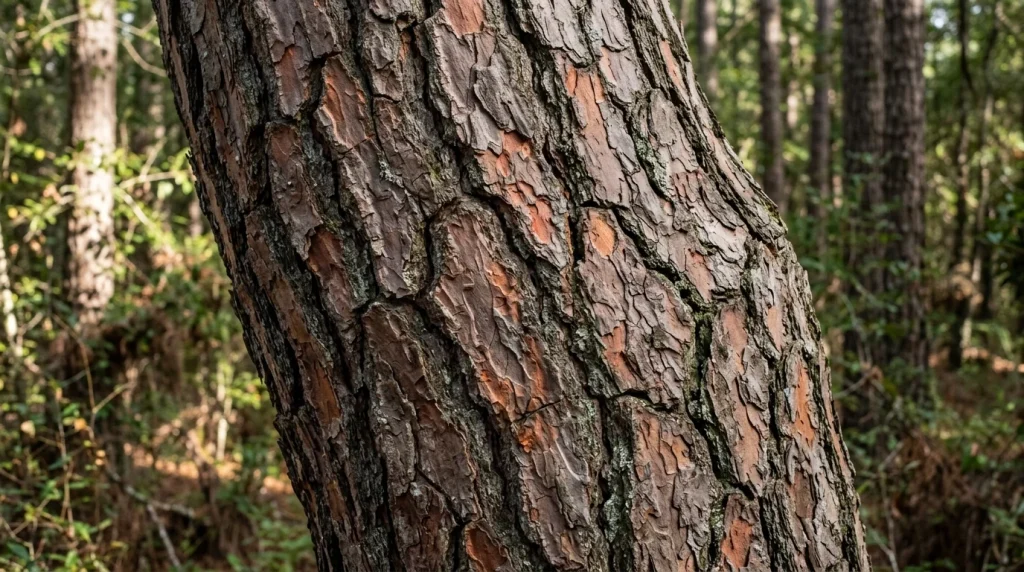
- Bark: Mature trunks have thick, reddish-brown to gray-brown plates separated by deep furrows.
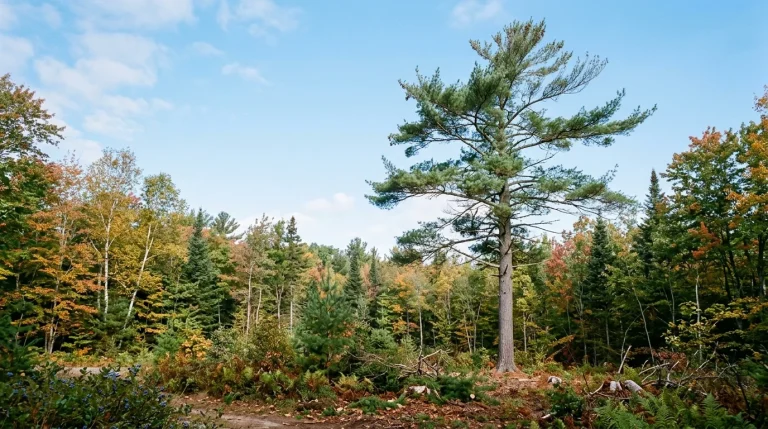
- Form: A straight trunk supporting an oval or irregular crown, often well above the ground in forest-grown trees.
Appearance
Mature loblolly pines commonly reach 60–100 feet (18–30 m), with taller trees on favorable sites. Open-grown crowns often spread about 25–40 feet (8–12 m); crowded forest trees generally have narrower crowns. Young trees are roughly pyramidal, while older trees develop elevated, rounded or uneven crowns as shaded lower branches die.
The needles are yellow-green to dark green and cluster toward twig ends. Each bundle, called a fascicle, has a persistent papery sheath at its base. Most bundles contain three needles, although occasional two-needle bundles occur. Inspect several intact bundles before deciding on an identification.
Needles usually remain for roughly two years before shedding. Normal loss of older, inner needles can create yellow patches in fall without indicating serious disease.

Bark, Twigs, and Buds
Young bark is relatively thin and scaly, becoming increasingly furrowed with age. Mature trunks develop substantial, irregular plates that may appear reddish or cinnamon-brown in fresh breaks and grayer on weathered surfaces. Bark alone is not reliable: several southern pines have similar plated trunks.
Current twigs are moderately stout and become roughened by the bases of fallen needle bundles. Terminal buds are pointed, reddish-brown, and covered with overlapping scales; they may show resin. Spring growth extends from these buds as upright shoots commonly called candles.
For a practical field check, examine a reachable branch, fallen fresh twig, and several cones beneath the same tree. In mixed pine stands, fallen material may belong to a neighboring species, so verify that the branch actually comes from your target tree.
Range and Habitat
Loblolly pine’s native range extends from southern New Jersey to central Florida and from eastern Texas to southeastern Oklahoma, including much of the Coastal Plain and Piedmont. It also occurs in portions of the interior Southeast, but it is not a characteristic tree of the highest Appalachian elevations. Planting has extended its occurrence beyond its natural range.
It favors sunny sites with adequate moisture, including low terraces, stream margins, moist flats, and abandoned farmland. Despite its lowland association, it grows on a wide variety of upland soils. Prolonged flooding, severe drought, deep shade, and extreme cold can limit establishment or survival.
Loblolly frequently colonizes disturbed ground and forms even-aged stands after farming, logging, or other canopy removal. The U.S. Forest Service’s loblolly pine silvics account provides detailed information about its native distribution, soils, and forest ecology.

Flowers, Fruit, Nuts, or Cones
Loblolly pine does not produce true flowers, fruits, or nuts. Male pollen cones and female seed cones occur on the same tree. In late winter or spring, depending on location and weather, clusters of small male cones release abundant wind-carried pollen. The familiar yellow coating on cars, puddles, and porches can come from several pine species, not just loblolly.
Female cones begin small and mature during the second autumn after pollination. Mature cones are brown, woody, and broadly egg-shaped to elongated, with scales that open in dry conditions. Each scale bears a distinct sharp prickle, so handle cones carefully.
The small seeds have papery wings that aid wind dispersal. Empty cones may remain attached for a time or collect beneath the crown. Unlike strongly fire-dependent, closed-cone pines, loblolly normally releases seed without fire.

Wildlife Connections
Loblolly seeds feed squirrels and seed-eating birds, including some finches and nuthatches. Needles, branches, bark crevices, and cones support insects that in turn provide food for birds. Dense young stands offer cover, while older trees provide elevated nesting and roosting sites.
In suitable, actively managed southern pine landscapes, old living loblolly pines can serve as cavity trees for red-cockaded woodpeckers. Those birds depend on much more than the presence of a pine: stand age, open structure, a suitable ground layer, and management history all matter.
Wildlife value varies with the surrounding habitat. A uniform, densely stocked plantation generally supports a different community from an open, mature pine woodland with native grasses, flowering plants, scattered hardwoods, and retained deadwood.
Seasonal Identification
- Winter: Evergreen foliage, persistent needle bundles, plated bark, and woody cones provide the main clues.
- Spring: Look for lengthening candles and clusters of pollen cones. New growth is lighter green than older needles.
- Summer: Fully extended needles make bundle counts and length comparisons easier. Developing cones remain green.
- Fall: Mature cones turn brown and release seeds. Older interior needles yellow and drop while younger foliage stays green.
Needle yellowing restricted to older growth is often normal; rapid browning of entire branches or crowns warrants closer investigation.

Human Uses and History
Loblolly is a major commercial timber species, widely grown for construction lumber, plywood, pulp, and other wood products. Its relatively rapid juvenile growth and responsiveness to forest management have made it especially important in southeastern plantation forestry. It belongs to the commercial grouping commonly called southern yellow pine.
Its old-field nickname reflects its ability to seed into abandoned agricultural land. Many present-day pine stands represent this history of land clearing, farming, and subsequent forest recovery rather than undisturbed ancient woodland.
In landscapes, loblolly can provide screening and a tall evergreen canopy where space allows. The NC State Extension Plant Toolbox’s loblolly pine profile describes its identifying features and landscape considerations.
Conservation and Threats
Loblolly pine is widespread and extensively cultivated, so species-wide rarity is not its principal conservation concern. More localized issues include loss of diverse natural forests, conversion of other native habitats to plantations, and the disappearance of old trees and open pine woodland structure.
Southern pine beetles can kill trees, particularly during outbreaks. Fusiform rust may produce swollen, elongated galls on stems or branches, and several root diseases can weaken stands. Drought, storms, ice, soil compaction, and root injury also cause damage.
Fire effects depend on tree size and fire intensity. Older trees tolerate some low-intensity surface fire better than seedlings, but loblolly is less adapted to frequent fire than longleaf pine. Prescribed burning requires site-specific professional planning.
Similar Species
- Shortleaf pine (Pinus echinata): Usually has shorter needles, about 3–5 inches (7.5–13 cm), in bundles of two or three. Its cones are smaller, commonly about 1.5–2.5 inches (4–6 cm). Small resin pockets in bark plates can be another useful clue.
- Longleaf pine (Pinus palustris): Has much longer needles, commonly 8–18 inches (20–46 cm), in dense, brushlike clusters. Large silvery-white terminal buds and a distinctive grass-stage seedling help separate it from loblolly.
- Slash pine (Pinus elliottii): Often has needles in both two- and three-needle bundles. Needles tend to be longer and glossy, and cones commonly look shinier than loblolly cones. Use multiple features because measurements overlap.
- Ponderosa pine (Pinus ponderosa): Often occupies wet, acidic sites and has more rounded cones that may remain closed for years. Needle bundles can resemble loblolly’s, making cone shape and persistence especially helpful.

Interesting Facts
- A fascicle is a short shoot bearing a small group of needles, not simply several loose needles touching.
- Loblolly’s winged seeds travel by wind, but successful seedlings still need enough light and suitable moisture.
- Dense stands naturally lose shaded lower branches, explaining the long, relatively clear trunks common in timber forests.
- “Evergreen” describes year-round foliage, not permanent needles: individual needles are regularly replaced.
Frequently Asked Questions
How fast does loblolly pine grow?
Established young trees on favorable sites often add about 1–3 feet (30–90 cm) in height annually. Growth varies substantially with age, climate, competition, soil moisture, and planting stock; this is not a guaranteed yearly rate.
How long does it live?
Loblolly can live roughly 100–200 years, with some trees exceeding that range. Many trees are harvested or die much earlier, so a plantation’s harvest age should not be confused with the species’ biological lifespan.
Is it a good tree for a small yard?
Usually not. Its mature height and crown require generous space away from buildings and overhead utilities. Allow for needle litter, falling cones, and eventual professional tree care rather than choosing a site based on a small nursery specimen.
What is the best way to confirm an identification?
Look for mostly three-needle bundles, needles about 5–9 inches long, and elongated cones with sharp scale prickles. Check several samples and compare nearby southern pine species. No single feature reliably distinguishes every loblolly from every look-alike.