Jack Pine Guide
Keep Track of What You See
Create a free Wild Things Guide membership to record this Jack Pine in My Sightings and build your personal wildlife list.
Join to Add This SightingTree Name
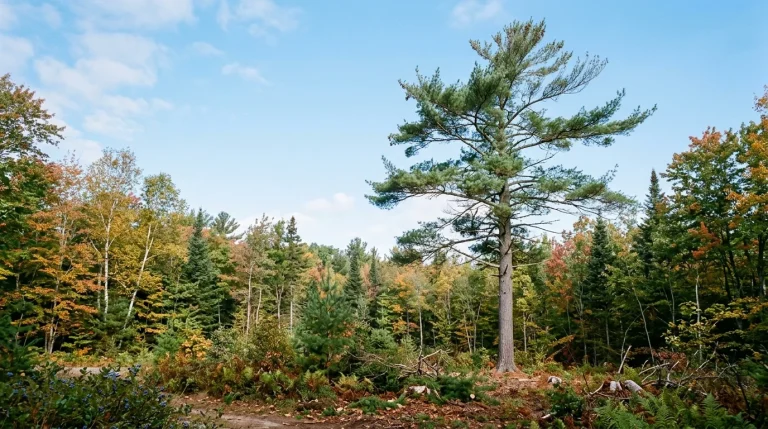
Jack pine (Pinus banksiana) is a native North American evergreen conifer in the pine family, Pinaceae. It is especially characteristic of sandy barrens, rocky uplands, and fire-shaped boreal forests. A mature tree may have a straight trunk and narrow crown, or a crooked, open outline on an exposed site. Shape alone is unreliable: the strongest identification combines short needles in pairs with small, often curved cones that persist on branches.

Quick Identification
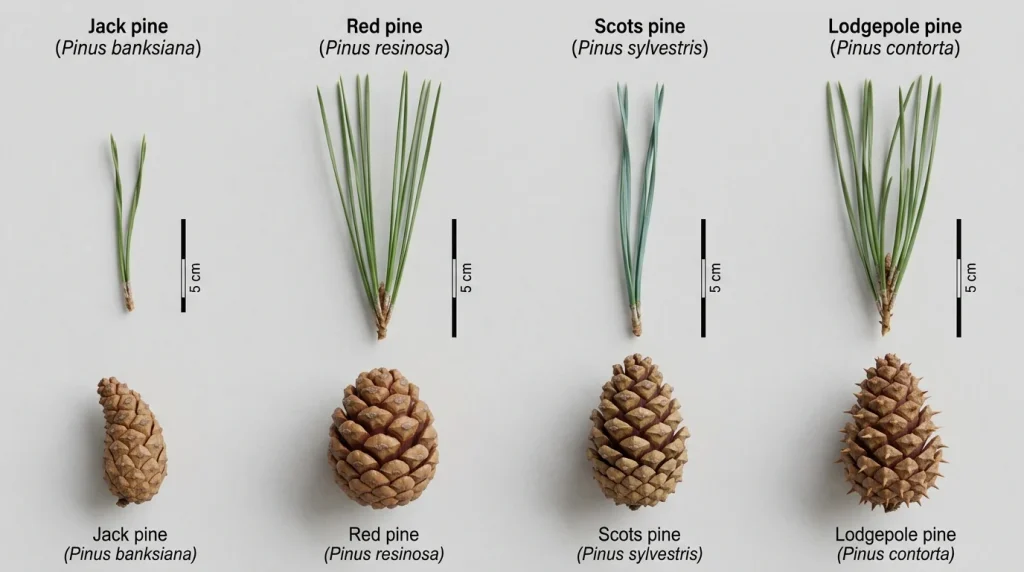
- Needles: Usually ¾–1½ inches (2–4 cm) long, in bundles of two; commonly twisted, spreading, and yellowish green to green.
- Cones: About 1–2 inches (2.5–5 cm) long, often noticeably curved or asymmetric, and attached close to the branch.
- Persistent cones: Several years of cones may remain clustered along older branches, often with many still closed.
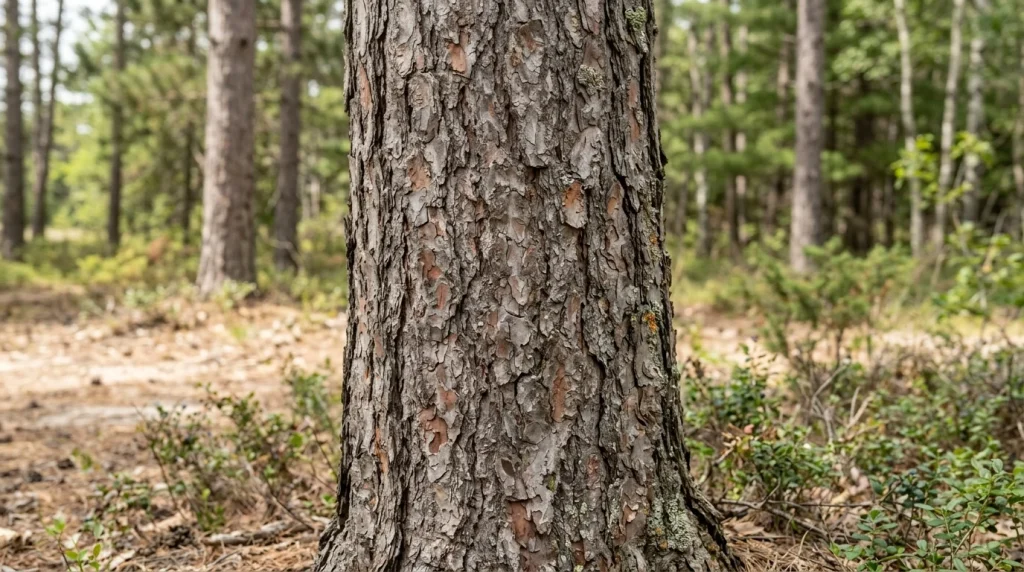
- Bark: Thin and reddish brown to gray-brown when young, becoming scaly and irregularly plated with age.
- Setting: Dry sand, gravel, shallow rocky soil, or relatively young forest established after disturbance.
Inspect several needle bundles and cones rather than judging a single specimen. Cone curvature varies, and some populations have many cones that open without fire.
Appearance
Mature jack pines commonly reach about 30–70 feet (9–21 m), with crowns roughly 15–30 feet (4.5–9 m) wide where space permits. Trees on poor, exposed ground may remain much smaller. Closely spaced forest trees tend to be slender, while open-grown individuals develop spreading, irregular branches and sometimes leaning trunks.
The foliage usually looks relatively sparse compared with the longer, denser needle clusters of red pine. Needles occur in pairs within a small papery sheath at their base. Each needle is stiff, often slightly twisted, and short enough that a leafy twig can look bristly rather than feathery.
Young, established trees may add roughly 12–24 inches (30–60 cm) in height annually on suitable sites, but growth varies greatly with moisture, competition, and soil. Many trees live around 80–150 years; older individuals occur. These are field expectations, not dependable ages inferred from size.

Bark, Twigs, and Buds
Young bark is relatively thin and may appear reddish brown before becoming darker and scaly. Older trunks develop irregular gray-brown or reddish-brown plates separated by shallow fissures. Jack pine generally lacks the conspicuously thick, deeply furrowed bark associated with some larger fire-tolerant pines.
Current twigs are slender and yellowish to reddish-brown and darken with age. Buds are small, pointed, brown, and often resinous. Bud appearance is best treated as supporting evidence rather than a decisive field mark.
Look along older branch sections for attached cones after the surrounding needles have fallen. This accumulation of cones, combined with short paired needles farther out on the same branch, is especially useful. Avoid peeling bark or breaking branches; fallen material often provides enough detail.
Range and Habitat
Jack pine is widespread across boreal Canada, from the Northwest Territories and western interior east to Quebec and the Maritime provinces. Its range extends south into the Great Lakes region and parts of the northeastern United States. Local occurrence is uneven, reflecting soil, climate, fire history, and planting.
Typical habitats include sandy outwash plains, dunes, gravelly deposits, and shallow soils over bedrock. It tolerates acidic, nutrient-poor conditions that limit many competing trees. Although often associated with dry uplands, it also occurs on some wetter sites; sandy ground is a useful clue, not an absolute requirement.
This is a strongly light-demanding pioneer. After fire or another major disturbance, seedlings may establish densely on exposed seedbeds. Without renewed disturbance, more shade-tolerant trees can gradually replace it. The U.S. Forest Service’s jack pine silvics account explains its distribution, regeneration, and relationship with site conditions.

Flowers, Fruit, Nuts, or Cones
Jack pine does not produce botanical flowers or fleshy fruit. Individual trees bear both pollen cones and seed cones. Small pollen cones occur in clusters near the bases of new shoots and release windborne pollen in spring, with timing varying by latitude and weather.
Young seed cones form toward shoot tips and mature during the second growing season. Mature cones are woody, usually curved or uneven-sided, and borne singly or in groups. Their scales lack the prominent, persistent sharp prickles typical of some other pines.
Many jack pine cones are serotinous: resin bonds keep them closed after the seeds mature. Heat can break those bonds, allowing cones to open and release small winged seeds. Fire is an important trigger, but strong solar heating can also open some cones. The proportion of tightly closed cones varies by tree and region. Do not assume every jack pine requires fire for seed release.

Wildlife Connections
Jack pine forests provide seeds, insects, cover, and nesting habitat. Red squirrels and seed-eating birds use the cones and seeds, while insect-feeding birds forage among needles, bark, and branches. Dead trees and decaying wood support insects and, where suitable cavities develop, nesting or sheltering wildlife.
The best-known association is with Kirtland’s warbler, which nests on or near the ground in particular kinds of young, dense jack pine habitat, especially in the Great Lakes region. Tree age, stand density, low branches, openings, and ground vegetation all matter. An isolated backyard jack pine is not equivalent habitat.
Wildlife value also changes as stands mature. Young thickets, older woodland, and burned patches support different communities, making landscape variety important.
Seasonal Identification
Spring: Watch for elongating shoots and clusters of pollen cones. Older woody cones usually remain available for identification even before new growth is obvious.
Summer: Check needle length, paired bundles, and cone shape together. Fresh growth can look brighter than older foliage, but color varies with light and growing conditions.
Autumn: Some older, interior needles yellow and drop as part of normal evergreen renewal. Widespread browning of shoot tips or entire branches deserves closer attention, not dismissal as seasonal shedding.
Winter: Persistent paired needles and retained cones are excellent clues. The open, sometimes angular crown stands out against snow, but winter silhouette should support—not replace—close examination.

Human Uses and History
Jack pine has long supplied pulpwood, lumber, poles, and other wood products in northern forest regions. Its wood is useful for construction and manufactured products, although knots, stem form, and other characteristics influence the suitability of individual logs.
Indigenous peoples within its range have used jack pine materials in locally specific ways. Such knowledge belongs to particular communities and traditions; it should not be reduced to a universal medicinal claim or an invitation to ingest resin or needles.
Foresters manage jack pine through planting, seeding, and regeneration practices that provide abundant light and suitable seedbeds. It can be useful in native restoration on appropriate sandy sites, but it is not a universal ornamental choice. Match it to local climate, available space, and soil rather than expecting a dense, symmetrical lawn tree.
Conservation and Threats
Jack pine remains widespread, but individual populations and jack pine ecosystems face meaningful pressures. Barren conversion, fragmentation, and loss of suitable regeneration conditions can reduce habitat. Fire exclusion may allow competing vegetation to replace jack pine where periodic disturbance historically maintained it.
The solution is not simply to burn more everywhere. Fire frequency, severity, season, and the availability of mature seed-bearing trees influence recovery. Repeated burning before a new stand develops a substantial cone crop can hinder regeneration.
Drought, warming conditions, insects, and diseases also affect stands. Jack pine budworm can cause substantial defoliation and mortality during outbreaks, and bark beetles are a concern in parts of the western range. Prescribed burning and other habitat treatments require professional planning and local safeguards.
Similar Species
- Lodgepole pine (Pinus contorta): Also has two needles per bundle and may retain closed cones. Its needles are often longer, and cone scales commonly bear conspicuous prickles. Western range overlap and hybridization can complicate identification.
- Scots pine (Pinus sylvestris): An introduced pine often found in plantings or escaped nearby. It also has paired, twisted needles, but mature upper trunks commonly show conspicuous orange bark. Its cones are generally less characteristically curved.
- Red pine (Pinus resinosa): Shares many Great Lakes habitats but has much longer paired needles, commonly 4–6 inches (10–15 cm), and larger, more rounded cones without jack pine’s usual hooked appearance.
- Pitch pine (Pinus rigida): Usually has three needles per bundle, pricklier cones, and may produce conspicuous shoots directly from the trunk.
Interesting Facts
- Retained cones can form an aerial seed bank, keeping seeds above ground until conditions favor release.
- Jack pine’s fire relationship depends heavily on reproduction and recolonization; mature trees are not necessarily resistant to severe burning.
- Its ability to occupy poor soils reflects tolerance of difficult conditions, not a requirement for nutrient starvation.
- A curved cone is memorable, but a sound identification still includes needle bundles, habitat, and regional context.
Frequently Asked Questions
Does jack pine need fire to reproduce?
Not always. Many cones open after heating, but others open without fire. Fire can also expose seedbeds and reduce competition, so its role extends beyond opening cones.
Is jack pine native to North America?
Yes. It is native across much of boreal Canada and portions of the northern United States. A tree planted outside that range is not evidence of a local native population.
What is the easiest way to identify it?
Find short needles in bundles of two, then look for small, curved cones retained along branches. That combination is more reliable than bark or crown shape alone.
Can jack pine grow in a yard?
Yes, where climate, sunlight, drainage, and space suit it. It generally performs best with full sun and limited competition; persistently waterlogged or heavily shaded garden sites are poor choices.