

Least Grebe Guide
Keep Track of What You See
Create a free Wild Things Guide membership to record this Least Grebe in My Sightings and build your personal wildlife list.
Join to Add This SightingIntroduction
The Least Grebe (Tachybaptus dominicus) is the smallest grebe species in the Americas. Small and buoyant, this tiny waterbird looks almost like a toy duck floating across quiet southern ponds. Despite its small size, it is a master diver and a quick underwater hunter. Observers often spot it bobbing on calm waters in tropical regions, extreme southern Texas, and parts of the Caribbean.
Unlike true ducks, grebes have specialized lobed toes rather than fully webbed feet, making them incredible swimmers but awkward on land. The Least Grebe often frequents small, vegetation-packed ponds where larger waterbirds cannot easily operate. Because it hides so well in aquatic plants and dives at the slightest disturbance, identifying this species requires paying close attention to its unique size, bright eye color, and overall shape.

Quick Identification
Identifying a Least Grebe in the field comes down to a few key visual features:
- Size: Tiny body, measuring around 8 to 10 inches long—much smaller than any native North American duck.
- Eye: A striking, golden-yellow iris that stands out sharply against dark facial feathers.
- Bill: Short, dark, thin, and pointed, unlike the thick, hooked bill of a Pied-billed Grebe.
- Plumage: Overall dark soot-gray body with a darker head and throat in breeding plumage.
- Behavior: Rides low in the water and dips quietly beneath the surface without leaving much splash.
Appearance
The Least Grebe is a compact bird with a rounded body and practically no visible tail. Its dark gray feathers blend easily with the shadows cast by marsh plants. In bright sunlight, its head and neck show a soft slate-gray tone that darkens near the crown.
Its most distinctive head feature is the piercing yellow eye, which gives the bird an intense glare. Its bill is short, straight, and dark, designed for snatching nimble aquatic prey. In flight, which is rare, a white patch on the secondary flight feathers briefly becomes visible. Its feet, set far back on its body, have wide, fleshy lobes on each toe that propel the bird efficiently underwater.

Breeding and Nonbreeding Plumage
Plumage subtle changes happen between seasons, though the overall dark appearance remains consistent year-round.
Breeding Plumage: During the spring and summer breeding season, adult Least Grebes show a dark, rich slate-black throat and crown. The sides of the head are deep charcoal gray, making the golden-yellow eye look especially brilliant and sharp. The bill stays completely black.
Nonbreeding Plumage: In winter or during the nonbreeding period, the throat lightens significantly, becoming pale gray or off-white. The chin area shows the lightest feathers. The body feathers turn slightly duller brownish-gray, and the eye color remains yellow, though it can sometimes appear slightly less intense than in full breeding condition.

Size and Wingspan
The Least Grebe is distinctly tiny compared to other diving birds found across North America.
- Length: 8.3–10.2 inches (21–26 cm)
- Wingspan: 11.0–13.8 inches (28–35 cm)
- Weight: 2.8–5.3 ounces (80–150 grams)
Because of its light weight and compact size, it can take off from much smaller bodies of water than larger grebes or ducks, which often require long running starts across the water surface.
Range and Distribution
The Least Grebe is primarily a neotropical species. Its range stretches across Central America, the Caribbean, and northern South America down into Argentina. In North America, its permanent year-round boundary reaches into extreme southern Texas, particularly within the Lower Rio Grande Valley.
Occasionally, vagrant individuals wander farther north into central Texas, southern Arizona, or western Gulf Coast areas. However, these movements are unpredictable. The species is largely non-migratory across most of its warm, tropical range, staying in local wetlands as long as water remains available.

Habitat
Least Grebes prefer calm, shallow freshwater environments rich in aquatic plants. They thrive in places that might seem too small or overgrown for other waterbirds.
Typical habitats include:
- Freshwater farm ponds and cattle tanks
- Quiet resacas (oxbow lakes) and slow-moving tropical streams
- Roadside ditches and drainage canals with dense reeds
- Freshwater marshes dominated by cattails and water lilies
They generally avoid wide-open, windy lakes or rough coastal ocean waters, preferring sheltered spots protected from strong currents and breeze.

Behavior
The Least Grebe spends almost its entire life on the water. Because its legs are set far back on its body to aid swimming, walking on land is extremely awkward, so it rarely comes ashore except to sit on its floating nest.
When alarmed, the Least Grebe rarely flies away. Instead, it sinks slowly beneath the surface like a submarine or dives instantly with a quick leap. It can remain submerged for many seconds, resurfacing quietly within heavy vegetation. Like many grebes, it regularly ingests its own feathers, which line its stomach to help protect its digestive tract from sharp fish bones and hard insect shells.
Diet
The Least Grebe is an active aquatic predator, hunting by diving beneath the surface or snatching items directly off floating leaves. According to species accounts maintained by the Cornell Lab of Ornithology, its diet consists heavily of small aquatic animals found in dense underwater vegetation.
Primary food items include:

Vocalizations
- Aquatic insects such as dragonfly nymphs, water bugs, and beetle larvae
- Small fish and minnows
- Freshwater crustaceans like small crayfish and shrimp
- Tadpoles and tiny frogs
- Snails and small aquatic invertebrates
Though often quiet, the Least Grebe can be surprisingly loud when advertising its territory or communicating with a mate from inside thick reeds.
Its primary call is a nasal, whinnying chatter that rises and falls in pitch, somewhat resembling a horse’s call or that of a chatterbox rail. During courtship, paired birds often perform vocal duets, making rapid, high-pitched chattering or trilling sounds together. When startled or calling to chicks, they make short, soft tick or check notes.
Breeding and Nesting
Least Grebes are monogamous and maintain strong pair bonds during nesting. Nesting can happen almost anytime during the year in tropical regions if water levels and food sources remain stable. In Texas, breeding typically peaks between spring and late summer.
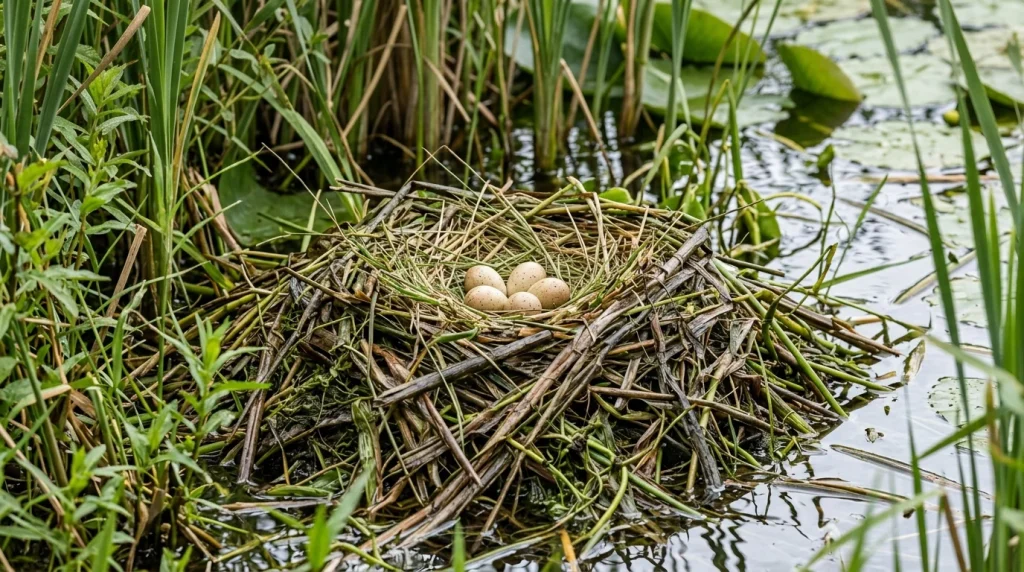
The nest is a wet, floating platform made of decaying water plants, algae, reeds, and twigs. The pair anchors this platform to living emergent vegetation, such as cattails or sunken branches, to keep it from drifting away. The female lays 3 to 6 pale bluish-white eggs. Over time, the damp, decaying plants in the nest stain the eggshells muddy brown. Both parents share incubation duties for roughly 21 to 24 days.
Young and Development
Chicks hatch covered in dark, striped down feathers that offer excellent camouflage among wetland shadows. Shortly after hatching, the tiny chicks leave the nest and climb directly onto their parents’ backs. They nestle under the wing feathers for warmth and safety.
Parents will even dive underwater with young chicks clinging securely to their backs. Both adults feed the chicks small, soft aquatic insects and tiny pieces of feathers to aid digestion. The chicks grow rapidly and become independent in about 1 to 2 months.
Where to See
In the United States, the Lower Rio Grande Valley of Texas offers the most reliable opportunities to view Least Grebes. Key locations include:
- Santa Ana National Wildlife Refuge: Check small, vegetation-lined ponds along the trail network.
- Sabal Palm Sanctuary: Look in calm oxbow lakes (resacas) under thick canopy cover.
- Laguna Atascosa National Wildlife Refuge: Search freshwater impoundments with abundant reed edges.
When searching, scan the shadows near cattails and overhanging branches rather than looking out into the center of broad, open water.
Similar Species
Several other waterbirds share parts of the Least Grebe’s habitat, but key differences help set them apart:
- Pied-billed Grebe: Noticeably larger and stockier with a thicker, pale bill marked by a dark vertical stripe in summer. It lacks the bright yellow eye of the Least Grebe (it has a dark eye).
- Eared Grebe: Larger; in winter, it has a dark cap, white neck, and a bright red eye rather than a yellow eye.
- Green-winged Teal / Ducks: Duck species have broad, flattened bills, webbed feet, and sit higher out of the water than the tiny Least Grebe.
Conservation
The Least Grebe is classified as Least Concern globally because of its extensive range across the Americas. Its global population appears stable overall.
However, local populations—especially near its northern limits in Texas—face ongoing habitat challenges. Key threats include:
- Drainage and filling of small wetlands for urban development
- Pesticide and agricultural runoff into farm ponds
- Removal of shoreline vegetation along freshwater ponds
Protecting small, vegetated freshwater ponds and controlling chemical runoff remain critical for maintaining healthy local populations.
Field Identification Tips
When you spot a small swimming bird in warm southern wetlands, run through this quick field checklist:
- Check the size—is it significantly smaller than nearby ducks or Pied-billed Grebes?
- Look closely at the face—do you see a sharp, glowing yellow eye?
- Examine the bill—is it thin, short, dark, and pointed?
- Observe the behavior—does it sink quietly under the surface near thick reeds?
- Check the plumage—is the body overall dark gray rather than warm brown?
Frequently Asked Questions
Do male and female Least Grebes look different?
No, males and females look virtually identical in plumage and eye color. Males tend to be slightly larger on average, but this difference is rarely noticeable unless a pair is swimming side by side.
Can Least Grebes fly?
Yes, they can fly well when necessary, but they prefer not to. They usually fly only at night when moving between different bodies of water or searching for new ponds after dry weather.
Why do Least Grebes eat their own feathers?
Feathers form a protective mat inside their stomach. This mat traps sharp fish bones and hard insect shells until the bird can safely digest them or regurgitate them, protecting its stomach lining.


