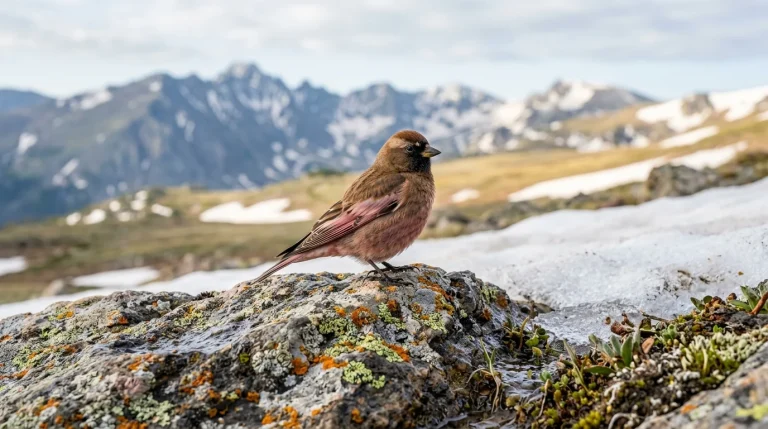
Lawrence’s Goldfinch Guide
Keep Track of What You See
Create a free Wild Things Guide membership to record this Lawrence’s Goldfinch in My Sightings and build your personal wildlife list.
Join to Add This SightingIntroduction
Lawrence’s Goldfinch (Spinus lawrencei) is a small, elegant finch of western North America. It is especially associated with California, although its seasonal and often unpredictable movements can carry it into Arizona, New Mexico, northern Mexico, and occasionally beyond its usual range.
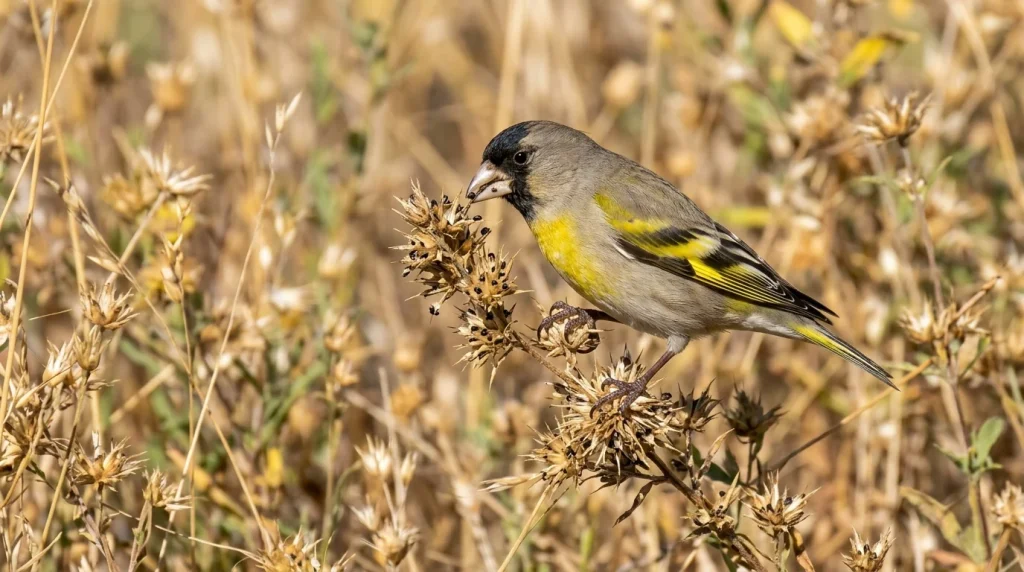
The breeding male’s gray body, black face, and bright yellow breast patch make him distinctive. Females and immature birds are subtler, but their compact shape, pale bill, yellow wing markings, and social behavior provide useful clues. Lawrence’s Goldfinches frequently travel in flocks and may appear where abundant seed crops and dependable water coincide, only to be absent from the same location in another year.
This irregularity is part of the species’ appeal—and its identification challenge. Birders are more likely to find Lawrence’s Goldfinches by learning their preferred habitat, listening for their musical calls, and checking mixed finch flocks than by relying on a single dependable site.

Quick Identification
- Overall shape: Small, compact finch with a short neck, notched tail, and pointed, conical bill.
- Adult male: Mostly gray with a black crown, face, and throat; bright yellow breast and conspicuous yellow wing panels.
- Adult female: Gray-brown to olive-gray, without the male’s black face; yellow is concentrated in the wings and sometimes washed across the breast.
- Wings: Dark with bold yellow patches or bars, often obvious in flight.
- Bill: Small, pointed, and usually pale pinkish or flesh-colored.
- Behavior: Often occurs in mobile flocks, feeding on weed seeds or visiting water.
- Voice: Light, tinkling calls and a varied, musical song that may incorporate imitations of other birds.
Appearance
Adult males in fresh breeding plumage are among the easiest western finches to recognize. The head is marked by a sharply contrasting black crown and face, while the back, sides, and much of the underparts are soft gray. A rich yellow patch covers the central breast. Black wings carry broad yellow markings, producing a bright flash when the bird takes flight. The tail is dark and distinctly notched.
Female Lawrence’s Goldfinches lack the male’s black facial pattern. Their heads and backs are muted gray, brownish gray, or olive-gray. Yellow wing markings remain visible, though they may look less saturated than those of an adult male. Some females show a modest yellow wash on the breast or throat. The combination of subdued body color and contrasting yellow in the wings is often more useful than any single plumage mark.
Juveniles are browner and more streaked than adults. Their yellow wing pattern may already be evident, but it can be muted. Plumage also changes with wear, molt, age, light, and viewing angle; a distant bird in shade may show much less color than expected.

Size and Wingspan
Lawrence’s Goldfinch is a small songbird, similar in general size to an American Goldfinch or Lesser Goldfinch.
- Length: About 4.5–5 inches (11.5–13 centimeters)
- Wingspan: Roughly 8–9 inches (20–23 centimeters)
- Build: Compact, with a short conical bill and moderately short, notched tail.
Direct size comparisons can be misleading in the field. Posture, distance, and feather fluffing all affect apparent size, so observers should combine proportions with plumage, voice, and behavior.
Range and Distribution
The core range lies in California and northern Baja California. Breeding birds occur locally in the Coast Ranges, foothills around the Central Valley, parts of southern California, and suitable interior valleys and mountain-edge habitats. Distribution is patchy rather than continuous.
After breeding, flocks may move southeast into Arizona, New Mexico, and northwestern Mexico. Numbers and locations vary considerably by season and year, probably in response to rainfall, seed production, and water availability. Small numbers sometimes wander outside the expected range.
Because Lawrence’s Goldfinch is nomadic, a location that hosts a large flock one winter may have few or none the next. Current regional reports are particularly valuable when planning a search. The Cornell Lab of Ornithology species account provides additional identification and distribution information.

Habitat
Lawrence’s Goldfinches favor open, seasonally dry landscapes with scattered trees, seed-producing plants, and nearby water. Typical breeding settings include open oak woodland, grassy foothills, chaparral edges, stream corridors, ranchland, and lightly wooded valleys. They generally avoid both dense forest and completely treeless expanses.
Water is an important habitat feature, particularly in arid regions. Birds may gather near springs, creeks, ponds, stock tanks, and other reliable sources. Outside the breeding season, flocks also use weedy fields, roadsides, desert washes, orchards, and disturbed ground where annual plants produce abundant seed.

Behavior
This Goldfinch is social for much of the year. Birds feed, drink, and travel in flocks, sometimes joining Lesser Goldfinches, American Goldfinches, Pine Siskins, or sparrows. Their flight is buoyant and undulating, with rapid wingbeats interrupted by brief glides.
On the ground or in low vegetation, Lawrence’s Goldfinches move actively as they extract seeds from flower heads. They may cling sideways or hang at an angle to reach food. Flocks often descend together to drink, remaining alert and retreating quickly to nearby trees or shrubs if disturbed.
Movements are flexible rather than governed by a simple, uniform migration route. Local abundance can change quickly as seed crops mature or dry up.
Diet and Hunting
Lawrence’s Goldfinch is primarily a seed eater and does not hunt in the manner of an insectivorous or predatory bird. Its narrow, conical bill is suited to removing and cracking small seeds.
Common food sources include:
- Seeds of native and introduced annual plants
- Fiddleneck, tarweed, thistle, and other composite flowers
- Grass seeds
- Seeds gathered from low weeds or directly from the ground
- Occasional small invertebrates, especially when feeding growing young
Flocks often concentrate where rainfall has produced a strong crop of annual plants. They may visit bird feeders, particularly where small seeds such as nyjer are offered, but feeder use is inconsistent and should not be expected throughout the range.
Vocalizations
The usual calls are high, light, and musical. Contact notes may sound tinkling, bell-like, or slightly wheezy. Because flocks call frequently in flight, learning the voice can reveal birds before their yellow wing panels are visible.
The male’s song is a long, varied series of whistles, trills, chatters, and call notes. Lawrence’s Goldfinches are accomplished vocal mimics, and they may weave portions of other species’ calls into their performance. Songs differ among individuals, making rhythm and tone more dependable than a single written mnemonic.
Breeding and Nesting
Breeding usually takes place in spring and early summer, although timing varies with local rainfall and food conditions. Courtship involves song, close following, and display flights. Pairs may nest near other Lawrence’s Goldfinches where habitat and food are favorable, but they do not form tightly packed colonies.
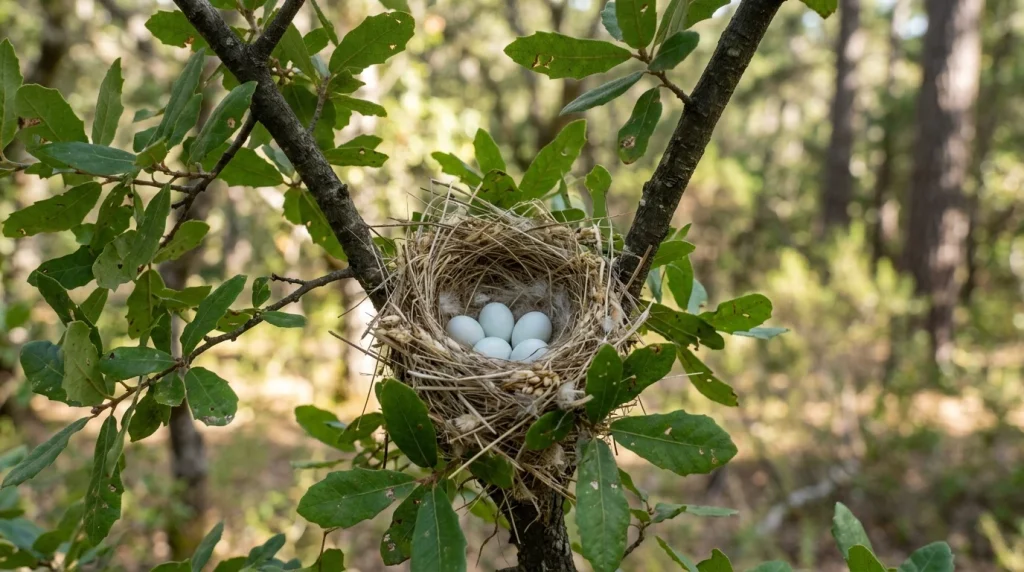
The female builds a compact open cup, typically placing it on a horizontal limb, in a fork, or among dense outer foliage. Oaks are frequently used, though other trees and tall shrubs may also support nests. Fine stems, grasses, plant fibers, and soft materials form the cup.
A clutch commonly contains about three to six pale bluish or blue-white eggs. The female performs most or all incubation, while the male may bring food. Incubation is generally around two weeks, though reported timing varies. Both parents contribute to feeding the nestlings.
Young and Development
Hatchlings are helpless and depend on adults for warmth and food. Parents deliver softened or regurgitated seeds, sometimes supplemented with small invertebrates. This concentrated food allows the nestlings to develop rapidly.
Young birds generally leave the nest after roughly two weeks, although weather, food supply, and disturbance may affect timing. Recently fledged juveniles remain dependent on their parents and can be recognized by persistent begging, fluttering wings, brownish plumage, and incomplete coordination. Family groups may merge into larger post-breeding flocks.
Observers should watch nests from a respectful distance. Prolonged close approaches can interrupt feeding or draw predators toward the site.
Where to See
California offers the best overall opportunity. Search open oak woodland, dry foothill valleys, chaparral edges, and weedy areas near dependable water. In winter, check lowlands and desert-edge habitats in southern California, Arizona, New Mexico, and northwestern Mexico.
Useful search strategies include:
- Scan flocks gathering at springs, ponds, creek crossings, and stock tanks.
- Inspect weedy roadsides and fields with mature seed heads.
- Listen for high, tinkling flight calls.
- Check mixed flocks of Lesser Goldfinches and Pine Siskins.
- Visit in the morning, when feeding and drinking activity can be greatest.
- Review recent local bird reports because favored locations change from year to year.
Similar Species
Lesser Goldfinch: Adult males usually have a black or greenish back, yellow underparts, and prominent white wing patches. They lack the Lawrence’s male’s gray body and isolated yellow breast patch. Female Lesser Goldfinches tend to appear greener or yellower overall and usually show a stouter-looking bill.
American Goldfinch: Breeding males are much more extensively yellow, with black wings and a black forehead. Nonbreeding birds are buffy or olive-brown and show pale wing bars rather than the strong yellow wing panels of Lawrence’s Goldfinch.
Pine Siskin: Pine Siskins are heavily streaked, with a slimmer, sharper bill. Their wings and tail may show yellow, but the yellow is generally less block-like. Siskins also give a distinctive rising, buzzy call.
Female House Finch: Female House Finches are larger, more strongly streaked, and lack yellow wing patches. Their bill is deeper, and their flight pattern and calls differ.
Conservation
Lawrence’s Goldfinch is commonly classified as Least Concern at the global level. Nevertheless, its nomadic behavior and uneven distribution make population trends difficult to evaluate. Counts can vary sharply without necessarily indicating a comparable change in the total population.
Potential pressures include loss or degradation of open oak woodland, removal of weedy feeding areas, development around water sources, pesticide exposure, severe drought, and changes in fire patterns. Climate-driven changes in rainfall could also alter seed crops and breeding habitat availability.
Maintaining native grasslands and open woodland, protecting riparian corridors, and conserving safe water sources can benefit this species and other birds of dry western landscapes.
Field Identification Tips
- Start with the wings: Look for concentrated yellow panels against otherwise dark wings.
- Check the body color: Adult males are gray rather than broadly yellow, green, or streaked.
- Study the head: A breeding male’s black face and crown sharply contrast with the gray body and pale bill.
- Use multiple marks on females: Combine yellow wings, subdued gray-brown plumage, small size, bill shape, and voice.
- Watch the flock in flight: Yellow wing markings may be clearer when the wings open.
- Listen before looking: Tinkling calls frequently disclose a flock hidden in foliage or passing overhead.
- Consider place and season: A sighting is more likely in the core western range, but local occurrence can be highly irregular.
Frequently Asked Questions
Why is it called Lawrence’s Goldfinch?
The species was named in honor of George Newbold Lawrence, a nineteenth-century American ornithologist. Its scientific name, Spinus lawrencei, preserves the same dedication.
Is Lawrence’s Goldfinch found only in California?
No. California contains much of its breeding range, but birds also occur in Baja California and move seasonally into Arizona, New Mexico, and northwestern Mexico. Wandering individuals may appear farther away.
Do Lawrence’s Goldfinches visit feeders?
They sometimes visit feeders stocked with small seeds, including nyjer, especially when natural food is limited. Feeder attendance is irregular, and habitat with seed-bearing plants and nearby water is often more dependable.
How can I identify a female?
Look for a small gray-brown finch with a pale conical bill, dark wings, and distinct yellow wing markings. Females lack the adult male’s black facial pattern and bright central breast patch. Voice, flock companions, and location can help confirm the identification.
Are Lawrence’s Goldfinches migratory?
They are migratory and nomadic, but their movements are not uniform. Seasonal travel appears strongly influenced by rainfall, seed abundance, water, and breeding conditions.
What is the best time to see one?
Spring is useful for locating singing males in California breeding habitat. Fall and winter can produce larger flocks across the southwestern portion of the range. In any season, recent sightings are valuable because distribution changes substantially from year to year.