Horned Lizard Guide
Keep Track of What You See
Create a free Wild Things Guide membership to record this Horned Lizard in My Sightings and build your personal wildlife list.
Join to Add This SightingIntroduction
Horned lizards are a distinctive group of squat, spiny reptiles in the genus Phrynosoma. They are often called “horned toads,” but they are true lizards, not amphibians. Several species occur across western North America, from southern Canada through the western and south-central United States into Mexico and parts of Central America.
No single binomial applies to every horned lizard. The familiar Texas horned lizard, Phrynosoma cornutum, is one representative species; others include the greater short-horned lizard (P. hernandesi), desert horned lizard (P. platyrhinos), regal horned lizard (P. solare), round-tailed horned lizard (P. modestum), and coast horned lizard (P. blainvillii). Identification should therefore combine body shape with horn arrangement, side fringes, coloration, habitat, and location.

Quick Identification
- Broad, flattened body with a small, narrow tail.
- Prominent pointed scales or “horns” along the back of the head.
- Rough, spiny skin and short, sturdy legs.
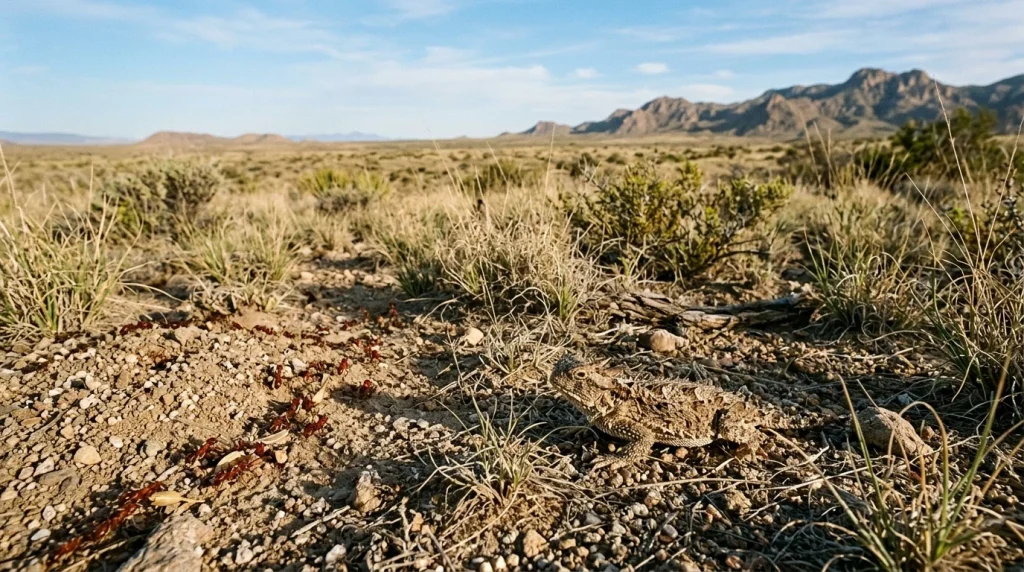
- Earth-toned coloration matching sand, gravel, or dry soil.
- Usually found in open, sunny country where ants are abundant.
- More likely to remain motionless or flatten against the ground than flee immediately.
The combination of a disk-shaped body, cranial horns, and cryptic coloration is unmistakable at close range. From a distance, however, a motionless horned lizard can resemble a stone, dry leaf, or clump of soil.
Appearance
Horned lizards have compact bodies covered by keeled, pointed scales. Their heads are relatively wide, with bony projections extending from the rear and sides of the skull. The number, length, and orientation of these horns vary among species. Texas and regal horned lizards have especially conspicuous rear horns, while short-horned species have reduced, less projecting head spines.
Typical colors include tan, gray, reddish brown, ocher, and pale cream. Dark blotches often cross the back, and some species have pale lines or contrasting borders around those blotches. Color usually reflects local soil. Individuals from red sand may appear rusty, while those occupying pale desert pavement are often gray or straw-colored. Limited physiological color change can also make an individual appear lighter or darker.

Size and Physical Characteristics
Most adult North American horned lizards measure about 3–8 inches (7.5–20 cm) in total length, although size differs considerably by species and sex. The body accounts for most of that length because the tail is short. Females are commonly larger and heavier than males.
The broad body can flatten against the ground or inflate when threatened. Rows of enlarged scales may form a fringe along each side. Feet have clawed toes suited to loose soil, but horned lizards are not built for sustained high-speed pursuit. Their short legs and low profile support brief dashes, digging, and careful movement among sparse vegetation.
Similar Species
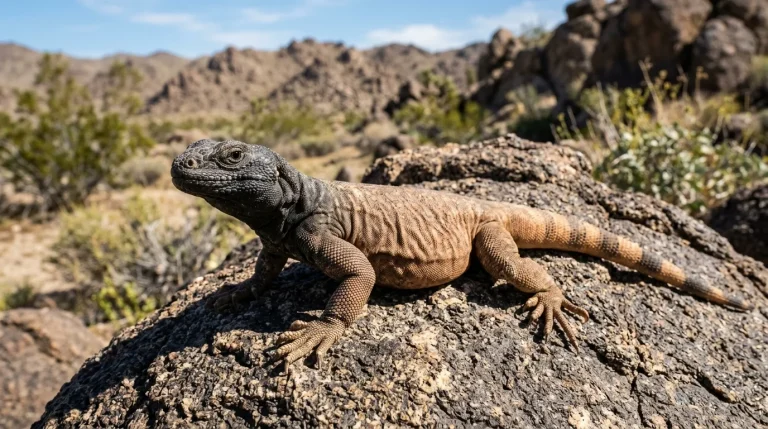
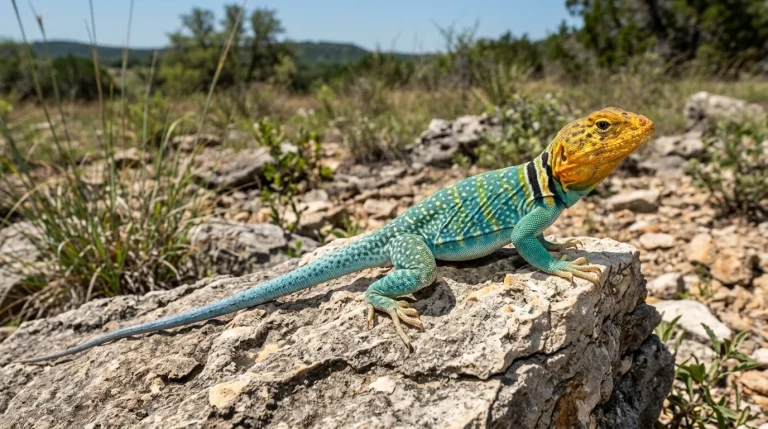
Other North American lizards rarely share the complete horned-lizard profile. Fence lizards and spiny lizards may have rough scales, but they possess longer tails, narrower bodies, and no crown of head horns. Collared lizards have longer legs and more vivid patterns. Young chuckwallas can be broad-bodied but lack sharp cranial projections.
Distinguishing horned lizard species is more difficult. Texas horned lizards usually have two long rear head horns, strong side fringes, and dark dorsal blotches edged with pale scales. Desert horned lizards generally have shorter horns and a single side fringe. Round-tailed horned lizards have relatively smooth outlines and often curl or raise the tail to resemble vegetation. Greater short-horned lizards have very short head horns and occur in cooler grasslands, shrublands, and mountain basins. Regional range maps and close photographs are often needed for a confident identification.
Habitat
Horned lizards favor open habitats with abundant sunlight, exposed soil, and access to loose substrate for shallow burial. Depending on species, suitable environments include desert flats, sagebrush steppe, shortgrass prairie, oak woodland openings, coastal scrub, thornscrub, and dry mountain valleys.
Good habitat is usually structurally varied rather than completely bare. Scattered grasses, low shrubs, rocks, and patches of open ground provide basking sites, shade, concealment, and feeding areas. Harvester-ant colonies are especially important to several species.
Geographic Range
The genus is native to western and south-central North America. Collectively, horned lizards occur from southern Canada through much of the western United States and into Mexico, with the broader genus extending into northern Central America. They are absent from most humid eastern forests.
Ranges differ substantially among species. The Texas horned lizard occupies parts of the Great Plains, Southwest, and northern Mexico. Desert and regal horned lizards occur primarily in arid southwestern regions, while short-horned species extend farther north and reach higher elevations. Document records outside the expected range carefully, as escaped or illegally released animals occasionally occur.

Behavior
These lizards rely heavily on camouflage. An undisturbed individual may sit still for long periods, then walk in short bursts before freezing again. This stop-and-start movement makes the animal difficult for visually hunting predators to follow.
Horned lizards bask to raise their body temperature, shifting between sun and shade as conditions change. They may wriggle into loose soil until only the head is exposed. Most are solitary outside courtship and breeding, although several individuals may use the same productive feeding area.
Diet and Feeding
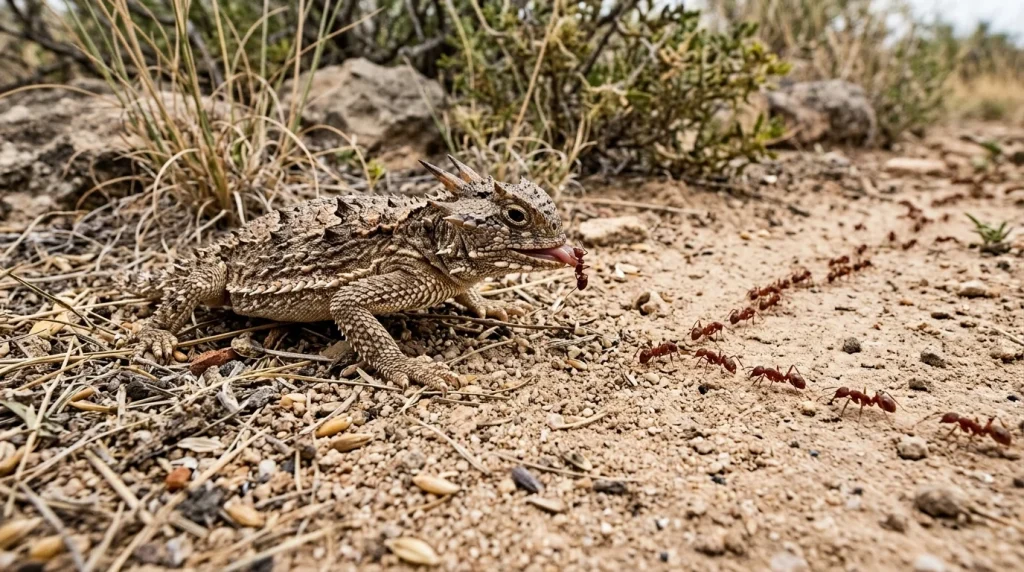
Ants form a major part of the diet, particularly harvester ants. A horned lizard typically waits beside an active trail and picks off workers with quick movements of its sticky tongue. It may consume many ants during a feeding session because each ant provides relatively little energy.
Beetles, termites, grasshoppers, spiders, and other small invertebrates supplement the diet. Exact proportions vary by species, locality, season, and prey availability. Horned lizards should not be assumed to eat only ants, but the loss of native ant communities can sharply reduce habitat quality.
Activity and Seasonal Patterns
Horned lizards are primarily diurnal. In spring and mild weather, they may remain active through much of the day. During intense summer heat, activity often shifts toward morning and late afternoon, with midday spent beneath shrubs or partly buried in soil.
In cold-winter regions, individuals become dormant underground for several months. Emergence may occur from early to late spring depending on latitude, elevation, soil temperature, and weather. Southern desert populations can have longer active seasons but may reduce surface activity during drought or extreme heat.
Reproduction and Life Cycle
Courtship and mating generally occur in spring or early summer, although local timing varies. Most horned lizard species lay eggs in excavated nests. Females select loose, workable soil, dig a chamber, deposit the clutch, and cover the site. Incubation depends on temperature and may last several weeks.
Short-horned species living in cool climates are notable exceptions: they give birth to live young. Retaining embryos lets a female regulate temperature behaviorally by basking. Clutch and litter sizes vary widely by species and female size, from relatively few young to several dozen in some large species.
Young and Juveniles
Young horned lizards are Miniature versions of adults, already possessing flattened bodies and visible head spines. Their horns are shorter, and proportions may change as they grow. Hatchlings and newborns begin feeding on very small ants and other tiny arthropods.
Juveniles are vulnerable to heat, dehydration, vehicles, birds, snakes, and small mammals. Their camouflage is effective, but their tiny size makes them easy to overlook. Observers should avoid handling them or disturbing loose soil around possible nesting and nursery areas.
Predators and Defense
Likely predators include roadrunners, hawks, shrikes, snakes, coyotes, foxes, and other carnivorous mammals. Domestic and free-ranging cats can also kill horned lizards.
Camouflage and immobility are the first defenses. If discovered, a lizard may sprint briefly, flatten itself, wedge beneath vegetation, hiss, or inflate its body so the spines become harder to swallow. Several species can direct blood from the corners of their eyes when severely threatened, especially by canine predators. This striking response is not used in every encounter and should never be provoked for observation or photography.

Tracks, Signs, and Other Evidence
Tracks are small and easily erased by wind. On fine sand, look for alternating footprints on either side of a narrow body or tail trace. The short tail may leave an intermittent drag rather than a continuous line. Shallow, lizard-sized depressions can mark places where an animal rested or buried itself.
Active harvester-ant trails, nest entrances, and discarded seed husks indicate potentially useful feeding habitat but do not prove that horned lizards are present. Shed skin is usually recovered in fragments. Droppings are small, dark, and commonly capped with white urates, making them difficult to distinguish from those of other lizards.
Where and How to Find It
Search slowly in open habitat during mild, sunny mornings in spring or early summer. Examine the edges of ant trails, bare patches between bunchgrasses, sandy road margins, and sunlit openings beside shrubs. Scan for symmetry: paired head horns or a regular body outline may stand out before its color does.
Walking is generally more effective than driving. Stop frequently and look back because a lizard invisible from one angle may be obvious from another. Avoid stepping on ant mounds, overturning rocks, or digging. Binoculars and a camera with a modest telephoto lens let you identify them without capture.
Conservation Status and Threats
The genus has no single conservation status. Many species are globally categorized as relatively secure, but some populations have declined or disappeared locally. The Texas horned lizard, for example, is protected or listed as a species of conservation concern in parts of its range. The University of Michigan’s Animal Diversity Web account for the Texas horned lizard provides additional species-level natural-history information.
Major threats include grassland and desert habitat conversion, road mortality, intensive ground disturbance, pesticide use, collection, and fragmentation from development. Introduced ants can displace native harvester ants, reducing an important food source. Conservation is most effective when it retains native ant communities, open ground, shrub cover, and connected areas large enough to support seasonal movements.
Relationship with Humans
Horned lizards are harmless to people and do not possess venom or a dangerous bite. Their unusual appearance has made them regional symbols, particularly in the American Southwest. It has also encouraged collection for pets and souvenirs, practices that contributed to historical declines.
They generally fare poorly when removed from the wild because of specialized diets, ultraviolet-light requirements, temperature needs, and stress. Collection is restricted or prohibited in many jurisdictions. A found lizard should normally be photographed where it stands and left in place.
Interesting Facts
- The name Phrynosoma is derived from Greek roots commonly interpreted as “toad-bodied.”
- Head horns have bony cores and are not merely loose surface scales.
- Some species obtain useful moisture from rain or dew collected between their scales and moved toward the mouth.
- Blood-squirting defense is associated particularly with attacks by canids and is only one part of a broader defensive sequence.
- Live birth in short-horned species is an adaptation well suited to cool northern and high-elevation environments.
Frequently Asked Questions
Are horned lizards poisonous?
No. They are not poisonous or venomous and present little danger to people. Their horns, body inflation, and occasional ocular blood defense discourage predators.
Can every horned lizard squirt blood from its eyes?
No. This behavior is best documented in several species and may vary by population and circumstances. Even capable individuals rely first on camouflage, flattening, or escape.
What is the difference between a horned lizard and a horned toad?
There is no biological difference. Horned toad” is a traditional nickname inspired by the animal’s rounded body. Horned lizard is the more accurate name because these reptiles have scales, claws, lungs, and other lizard characteristics.
Why are there no horned lizards near an active ant mound?
One ant colony does not guarantee suitable habitat. Lizards also need appropriate prey species, loose soil, basking sites, shelter, seasonal refuges, and safe connections to surrounding habitat.
Should I move one off a road?
If you can do it safely and local regulations allow, move it only a short distance in the direction it was traveling. Never relocate a horned lizard to another property, park, or habitat patch.