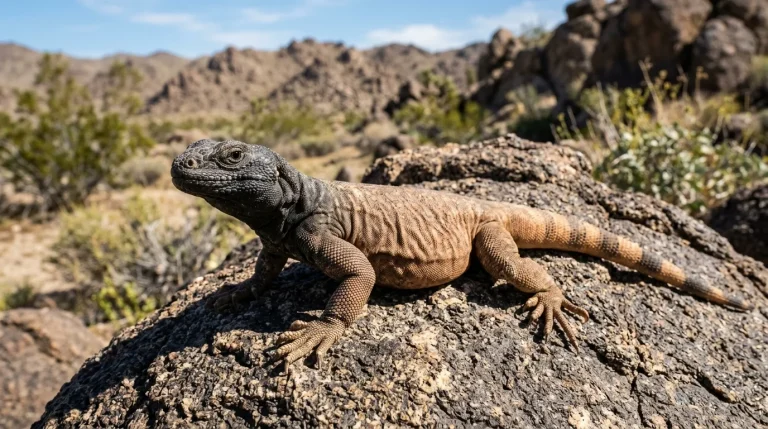
Western Whiptail Guide
Keep Track of What You See
Create a free Wild Things Guide membership to record this Western Whiptail in My Sightings and build your personal wildlife list.
Join to Add This SightingIntroduction
The western whiptail (Aspidoscelis tigris) is a quick, ground-dwelling lizard of western North America. It belongs to the family Teiidae, a group whose North American members are commonly called whiptails and racerunners. Older field guides may list this species as Cnemidophorus tigris.
Western whiptails are best recognized by their exceptionally long tails, streamlined bodies, pointed snouts, and restless foraging behavior. Their markings vary considerably across a broad geographic range. Depending on age and locality, an individual may appear striped, spotted, mottled, or crosshatched. Because several related whiptails overlap in the Southwest, consider location and pattern together.

Quick Identification
- Slender, fast-moving terrestrial lizard with a pointed head.
- Very long, gradually tapering tail, often about twice the body length.
- Granular scales on the back and larger rectangular scales underneath.
- Adults commonly show pale spots, broken stripes, bars, or a netlike pattern.
- Juveniles are darker and more distinctly striped, often with a bluish tail.
- Usually seen running between shrubs or actively digging in loose soil.
A whiptail rarely remains exposed for long. It commonly runs in short bursts, stops beneath vegetation, and resumes searching through leaf litter or soil.
Appearance
The western whiptail has a narrow body, strong limbs, long toes, and an elongated head with a pointed snout. Its dorsal coloration is highly variable. The background may be gray, tan, brown, olive, or nearly black, overlaid with cream or yellowish lines, pale spots, dark bars, or irregular reticulation. The sides are frequently more strongly patterned than the center of the back.
The underside is generally pale, although some adults develop bluish, gray, or dark pigmentation on the throat, chest, or belly. Breeding males may show stronger blue or blue-black coloration. The tongue is slender and forked, helping the animal investigate chemical cues while foraging.

Size and Physical Characteristics
Adults are typically about 9–14 inches (23–36 cm) long. Much of that measurement is tail: the snout-to-vent length is usually only about 3–5 inches (8–13 cm). A regenerated tail may be shorter, thicker, or less evenly colored than the original.
The small, granular dorsal scales contrast with broad belly scales arranged in regular rows. Hind limbs are relatively powerful, allowing rapid acceleration over open ground. Long toes provide traction on sand and loose soil. Males often have larger heads and more noticeable femoral pores along the undersides of the thighs, but these differences can be difficult to judge without close examination.
Similar Species
Other Aspidoscelis species can be extremely similar. The six-lined racerunner (Aspidoscelis sexlineatus) typically has six clean, pale stripes and occurs mainly east and south of the western whiptail’s core range. It often favors open sandy ground and can be just as fast.
Striped whiptails such as the plateau striped whiptail (Aspidoscelis velox) tend to retain more continuous longitudinal lines as adults. Several all-female whiptail species of the Southwest also have orderly stripes or combinations of stripes and spots. The western skink has smooth, shiny scales, a less pointed head, shorter limbs, and a more cylindrical body. Fence lizards are stockier, have rough or spiny scales, and usually climb more readily.
Pattern alone may not identify every whiptail. Range, scale arrangement, age, and local species lists can be necessary, particularly in Arizona, New Mexico, and adjoining areas.
Habitat
Western whiptails inhabit deserts, shrublands, open woodland, grassland edges, dry washes, canyon bottoms, and disturbed sites with patches of loose soil. They are often associated with sagebrush, creosote bush, rabbitbrush, pinyon-juniper openings, chaparral margins, and sparsely vegetated slopes.
Good habitat usually combines sunny foraging ground with nearby cover. Shrub bases, rocks, logs, rodent burrows, and accumulations of plant debris provide retreats from predators and temperature extremes. Heavy, continuously moist forest is generally unsuitable.

Geographic Range
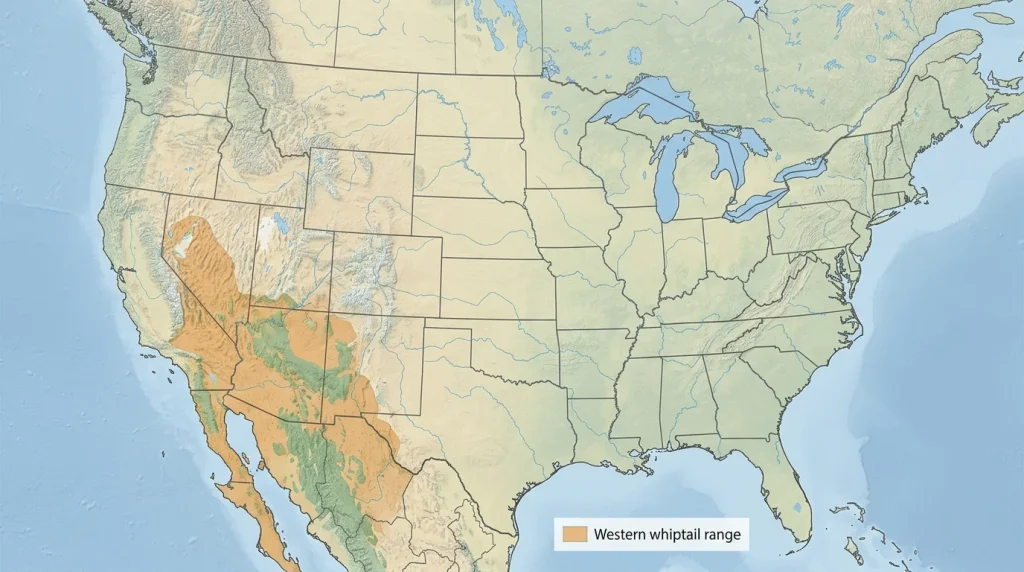
The species occurs widely across western and southwestern North America. Its range includes portions of the western United States from the Pacific states and interior Great Basin south and east into the desert Southwest, with populations extending into northern and western Mexico, including parts of Baja California.
Distribution is not continuous in every region. Mountain ranges, unsuitable vegetation, elevation, and soil conditions create local gaps, while the exact limits depend partly on how geographic forms within the western whiptail complex are classified.
Behavior
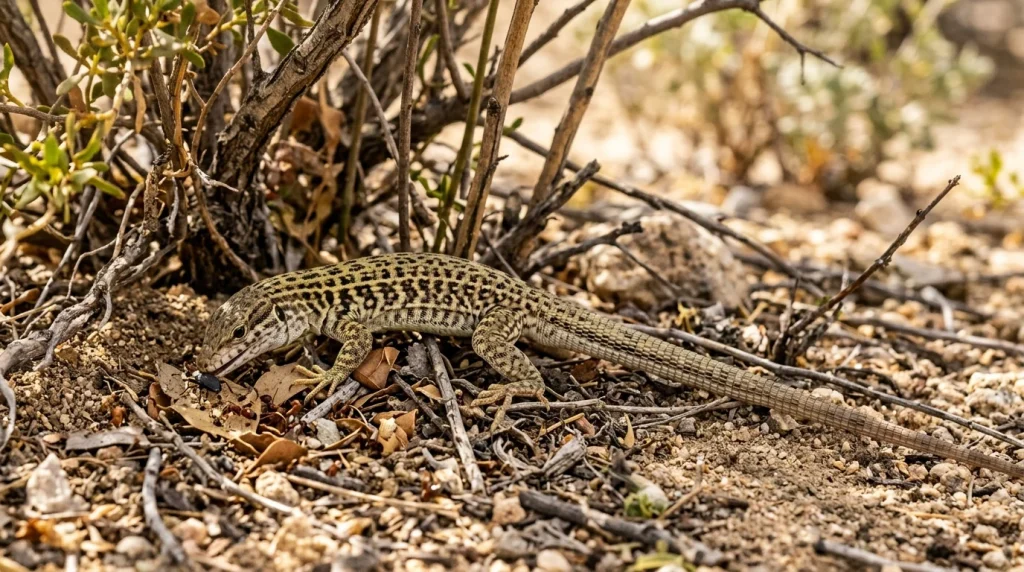
Unlike an ambush predator waiting motionless for prey, a western whiptail searches actively. It moves beneath shrubs, probes crevices, flicks its tongue, scratches through litter, and digs shallow holes with its forefeet. This near-constant activity is one of the most useful field clues.
When alarmed, the lizard sprints toward cover with its body held low and tail streaming behind. It may pause inside a shrub before making another dash. Individuals shelter in self-dug burrows, existing animal burrows, or protected spaces under rocks and woody debris.
Diet and Feeding
Western whiptails primarily eat terrestrial invertebrates. Common prey includes ants, termites, beetles and their larvae, grasshoppers, crickets, spiders, caterpillars, and other small arthropods. Larger individuals may occasionally take small lizards or other suitably sized animal prey.
Prey is located by sight and chemical investigation. A foraging whiptail may push its snout into loose soil and rapidly sweep material aside with its front feet. Diet varies with season, habitat, and local prey availability.
Activity and Seasonal Patterns
The western whiptail is diurnal. It often emerges after the ground has warmed and remains active through late morning. In hot desert conditions, activity may decline around midday and resume later in the afternoon. Because active foraging requires warm muscles, whiptails generally operate at relatively high body temperatures.
Seasonal activity begins in spring, although timing varies with latitude, elevation, and weather. Individuals remain underground during cold winter periods. In extremely hot or dry conditions, they may also reduce surface activity. Juveniles are often conspicuous in late summer following hatching.
Reproduction and Life Cycle
Unlike several related all-female whiptails, western whiptails normally reproduce sexually and populations include males and females. Courtship and mating generally occur in spring or early summer. Females deposit a small clutch of flexible-shelled eggs in loose, protected soil, often where temperature and moisture remain comparatively stable.
Incubation lasts several weeks, with development influenced by local conditions. Some females may produce more than one clutch in favorable southern environments, but this should not be assumed throughout the range. Growth is rapid during the warm season, and sexual maturity may be reached after one or more years.
Young and Juveniles
Hatchlings are Miniature but more sharply striped versions of adults. They commonly have a dark brown or blackish body crossed by narrow cream or yellow lines. The tail may be bright blue or blue-green, especially in very young animals. This contrasting tail can draw a predator’s attention away from the body.
As a whiptail grows, its stripes often break into spots, bars, or a reticulated pattern, while the blue tail fades. Because this change is gradual, young western whiptails can resemble adults of permanently striped species.
Predators and Defense
Predators include snakes, roadrunners and other birds, small mammals, and larger lizards. The whiptail’s first defenses are vigilance and speed. It uses vegetation and irregular ground to break a pursuer’s line of sight, then enters a burrow or narrow refuge.
If seized, it may twist, scratch, or bite. The tail can detach through autotomy, leaving the predator with a wriggling distraction while the lizard escapes. A replacement grows, but regeneration costs energy and does not perfectly reproduce the original tail. Whiptails do not rattle, rear up, or possess venom.

Tracks, Signs, and Other Evidence
Tracks are small and easy to overlook. Hind footprints are larger than foreprints, and long toe marks may register clearly in fine sand or dust. A narrow tail line may appear between tracks, although a running animal often carries its tail above the surface.
Shallow scratch marks, disturbed leaf litter, and small excavations around shrub bases can indicate active foraging, but these signs are not species-specific. A quick rustle followed by a glimpse of a long tail is often the first evidence of a nearby whiptail.
Where and How to Find It
Search on warm, clear mornings from spring through early fall. Walk slowly along desert washes, sandy trails, shrubland openings, and sunny woodland edges. Scan several feet ahead rather than looking directly beside your boots; whiptails often detect approaching people first.
Listen for movement under low shrubs and watch open spaces between cover patches. Binoculars can help with pattern assessment because close pursuit usually drives the animal underground. Photography from a distance is preferable to capture or handling. Never overturn heavy rocks carelessly, and replace any movable cover exactly as found.
Conservation Status and Threats
The western whiptail is commonly assessed as Least Concern across its broad range. It occupies many protected landscapes and can tolerate some moderate disturbance where open ground, prey, and shelter remain available.
Local populations can nevertheless be affected by urban development, intensive agriculture, off-road vehicle use, invasive plants, pesticide exposure, altered fire patterns, and collection. Roads may cause mortality and divide habitat. Climate-related changes in vegetation and seasonal heat could also shift suitable activity periods, although effects are likely to differ by region.
Relationship with Humans
Western whiptails are harmless to people and help consume insects and other arthropods. They do not damage buildings and are unlikely to establish themselves indoors. If you encounter a lizard in a yard, leave it alone and allow it access to cover.
Handling is discouraged because whiptails are easily stressed and may shed their tails. Dogs and free-ranging cats can injure or kill them. Native shrubs, pesticide-free ground, leaf litter, and small undisturbed shelter areas can make desert and xeric gardens safer for local lizards.
Interesting Facts
- The whip-like tail can account for roughly two-thirds of the animal’s total length.
- Western whiptails forage more actively than many familiar sit-and-wait lizards.
- The scientific name tigris refers to the barred, or tiger-like, markings seen in some forms.
- Juveniles and adults may look different enough to be mistaken for separate species.
- Some close relatives reproduce without males, but the western whiptail normally has both sexes.
- Taxonomic boundaries within the western whiptail complex have changed as genetic evidence has accumulated.
Frequently Asked Questions
Are western whiptails venomous?
No. They have no venom apparatus and present no meaningful danger to people or pets.
Why is the tail so long?
The tail contributes to balance during rapid running and sharp turns. It can also detach when grasped, potentially allowing the lizard to escape a predator.
Can a western whiptail regrow its tail?
Yes, but the replacement is usually shorter and differs internally and externally from the original. Tail loss carries energetic costs.
How can I distinguish a whiptail from a skink?
Whiptails have a pointed head, long limbs and toes, granular dorsal scales, and an alert, searching gait. Skinks usually appear smoother, shinier, shorter-legged, and more cylindrical.
Do western whiptails reproduce without males?
Western whiptails ordinarily reproduce sexually. Parthenogenesis occurs in several related Aspidoscelis species, which is one reason careful identification matters.
Why does a whiptail keep stopping and starting?
This is typical active-foraging behavior. The lizard alternates rapid movement with pauses used to inspect its surroundings, sample chemical cues, and detect prey or predators.