Green Iguana Guide
Keep Track of What You See
Create a free Wild Things Guide membership to record this Green Iguana in My Sightings and build your personal wildlife list.
Join to Add This SightingIntroduction
The green iguana (Iguana iguana) is a large, tree-dwelling lizard native to southern Mexico, Central America, and tropical South America. Escaped or released pets established breeding populations in southern Florida, where warm weather, abundant canals, and ornamental vegetation provide favorable conditions.
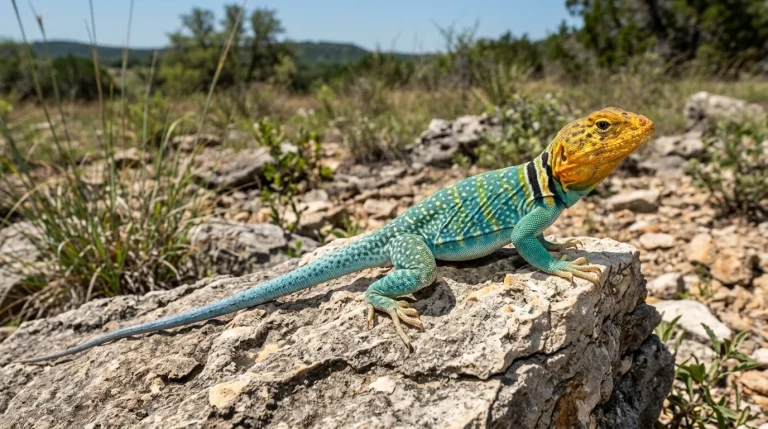
Despite its common name, this iguana is not always green. Large adults may appear gray-green, brown, bluish, or orange. In southern Florida, the word “iguana” may also refer loosely to introduced spiny-tailed iguanas, so body shape, tail structure, and facial scales are important identification clues.
Quick Identification
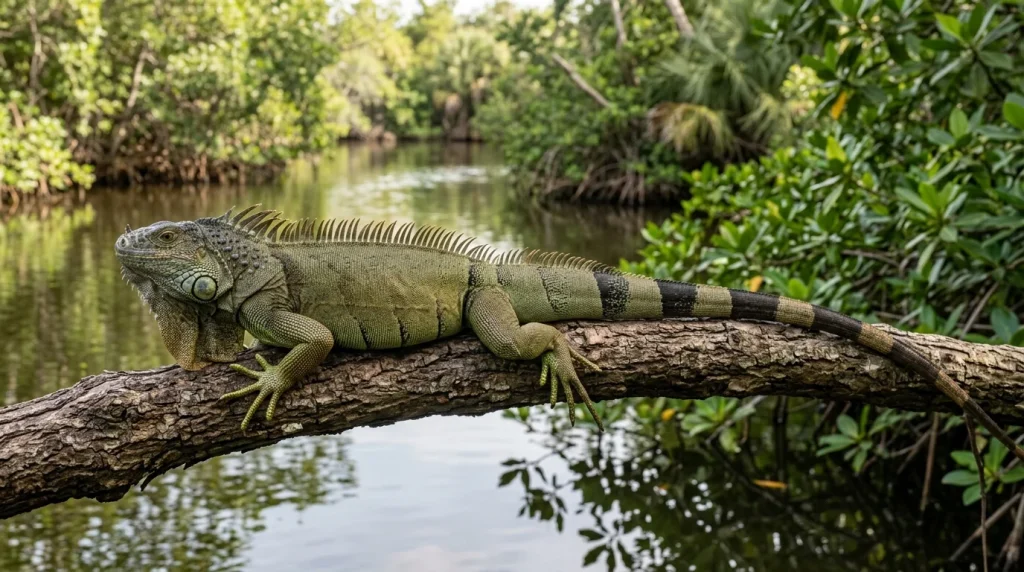
- Very large lizard, commonly 4–5 feet (1.2–1.5 m) long, including the tail.
- Long, laterally compressed tail with dark crossbands.
- Row of pointed spines along the neck, back, and front of the tail.
- Large hanging throat fan, or dewlap.
- Conspicuous round scale below the ear opening.
- Long toes, strong claws, and a distinctly arboreal build.
- Often seen basking on branches, seawalls, roofs, docks, or canal banks.
Appearance
Green iguanas have a heavy body, relatively short neck, powerful limbs, and an exceptionally long tail. The head is blunt and deep, especially in mature males. A serrated crest of flexible spines begins behind the head and continues down the back. The largest spines generally occur over the neck and shoulders.
Color varies with age, sex, condition, and population. Juveniles are usually vivid leaf-green, providing camouflage among foliage. Adults often fade to olive, gray-green, brownish green, or muted blue-green. Mature males may develop orange or rusty coloration during the breeding period. Dark bands commonly cross the tail, and pale or dark mottling may mark the body and limbs.
One of the best close-range field marks is the enlarged, plate-like subtympanic scale located below the circular ear opening. Both sexes also possess a dewlap, although it is normally larger and more conspicuous in adult males.

Size and Physical Characteristics
Adults commonly measure about 4–5 feet (1.2–1.5 m) in total length, but much of that measurement is tail. Exceptionally large males can exceed 5 feet and may approach 15–17 pounds (6.8–7.7 kg). Females are generally smaller and more lightly built.
The feet have five long toes equipped with curved claws for gripping bark. Strong hind legs allow an iguana to leap between branches or drop from vegetation when escaping. The muscular tail is compressed from side to side, helping with swimming and defense. Adult males tend to have broader heads, larger jowls, taller dorsal spines, and more prominent dewlaps than females.
Similar Species
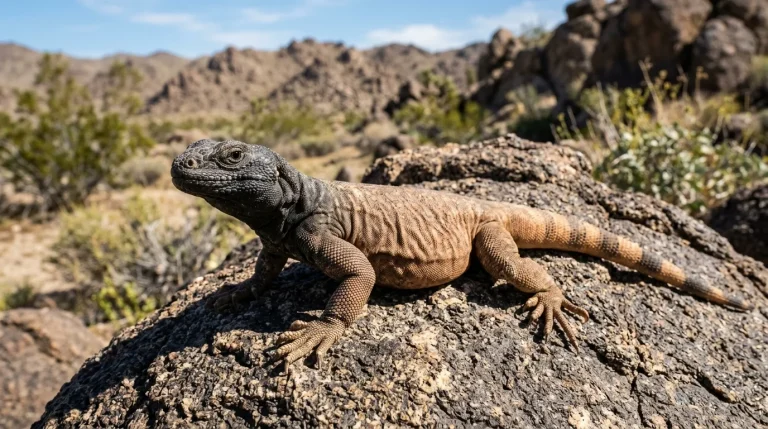
The black spiny-tailed iguana (Ctenosaura similis) is also established in parts of Florida. It usually has a rough, heavily keeled tail covered with rings of stiff spines, rather than the smoother, whip-like banded tail of a green iguana. Adult spiny-tailed iguanas are often gray or tan with dark bands and spend more time on the ground.
The Mexican spiny-tailed iguana (Ctenosaura pectinata) is similarly distinguished by a strongly armored tail. Brown basilisks have long toes and a prominent crest but are much slimmer and smaller, and they lack the green iguana’s large, round cheek scale. Cuban knight anoles can be bright green and arboreal, yet they are considerably smaller and have an anole-like head and toe pads rather than an iguana’s massive body and long dorsal crest.
Habitat
Southern Florida populations occupy subtropical environments with trees, open basking sites, and nearby water. Typical locations include canal margins, mangrove edges, drainage corridors, coastal hammocks, landscaped neighborhoods, golf courses, parks, agricultural margins, marinas, and disturbed woodland.
Green iguanas climb readily and often rest high in trees, but they descend to feed, cross open ground, or reach nesting areas. Earthen canal banks, levees, and landscaped slopes may be used for burrows and nest chambers. Their association with water provides an effective escape route.

Geographic Range
The species’ native range extends through tropical parts of the Americas, from southern Mexico and Central America into much of northern and central South America, with populations on some Caribbean islands. In the United States, established populations are non-native and concentrated in southern Florida.
They are especially associated with the warm Atlantic and Gulf coastal portions of the peninsula, including urbanized canal systems. Observations may occur farther north, but repeated cold weather restricts long-term survival and reproduction. Distribution changes as animals disperse or are transported, so current records from the Florida Fish and Wildlife Conservation Commission are useful when evaluating a local sighting.

Behavior
Green iguanas are primarily arboreal and diurnal. They often begin the day by basking, then move through vegetation to feed. Adults may maintain favored trees, rooftops, seawalls, or branches over water. Several animals can gather where food and basking sites are abundant, although males may become territorial during breeding activity.
When approached, an iguana may freeze, sidle around a trunk, climb higher, or sprint toward water. It is a capable swimmer and propels itself mainly with side-to-side tail movements. An animal on an overhanging branch may escape by dropping directly into a canal or pond.
Diet and Feeding
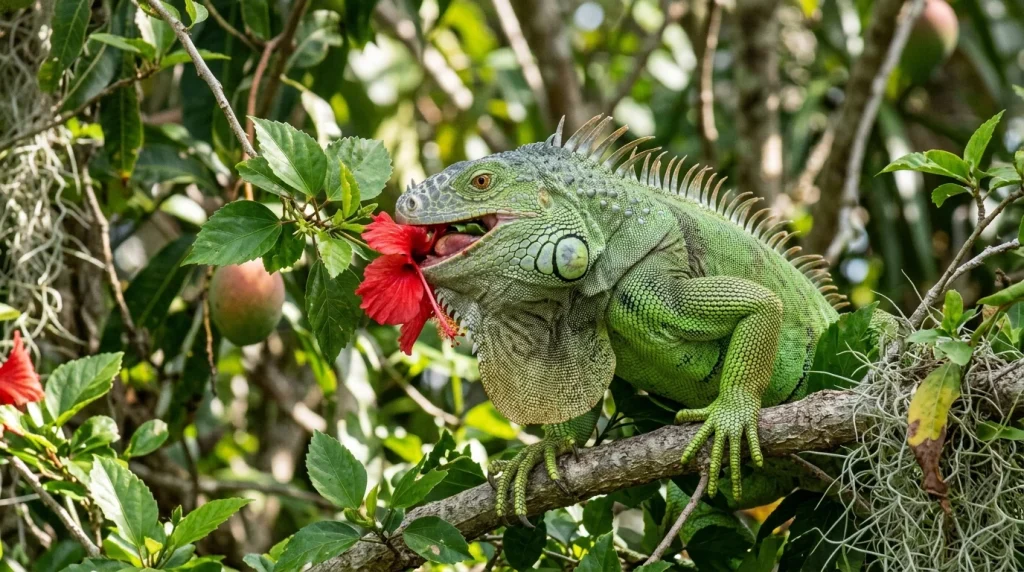
Green iguanas are predominantly herbivorous. They browse leaves, tender shoots, flowers, and fruit from a wide variety of native and ornamental plants. In Florida landscapes, they may eat hibiscus, orchids, bougainvillea, vegetable plants, and ripe fruit, although food choices vary locally.
Young animals sometimes ingest insects or other small animal material, and occasional scavenging has been reported. Nevertheless, foliage and other plant matter form the characteristic diet. Iguanas frequently feed above ground, leaving clipped shoots, stripped foliage, or irregular bites on flowers and fruit.
Activity and Seasonal Patterns
Activity is greatest on warm, sunny days. Basking helps these ectothermic reptiles reach temperatures needed for movement and digestion. During the hottest part of a summer day, individuals may rest in shade or remain among dense foliage.
SouthernFlorida’ss mild climate permits activity through much of the year, but cold fronts can sharply reduce movement. During unusually cold weather, chilled iguanas may lose their grip and fall from trees. A cold-stunned animal can appear dead while still alive, and it may recover as temperatures rise. Severe or prolonged cold can cause mortality, particularly in smaller animals.
Reproduction and Life Cycle
Breeding timing varies with weather and local conditions but generally occurs during Florida’s cooler, drier part of the year. Mature males display with head bobs, an extended dewlap, stiff postures, and occasional chasing or combat. Orange breeding coloration may become especially noticeable at this time.
Females excavate tunnels in sunny, well-drained soil and deposit several dozen leathery eggs in a chamber. More than one female may use the same suitable slope or nesting area. Incubation lasts for several months, with development driven largely by soil temperature. The female provides no parental care after nesting.
Young and Juveniles
Hatchlings are small, slender, and usually bright green. Their vivid coloration blends with new leaves and low vegetation. Young iguanas may remain in loose groups and use dense shrubs, vines, or waterside plants for food and cover.
Juveniles have proportionally shorter dorsal spines and less massive heads than adults, but the long tail, dewlap, and enlarged scale below the ear are already evident. Growth depends on temperature and food availability. Many young do not survive because they are vulnerable to predators, cold, and dehydration.
Predators and Defense
Wading birds, hawks, owls, snakes, large fish, raccoons, and other opportunistic predators may take juvenile iguanas. Adults have fewer natural enemies in developed southern Florida, although large birds, mammals, crocodilians, and domestic dogs may attack them.
Escape is the usual defense. If cornered, an iguana may inflate its body, extend the dewlap, open its mouth, hiss, bite, scratch, or strike with its tail. A large adult can deliver a painful bite or forceful tail blow. Young iguanas can shed part of the tail more readily than large adults, and a lost tail may regrow imperfectly.

Tracks, Signs, and Other Evidence
Tracks show five long, spreading toes, often with fine claw marks. Hind tracks are larger than front tracks. On mud or sand, a narrow tail drag may run between alternating footprints, although animals holding the tail clear of the ground leave no drag line.
Droppings are usually dark, cylindrical masses accompanied by a white or cream urate deposit. Repeated droppings may accumulate beneath favored branches, docks, roofs, or seawalls. Other signs include shed skin, browsed ornamentals, burrow entrances in sunny banks, and slide marks leading into water.
Where and How to Find It
Search canal-side trees and exposed branches during sunny mornings. Scan slowly for a long banded tail, angular head, or silhouette of dorsal spines. Iguanas often remain motionless and can resemble a branch until they turn their head or move into sunlight.
Other productive places include seawalls, bridge approaches, marina vegetation, golf-course ponds, and landscaped properties with flowering shrubs. Binoculars allow safe viewing without forcing the animal to flee. Do not reach into burrows or attempt to handle a large iguana; bites, claws, and tail strikes can cause injury.
Conservation Status and Threats
The green iguana is commonly assessed as Least Concern globally because it remains widespread, although local populations may face habitat loss, hunting, collection, and other pressures. That global status does not describe its ecological role in Florida, where it is an introduced species rather than a native conservation target.
In Florida, green iguanas can damage vegetation, undermine banks with burrows, and affect infrastructure or sensitive habitats. Cold weather is a major natural limit, while control programs and restrictions on possession or release aim to reduce spread. Regulations can change, so residents should consult current state and local guidance before taking action.
Relationship with Humans
Many people enjoy observing iguanas, but dense populations can create practical problems. They may eat valuable landscaping, leave droppings on docks and patios, dig near seawalls, or bask beside roads. They can also carry bacteria such as Salmonella, as many reptiles can, so wash your hands after contact with an animal or contaminated surface.
Never release green iguanas outdoors. Feeding wild individuals encourages crowding and reduces their wariness around people. Exclusion, removing artificial food sources, and protecting vulnerable plantings are generally more effective than confrontation. Any removal must comply with animal-welfare requirements, property rules, and current Florida regulations.
Interesting Facts
- A light-sensitive parietal organ on top of the head can help detect changes in brightness and overhead movement.
- Green iguanas possess nasal salt glands and may expel excess salts in a sneeze-like spray.
- The tail accounts for more than half of an adult’s total length.
- They are strong swimmers and can remain submerged while escaping danger.
- Bright orange adults are not a separate Florida species; the color is often most developed in mature breeding males.
- Communal nesting can produce concentrations of burrows and hatchlings in a relatively small area.
Frequently Asked Questions
Are green iguanas native to Florida?
No. Florida populations originated from escaped or intentionally released captive animals. The species is native to tropical mainland America and parts of the Caribbean.
Are green iguanas dangerous?
They normally flee from people, but a cornered or handled adult can bite, scratch, or whip with its tail. Observe from a respectful distance and keep pets away.
Why do iguanas fall from trees during cold weather?
Low temperatures slow their muscles and nervous system. A severely chilled iguana may lose its grip and become temporarily immobile. It can revive when warmed, so don’t assume a fallen animal is dead.
How can I distinguish a green iguana from a spiny-tailed iguana?
Look at the tail. A green iguana has a long, relatively smooth, laterally compressed tail with dark bands. A spiny-tailed iguana has conspicuous rings of stiff, rough scales that give the tail an armored appearance.
Can green iguanas be kept or released in Florida?
Florida regulates this non-native species, and releasing any captive iguana is inappropriate and may be unlawful. Prospective or current keepers should review current state requirements rather than relying on older pet-care information.