Great White Heron Guide
Keep Track of What You See
Create a free Wild Things Guide membership to record this Great White Heron in My Sightings and build your personal wildlife list.
Join to Add This SightingIntroduction
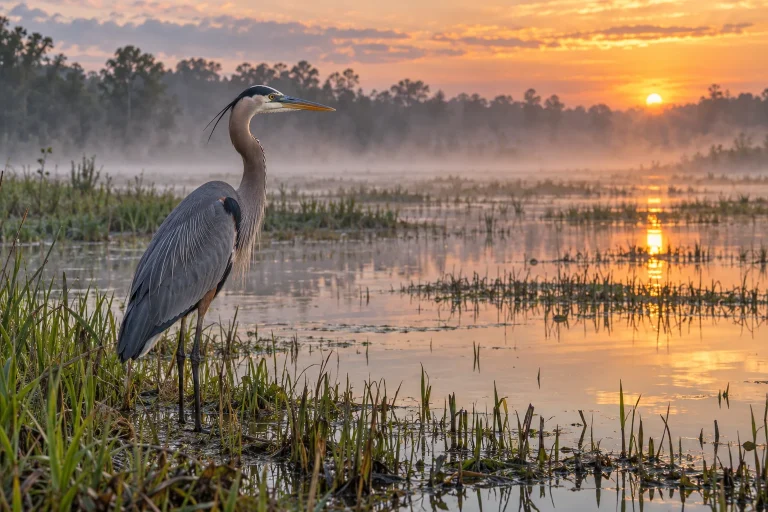
The Great White Heron is one of North America’s most impressive white wading birds. Scientists widely recognize it as a distinct white morph or subspecies of the Great Blue Heron (Ardea herodias occidentalis), known for its massive size, pure white feathers, heavy yellow bill, and pale legs. At first glance, it looks like other white birds such as the Great Egret, but closer inspection reveals key differences in body shape, leg color, and bill size.
This bird is strongly tied to warm, shallow coastal marine waters, especially around South Florida, the Florida Keys, and the West Indies. Recognizing this large heron in the field helps birdwatchers distinguish it from other tall white waders that share its tropical mudflats and mangrove habitats.
Quick Identification
When observing a large white wading bird in shallow saltwater, look for these key field traits to identify a Great White Heron quickly:
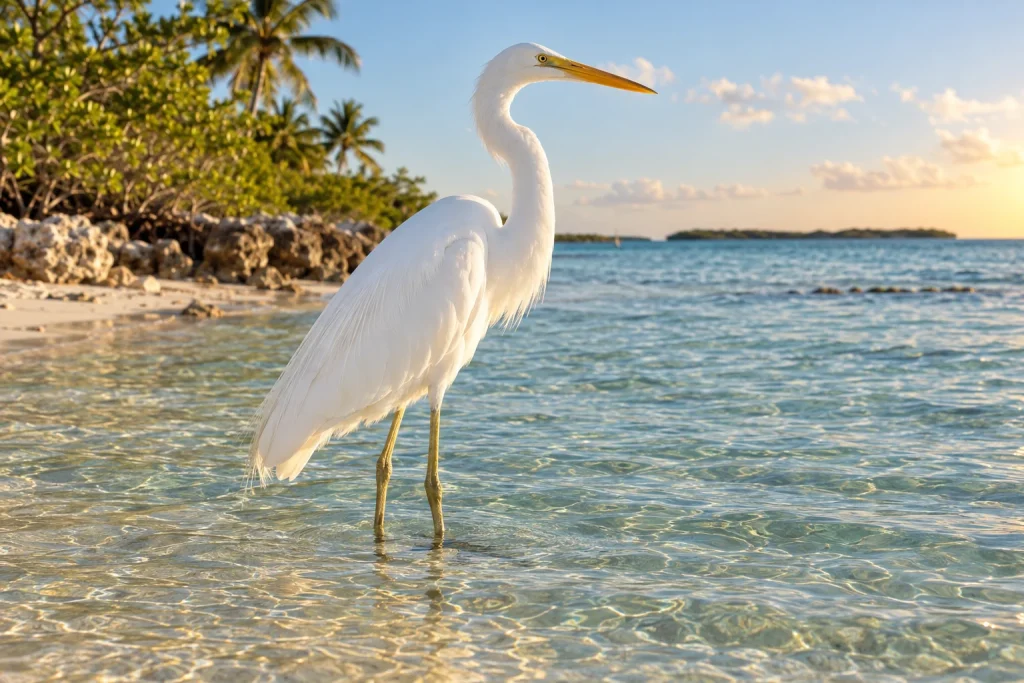
- Plumage: Completely pure white all over the body.
- Bill: Very heavy, long, and deep yellow to orange-yellow.
- Legs and Feet: Dull yellow-green to pale pinkish-yellow, never jet black.
- Size: Substantially larger and bulkier than a Great Egret, with a thicker neck and heavier head.
- Flight: Flies with slow, deliberate wingbeats and its long neck pulled back into a tight “S” curve.
Appearance
The Great White Heron is entirely white, with no grey or blue feathers on its body. Unlike smaller egrets, its head looks heavy and solid, and it holds a thick, dagger-like bill that can spear large prey with ease. During the breeding season, its bill brightens to a vivid orange-yellow, and short white plumes may extend from the back of its head and lower neck.
The bird’s bare parts are crucial for field identification. Its eye is bright yellow. Its legs and large feet range from dull yellowish-green to soft grayish-yellow and sometimes turn slightly pinkish during courtship. This leg color easily sets it apart from the Great Egret, which always displays jet-black legs and feet.

Size and Wingspan
This bird is the largest white wading bird found in North America. Its measurements closely mirror those of the typical dark Great Blue Heron:
- Length: 38 to 52 inches (97 to 132 cm)
- Wingspan: 71 to 79 inches (180 to 200 cm)
- Weight: 4.5 to 5.5 pounds (2.0 to 2.5 kg)
Its massive wingspan gives the bird a slow, powerful flight style. In the air, its broad wings and heavy body make it look noticeably larger than any egret species flying in the same area.
Range and Distribution
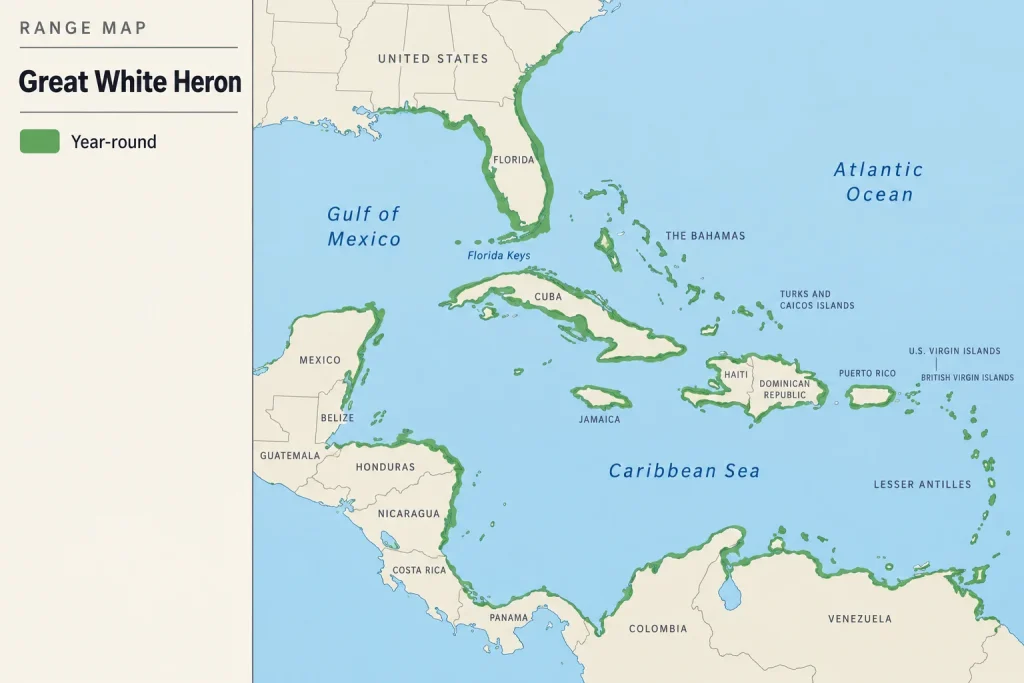
The Great White Heron has a relatively restricted range compared to the widespread dark Great Blue Heron. It is primarily a coastal resident in the subtropical and tropical Atlantic and Caribbean.
Its core population is concentrated in extreme South Florida, including Florida Bay and the Florida Keys. Beyond Florida, it occurs on island groups across the Bahamas, Cuba, Jamaica, and other parts of the Caribbean, as well as along the eastern coast of the Yucatán Peninsula in Mexico. Individual birds occasionally wander farther north along the Atlantic coast of the United States, but these sightings are uncommon.
Habitat
Unlike typical Great Blue Herons, which often hunt in freshwater rivers, ponds, and inland lakes, the Great White Heron is almost exclusively marine. It relies on shallow, sheltered saltwater environments along low-lying coasts.
Typical habitats include:
- Shallow coastal mudflats and sandbars
- Tidal lagoons and mangrove-lined bays
- Coral reef flats exposed during low tide
- Seagrass beds in protected sounds and keys
Behavior
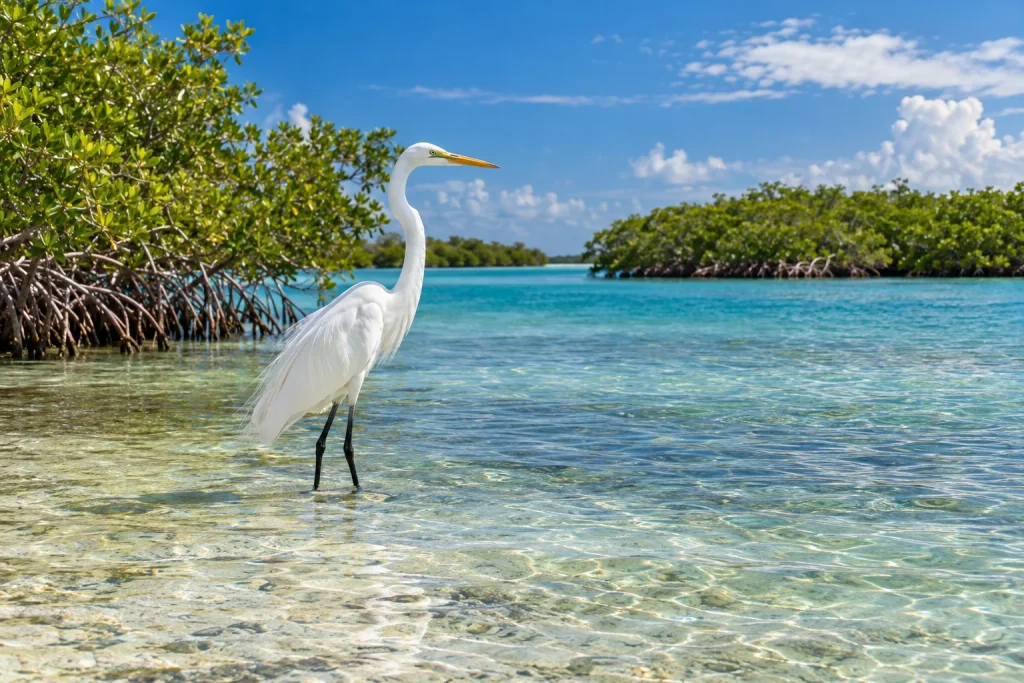
The Great White Heron is a patient, solitary hunter. It often stands completely motionless in shallow water for long periods, waiting for an unsuspecting fish to swim within reach. When moving, it walks deliberately, lifting each foot to avoid creating ripples.
When resting, it roosts in dense mangrove trees or on secluded sandy spits. Though generally solitary while feeding, it will tolerate other wading birds nearby if food is abundant. When defending its feeding territory against other herons or egrets, it raises its neck feathers and utters deep, aggressive croaks.
Diet
This bird is an opportunistic predator that feeds mainly on small to medium-sized coastal fish. Its heavy bill lets it handle larger prey than smaller egrets can.
Common food items include:
- Mullet, killifish, and snook
- Marine catfish and toadfish
- Crabs, shrimp, and other marine crustaceans
- Occasional small lizards, snakes, or young sea turtles on beach edges
When striking, the heron rapidly extends its neck, thrusting its sharp bill like a spear into the water to impale or grasp the fish before swallowing it headfirst.

Vocalizations
Great White Herons are generally quiet birds, but they produce harsh, deep sounds when startled, threatened, or interacting near their nests. Their vocalizations match those of the dark Great Blue Heron.
The most common call is a low, raspy frahnk or roh-roh-roh croak given when flushed into flight. Near nesting colonies, adult birds communicate with soft clucking noises, bill-snapping sounds, and harsh squawks during territory disputes.
Breeding and Nesting
Breeding usually occurs between October and April in South Florida, when food is most abundant. Great White Herons typically nest in small colonies on isolated mangrove keys, often alongside other species of herons, egrets, and pelicans.
The nest is a large, sturdy platform built from heavy sticks and lined with smaller twigs and leaves. Both male and female gather materials and build the nest high up in red or black mangrove trees. Courting birds perform visual displays, including stretching their necks upward, snapping their bills, and weaving sticks together to cement their pair bond.

Young and Development
The female typically lays 3 to 4 pale blue-green eggs. Both parents take turns incubating the eggs for approximately 27 to 29 days. The newly hatched chicks are semi-helpless and covered in soft white down.
Both adults feed the nestlings by regurgitating partially digested fish onto the nest floor or directly into the chicks’ bills. The chicks grow rapidly and begin climbing onto adjacent branches around 6 weeks of age. They usually learn to fly and become independent at 7 to 8 weeks after hatching.
Where to See
The best place in North America to observe this bird is the Florida Keys. Key locations include the Great White Heron National Wildlife Refuge, which was created specifically to protect these birds and their shallow-water feeding grounds. Visitors can also spot them along shallow flats throughout Everglades National Park and Biscayne National Park.
For detailed seasonal sighting records and recent observations across South Florida, birders can consult the Cornell Lab of Ornithology field resources.
Similar Species
Correctly identifying a white heron requires careful attention to key field marks, as several other white species share the same shallow coastal waters:
- Great Egret: Has black legs and feet, a slender yellow bill, and a much thinner neck. It is smaller overall than the Great White Heron.
- Snowy Egret: Much smaller, with a thin black bill, black legs, and bright yellow feet (“golden slippers”).
- Reddish Egret (White Morph): Smaller, with a pink bill tipped in black, and an active, hyperactive “dancing” foraging style.
- Wurdemann’s Heron: An intermediate cross-form between dark Great Blue Herons and Great White Herons, featuring a pure white head on a dark slate-blue body.
Conservation
At the species level, the Great Blue Heron is classified as Least Concern. However, the specific Great White Heron population (subspecies occidentalis) has a much smaller geographical range and faces unique local threats.
Habitat destruction from coastal development, human disturbance at island nesting colonies, tropical storms, and sea-level rise continue to challenge their survival in the Florida Keys. Protecting coastal marine reserves and mangrove forests remains essential to maintaining healthy nesting populations.
Field Identification Tips
When you spot a large white wading bird along the coast, run through this quick step-by-step checklist:
- Check leg color: Pale yellowish-green or pinkish means Great White Heron; jet black means Great Egret.
- Examine bill shape: A thick, heavy, deep-yellow bill indicates a Great White Heron; a narrow, slim yellow bill suggests a Great Egret.
- Observe body posture: A stocky neck and heavy head structure point to a Great White Heron.
- Watch hunting behavior: Slow, patient standing or deliberate stepping indicates a heron, while rapid dashing or wing-flapping points toward a Reddish Egret.
Frequently Asked Questions
Is the Great White Heron a distinct species?
Current ornithological consensus treats the Great White Heron as a distinct white morph or subspecies (Ardea herodias occidentalis) of the Great Blue Heron, rather than a separate species.
How can I quickly tell a Great White Heron from a Great Egret?
Look at the legs and bill. The Great White Heron has pale yellowish-green legs and a thick, heavy yellow bill. The Great Egret has jet-black legs and a slender yellow bill.
Where does the Great White Heron live?
It lives almost exclusively in shallow coastal environments, primarily around South Florida, the Florida Keys, the Bahamas, and coastal areas of the Caribbean.