

Great-tailed Grackle Guide
Keep Track of What You See
Create a free Wild Things Guide membership to record this Great-tailed Grackle in My Sightings and build your personal wildlife list.
Join to Add This SightingIntroduction
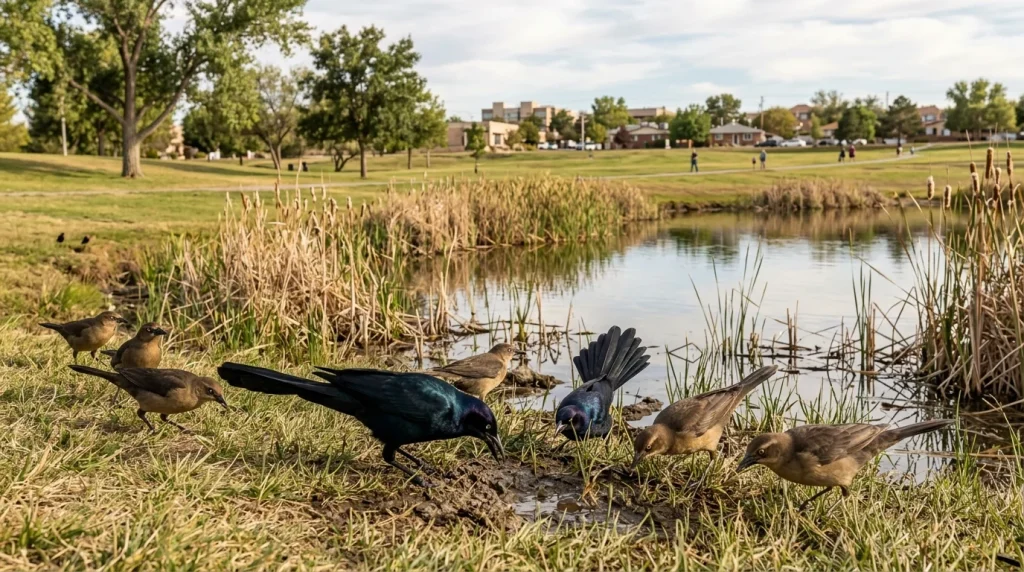
The Great-tailed Grackle (Quiscalus mexicanus) is a conspicuous, adaptable songbird of open country, farms, suburbs, and cities. Adult males are glossy black birds with remarkably long, keel-shaped tails, while females are smaller and brown. Both sexes have long legs, stout bills, and a confident walking style.
Native to the Americas, the species has expanded substantially within the United States, especially across the Southwest and Great Plains. Great-tailed Grackles often gather in noisy flocks around parking lots, agricultural fields, feedlots, parks, and other places where food is plentiful. Their varied whistles, rattles, clacks, and metallic notes make them as recognizable by sound as by appearance.

Quick Identification
- Adult male: Glossy black with blue, purple, or green iridescence, a pale yellow eye, and an extremely long tail.
- Adult female: Warm to dark brown, usually paler on the throat and breast, with a long tail and pale eye.
- Shape: Long-legged and long-billed, with a relatively flat crown and a tail often held in a folded V or deep keel.
- Flight: Strong, direct wingbeats interrupted by glides; the long tail is especially noticeable in flight.
- Behavior: Frequently walks on the ground, forages in human-modified settings, and forms large communal roosts.
Appearance
Male and female Great-tailed Grackles differ so strongly that inexperienced observers may initially mistake them for separate species. The adult male is glossy black overall. In favorable light, his head and body can show violet, blue, bronze, or green reflections. His bill is long, dark, and fairly heavy, and his iris is generally pale yellow. The central tail feathers are greatly elongated, producing the species’ distinctive oversized tail.
When displaying, a male may spread or vertically fold the tail, puff his body feathers, raise his bill, and partially droop his wings. At rest, the folded tail can look narrow and tapered. Worn plumage or flat light may hide much of the male’s iridescence.
Females are considerably smaller. Their plumage ranges from grayish brown to warm cinnamon-brown, with the throat and upper breast often paler than the wings and back. The face may show a subtle pale eyebrow or darker cheek pattern, but these markings vary. Juveniles resemble females and generally have darker eyes at first. Young males gradually acquire irregular patches of black plumage.

Size and Wingspan
Size varies markedly by sex. Adult males are commonly about 43–46 cm (17–18 in) long, with much of that length coming from the tail, and have a wingspan of about 56–58 cm (22–23 in). Females are usually about 32–38 cm (13–15 in) long and may span approximately 46–49 cm (18–19 in).
A male may appear crow-sized at a glance, but he is more slender, with a narrower bill, longer legs, and a much longer graduated tail. Females are closer to other large blackbirds in overall bulk. Posture can exaggerate size: displaying males stretch upward and fan or fold the tail, making them look particularly imposing.
Range and Distribution
Great-tailed Grackles occur from the western and central United States through Mexico and Central America, with the broader species range extending into northwestern South America. Within the United States, they are firmly established in the Southwest, Texas, parts of California, and much of the southern and central Great Plains. They have continued to appear farther north and east, although distribution becomes more local near the expanding edges of the range.
Most populations are resident or make only local seasonal movements. Northern birds may shift toward dependable food, open water, or communal roosts during winter. For a current overview of identification and North American distribution, see the Cornell Lab of Ornithology’s Great-tailed Grackle account.

Habitat
This grackle favors open landscapes containing short vegetation, bare ground, shallow water, scattered trees, or buildings. Typical habitats include irrigated farmland, cattle operations, marsh edges, reservoirs, city parks, campuses, golf courses, shopping centers, roadside rest areas, and residential neighborhoods.
Although frequently associated with wetlands, the species does not require extensive natural marshes. Irrigation canals, stormwater ponds, ornamental plantings, and watered lawns can provide similar resources. Tall trees, dense palms, reed beds, utility structures, and landscaped vegetation may support nesting colonies or nighttime roosts.
Behavior
Great-tailed Grackles spend much of the day walking rather than hopping. They investigate soil, shallow water, grass, pavement, refuse areas, and outdoor dining spaces with deliberate steps. Their adaptability and readiness to explore unfamiliar objects help them exploit rapidly changing urban and agricultural environments.
The species is highly social outside territorial encounters. Flocks may contain a few birds or hundreds, while favorable winter roosts can hold far more. At dusk, streams of grackles often converge on trees, reeds, or structures. Within breeding colonies, males display conspicuously and may compete for access to several females. Chases, raised bills, flared feathers, and tail postures are common.
Diet and Hunting
Great-tailed Grackles are opportunistic omnivores. Their diet includes beetles, grasshoppers, caterpillars, spiders, worms, aquatic invertebrates, small fish, tadpoles, frogs, lizards, eggs, nestlings, grain, seeds, fruit, and discarded human food. The proportions vary with season and local availability.
They pick food from the ground, probe wet soil, wade through shallow water, turn over loose objects, and capture insects disturbed by livestock or machinery. Birds may also follow tractors, forage around feeding animals, or search along shorelines. Although capable of taking small vertebrates and the contents of other birds’ nests, they are primarily flexible foragers rather than specialized predators.

Vocalizations
The Great-tailed Grackle has an unusually broad and mechanical-sounding vocabulary. Calls include hard chack notes, nasal squeaks, rattles, clicks, whistles, metallic clangs, and rising or falling glides. Some sounds resemble creaking hinges, electronic tones, or scraping metal.
Males frequently sing from exposed perches such as treetops, signs, roofs, and utility wires. A display song may be accompanied by puffed feathers, partly spread wings, and an elevated bill. Females also give calls and shorter vocalizations. A large roost or colony can produce a constant mixture of harsh notes and conversational chatter.
Breeding and Nesting
Breeding activity begins in spring in much of the United States, though timing varies with latitude and local conditions. Great-tailed Grackles often nest in loose colonies. Males display within breeding areas, but females perform most or all nest construction, incubation, and routine care of the young.
The nest is a bulky, deep cup made from grasses, weed stems, strips of bark, roots, and human-made fibers. Mud or damp plant material may reinforce the structure, and the inner cup is lined with finer vegetation. Nests are placed in dense trees, shrubs, palms, reeds, or occasionally on artificial structures, often near water.
A typical clutch contains about three or four eggs, although clutch size varies. Eggs are pale bluish, grayish, or buff and marked with dark scrawls, blotches, or spots. Incubation lasts roughly two weeks. Nest location, weather, predators, and disturbance can strongly affect breeding success.

Young and Development
Hatchlings are helpless and sparsely covered with down. The female broods and feeds them, bringing insects and other protein-rich foods during early growth. Nestlings develop rapidly and commonly leave the nest after approximately three weeks, though fledging age is not identical in every nest.
Recently fledged birds have short-looking tails, loosely textured brown plumage, and dark or dull eyes. They remain dependent on adults while learning to forage. Juvenile males may resemble large females before black feathers begin appearing. The elongated adult male tail and full glossy plumage develop later.
Where to See
In the core North American range, productive locations include supermarket parking lots, urban ponds, agricultural fields, livestock facilities, river parks, marsh edges, and highway rest areas. Search grassy areas early in the day, then check tall trees and utility lines for birds loafing or displaying.
Evening provides an excellent opportunity to watch communal-roost movements. Look for long-tailed silhouettes flying in a shared direction shortly before sunset. In places where the species is still uncommon, sewage ponds, reservoirs, irrigated parks, and concentrations of blackbirds are sensible places to check. Review local records before assuming that every large grackle is this species.
Similar Species
Boat-tailed Grackle: This close relative is most likely to be confused with, particularly near the Gulf Coast. Boat-tailed Grackles are strongly associated with coastal marshes and nearby developed areas, while Great-tailed Grackles are widespread inland. Eye color in Boat-tailed Grackles varies geographically, so it is not always decisive. Range, habitat, vocalizations, tail proportions, and direct comparison are more reliable together.
Common Grackle: The Common Grackle is shorter-tailed and more compact, with a heavier-looking body. Adult males often have a glossy blue or purple head that contrasts with a bronzy body. Their tails can look keel-shaped, but they are not proportionally as long as those of male Great-tailed Grackles.
Brewer’s Blackbird: Male Brewer’s Blackbirds also have pale eyes and glossy black plumage, but they are much smaller, shorter-billed, and short-tailed. Females are plain gray-brown and lack the Great-tailed Grackle’s large size, heavy bill, and lengthy tail.
American Crow: A distant male grackle may initially suggest a crow. Crows are bulkier, have thick black bills and dark eyes, and lack a deeply graduated tail. Their familiar cawing calls are also very different.
Conservation
The Great-tailed Grackle is commonly classified as Least Concern. It has a large range and has benefited from irrigation, agriculture, urban landscaping, artificial ponds, and abundant human-associated food. Its long-term expansion in the United States is one of the more striking range changes among familiar North American birds.
Local conflicts can arise where large roosts produce noise and droppings or where birds feed on crops. Management should account for active nests, applicable wildlife protections, and the possibility of moving a roost rather than eliminating it. Despite its overall success, individuals remain vulnerable to vehicle strikes, entanglement, pesticides, contaminated water, severe weather, and destruction of nesting vegetation.
Field Identification Tips
- Start with structure: check for long legs, a stout pointed bill, and an exceptionally long graduated tail.
- Use sex as an identification clue. Glossy black males and brown females often forage together despite their different appearance.
- Watch a male from behind. The tail may be folded into a pronounced vertical V or keel.
- Do not rely on iridescent color alone; it changes with lighting, feather wear, and viewing angle.
- Listen for whistles, metallic clanks, rattles, and squeaks rather than a simple melodious song.
- Where Boat-tailed Grackle is possible, combine location, habitat, voice, eye color, and proportions instead of using one feature.
- Be cautious with juveniles, whose short tails and dark eyes can make them look unlike adults.
Frequently Asked Questions
Are Great-tailed Grackles crows?
No. They belong to the blackbird family, Icteridae, along with meadowlarks, orioles, cowbirds, and other grackles. Crows belong to the family Corvidae.
Why is the male’s tail so large?
The long tail is used in visual displays and may help signal maturity or condition. It also contributes to maneuvering in flight, although its most obvious role to an observer is in courtship and aggressive postures.
Do Great-tailed Grackles migrate?
Many are year-round residents. Local movements occur in response to weather, food, breeding conditions, and roost availability, especially near the northern edge of the range.
Are they aggressive?
They can be assertive around food, nest sites, and display areas. Most interactions with people involve close approach or opportunistic food searching rather than direct aggression.
How can females be separated from female Boat-tailed Grackles?
These birds can be difficult to separate where ranges overlap. Geographic location, habitat, voice, body proportions, and association with identifiable males are usually more helpful than any single plumage mark.


