Great Egret Guide
Keep Track of What You See
Create a free Wild Things Guide membership to record this Great Egret in My Sightings and build your personal wildlife list.
Join to Add This SightingIntroduction
The Great Egret (Ardea alba) is one of North America’s most recognizable wading birds. With long, jet-black legs, snow-white feathers, and a sharp, bright yellow bill, this stately bird is a familiar sight along coastlines, riverbanks, and marshy wetlands. Though hunters once hunted it nearly to extinction for its delicate back plumes, conservation efforts helped the species recover dramatically. Today, the Great Egret symbolizes wildlife protection and stands as a testament to modern conservation success.
Whether wading through shallow marshland or perching quietly in high treetops, the Great Egret catches the eye with its graceful movements and tall, slender frame. Understanding its habits, field marks, and seasonal changes helps birdwatchers easily identify this striking bird across North America.

Quick Identification
To quickly identify a Great Egret in the field, look for these key visual features:
- Plumage: Bright white year-round.
- Bill: Heavy, dagger-like bill, yellow to orange-yellow.
- Legs and Feet: Entirely black from the upper legs down through the toes.
- Body Shape: Tall, slender body with a long, elegant S-shaped neck.
- Flight Profile: Flies with slow, deliberate wingbeats, holding its head tucked back near its shoulders.
Appearance
The Great Egret is an all-white wading bird with no feather color variations. Males and females share identical plumage, making them difficult to distinguish in the field by sight alone.
During the non-breeding season, adults display plain white feathers, a clear yellow bill, and dark black legs and feet. The bare skin between the eye and the bill, known as the lores, appears yellowish-green to yellow.
As the breeding season approaches, adults undergo a dramatic transformation:
- Breeding Plumes (Aigrettes): Long, lace-like feathers grow from the middle of the back and extend past the tail. These feathers can be raised during courtship displays.
- Facial Skin: The lores flush a brilliant, vibrant lime-green color.
- Bill Color: The bill may take on a slightly deeper orange-yellow tint at the base.
Juvenile Great Egrets closely resemble non-breeding adults, possessing clean white feathers, yellow bills, and dark legs, though their feathers may appear slightly less neat overall.

Size and Wingspan
The Great Egret is a large wading bird, second only to the Great Blue Heron in size among North American herons. Detailed physical measurements include:
- Body Length: 37 to 41 inches (94 to 104 cm)
- Wingspan: 51 to 57 inches (131 to 145 cm)
- Weight: 1.8 to 3.3 pounds (800 to 1500 g)
Despite its large visual profile, the Great Egret is surprisingly lightweight because of its hollow bones and slender build. Standing upright, an adult can reach nearly four feet.
Range and Distribution
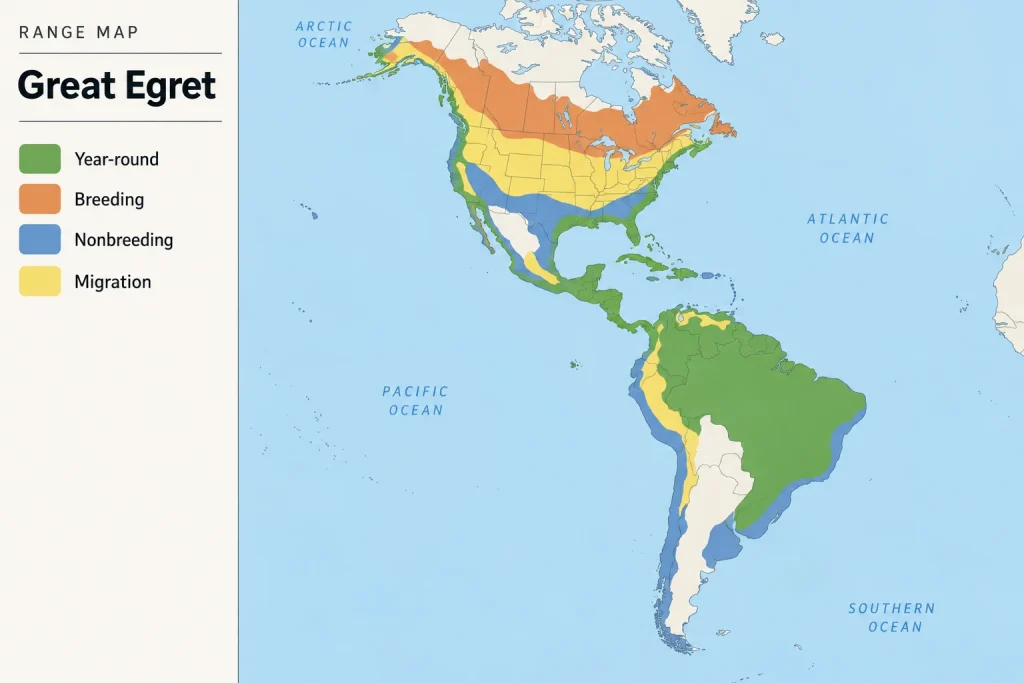
The Great Egret has a vast global distribution across North America, South America, Europe, Africa, Asia, and Australia. In North America, its distribution follows distinct seasonal patterns:
- Breeding Range: Extends across much of the central and eastern United States, northern coastal regions, and localized areas in the West.
- Year-Round Range: Resident populations live along the Atlantic Coast from New Jersey south, the entire Gulf Coast, parts of the West Coast, and south through Mexico.
- Non-Breeding Range: Northern populations migrate south for the winter, gathering in coastal estuaries, southern states, and Central America.
Detailed range maps from the Cornell Lab of Ornithology show how these migration routes expand inland along major river valleys in spring and fall.
Habitat
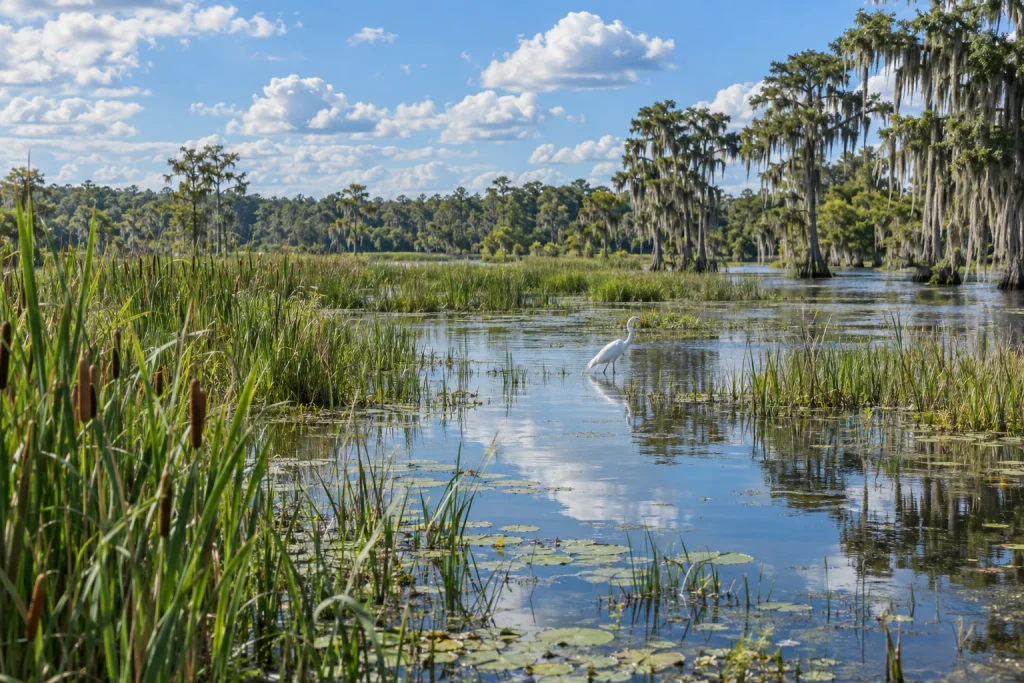
Great Egrets rely heavily on aquatic environments with shallow, open water for hunting. Common habitats include:
- Freshwater and saltwater marshes
- Swamps and flooded forests
- Tidal mudflats and mangrove estuaries
- Pond edges, lake shores, and river margins
- Agricultural fields, flooded rice paddies, and drainage ditches
They prefer shallow areas where they can wade comfortably while keeping their bodies above water. They also need nearby tall trees, shrubs, or dense vegetation for safe roosting and nesting away from land predators.
Behavior
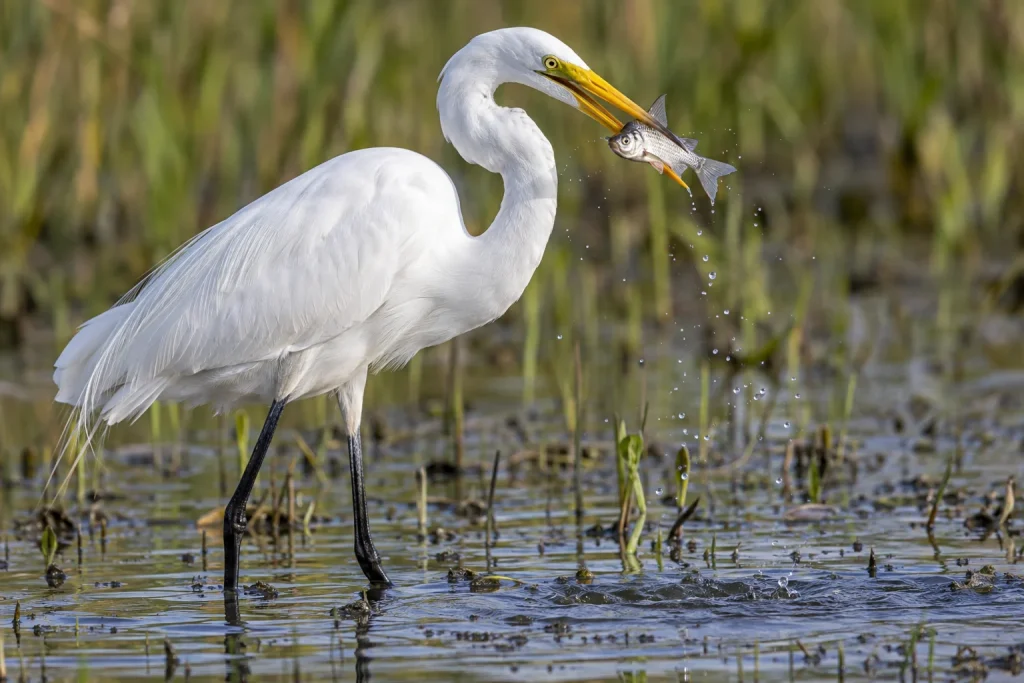
Great Egrets are methodical hunters that spend hours searching for food in shallow water. Their typical hunting behavior involves two main approaches: standing motionless and waiting for prey to swim within reach, or walking slowly and deliberately through the water.
When it spots prey, the egret freezes, tilts its neck, and strikes forward with surprising speed, impaling or gripping the victim in its sharp bill. After capturing prey, the bird usually tilts its head back and swallows it whole, headfirst.
In flight, the Great Egret moves slowly and majestically. It beats its broad wings slowly and pulls its long neck into a tight S-curve, resting its head near its shoulders. Its long black legs trail straight out behind its body.
Diet
Great Egrets are opportunistic carnivores with a varied diet based primarily on aquatic life. Common food items include:
- Small to medium-sized fish (minnows, sunfish, perch)
- Amphibians, including frogs, toads, and tadpoles
- Crayfish, crabs, and other aquatic invertebrates
- Reptiles, such as small water snakes and young turtles
- Small mammals like meadow voles and mice in flooded fields
- Insects, including dragonflies and water beetles
Although they often forage near other wading birds, Great Egrets defend their personal hunting space, frequently chasing away smaller egrets or herons that get too close.
Vocalizations
Great Egrets are generally quiet birds, especially while hunting in open water. However, they are far from silent when disturbed or when gathering at breeding colonies.
Their most common call is a deep, low, gravelly croak or dry rattle, often transcribed as karrr or cuk-cuk-cuk. They make this sound when startled into flight, during territorial conflicts, or when defending a hunting spot. At nesting colonies, adults and chicks create a noisy environment filled with raspy squawks, bill snaps, and harsh chattering calls.
Breeding and Nesting
Great Egrets breed in large group colonies called heronries or rookeries, frequently sharing trees with Great Blue Herons, Snowy Egrets, and night-herons. Nesting typically begins in early spring.
Courtship begins when the male selects a nest site and performs courtship displays. He raises his long, lacy back plumes into a fan, stretches his neck upward, and snaps his bill. The brilliant green facial skin flashes bright color during these displays.
Once paired, both birds build a large platform nest using sticks and twigs. They usually build nests high in trees or tall bushes near water, ranging from 10 to 80 feet above the ground. The female lays a clutch of 3 to 5 pale blue-green eggs, and both parents take turns incubating them for roughly 23 to 27 days.

Young and Development
Great Egret chicks hatch covered in fluffy white down with open eyes, but they are helpless and rely entirely on their parents for food and warmth. Parents feed chicks by regurgitating digested food directly into their open bills.
Key stages in chick development include:
- First 2 Weeks: Chicks grow rapidly, learning to stand and compete with nestmates for food.
- 3 to 4 Weeks: Chicks begin climbing out of the nest onto nearby branches and practice flapping their wings.
- 6 to 7 Weeks: Young egrets take their first flights and learn to hunt near the colony.
- 8 to 10 Weeks: Young birds become fully independent from their parents.
Competition among siblings can be fierce. In years when food is scarce, older, larger chicks often monopolize the food supply, causing younger nestmates to be lost.
Where to See
Finding a Great Egret is often straightforward if you visit the right aquatic habitats during warm months. Look for them standing along the edges of open water in national parks, wildlife refuges, and coastal reserves.
Excellent locations to observe Great Egrets in North America include:
- Everglades National Park (Florida)
- Blackwater National Wildlife Refuge (Maryland)
- Bear River Migratory Bird Refuge (Utah)
- Anahuac National Wildlife Refuge (Texas)
- Sacramento National Wildlife Refuge (California)
Even outside designated reserves, check neighborhood stormwater retention ponds, local lake margins, and wet roadside ditches during late summer and fall migration.
Similar Species
Several other white wading birds share habitat with the Great Egret. Comparing key field marks makes separation simple:
- Snowy Egret: Significantly smaller with a dark black bill, black legs, and bright yellow feet (“yellow slippers”).
- Cattle Egret: Much smaller with a shorter neck, stocky build, and a short yellow bill. Breeding adults display buff-orange patches on their head, chest, and back.
- Great Blue Heron (White Morph): Found in extreme southern Florida. Looks very similar in color but is noticeably larger with pinkish-yellow legs and a heavier bill.
- Little Blue Heron (Juvenile): Young Little Blue Herons are all white but have dull greenish-yellow legs and a dark-tipped greyish bill.
Conservation
The Great Egret holds a significant place in North American wildlife conservation history. In the late 19th and early 20th centuries, plume hunters killed millions of egrets for their delicate breeding feathers to decorate women’s fashionable hats.
Public outcry over this slaughter led directly to the formation of early Audubon societies and the passage of the landmark Migratory Bird Treaty Act of 1918. Protected from hunting, Great Egret populations recovered impressively over the following decades.
Today, the International Union for Conservation of Nature (IUCN) lists the Great Egret as Least Concern. However, modern threats remain, including habitat loss from wetland drainage, chemical runoff, water pollution, and climate change that affects wetland hydrology.
Field Identification Tips
When you spot a large white bird near water, use this step-by-step mental checklist to confirm it is a Great Egret:
- Check the overall size: Is it a tall, large wading bird standing roughly three feet tall?
- Examine the bill: Is the bill long, straight, and bright yellow?
- Look down at the legs: Are the legs and feet entirely black with no yellow toes?
- Observe the flight posture: Is the neck tucked back into an S-curve while flying with slow wingbeats?
- Check facial skin: Is the skin around the eyes yellow (non-breeding) or bright lime-green (breeding)?
Frequently Asked Questions
Is a Great Egret the same thing as a Great White Heron?
No. While both are large white wading birds, the Great White Heron is actually an all-white color form (morph) of the Great Blue Heron, found primarily in southern Florida and the Caribbean. It has pale legs and a heavier bill, whereas the Great Egret has black legs.
Do male and female Great Egrets look different?
No, males and females have identical white plumage, black legs, and yellow bills year-round. During the breeding season, both sexes grow long back plumes and develop bright green facial skin.
Why do Great Egrets pull their necks in when flying?
Folding the neck into an S-shape brings the center of gravity closer to the body, making long-distance flight more aerodynamic and energy-efficient. Cranes and storks fly with extended necks, which helps birdwatchers distinguish them from egrets and herons at a distance.