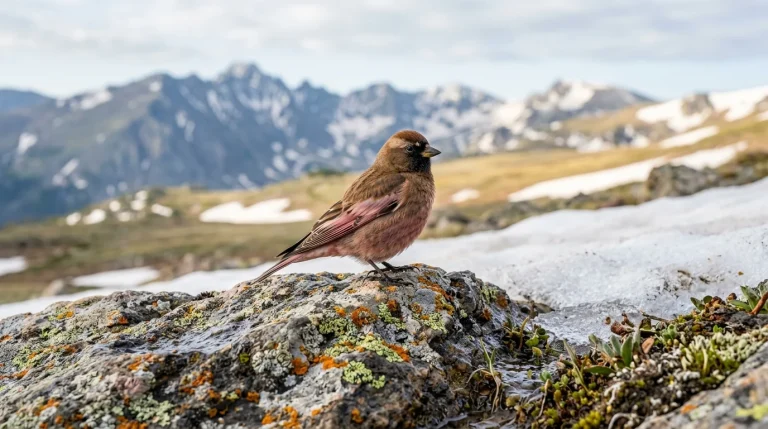
Gray-crowned Rosy-Finch Guide
Keep Track of What You See
Create a free Wild Things Guide membership to record this Gray-crowned Rosy-Finch in My Sightings and build your personal wildlife list.
Join to Add This SightingIntroduction
The Gray-crowned Rosy-Finch (Leucosticte tephrocotis) is a rugged mountain songbird associated with alpine tundra, rocky slopes, snowfields, and windswept ridges across western North America. During winter, flocks descend into valleys and open foothills, where the birds become more accessible around weedy fields, roadsides, and feeding stations.
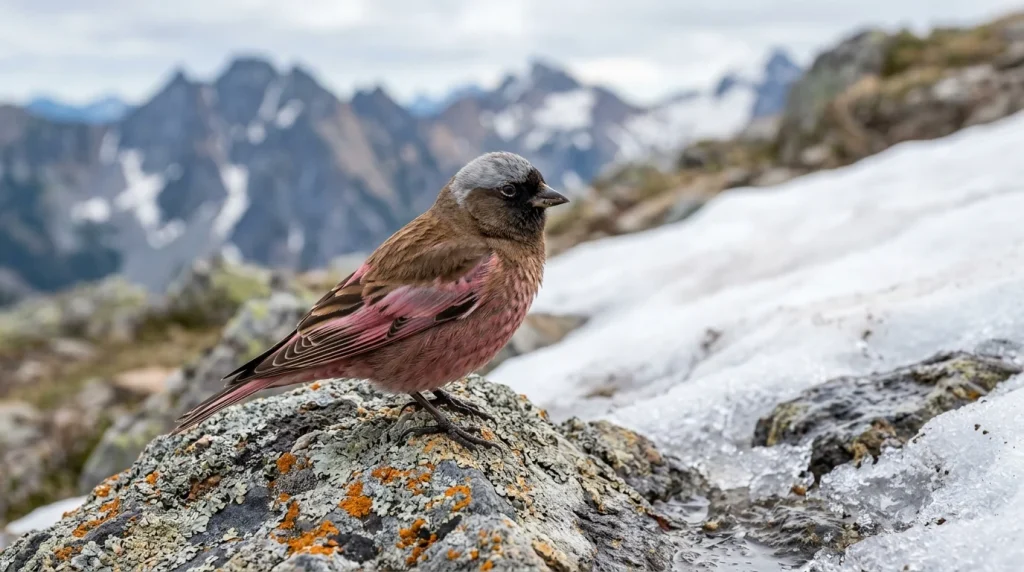
Its combination of a gray crown, dark face, warm brown body, and pink-washed wings and flanks is distinctive at close range. Identification can be less straightforward in poor light, however, because the rosy color may appear muted and several recognized subspecies differ in the amount of gray on the head. Females are generally duller than males, while juveniles lackadults’ults’ bold head pattern and much of their pink coloration.
This species is a member of the finch family, Fringillidae. It is closely related to the Black Rosy-Finch and Brown-capped Rosy-Finch, two species that can overlap with it in winter.
Quick Identification
- Overall shape: A stocky, medium-sized finch with a rounded body, relatively long wings, and a slightly notched tail.
- Head: Gray crown contrasting with a dark forehead and throat in adults; some populations have gray extending broadly across the cheeks.
- Body: Mostly warm brown, often darkest on the breast and back.
- Rosy color: Pink to rosy-red edging or washes on the wings, rump, belly, and flanks, strongest in adult males.
- Bill: Short and conical; dark in the breeding season and often yellowish in winter.
- Flight: Strong and undulating, frequently performed in compact, fast-moving flocks.
- Typical setting: Alpine rocks and snow margins in summer; open valleys, farms, and mountain settlements in winter.
Appearance
Adult Gray-crowned Rosy-Finches have warm cinnamon-brown to chocolate-brown bodies. Their flight feathers and tail are darker, while pink or rosy-red feather edges brighten the wings, lower flanks, belly, and rump. The intensity of this color varies with sex, age, feather wear, lighting, and subspecies.
The head pattern is the most useful field mark. Most adults show a pearl-gray crown behind a blackish forehead. The throat and area around the base of the bill are also dark. In some northern and coastal populations—often informally called Hepburn’s Rosy-Finches—the gray extends down the sides of the head, producing a broad gray hood around a smaller dark facial area. Interior birds more often show gray concentrated on the crown, with darker cheeks.
Males tend to have richer pink highlights and a more extensive black forehead and throat. Females share the same basic pattern but are usually browner, with less saturated pink and a less sharply defined dark face. These differences are relative, so sex may be difficult to determine when a bird is alone.
Juveniles are much plainer. They are brownish overall, with subtle streaking or pale feather edges and little obvious pink. Their heads initially lack the strongly contrasting gray-and-black pattern of adults. By autumn, molt produces a more recognizable rosy-finch appearance.

Size and Wingspan
Gray-crowned Rosy-Finches vary noticeably across their broad range, with some northern forms averaging larger than interior populations.
- Length: Approximately 14–21 cm (5.5–8.3 in)
- Wingspan: About 33 cm (13 in), with individual variation
- Build: Stocky and deep-bodied, with long, pointed wings suited to travel through exposed mountain terrain
They are generally larger and heavier-looking than common redpolls or Pine Siskins. Compared with a House Finch, a Gray-crowned Rosy-Finch often appears broader-bodied and longer-winged.
Range and Distribution
The species occurs across much of western and northwestern North America. Its breeding distribution includes Alaska, the Aleutian Islands, western Canada, and scattered high-elevation areas of the western United States. Some populations breed on remote islands and coastal cliffs, while others occupy alpine mountain systems well above the tree line.
In winter, many birds move southward or descend to lower elevations. They may occur from southern Alaska and western Canada through the Rocky Mountain, Great Basin, Cascade, and Sierra Nevada regions. Numbers and locations can vary from year to year in response to snow cover and food supplies. Occasional wandering flocks appear east of the species’ usual winter range.
Resident or short-distance movements occur in some coastal populations, whereas interior mountain birds may undertake more pronounced seasonal migrations. The Cornell Lab of Ornithology species account provides additional identification and distribution information.

Habitat
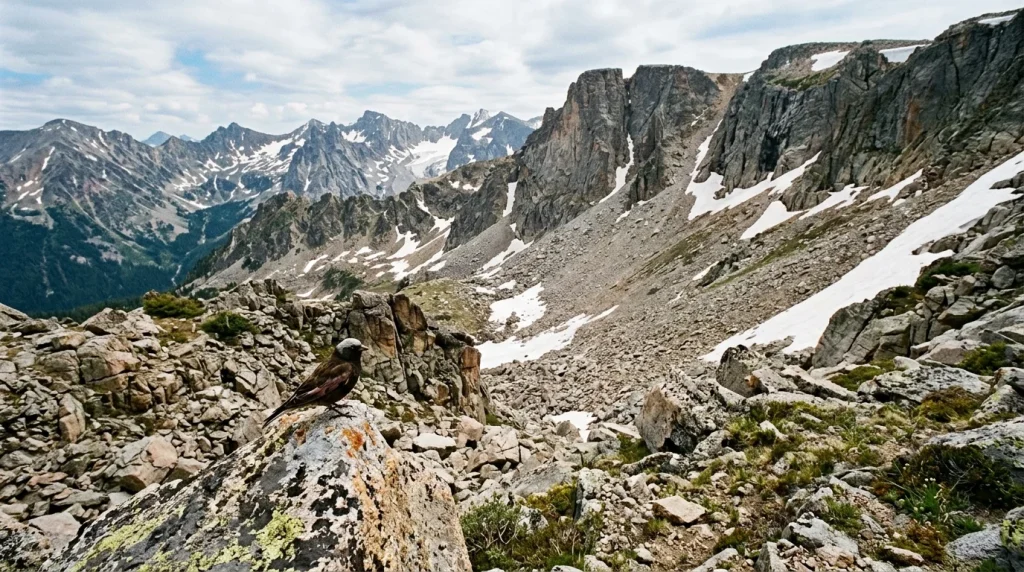
During the breeding season, Gray-crowned Rosy-Finches occupy some of North America’s harshest bird habitats. Typical sites include alpine tundra, talus slopes, rocky cirques, cliff faces, volcanic terrain, glacier margins, and barren ridges with persistent patches of snow. Vegetation is often sparse and low, and suitable nesting crevices may be more important than plant cover.
Coastal populations also use rocky islands, sea cliffs, and open tundra. In winter, the species becomes less strictly alpine. Flocks visit open foothills, sagebrush country, short-grass fields, agricultural margins, roadsides, gravel areas, ski communities, and settlements near mountain valleys. They generally favor broad, open ground where wind or melting snow exposes seeds.
Behavior
Gray-crowned Rosy-Finches are highly social outside the breeding season. Winter flocks may contain a few birds or several hundred, sometimes mixing with other rosy-finches, Snow Buntings, Horned Larks, or redpolls. A flock commonly sweeps into a feeding area, drops to the ground, and then rises almost simultaneously when disturbed.
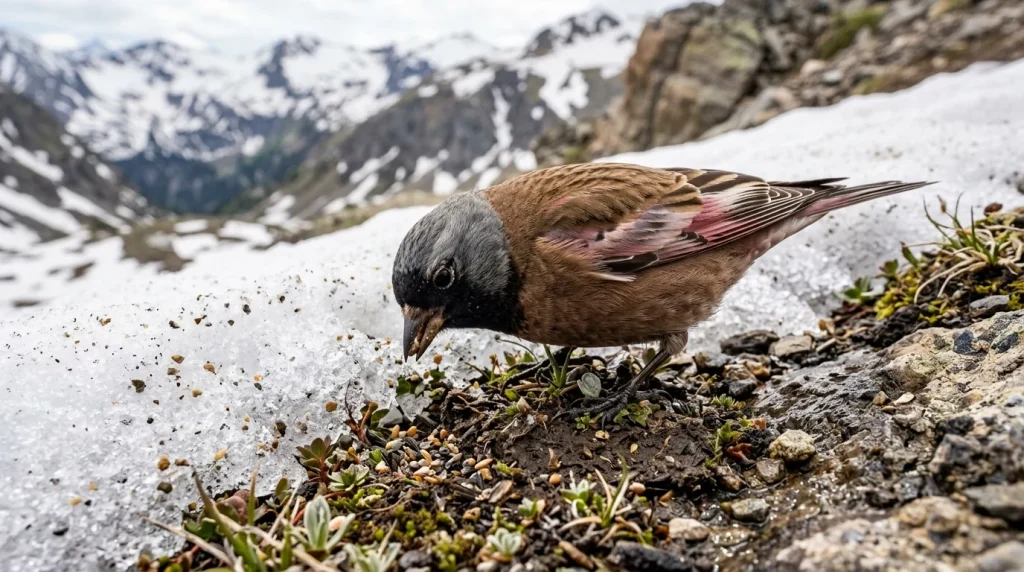
On the ground, these finches walk and hop while picking food from soil, low plants, rocks, and snow crusts. They are notably tolerant of cold, but they seek sheltered roosts in caves, crevices, cliffs, buildings, or dense structures during severe weather. Birds may fluff their body feathers to conserve heat and spend long periods feeding when winter days are short.
Breeding pairs are territorial near nest sites, although they may share productive feeding areas. Their long wings allow quick travel between nesting cliffs and patches of insects or seeds.
Diet and Hunting
Despite traditional use of “hun” hunting, this finch mainly forages rather than actively pursuing large prey. Seeds form much of its diet, especially outside the breeding season. Common foods include seeds of grasses, sedges, mustards, sunflowers, and other low alpine or weedy plants.
In spring and summer, adults take more animal food, including flies, beetles, caterpillars, and other small invertebrates. Insects are especially important for growing nestlings. Birds often search along melting snowbanks, where windblown insects collect, and newly exposed ground provides concentrated food. They may pick insects directly from snow, rocks, or vegetation and occasionally catch flying insects in short aerial sallies.
Winter flocks readily consume scattered seed beneath feeding stations. Offering seed near suitable western mountain habitat may attract them, but keep feeders clean and protect food from moisture to reduce disease transmission.
Vocalizations
The Gray-crowned Rosy-Finch is not known for an elaborate, far-carrying song. Its common calls are short, buzzy or husky notes often rendered as chew, jeer, or chew-ee. Flocks maintain contact with soft twitters and repeated call notes, creating a conversational murmur while feeding or flying.
The male’s song is a brief series of warbles, trills, and scratchy notes. Wind can make these sounds difficult to hear in alpine settings. Observers are often alerted first by the calls of a flock passing overhead rather than by a stationary singing bird.
Breeding and Nesting
Breeding usually begins later than in many lowland songbirds because snow persists in alpine habitat. Timing varies with latitude, elevation, and local weather. Courtship includes song, posturing, and display flights, while males may show their rosy wing and body feathers during interactions.
The nest is concealed in a protected cavity or crevice. Natural locations include cliff cracks, spaces beneath rocks, talus cavities, caves, and recesses near glaciers. Birds also use human-made structures such as abandoned buildings, mine features, bridges, or sheltered ledges when these resemble natural cavities.
The female is thought to perform most or all nest construction. The nest is a substantial cup made from grasses, stems, roots, moss, and similar material, usually lined with fine grass, hair, feathers, or other insulating fibers. A typical clutch contains about three to five eggs, which are generally plain white. The female incubates for roughly two weeks, while the male may bring her food near the nest.

Young and Development
Gray-crowned Rosy-Finch chicks hatch helpless, sparsely covered with down, and dependent on their parents for warmth and food. Both adults feed the nestlings, delivering softened seeds and protein-rich insects. Frequent feeding helps the young develop quickly during the short alpine summer.
Nestlings generally remain in the nest for approximately two to three weeks, although development varies with weather and food availability. After fledging, young birds stay near their parents and continue to receive food while improving their flight and foraging skills. Family groups may gather with other rosy-finches before seasonal movements begin.
Juveniles initially look plain brown and can be confusing. Their first major transition into more adult-like plumage occurs as fresh feathers reveal the gray crown, dark face, and rosy highlights.
Where to See
Summer observation usually requires travel into high, open mountain country. Search near talus slopes, cliffs, snowfields, alpine visitor areas, and ridgelines above the tree line. In Alaska and western Canada, rocky tundra and coastal cliffs may also support breeding birds. Avoid approaching nest crevices, as seemingly barren rock faces can contain active nests.
Winter is often the easiest season to find the species. Useful locations include:
- Mountain passes and open valleys with exposed seed-bearing plants
- Roadsides where snowplows uncover gravel and weed seeds
- Ranches, farm margins, and grain areas near western mountains
- Ski towns and high-elevation communities with established feeding stations
- Wind-scoured ridges and snow-free patches in sagebrush or grassland
Because flocks are mobile, recent local reports are particularly useful. Scan airborne finch flocks for flashing pink wings and listen for husky contact calls.
Similar Species
- Black Rosy-Finch: Much darker overall, appearing deep chocolate to nearly black. It has a gray crown and pink highlights but lacks the gray crown and broadly brown body. Hybrids and worn individuals can complicate identification where ranges overlap.
- Brown-capped Rosy-Finch: Usually has a brown crown rather than a clearly gray one and often shows more extensive rosy color on the underparts. The face lacks the same crisp gray-crown contrast.
- House Finch: Male House Finches have red on the head and breast rather than concentrated pink in the wings and flanks. They lack a gray crown and dark facial mask.
- Common Redpoll: Smaller and more heavily streaked, with a tiny red crown patch and black chin. Redpolls are paler and lack broad rosy wing panels.
- Pine Siskin: Smaller, slimmer, and strongly streaked, with yellow—not pink—in the wings and tail.
Conservation
The Gray-crowned Rosy-Finch is commonly classified as Least Concern on the IUCN Red List because it has a broad range and is not considered globally threatened. Nevertheless, monitoring alpine birds is difficult, and some surveys suggest declines or regional concerns. Population estimates should be treated cautiously because breeding sites are remote and winter flocks are highly mobile.
Potential pressures include climate-driven changes to snowfields and alpine insect communities, altered vegetation, severe weather, disturbance near nests, collisions, and disease transmission at crowded feeders. Development and recreation in mountain environments may also affect local habitat. Maintaining natural alpine areas, limiting disturbance around nesting cliffs, and practicing responsible feeder hygiene can benefit the species.
Field Identification Tips
- Start with structure. Look for a stocky finch with long, pointed wings rather than relying immediately on color.
- Confirm the gray crown. Adults should show genuine gray on the crown or much of the head, depending on population.
- Check the face. A dark forehead and throat contrast with the gray crown, especially in adult males.
- Watch the wings in flight. Rosy-pink edges and panels may be more conspicuous when the bird opens its wings.
- Allow for dull females and juveniles. Pink may be limited, and young birds can appear almost entirely brown.
- Use habitat and season. Alpine rocks in summer and open western valleys in winter strongly support the identification.
- Examine the whole flock. Mixed rosy-finch flocks occur, so do not assume every nearby bird is the same species.
- Account for lighting. Warm sunlight can make brown feathers look pink, while heavy cloud can hide real rosy coloration.
Frequently Asked Questions
Why is it called a rosy-finch?
The name refers to the pink or rosy-red coloration on the wings, rump, flanks, and belly. The color is typically strongest in adult males but is present to varying degrees in females.
Does every Gray-crowned Rosy-Finch have the same head pattern?
No. Geographic populations differ. Some have gray mainly on the crown, while others show an extensive gray hood covering much of the head. Age, sex, molt, and feather wear also affect appearance.
Are Gray-crowned Rosy-Finches found at feeders?
Yes, especially during snowy weather in western mountain communities. They may arrive in large flocks for small seeds. Clean feeding surfaces and fresh, dry food are important when many birds gather.
Do they stay in the high mountains all year?
Not always. Many descend to valleys, foothills, and open lowlands during winter. The distance traveled varies among populations, and some coastal birds may remain relatively close to their breeding areas.
How can I separate a female from a male?
Females are usually duller brown, with less extensive black on the face and less saturated pink. The overlap is substantial, however, and a single bird may not be safely sexed without direct comparison.
What is the best single identification feature?
For an adult, the combination of a gray crown, dark forehead and throat, brown body, and pink in the wings and flanks is more reliable than any one feature alone.