
Common Grackle Guide
Keep Track of What You See
Create a free Wild Things Guide membership to record this Common Grackle in My Sightings and build your personal wildlife list.
Join to Add This SightingIntroduction
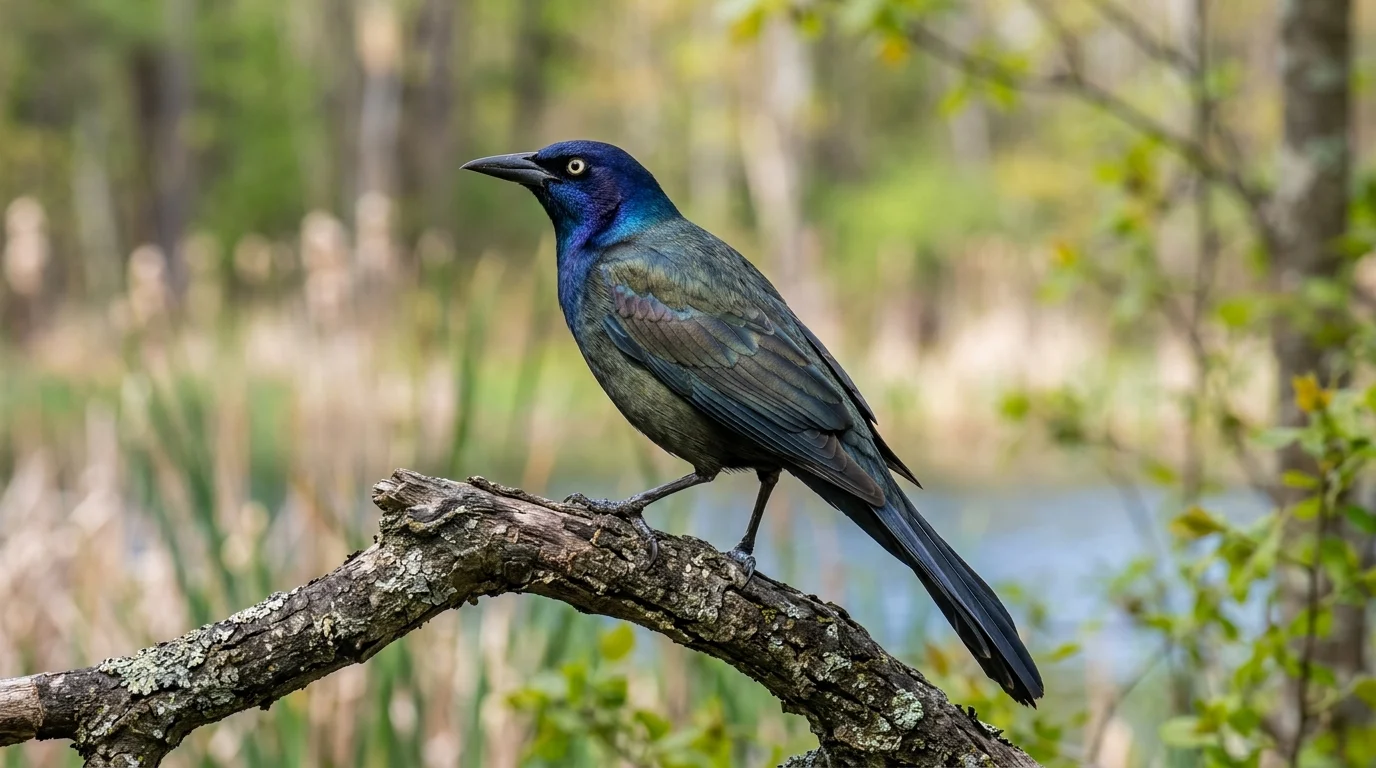
The Common Grackle (Quiscalus quiscula) is a large, long-tailed blackbird found across much of eastern and central North America. Frequently seen striding across lawns, gathering in noisy flocks, or perching conspicuously in treetops, it is familiar around farms, suburbs, wetlands, and city parks.
At first glance, an adult may appear uniformly black. In good light, however, males show glossy blue, violet, green, or bronze iridescence. A pale yellow eye, long keel-shaped tail, and heavy pointed bill help separate the Common Grackle from smaller blackbirds and European Starlings. The Cornell Lab of Ornithology’s Common Grackle account provides additional photographs, sounds, and seasonal range information.
Quick Identification
- Large, lanky blackbird with a long tail and long legs
- Adult has a conspicuous pale yellow or whitish-yellow iris
- Male is glossy black with blue, violet, green, or bronze iridescence
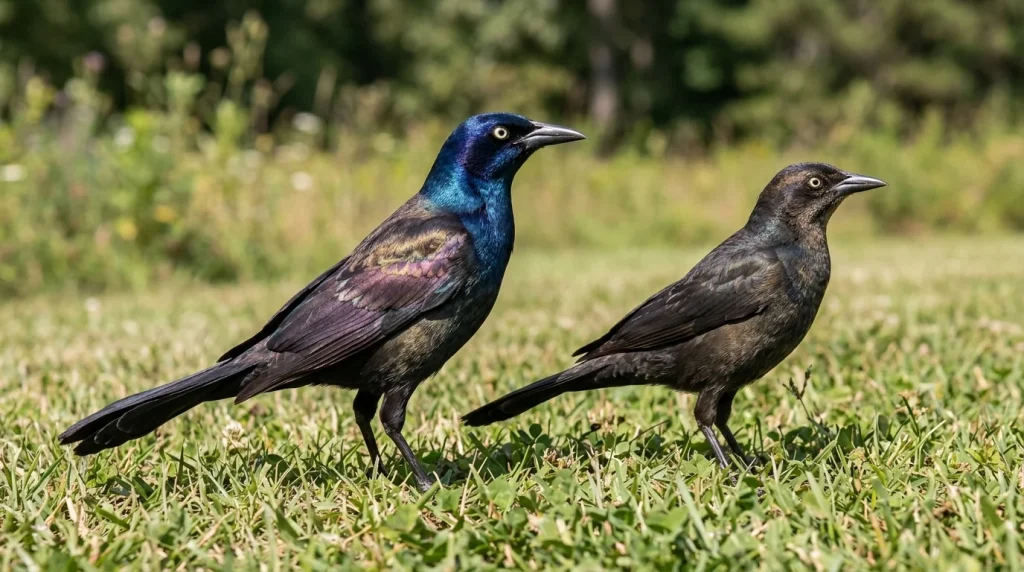
- Female is slightly smaller and generally less glossy than the male
- Tail may appear folded into a shallow V or keel during flight
- Bill is longer and heavier than that of most other blackbirds
- Flight is direct, with strong wingbeats interrupted by short glides
- Voice includes harsh clacks, squeaks, whistles, and metallic notes
Appearance
Adult male Common Grackles have glossy dark plumage, but their exact appearance changes with light and viewing angle. The head commonly reflects deep blue or violet, while the body may look purple, green, or bronze. Birds associated with the “Bronzed Grackle” form tend to show a bronzy body contrasting with a blue-purple head. More easterly birds may appear purple or blue-green over much of the body. These are geographic plumage tendencies within the Common Grackle rather than reliably separable species.
Adult females have the same general shape and pale eye but are usually smaller, less strongly iridescent, and somewhat duller. Sex can be difficult to judge without direct comparison. Both sexes have long legs, a relatively flat crown, a substantial tapered bill, and a long, graduated tail.
Juveniles are much easier to distinguish from adults. A newly fledged Common Grackle is brownish overall, with little or no iridescence and a dark eye. As immature birds molt, they gradually acquire darker feathers and the characteristic pale adult iris.
Size and Wingspan
Common Grackles are typically 28–34 cm (11–13.4 in) long, with a wingspan of about 36–46 cm (14.2–18.1 in). Their long tail accounts for a substantial part of the total length. Males average larger and heavier than females, although overlap occurs.
They are noticeably larger and longer-tailed than Red-winged Blackbirds, Brewer’s Blackbirds, and European Starlings. They are smaller and less massive than American Crows. Compared with the closely related Great-tailed and Boat-tailed Grackles, the Common Grackle usually has a shorter, less dramatically flared tail.
Range and Distribution
The species occurs widely across central and eastern North America. Its breeding range extends through much of southern and central Canada and across the eastern two-thirds of the United States, reaching west into portions of the Great Plains and Rocky Mountain region.
Common Grackles are year-round residents in many central, eastern, and southeastern areas. Birds breeding in Canada and the northern United States are more strongly migratory, moving south during autumn and returning in spring. Winter flocks can become especially numerous in the southeastern United States. Distribution varies locally, and the species is uncommon or absent across much of the far West.

Habitat
Common Grackles use open or partly open landscapes that provide both feeding areas and trees or shrubs for nesting and roosting. Typical settings include suburban neighborhoods, city parks, cemeteries, agricultural fields, feedlots, orchards, woodland edges, marsh borders, stream corridors, and lakeshores.
They generally avoid the interiors of extensive, unbroken forests. Human-modified landscapes often suit them because lawns and fields offer accessible food while ornamental conifers, shelterbelts, and mature shade trees provide nest sites. Large communal roosts may form in woodlots, reed beds, or planted trees.

Behavior
On the ground, Common Grackles walk with deliberate steps rather than making the two-footed hops typical of many smaller songbirds. They probe grass, flip leaves, inspect shallow water, and search around parked cars, picnic areas, farm buildings, or livestock facilities.
Outside the nesting season, they are highly social. Flocks may contain hundreds or thousands of grackles and can mix with Red-winged Blackbirds, Brown-headed Cowbirds, European Starlings, and other species. At evening roosts, streams of birds may arrive from several directions.
Breeding males perform a display in which they raise or spread the tail, partly open the wings, point the bill upward, and give a creaking song. Aggressive encounters may involve posturing, chasing, and bill-pointing. Despite their boldness around people, grackles normally move away when closely approached.
Diet and Hunting
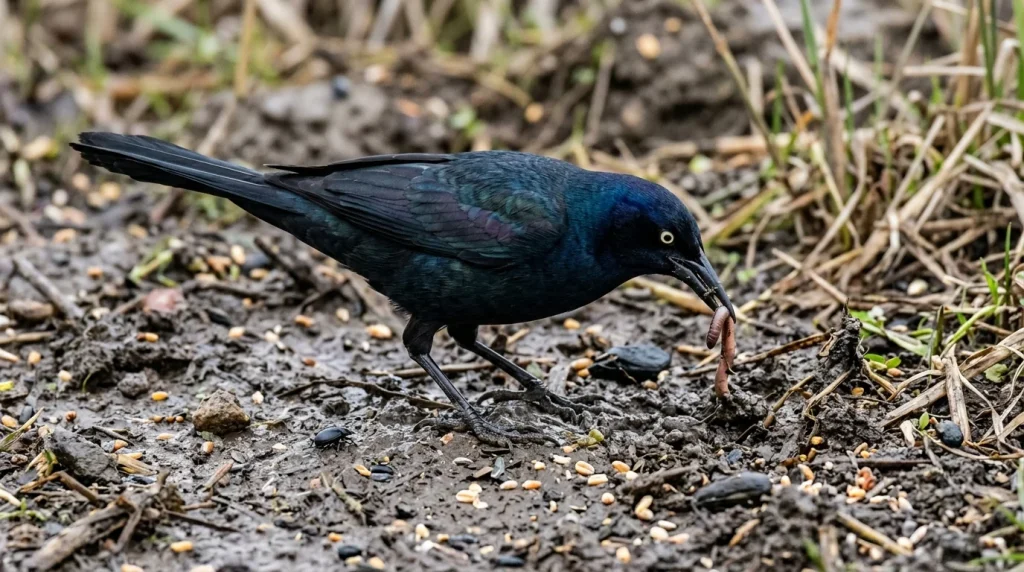
Common Grackles are opportunistic omnivores. Their diet includes beetles, grasshoppers, caterpillars, spiders, earthworms, aquatic insects, snails, crayfish, small fish, frogs, seeds, acorns, berries, and cultivated grain. Corn is especially attractive, and flocks sometimes forage in recently planted or harvested fields.
Most food is collected from the ground or shallow water. A grackle may probe soil, turn over debris, wade along a muddy edge, or pick insects from vegetation. Its sturdy bill can pry open or manipulate food. Individuals also visit bird feeders and eat discarded human food when available.
Grackles sometimes take bird eggs, nestlings, or small vertebrates, but these foods form only part of a broad and variable diet. Such predation is natural behavior and should not be assumed to be the main cause of every unsuccessful backyard nest.
Vocalizations
The Common Grackle’s song is short, harsh, and mechanical rather than melodious. It is often rendered as a rising squeak or creak followed by a metallic note, sometimes compared to a rusty gate. During display, the male may fluff his feathers and spread his wings and tail while singing.
Calls include deep chack notes, nasal whistles, rattles, and sharp alarm sounds. A large flock creates a complicated chorus of clicks, squeaks, and conversational clucking. Learning the abrupt, rough-edged quality of these sounds can help locate grackles before they come into view.
Breeding and Nesting
Breeding begins in spring, with timing varying by latitude. Common Grackles may nest as isolated pairs, loose colonies, or members of mixed blackbird colonies. The female generally selects the site and constructs a bulky cup of twigs, grasses, leaves, strips of bark, paper, and other available material. The interior is often reinforced with mud or decayed vegetation and lined with fine grass.
Nests are commonly placed in dense conifers, deciduous trees, shrubs, cattails, or human structures. Height varies considerably. A typical clutch contains four or five eggs, although smaller or larger clutches occur. The eggs are usually pale blue, greenish, grayish, or nearly white, marked with brown, black, or purple blotches and irregular scrawls.
The female performs most or all incubation, which typically lasts about two weeks. Both parents may bring food to the young, though their contributions can differ among pairs.

Young and Development
Hatchlings are helpless and sparsely covered with down. They grow rapidly on a protein-rich diet dominated by insects and other small animal prey. Nestlings generally leave the nest around two weeks after hatching, before their flight and foraging skills are fully developed.
A recently fledged grackle may sit low in a shrub or on the ground while calling for its parents. Unless it is injured or in immediate danger, it usually does not need rescuing. Adults continue feeding and guarding fledglings as they gain strength. Young birds retain brown plumage and dark eyes for a period before developing the glossy feathers and pale eyes of adults.
Where to See
Good places to look include large lawns, parking-lot edges, athletic fields, farms, lakeshores, wetland margins, and neighborhoods with mature trees. In spring, watch treetops and utility lines for displaying males. Grackles often feed below seed-bearing trees or beneath bird feeders.
During migration and winter, check agricultural fields in the late afternoon. Flocks often travel toward communal roosts near sunset, and their steady flight lines may reveal where large numbers are gathering. Scanning mixed blackbird flocks carefully is often more productive than searching for isolated individuals.
Similar Species
Brewer’s Blackbird: The male also has a pale eye and glossy plumage, but it is smaller, shorter-tailed, and more compact, with a finer bill. Female Brewer’s Blackbirds are brownish rather than glossy black.
European Starling: Starlings have shorter tails, pointed triangular wings, pinkish or reddish legs, and a straight yellow bill during the breeding season. In winter, their plumage is heavily spotted. Their flight is quicker and more compact.
Rusty Blackbird: This declining wetland blackbird is smaller and shorter-tailed. Breeding males are dark with pale eyes, while winter birds show rusty feather edging. Rusty Blackbirds favor wooded swamps and wet forest floors more consistently than Common Grackles.
Boat-tailed and Great-tailed Grackles: Both are generally larger and have exceptionally long tails, especially the males. Boat-tailed Grackles are strongly associated with coastal marshes in the East and Gulf region. Great-tailed Grackles are widespread in the South and West and have expanded into some areas where Common Grackles also occur. Range, voice, tail proportions, and female plumage should all be considered.
American Crow: A crow is substantially larger, with broader wings, a thicker neck, a heavier bill, and a fan-shaped rather than keel-shaped tail. It lacks the adult grackle’s pale eye and vivid iridescent color pattern.
Conservation
The Common Grackle is commonly classified as Least Concern on the IUCN Red List because it remains widespread and numerous. Nevertheless, long-term monitoring indicates a substantial population decline over recent decades. A familiar bird can still experience serious losses even while remaining locally abundant.
Possible pressures include changes in agricultural practices, habitat alteration, pesticide exposure, and direct control where large flocks are considered agricultural or roosting nuisances. Maintaining diverse native vegetation, reducing unnecessary pesticide use, and protecting wetlands and roost sites can benefit grackles and many other birds.
Field Identification Tips
- Start with structure: look for a long body, heavy bill, long legs, and an unusually long tail.
- Check the eye. Adults usually show a striking pale iris; juveniles have dark eyes.
- Do not rely on color alone. Iridescence changes dramatically with sunlight and viewing angle.
- Watch the tail in flight. A folded, keel-like or shallow V shape is a useful clue.
- Compare size within mixed flocks; Common Grackles are larger than most accompanying blackbirds and starlings.
- Use habitat and range cautiously, especially where Common, Great-tailed, and Boat-tailed Grackles overlap.
- Listen for short, creaking, metallic songs rather than the musical phrases expected from many songbirds.
Frequently Asked Questions
Are Common Grackles crows?
No. Common Grackles belong to the blackbird family, Icteridae, while crows belong to Corvidae. Grackles are smaller, slimmer, longer-tailed, and typically show pale eyes and strongly iridescent plumage.
Why do Common Grackles look blue, green, or purple?
Their feathers have microscopic structures that reflect light, producing iridescent colors. The visible hue changes with lighting, feather wear, viewing angle, sex, and geographic variation. In shade, the same bird may look nearly black.
Do Common Grackles migrate?
Many do. Northern populations generally move south for winter, while birds in milder parts of the range may remain throughout the year. Migration often occurs in large mixed-species flocks.
Are grackles harmful to other backyard birds?
Grackles may compete at feeders and occasionally take eggs or nestlings, but they are native omnivores performing normal ecological roles. Feeder crowding can be reduced with cage-style feeders, shorter perches, and careful cleanup of spilled seed.
How can I identify a juvenile Common Grackle?
Look for the adult’s long-tailed shape combined with plain brown plumage and a dark eye. Juveniles may appear softer and less sleek than adults and are often seen following parents while begging for food.


