Chokecherry Guide
Keep Track of What You See
Create a free Wild Things Guide membership to record this Chokecherry in My Sightings and build your personal wildlife list.
Join to Add This SightingTree Name
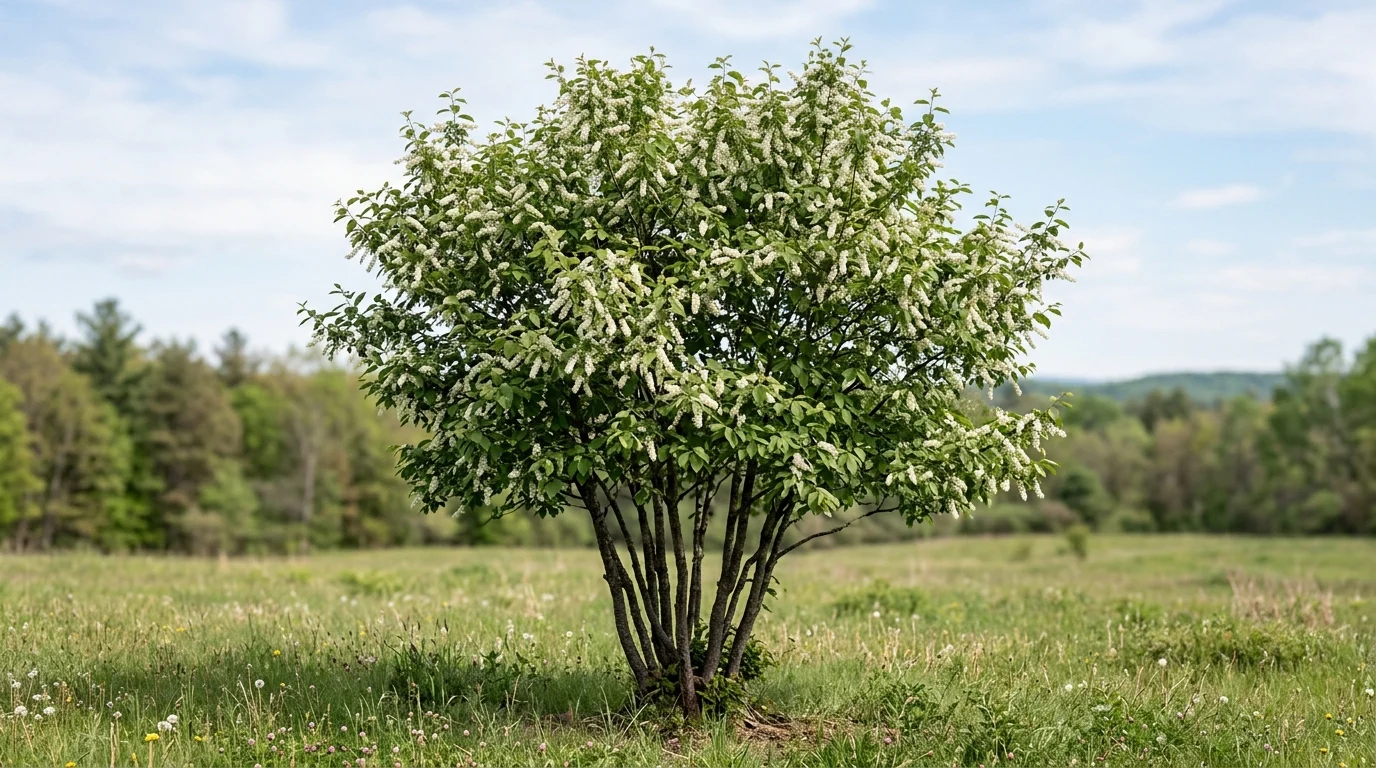
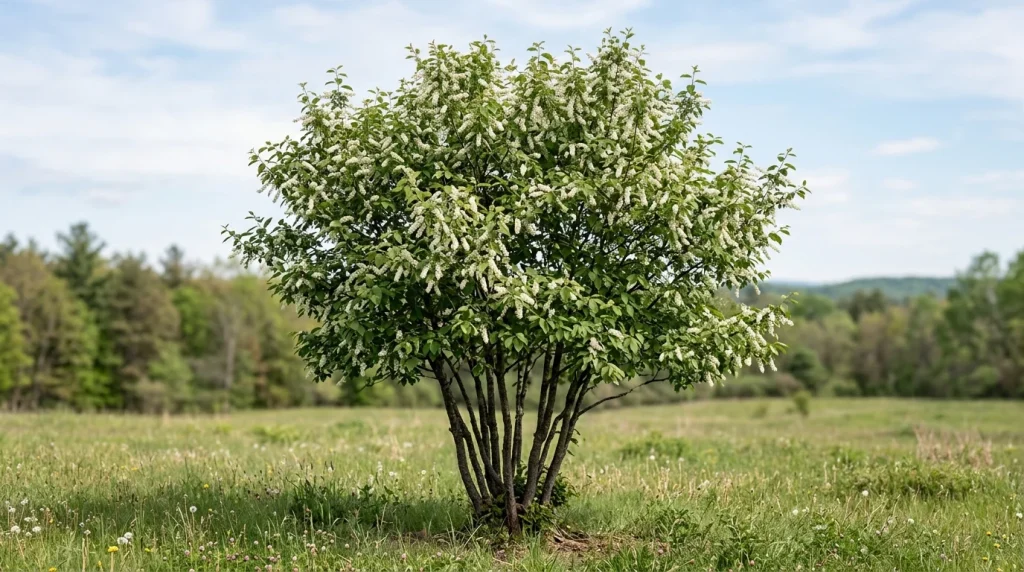
Chokecherry (Prunus virginiana) is a native North American shrub or small tree in the rose family (Rosaceae). It often forms thickets rather than a single, conspicuous trunk. Look for it along woodland edges, streams, roadsides, and old fields, where its white spring flower clusters and summer cherries attract attention. The common name describes thefruit’s puckering astringency, especially before it is fully ripe.
Quick Identification
- Habit: Usually a large, suckering shrub or small tree, about 10–25 feet (3–8 m) tall; occasionally taller.
- Leaves: Alternate, simple, broadly oval to egg-shaped, with a pointed tip and finely toothed edges.
- Flowers: Numerous small white flowers arranged along elongated, cylindrical clusters called racemes.
- Fruit: Pea-sized cherries in hanging clusters, changing from green through red to dark purple or nearly black.
- Bark: Young stems are smooth, reddish-brown to gray-brown, with pale horizontal lenticels.
- Best combination: Broad, finely toothed leaves plus elongated cherry clusters on a thicket-forming plant.
Do not identify chokecherry from fruit color alone. Several unrelated shrubs produce dark fruit, and some cherries closely resemble it.
Appearance
Open-grown chokecherry usually has a rounded or irregular crown, often spreading 10–20 feet (3–6 m). Crowded stems grow more upright. Shoots arising from the roots can expand into dense patches, so what looks like a group of separate shrubs may be one connected colony.
Leaves are commonly 2–4 inches (5–10 cm) long, sometimes larger on vigorous shoots. They are generally broader than black cherry leaves, with the widest portion near the middle or toward the outer half. The upper surface is green; the underside is paler. Fine, sharp teeth line the margin. Small glands often occur near the upper end of the leaf stalk.
Leaf shape and hairiness vary geographically. Some western plants have noticeably hairy leaf undersides. Purple-leaved landscape selections, including plants sold as ‘Canada Red’ or ‘Schubert’, can look quite different from ordinary green-leaved wild plants.

Bark, Twigs, and Buds
Young bark is relatively smooth, with conspicuous lenticels—the small pores that often appear as pale horizontal dashes. Older trunks become darker and may develop shallow fissures or irregular scales. Chokecherry generally lacks the strongly developed, dark, flaky plates characteristic of a mature black cherry.
Twigs are slender and brown to reddish brown. Winter buds are alternate, pointed, and covered with overlapping scales. Together with the lenticels and clustered growth habit, these features help narrow a winter identification, although they do not prove the species by themselves.
Damaged cherry twigs may release an almond-like odor, but smell is not a dependable safety test. Do not taste bark, buds, or twigs. Chokecherry tissues contain cyanogenic compounds that can release hydrogen cyanide when damaged or digested.

Range and Habitat
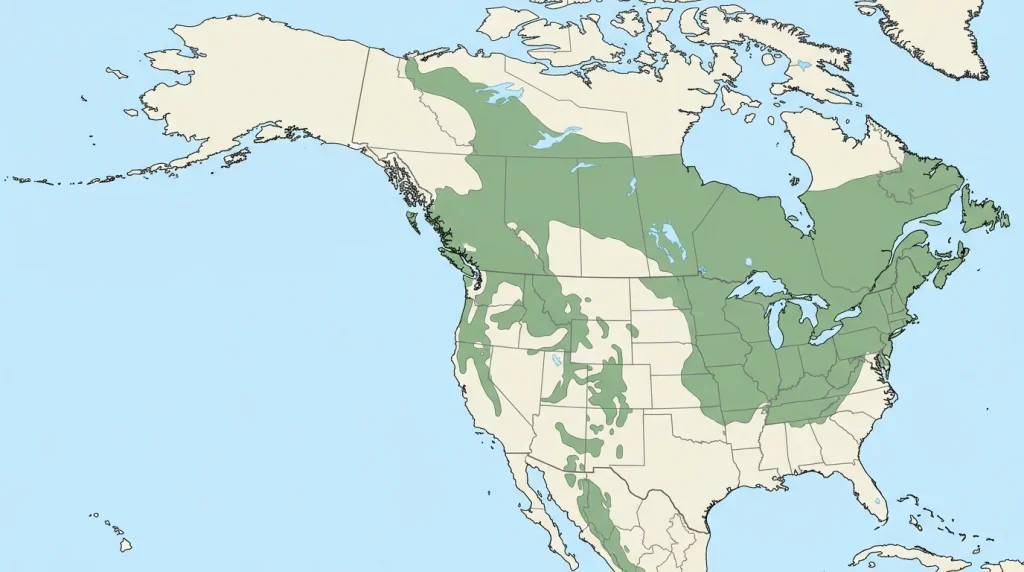
Chokecherry has a broad native range across much of Canada and the contiguous United States, extending through western mountain regions into northern Mexico. It is especially familiar in northern and interior landscapes. It is not equally common throughout that range and is scarce or absent across much of the southeastern coastal plain.
Typical habitats include streambanks, ravines, open woods, forest margins, rocky slopes, prairie draws, and disturbed ground. It tolerates many soil textures but generally performs best where drainage is adequate and some moisture is available. Flowering and fruiting are usually strongest in sun, although plants also grow in partial shade.
Its ability to resprout helps it persist after cutting and some other disturbances. A roadside thicket may therefore represent years of repeated regrowth rather than newly established seedlings.
Flowers, Fruit, Nuts, or Cones
Chokecherry blooms after the leaves begin opening, usually in spring to early summer depending on latitude and elevation. Each flower has five white petals and numerous stamens. Many flowers attach by short stalks to a central axis, producing clusters commonly about 3–6 inches (8–15 cm) long.
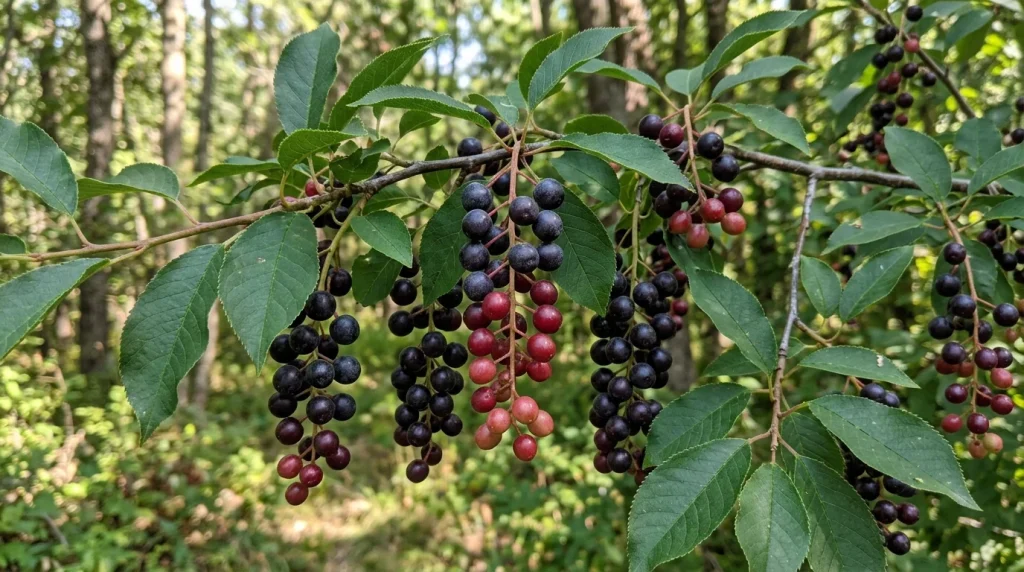
The fruit is a drupe, not a botanical berry: a thin layer of flesh surrounds one hard stone containing the seed. Individual cherries are usually about ¼–⅜ inch (6–10 mm) across. They ripen in summer or early fall, with timing varying considerably across the range.
Ripe fruit is commonly dark purple or almost black, although color varies among plants. Red fruit may be immature, but color alone cannot establish ripeness or identity. Clusters may carry a mixture of colors as the cherries develop.
Wildlife Connections
Chokecherry supplies food and structure to many animals. Robins, waxwings, thrushes, and other fruit-eating birds consume the cherries and disperse the stones. Bears and smaller mammals also eat the fruit where their ranges overlap with the plant.
The flowers attract bees, flies, and other insect visitors. The foliage supports caterpillars and other herbivorous insects, which in turn feed birds. Dense colonies offer nesting cover and sheltered travel routes for small animals.
Wildlife use does not mean every part is safe for people or livestock. Wilted, frost-damaged, or cut foliage can present a serious poisoning hazard to grazing animals. Keep pruning debris away from pastures, and seek veterinary help promptly if you suspect exposure.
Seasonal Identification
- Spring: Look for unfolding alternate leaves followed by elongated white flower clusters. Chokecherry flowers are not arranged in the compact bundles typical of pin cherry.
- Summer: Examine mature leaf shape, fine teeth, and fruit attached along a shared central stalk. Check several leaves, not just one unusually vigorous shoot.
- Fall: Leaves usually turn yellow, sometimes with orange or reddish tones. Remaining fruit clusters and root suckers can support identification.
- Winter: Look for slender alternate-budded twigs, horizontal lenticels, and multiple stems. Without leaves or fruit, identification may remain tentative.

Human Uses and History
Many Indigenous peoples across North America have longstanding food traditions involving chokecherry. Methods differ among communities and include drying fruit, making cakes, and combining prepared cherries with other foods. Some traditional methods involve crushing whole fruits and specialized processing; they should not be reduced to improvised kitchen instructions.
Today, people commonly use chokecherries for jelly, syrup, sauces, and preserves. Their tartness and astringency usually make them more appealing after preparation than eaten fresh. Use only positively identified fruit and a tested recipe that separates the stones without crushing them.
Safety: The seed inside the stone, as well as leaves, twigs, and bark, contains cyanogenic compounds. Do not chew or grind the stones, and do not assume ordinary cooking makes all plant parts safe. Keep unfamiliar fruit and discarded pits away from young children and pets.
In landscapes, chokecherry can provide seasonal flowers, wildlife habitat, and informal screening. Its suckering habit makes it better suited to naturalized areas than tight spaces beside paving.
Conservation and Threats
Chokecherry remains widespread and is not generally considered a conservation concern across its overall range. Individual populations can nevertheless be affected by clearing, heavy browsing, altered stream conditions, or repeated removal of shrub habitat.
Black knot is a conspicuous disease of chokecherry and other Prunus species. It produces elongated, rough black swellings on branches. These are fungal growths, not normal bark features. The University of Minnesota Extension’s black knot guide explains identification and management, including appropriate pruning practices.
Tent caterpillars, leaf spots, and other pests may also occur. Diagnose the problem before treating it; a native shrub supporting insects does not automatically require spraying. For planting projects, locally appropriate stock and room for suckering usually improve long-term results.
Similar Species
- Black cherry (Prunus serotina): Often becomes much larger. Its leaves are usually narrower and may have rusty hairs along the underside of the midrib near the base. Mature bark forms distinctive dark, flaky plates. Young plants require closer comparison.
- Pin cherry (Prunus pensylvanica): Typically has narrow, long-pointed leaves and bright red ripe fruit. Its flowers and cherries occur in small, umbrella-like groups rather than elongated chokecherry racemes.
- European bird cherry (Prunus padus): An introduced tree with similar elongated flower clusters. Leaf details, flower structure, and local distribution may be needed; consult a regional key where both occur.
- Common buckthorn (Rhamnus cathartica): Produces dark fruit but lacks showy white racemes. Leaves often have strongly curving veins, and twigs may end in a short spine. Fruits contain several seeds rather than one cherry stone.

Interesting Facts
A chokecherry thicket can outlast its individual stems because new shoots continually replace older growth. As a result, assigning an age to the entire patch is difficult. Individual stems are relatively short-lived compared with large forest trees.
The name “chokecherry ” refers to the mouth-drying sensation caused largely by astringent compounds in the flesh; that sensation is distinct from the toxicity concern associated with cyanogenic plant tissues.
Botanists recognize geographic variation within the species, but treatments of its varieties differ. A regional flora is more useful than leaf color alone for interpreting those differences.
Frequently Asked Questions
Is chokecherry a tree or a shrub?
Both descriptions are appropriate. It commonly grows as a multistemmed shrub but can develop into a small tree, especially when trained or growing under favorable conditions.
How fast does chokecherry grow?
Established plants may add roughly 1–2 feet (30–60 cm) in height annually under favorable conditions. Dry soil, shade, browsing, and climate can reduce growth; vigorous suckers may grow faster.
Are chokecherries the same as chokeberries?
No. Chokeberries belong to Aronia. Their fruits contain several small seeds, while chokecherry fruit contains one hard stone. Similar common names do not mean they are interchangeable in identification or preparation.
Will one plant produce fruit?
A single plant may fruit, but production varies with pollination, weather, and plant condition. Nearby genetically different chokecherries can increase opportunities for cross-pollination; root suckers from one colony are not necessarily genetically different individuals.