Chipping Sparrow Guide
Keep Track of What You See
Create a free Wild Things Guide membership to record this Chipping Sparrow in My Sightings and build your personal wildlife list.
Join to Add This SightingIntroduction
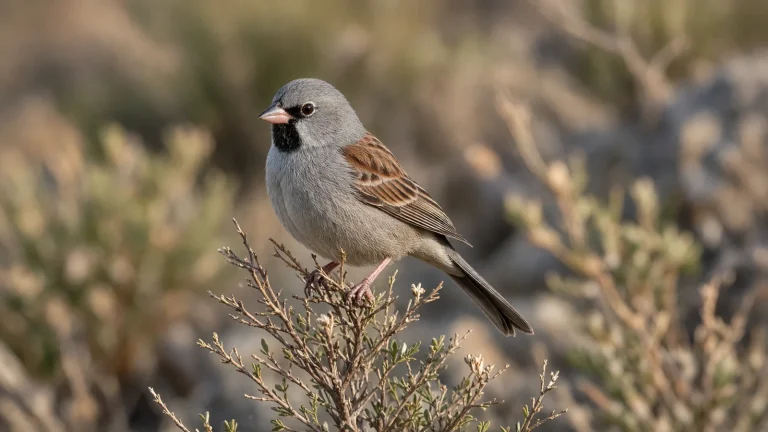
The Chipping Sparrow (Spizella passerina) is a small, trim North American songbird often found in open woods, parks, gardens, campgrounds, and suburban neighborhoods. Its sharp markings and preference for visible perches can make breeding adults relatively easy to identify. The bright rusty crown, white eyebrow, and narrow black line through the eye create a crisp facial pattern unlike that of most similar sparrows.
Identification becomes more challenging in fall and winter, when the crown is streaked rather than solid and the facial pattern looks subdued. Juveniles are streaked below and may bear little resemblance to adults. Season, location, voice, posture, and habitat are therefore important for confident identification.

Quick Identification
- Overall shape: Small, slender Sparrow with a rounded head, fairly long notched tail, and short conical bill.
- Breeding adult: Bright rusty crown, white eyebrow, black eye-line, gray face and nape, and plain pale underparts.
- Nonbreeding adult: Brown-streaked crown, weaker eye-line, and warmer buff tones on the face and breast.
- Back: Brown with dark streaks; the wings show two pale bars.
- Bill: Dark in the breeding season, often becoming pinkish or two-toned outside it.
- Voice: A long, dry, mechanically even trill; call is a sharp chip.
- Typical setting: Open ground near scattered trees, especially conifers.
Appearance
In fresh breeding plumage, an adult Chipping Sparrow has a rich rufous or chestnut crown that usually appears solid at normal viewing distance. A clean white supercilium runs above a narrow black eye-line, while the cheek, nape, and much of the face are gray. The throat and underparts are pale gray to whitish and normally lack strong streaking. The back is brown with blackish streaks, and the wings have two narrow pale wing bars.
Males and females are very similar. Males may average more strongly marked during the breeding season, but plumage alone generally does not allow reliable sexing in the field.
After the late-summer molt, adults look less sharply patterned. The crown becomes brownish and streaked, the eyebrow may be buff rather than white, and the black eye-line is less bold. A dark line may still extend through or behind the eye. Juveniles have heavy brown streaking across the breast and flanks, a streaked crown, and a less distinctive face. Their compact shape, wing bars, and association with adults can help establish their identity.

Size and Wingspan
Chipping Sparrows are among the smaller familiar North American sparrows. Adults are typically about 4.7–5.9 inches (12–15 centimeters) long, with a wingspan near 8.3 inches (21 centimeters). They usually weigh roughly 0.4–0.6 ounces (11–16 grams), although condition and season affect body mass.
They are noticeably smaller and more delicate than a White-crowned Sparrow or Song Sparrow. Compared with an American Tree Sparrow, a Chipping Sparrow often looks slimmer, with a smaller bill and a cleaner breast.
Range and Distribution
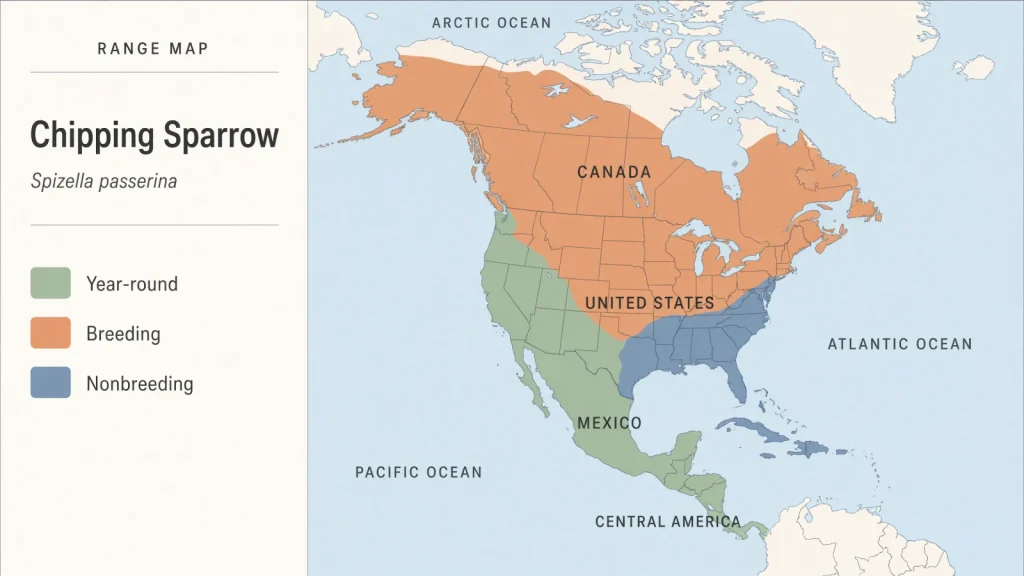
The species occurs across much of North America. Its breeding range extends from Alaska and much of Canada south through most of the contiguous United States, with populations also breeding in parts of Mexico and Central America. Northern and interior populations are migratory. They move into the southern United States, Mexico, and Central America for winter, while some southern populations remain in the same broad region year-round.
Spring arrival varies with latitude, generally occurring earlier in the southern United States and later across Canada and the northern states. Fall migration can produce loose flocks in weedy fields, woodland edges, and other seed-rich places. The Cornell Lab of Ornithology’s Chipping Sparrow account provides additional range and seasonal information.
Habitat
Chipping Sparrows favor open or broken woodland rather than dense forest. Common habitats include pine groves, woodland clearings, forest edges, orchards, shelterbelts, cemeteries, golf courses, parks, gardens, and residential areas with lawns and scattered trees. Conifers are frequently used for singing, shelter, and nesting, but deciduous shrubs and small trees are also suitable.
Good habitat usually combines open ground for feeding with nearby woody cover. The species often benefits from moderately landscaped environments, although heavily paved areas and lawns without seed-producing vegetation offer fewer resources.

Behavior
On the ground, Chipping Sparrows forage with quick hops, pausing to inspect bare soil, short grass, leaf litter, or low plants. They frequently fly to a fence, branch, or treetop when disturbed. Their flight is direct and lightly undulating, with bursts of rapid wingbeats.
Breeding birds are territorial, and males sing persistently from exposed perches. Outside the nesting season, territorial behavior relaxes, and the sparrows may gather in flocks. They sometimes mix with juncos, American Tree Sparrows, Field Sparrows, or other seed-eating birds. Flocks often feed quietly on the ground and retreat together into shrubs when alarmed.
Diet
The diet changes with season and food availability:
- Seeds: Grass seeds, weed seeds, and small grains are especially important outside the breeding season.
- Insects: Caterpillars, beetles, grasshoppers, leafhoppers, and other small invertebrates become more important in spring and summer.
- Nestling food: Young are fed mostly insects and other soft-bodied invertebrates, which provide protein and moisture.
Chipping Sparrows may visit feeding stations for small seeds, particularly millet scattered on or close to the ground. Native grasses, seed-bearing plants, brushy cover, and reduced pesticide use can make a yard more useful than feeders alone.

Vocalizations
Themale’ss song is a rapid series of nearly identical notes delivered as one prolonged, dry trill. It often sounds mechanical, with little change in speed or pitch. Songs may last several seconds and are commonly given from the upper branches of a conifer or another prominent perch.
The ordinary call is a sharp, dry chip, which likely contributed to the bird’s English name. Birds also use thin, high notes and agitated calls around a nest or predator. Voice is especially valuable in spring because other small sparrows may have similarly brown upperparts but very different song patterns.
Breeding and Nesting
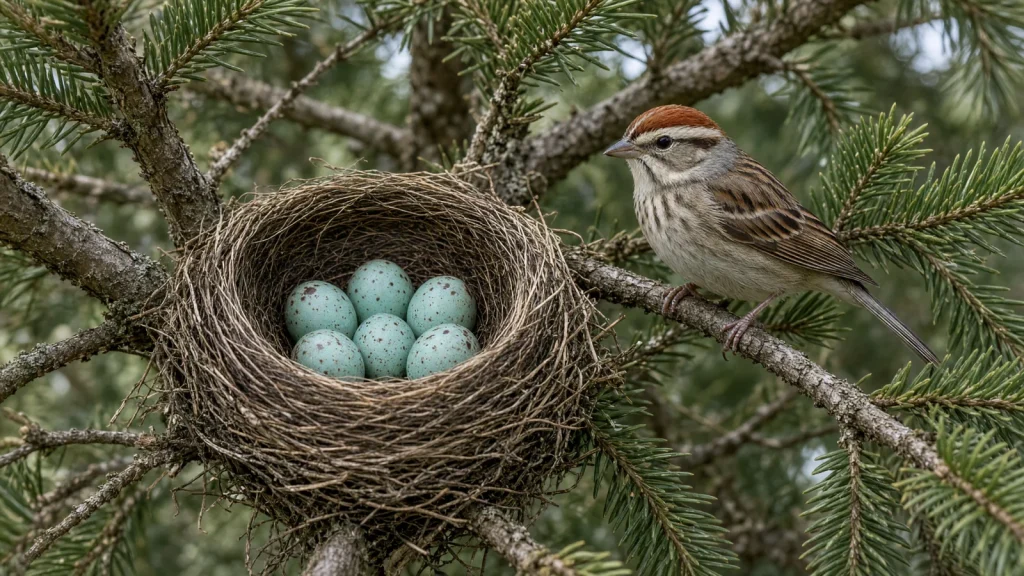
Pairs form after arrival on the breeding grounds. The female selects the nest site and does most or all of the construction while the male defends the territory. The nest is a compact open cup, typically placed on a horizontal branch or close to the trunk of a small conifer, shrub, or young deciduous tree. Some nests are only a few feet above the ground, although placement varies.
Fine grasses and plant stems form the outer structure. The lining often contains rootlets, fine fibers, and animal hair. Historically, the frequent use of horsehair led to the regional nickname “hairbird.”
A clutch commonly contains three or four eggs, though smaller or larger clutches occur. Eggs are pale blue to greenish blue with dark brown, purplish, or blackish spotting, often concentrated toward the larger end. Incubation is performed mainly by the female and lasts roughly 10–12 days. In favorable conditions, particularly toward the southern part of the range, a pair may attempt more than one brood.
Young and Development
Hatchlings are helpless and sparsely covered with down. Both parents bring insects to the nest, making frequent feeding trips during the rapid nestling period. Young usually leave the nest about 9–12 days after hatching, sometimes before they can fly strongly.
Recently fledged birds remain in nearby vegetation and continue to receive food from the adults. Their streaked underparts can be confused with other juvenile sparrows. Over the following weeks, they become more independent and acquire a plainer-breasted plumage. Family groups may later join larger flocks before migration.
Where to See
Look for Chipping Sparrows wherever short vegetation meets scattered trees. Productive locations include open pine woods, park edges, campgrounds, tree-lined farms, cemeteries, school grounds, and quiet residential neighborhoods. In spring, listen from late morning onward for a steady trill coming from high in a tree.
During migration and winter, search weedy field margins, brushy edges, and open woodland floors. Scan the ground first, then check nearby fences and low branches where flushed birds may perch. A small seed feeder or ground-feeding area can attract them, but natural seed patches often hold larger groups.
Similar Species
- American Tree Sparrow: Usually has a rusty eye-line, two-toned bill, and a dark central breast spot. It lacks the Chipping Sparrow’s bold black eye-line and is primarily a winter visitor across much of the United States.
- Clay-colored Sparrow: Has a buffier face, pale central crown stripe, distinct cheek pattern, and gray nape. Its buzzy song is unlike the Chipping Sparrow’s clean trill.
- Brewer’s Sparrow: Typically appears pale and finely streaked, with a less contrasting face and no bright solid crown. Range and dry sagebrush habitat are useful clues.
- Field Sparrow: Shows a pink bill, prominent pale eye-ring, warmer unmarked face, and less distinct eye-line. Its musical, accelerating song differs markedly.
- Dark-eyed Junco: Can give a similar trill, but most forms are larger and lack the Chipping Sparrow’s rusty-crowned facial pattern. Juncos also flash white outer tail feathers in flight.
- Pine Warbler: Its trill may sound similar, but the bird is yellowish, has a thin warbler bill, and usually forages among branches rather than on open ground.
Conservation
The Chipping Sparrow is commonly classified as Least Concern and remains widespread. Nevertheless, broad-scale monitoring has indicated long-term declines in parts of its range. Trends vary by region, and local abundance can change with land use, severe weather, pesticide exposure, and habitat management.
Maintaining open woodland, scattered trees, native seed-producing plants, and insect-rich nesting habitat can support the species. Keep cats indoors or otherwise prevent them from hunting birds, especially during the fledging season. Avoiding insecticides around active nests also helps preserve the invertebrate prey young need to grow.
Field Identification Tips
- Start with the face: In spring and summer, look for a rusty crown, white eyebrow, and thin black eye-line.
- Check the breast: Adult Chipping Sparrows have plain pale underparts. Strong streaking suggests a juvenile or another species.
- Assess the bill: A small bill fits Chipping Sparrow; a larger, bicolored bill may point toward American Tree Sparrow.
- Use season: A crisp rusty-crowned bird is expected during breeding, while winter birds are duller and more streaked on the crown.
- Listen for regularity: The song is fast and unusually even, without the accelerating rhythm of a Field Sparrow.
- Consider habitat: Open woods, lawns with scattered conifers, parks, and campgrounds are characteristic settings.
- Photograph multiple angles: Images showing the crown, face, breast, bill, and wing bars are more useful than a single rear view.
Frequently Asked Questions
Do male and female Chipping Sparrows look different?
They are very similar. A male may appear somewhat more crisply patterned in breeding condition, but sex usually cannot be established safely from a normal field view.
Do Chipping Sparrows visit feeders?
Yes. They may eat millet and other small seeds, usually on the ground or on low platform feeders. Nearby shrubs or trees provide important escape cover.
Why does a Chipping Sparrow sometimes have a streaked breast?
Juveniles are streaked below. Adults ordinarily have plain underparts, although worn feathers, shadows, or overlapping flank feathers can create misleading impressions.
Are Chipping Sparrows present all year?
That depends on location. Northern populations generally migrate, while birds in parts of the southern United States, Mexico, and Central America may be present year-round or replaced seasonally by migrants.
How can the song be separated from a junco or Pine Warbler?
First, locate the singer visually. The Chipping Sparrow’s trill is dry and mechanically even; junco songs are often more musical, while Pine Warblers sing from wooded canopies and show yellowish warbler plumage.