Black-chinned Sparrow Guide
Keep Track of What You See
Create a free Wild Things Guide membership to record this Black-chinned Sparrow in My Sightings and build your personal wildlife list.
Join to Add This SightingIntroduction
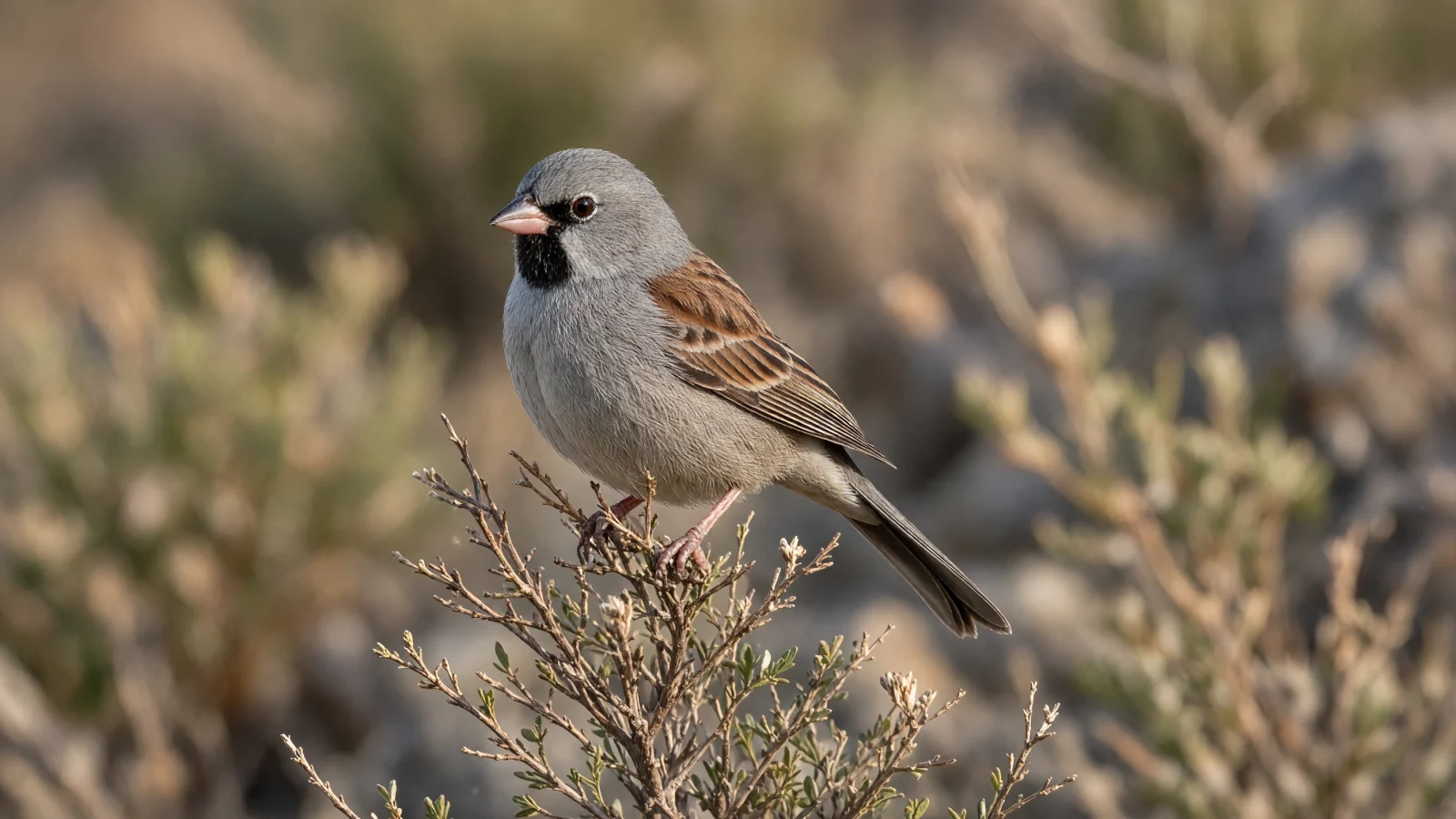
The Black-chinned Sparrow (Spizella atrogularis) is a slender, long-tailed Sparrow of dry slopes, open chaparral, and brushy mountain country in the southwestern United States and Mexico. A breeding male can look remarkably crisp: a pink bill, smooth gray head and underparts, rusty streaked back, and a sharply contrasting black chin and face.
Females, immature birds, and adults outside the breeding season are subtler. Their reduced black markings can make them resemble other small, gray-brown sparrows. Habitat, proportions, behavior, and voice therefore become especially important. The species is often easier to hear than to see because males sing from prominent shrub tops while foraging birds remain close to the ground.

Quick Identification
- Overall shape: Small, slim Sparrow with a rounded head and relatively long, narrow tail.
- Bill: Small, conical, and usually pinkish or flesh-colored.
- Breeding male: Gray head and underparts, black chin and face, and warm brown back with dark streaks.
- Female and nonbreeding adult: Duller gray-brown, with a reduced or indistinct black chin.
- Behavior: Forages low in shrubs or on the ground; singing males use exposed perches.
- Voice: A series of clear notes that accelerates into a rapid, musical trill.
- Habitat: Arid or semiarid brush, chaparral, sagebrush, and rocky mountain slopes.
Appearance
In breeding plumage, the adult male is distinctive. The head, nape, breast, and belly are largely smooth gray. Black covers the chin and central throat and may extend onto the face around the bill. The pale pink bill provides an obvious contrast. The back is rusty brown with dark streaking, while the wings are brown with subdued pale edging rather than bold wing bars.
The tail is dark, fairly long, and often held slightly raised. Unlike some desert sparrows, the bird lacks strong white outer tail feathers or a bold facial pattern. Its plumage can look surprisingly plain when posture or shadow hides the black chin.
Females generally have a browner or more muted head and less extensive black around the chin. Some show only a dusky smudge. Nonbreeding males may also appear duller because pale feather edges partly obscure the black. Juveniles are brownish and streaked below, temporarily lacking the clean gray appearance of adults.

Size and Wingspan
Black-chinned Sparrows are small and lightly built, broadly comparable in size to Chipping and Brewer’s Sparrows.
- Length: About 5.5–6 inches (14–15 centimeters)
- Wingspan: Approximately 8.5–9 inches (22–23 centimeters)
- Weight: Commonly around 0.3–0.5 ounces (9–15 grams)
Exact measurements vary among individuals. In the field, the long tail and slim body are usually more useful than an estimated length.
Range and Distribution
The Black-chinned Sparrow occurs primarily in the southwestern United States and Mexico. In the United States, its breeding distribution includes portions of California, Nevada, Utah, Arizona, New Mexico, and western Texas. Distribution is patchy because deserts, valleys, forests, and developed land separate suitable brushy slopes.
Many northern populations are migratory or move seasonally to lower elevations. Wintering birds occur mainly in the southern part of the breeding range and in Mexico. Mexican populations extend through suitable uplands well beyond the United States border, and some may be resident or move locally with season and elevation.
Because abundance varies geographically and from year to year, current observations and the species account from the Cornell Lab of Ornithology can help birders assess seasonal occurrence.

Habitat
This Sparrow favors dry, open shrublands rather than dense forest or treeless desert. Typical settings include chaparral-covered hillsides, sagebrush, pinyon-juniper edges, desert mountain washes, and rocky slopes with scattered shrubs. It often occupies rugged terrain where bare ground, stones, or exposed rock break low vegetation.
Common plant associations vary by region and may include sagebrush, chamise, manzanita, mountain mahogany, rabbitbrush, mesquite, and other drought-tolerant shrubs. Breeding birds usually require enough woody cover for nesting and escape, together with open patches for ground feeding.
Behavior
Black-chinned Sparrows spend much of their time close to the ground. They hop between rocks, inspect leaf litter, and move through the lower branches of shrubs while searching for food. A bird may pause in the open briefly before disappearing into cover.
During the breeding season, males become much more visible. They sing from the top of a shrub, yucca, fence post, or other exposed perch and may return repeatedly to the same song station. Territorial chases can involve quick, direct flights between neighboring bushes.
Outside the breeding season, individuals may join small, loose groups or associate with other sparrows. Their flight is generally low and slightly undulating, often ending with a rapid drop into vegetation.

Diet
The diet changes with season and food availability. Seeds are particularly important outside the breeding season, while insects provide protein during spring and summer.
- Seeds of grasses and herbaceous plants
- Small seeds gathered from shrubs or the ground
- Beetles, caterpillars, grasshoppers, and other small insects
- Spiders and similar terrestrial invertebrates
Most food is taken from bare ground, litter, low foliage, or seed heads. Adults feed nestlings primarily small invertebrates, although the precise mixture varies with local conditions.

Vocalizations
The male’s song is one of the best ways to locate this otherwise inconspicuous Sparrow. A typical performance begins with several separated, high, clear notes. These notes become progressively faster and merge into a rapid trill. The effect is sometimes compared to a bouncing object accelerating toward a finish, although songs vary among individuals and regions.
Calls are much less conspicuous and may include a thin, high seep or short, sharp note. In windy chaparral, the introductory notes of the song may carry farther than the final trill. Listen from overlooks or quiet roads early in the morning, when males are most likely to sing repeatedly.
Breeding and Nesting
Breeding generally occurs in spring and summer, with timing influenced by latitude, elevation, rainfall, and plant growth. The male defends a territory through song and visible display from elevated perches.
The nest is a compact open cup placed in a low shrub or small tree, often concealed within dense twigs and foliage. It is constructed from dry grasses, plant stems, bark fibers, and similar material, with a finer inner lining. Placement above ground varies with the structure of available vegetation.
A typical clutch contains about three or four eggs. The eggs are pale bluish or greenish and marked with reddish-brown or darker spots, often concentrated toward the broader end. The female performs most or all incubation, while both parents are believed to contribute to feeding the young. Incubation and nestling periods are each roughly a couple of weeks, although reported timing can vary.

Young and Development
Nestlings hatch helpless, with limited down and closed or partly closed eyes. Their parents deliver frequent meals of small insects and other invertebrates. Rapid growth allows the young to leave the nest before they are fully independent or capable of sustained adult-like flight.
Recently fledged birds remain in protective shrub cover and continue to receive food from their parents. Their streaked underparts and brownish coloration differ from adults’ smooth gray plumage. As body feathers are replaced, young birds gradually acquire the plainer face and underparts characteristic of the species, though the adult male’s strong black chin develops later.
Where to See
Good places to search include brushy mountain roads, chaparral trails, canyon slopes, and open sagebrush with scattered taller perches. In the United States, birders regularly encounter the species in suitable uplands of southern and central California, southern Nevada, Utah, Arizona, New Mexico, and western Texas.
- Visit during spring or early summer, when males are singing.
- Begin shortly after sunrise, before wind and heat reduce activity.
- Scan the highest exposed twigs of shrubs after hearing the song.
- Search slopes with a mixture of mature shrubs and open rocky ground.
- Remain on established roads and trails in fragile desert vegetation.
The species can be locally common yet absent from apparently similar habitat nearby. Elevation, shrub composition, fire history, and seasonal movement all affect where it occurs.
Similar Species
- Brewer’s Sparrow: Smaller-billed and finely streaked on the crown, with a pale eye ring and no black chin. Its overall appearance is browner and more patterned.
- Chipping Sparrow: Breeding adults have a rusty crown, white or gray eyebrow, and dark eye line. Nonbreeding birds retain a more obvious facial pattern than Black-chinned Sparrows.
- Sagebrush Sparrow: Usually shows a bold pale eye ring, dark whisker stripe, and more strongly patterned face. It also tends to look heavier-bodied.
- Black-throated Sparrow: Has a much more extensive black throat and face, bold white facial stripes, and white in the outer tail. It favors hotter, more open desert scrub.
- Dark-eyed Junco: Larger and stockier, with obvious white outer tail feathers and generally a broader, paler bill.
Conservation
The Black-chinned Sparrow is commonly classified as Least Concern globally. Nevertheless, broad status categories do not mean that every population is stable. Population estimates are difficult because the species occupies rugged, patchily surveyed country and may shift locally in response to rainfall, fire, and vegetation changes.
Potential pressures include chaparral clearing or fragmentation, overly frequent wildfire, conversion to invasive annual grasses, energy development, and climate-related changes in shrub cover. Fire is a natural force in some occupied landscapes, but repeated burns at short intervals can prevent mature shrub communities from recovering. Protecting large, connected areas with varied slope, elevation, and shrub age is likely to benefit the species.
Field Identification Tips
- Start with shape. Look for a small, slim Sparrow with a noticeably long tail and rounded gray head.
- Check the bill. A pinkish, finely pointed conical bill is useful even when the chin is shaded.
- Look for contrast. On breeding males, the black chin and face stand out against an otherwise gray front.
- Study the back. Warm rusty-brown upperparts with dark streaks contrast with the smooth gray underparts.
- Use habitat. A gray Sparrow on a dry, shrub-covered mountain slope is a stronger candidate than one in a lawn, marsh, or dense woodland.
- Learn the song. Clear introductory notes accelerating into a trill often reveal a bird before it can be seen.
- Allow for season. Females, young birds, and nonbreeding males may show little obvious black and require a combination of characters.
Frequently Asked Questions
Why is it called a Black-chinned Sparrow?
The name refers to the dark chin and central throat of the breeding male. The black may be reduced, partly concealed, or absent-looking in females, immature birds, and adults in worn or nonbreeding plumage.
Is the Black-chinned Sparrow found at backyard feeders?
It is not a regular feeder bird. It normally occupies natural shrublands and gathers seeds from the ground or plants. A feeder near suitable southwestern habitat might attract a wandering individual, but such visits are uncommon.
Is it closely related to the Chipping Sparrow?
Yes. Both are members of the genus Spizella and share a small body, conical bill, and relatively long tail. Plumage, habitat, range, and vocalizations usually separate them in the field.
When is the easiest time to find one?
Spring and early summer are generally best in the United States. Territorial males sing from exposed perches, making them easier to locate than during winter or migration.
Does every Black-chinned Sparrow have a black chin?
No. The feature is strongest in adult breeding males. Females may have a dusky or limited patch, and juveniles are streaked and lack the clean adult pattern. Also consider voice, shape, habitat, bill color, and back pattern.