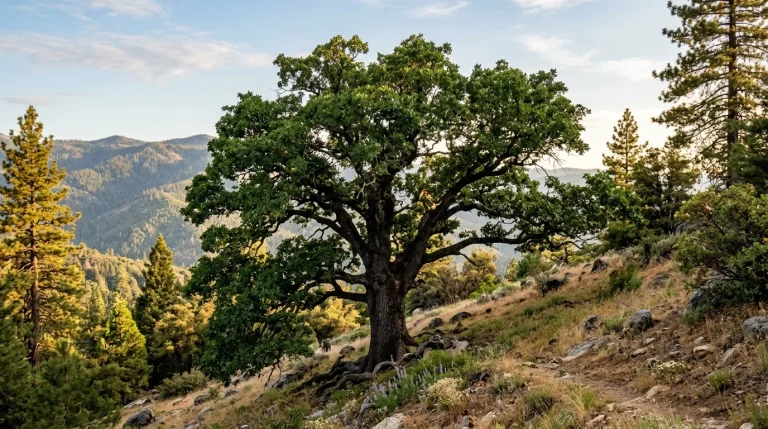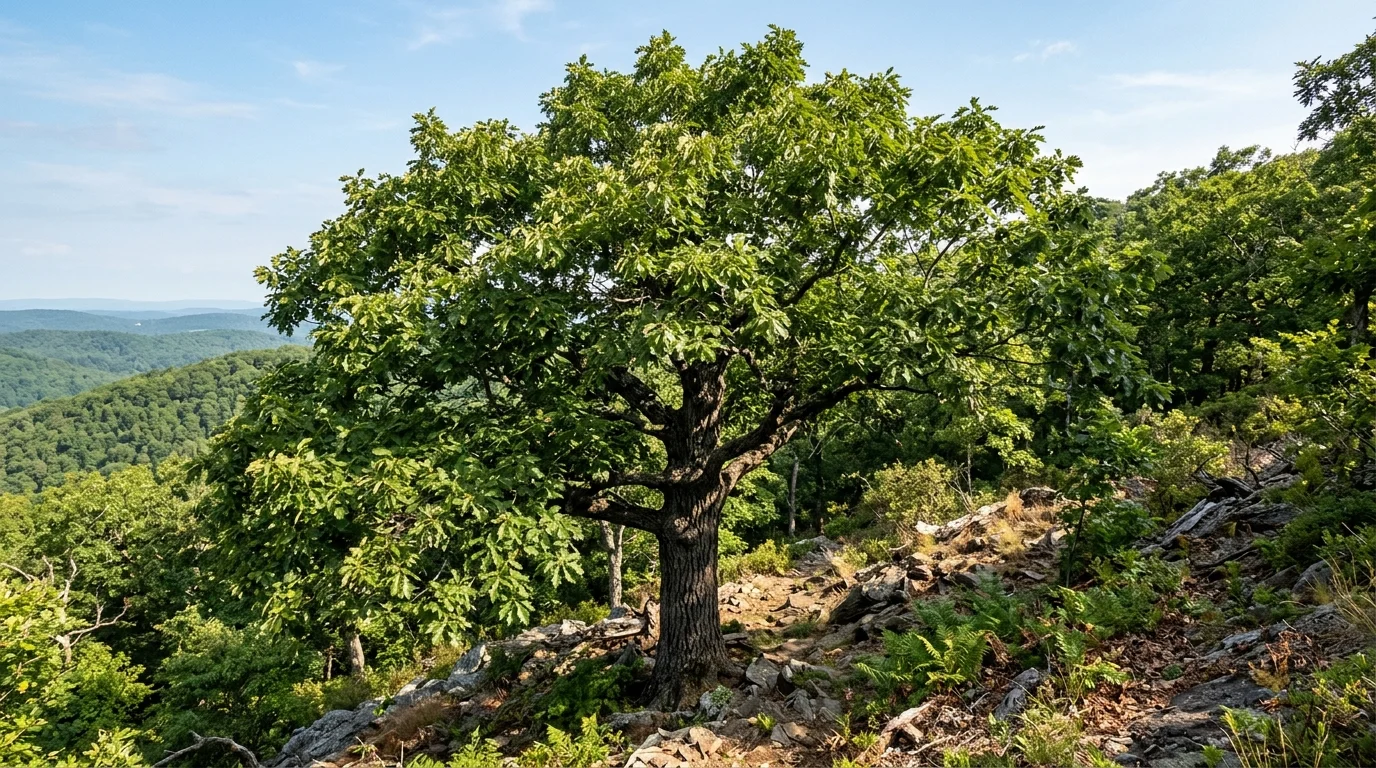
Chestnut Oak Guide
Keep Track of What You See
Create a free Wild Things Guide membership to record this Chestnut Oak in My Sightings and build your personal wildlife list.
Join to Add This SightingTree Name
Chestnut oak (Quercus montana) is a native deciduous oak of eastern North America. It belongs to the white oak group, whose acorns mature in one growing season and whose leaves usually have rounded lobes or teeth without bristle tips. The common name refers to the resemblance between its toothed leaves and those of the American chestnut.
Older books often call this tree Quercus prinus, but that name was historically applied inconsistently to chestnut oak and swamp chestnut oak. Quercus montana is the accepted name used here.

Quick Identification
- Form: A medium to large forest oak, commonly 60–80 feet tall, with a rounded or irregular crown.
- Leaves: Oblong, usually 4–8 inches long, with coarse, rounded teeth and no bristle tips.
- Bark: Dark gray to nearly black, divided into exceptionally deep, narrow ridges.
- Acorns: Large, shiny brown nuts with a bowl-shaped cup covering roughly one-third to one-half of the nut.
- Habitat: Dry, rocky ridges and upper slopes, especially in and around the Appalachian Mountains.
The most useful field combination is chestnut-like foliage, white-oak-type acorns, and thick, deeply furrowed bark on a dry upland site.
Appearance
Mature chestnut oaks are generally 60–80 feet tall, although favorable forest trees may exceed 90 feet. The trunk can reach 2–3 feet in diameter and occasionally more. Trees growing in closed woods tend to have a long trunk and a relatively compact crown. Open-grown specimens develop lower branches and a broader, rounded crown, often 50–70 feet across.
The leaves are alternate, simple, and usually 4–8 inches long. They are oblong to narrowly oval, widest near the middle or above it, with 10–16 or more pairs of coarse, rounded teeth. Each tooth may be shallowly triangular, but it lacks the stiff bristle found on red-group oaks. The upper surface is yellow-green to dark green; the underside is paler and may carry fine hairs, particularly along the veins. Leaf bases range from wedge-shaped to rounded, while the tip is pointed or bluntly tapered.
Young trees may be somewhat upright and irregular. Older trees often acquire heavy, crooked limbs, especially where exposed to wind and thin soils. The wood and root system allow the species to persist on sites that appear too rocky and dry for many other large hardwoods.

Bark, Twigs, and Buds
The bark is chestnut oak’s strongest year-round identification feature. On mature trunks it is thick, dark gray to blackish, and broken into long, narrow ridges separated by deep furrows. The ridges are often sharply defined rather than broad and flaky. From a distance, the trunk can look as though it has been deeply carved into vertical bands.
Young bark is smoother and gray-brown, so saplings are less distinctive. Twigs are moderately stout, brown to reddish brown, and may have scattered pale lenticels. The pith is star-shaped in cross section, as in other oaks. Terminal buds occur in clusters and are broadly egg-shaped, pointed, and brown, commonly about 1/4 inch long. Several overlapping bud scales are visible.
When identifying a leafless tree, combine the clustered terminal buds with the habitat and bark. Deeply furrowed bark alone is suggestive but not conclusive because older northern red oak, black oak, and other upland trees can appear similar at a distance.

Flowers, Fruit, Nuts, or Cones
Chestnut oak bears separate male and female flowers on the same tree. The flowers appear as the leaves expand in spring. Male flowers hang in slender yellow-green catkins, while the much smaller female flowers occur near the ends of new shoots. Wind carries the pollen.
The fruit is an acorn that matures during its first autumn, a characteristic of the white oak group. The nut is broadly oval to elongated, commonly 1–1.5 inches long, and turns glossy chestnut-brown when ripe. Its relatively deep, bowl-shaped cup encloses approximately one-third to one-half of the nut. Cup’sup’s scales are tightly pressed or slightly raised rather than loose and fringed.
Acorn crops vary greatly from year to year. During a heavy mast year, the ground beneath mature trees may be covered with nuts; in other years, production can be sparse. Fallen acorns germinate in autumn or soon afterward if moisture, temperature, and animal activity are favorable.

Range and Habitat
Chestnut oak is native to the eastern United States and reaches the southern edge of Ontario. Its distribution is centered on the Appalachian region, extending from parts of New England and New York west toward southern Michigan, Indiana, and Illinois, and south into portions of Mississippi, Alabama, Georgia, and the Carolinas. It is especially characteristic of the central and southern Appalachians. The North Carolina State University Extension species account provides additional horticultural and identification details.
This oak is strongly associated with dry, acidic, rocky soils on ridges, cliffs, upper slopes, and mountainsides. It often grows where soil is shallow, and drainage is rapid. Common associates include scarlet oak, black oak, northern red oak, pitch pine, table mountain pine, sourwood, blackgum, and various hickories.
Despite its reputation as a dry-site tree, chestnut oak usually performs best where roots can reach some dependable moisture. Its presence on harsh ridges reflects tolerance rather than an absolute requirement for poor soil. It is generally uncommon on wet bottomlands or strongly alkaline soils.

Wildlife Connections
Chestnut oak acorns are an important autumn food for white-tailed deer, wild turkeys, black bears, squirrels, chipmunks, mice, and other forest animals. Blue jays and additional birds may transport acorns away from the parent tree. Uneaten buried acorns can establish new seedlings, making seed-caching animals important dispersal partners.
The foliage supports caterpillars and other herbivorous insects, which in turn feed woodland birds. Mature crowns provide nesting and roosting sites, while bark crevices shelter spiders and insects. Woodpeckers, owls, bats, squirrels, and other wildlife may use cavities in old or damaged trees.
Don’t view acorns as a constant annual resource. Production fluctuates, and many oak species in a forest may produce heavy crops at roughly the same time. This intermittent abundance influences wildlife movement, feeding, and reproduction.
Seasonal Identification
Spring: Look for expanding yellow-green leaves and drooping male catkins. New foliage may be softly hairy before becoming firmer and darker.
Summer: The coarse, rounded leaf teeth are easy to inspect. Confirm that the teeth lack bristles, then check for dark, deeply ridged bark and a dry upland setting.
Autumn: Leaves commonly turn yellow, yellow-brown, or russet rather than brilliant red. Large brown acorns and their deep cups provide valuable identification evidence. Some leaves may remain attached after turning brown, particularly on young trees and lower branches.
Winter: Focus on the rugged vertical bark ridges, stout twigs, and clusters of brown terminal buds. Fallen leaves and empty acorn cups beneath the crown can help, although wind, water, and animals may move them.

Human Uses and History
Chestnut oak wood is heavy, hard, strong, and wear-resistant. People have used it for flooring, railroad ties, fence posts, rough construction, fuelwood, and barrels. The wood resembles that of other white oaks, and lumber is often marketed collectively rather than by individual oak species.
The bark is rich in tannins and was historically important to the leather-tanning industry, particularly in the Appalachian region. People sometimes harvested trees primarily for bark, which they could peel and transport to tanneries. This use contributed to the older common name “tanbark oak,” although that name can also be confused with unrelated western trees.
Chestnut oak is occasionally planted as a shade or landscape tree. Its mature size, large acorn crop, and preference for well-drained acidic soil make it better suited to parks, naturalized grounds, and large properties than to confined streets.
Conservation and Threats
Chestnut oak remains widespread and is not generally considered globally threatened. Nevertheless, individual populations face pressures from forest clearing, development on ridges, severe drought, repeated defoliation, invasive plants, and altered fire patterns. Abundant deer browsing can suppress regeneration by repeatedly eating seedlings.
Potential pests and diseases include spongy moth caterpillars, oak borers, root rots, cankers, and oak wilt. Healthy trees often tolerate a single episode of defoliation, but repeated leaf loss combined with drought can weaken them and invite secondary insects or fungi. Oak wilt risk varies geographically and deserves particular attention where the disease is established.
Because chestnut oak evolved in fire-influenced upland forests, changes in fire frequency can alter competition and regeneration. Fire may reduce thin-barked competitors, but intense burns can injure roots and trunks. Conservation is therefore best based on local forest conditions rather than a universal burning schedule.
Similar Species
Swamp chestnut oak (Quercus michauxii): Usually occupies moist bottomlands and lower slopes. Its leaves are often larger, broader, and noticeably whitish or softly hairy beneath. The bark tends to be paler and flaky rather than deeply cut into dark vertical ridges.
Chinkapin oak (Quercus muehlenbergii): Has chestnut-like leaves, but the teeth are commonly sharper and more regular. It is strongly associated with limestone or other base-rich soils, whereas chestnut oak typically favors acidic ridges.
American chestnut (Castanea dentata): Its leaves have many narrow, sharply pointed teeth, not the broad rounded teeth of chestnut oak. Chestnut fruit develops inside a densely spiny bur; oak acorns sit in individual scaly cups.
Rock chestnut oak hybrids and other white oaks: Oaks hybridize, and intermediate trees can resist tidy identification. When features conflict, examine several mature leaves, acorns with cups, bark, buds, and habitat rather than relying on one character.

Interesting Facts
- The species epithet montana means “of the mountains,” reflecting the tree’s strong association with Appalachian uplands.
- Its thick bark can protect it from low-intensity surface fire, although no tree is immune to severe burning.
- Chestnut oak can grow from cracks among boulders, but roots may extend into deeper pockets of soil hidden beneath the surface.
- Large acorns contain substantial food reserves, helping young seedlings establish on relatively dry sites.
- Despite its common name and similar leaf shape, chestnut oak is not closely related to true chestnuts beyond belonging to the same broader beech-family order.
Frequently Asked Questions
Is chestnut oak the same as American chestnut?
No. Chestnut oak is an oak that produces acorns. American chestnut produces nuts enclosed in spiny burs and has leaves with numerous sharp teeth.
Where is the best place to look for chestnut oak?
Search dry, acidic, rocky ridges and upper slopes in the Appalachian region and nearby eastern forests. Mature trunks with very deep vertical furrows are visible in every season.
How quickly does chestnut oak grow?
Young trees may add roughly 12–24 inches of height in a favorable year, but growth is often slower on the shallow, drought-prone sites where wild trees commonly occur.
Are chestnut oak acorns edible?
They are wildlife food and have been processed for human use, but raw acorns contain tannins that produce bitterness and can cause digestive distress. Correct identification and thorough leaching are necessary before any traditional food use.
Does chestnut blight affect chestnut oak?
No. Chestnut blight primarily attacks true chestnuts in the genus Castanea. Chestnut oak belongs to the genus Quercus, although it has its own oak-specific pests and diseases.