

California Black Oak Tree Guide
Keep Track of What You See
Create a free Wild Things Guide membership to record this California Black Oak Tree in My Sightings and build your personal wildlife list.
Join to Add This SightingTree Name
California Black Oak Tree (Quercus kelloggii) is a deciduous broadleaf tree in the beech family (Fagaceae). It is also called Kellogg oak. Despite its common name, it is not the same species as eastern black oak (Quercus velutina). California black oak belongs to the red oak group, whose members typically have bristle-tipped leaf lobes and acorns that require two growing seasons to mature.
The species honors American botanist Albert Kellogg. It is one of the most recognizable upland oaks in California, particularly where its dark trunk, broad crown, and sharply lobed leaves contrast with surrounding conifers.

Quick Identification
- Look for a medium to large deciduous oak with a broad, rounded or irregular crown.
- Leaves have seven to eleven deep, pointed lobes, usually ending in fine bristles.
- Mature bark is dark gray to nearly black, with deep furrows and thick, irregular ridges.
- Acorns are relatively large and mature during their second autumn.
- In fall, the foliage commonly turns yellow, gold, orange, or brown before dropping.
- Within its western range, the combination of deciduous leaves, deep bristle-tipped lobes, dark bark, and mountain habitat is highly useful for identification.
Appearance
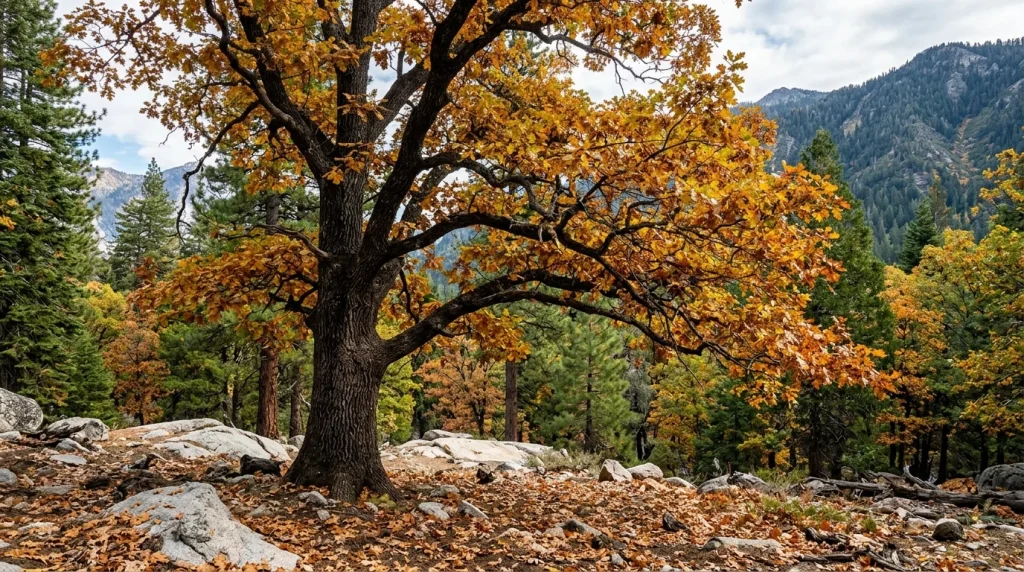
California black oak commonly reaches 30 to 80 feet tall, although favorable forest trees can grow taller. Open-grown trees often develop short trunks and wide, rounded crowns, while trees crowded among conifers tend to have straighter trunks and narrower crowns. Mature crown spread is frequently 30 to 60 feet.
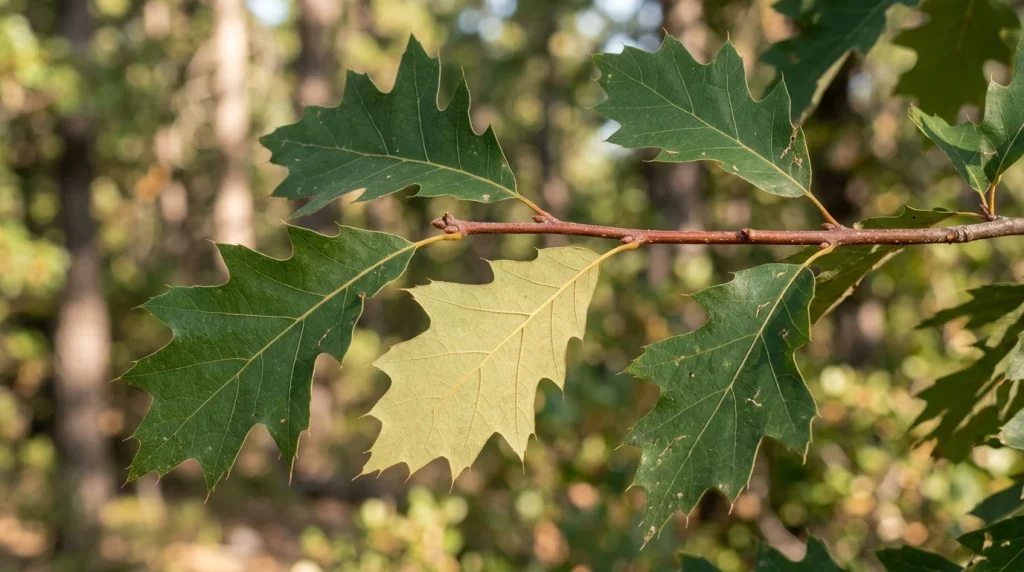
The alternate leaves are generally 4 to 10 inches long, though size varies with age, moisture, and exposure. Each leaf usually has seven to eleven deep lobes separated by broad, rounded sinuses. The lobes end in one or more slender bristles, a feature characteristic of the red oak group. Mature leaves are typically dark green above and paler beneath. Newly unfolding leaves may appear reddish or bronzy and can carry soft hairs that become less noticeable as the leaf matures.
Leaf shape is variable. Vigorous shoots and shaded lower branches may bear especially large leaves, while exposed crown foliage may be smaller, firmer, and more deeply cut. Identification should therefore rely on several leaves, along with bark, acorns, and habitat, rather than on a single specimen.
Bark, Twigs, and Buds
Young trunks and branches have relatively smooth gray bark. As the tree ages, the bark becomes thick, dark gray-brown to nearly black, and deeply divided into irregular ridges. Older trees can appear strikingly dark from a distance, helping explain the common name.
Twigs are usually reddish brown to gray-brown and moderately stout. The buds are clustered near the twig tips, as is typical of oaks. They are egg-shaped to pointed and may have fine hairs or pale-edged scales. Leaf scars are arranged alternately rather than directly opposite one another.
Dark, deeply furrowed bark is useful, but not conclusive on its own. Fire, age, lichens, moisture, and lighting can change the apparent bark color. On winter trees, check for clustered terminal buds, persistent acorns or cups beneath the crown, and the deeply divided fallen leaves.

Flowers, Fruit, Nuts, or Cones
California black oak is monoecious, meaning one tree produces separate male and female flowers. The inconspicuous flowers emerge with the leaves in spring. Male flowers hang in slender yellow-green catkins, while the much smaller female flowers occur singly or in small groups near new shoot growth. Wind carries the pollen.
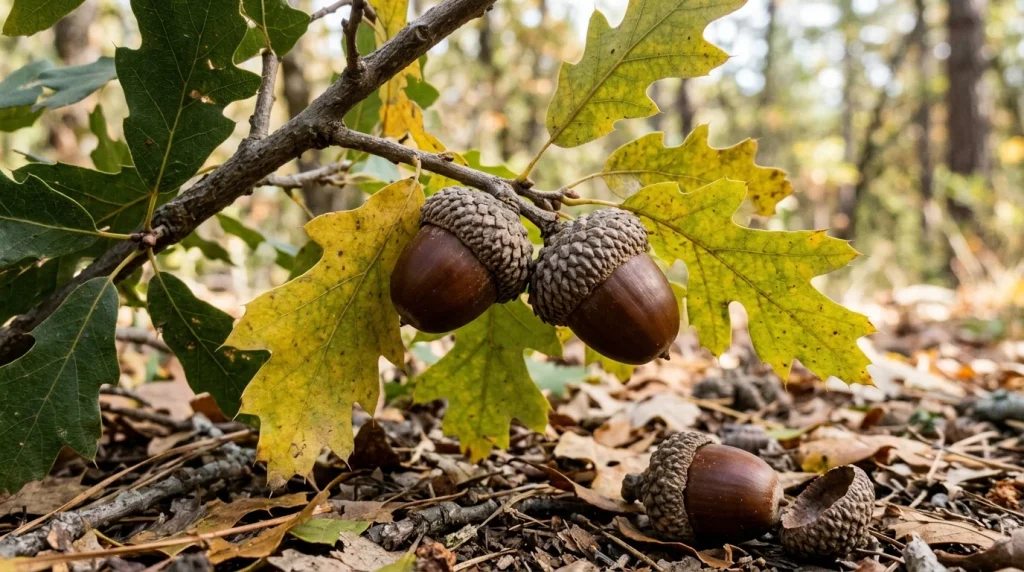
The fruit is an acorn, usually about 1 to 1.5 inches long. It is broadly egg-shaped to oblong, often with a rounded tip. A deep, bowl-shaped cup covers roughly one-third to nearly one-half of the nut and bears thick, overlapping scales. The acorns require two growing seasons to mature, ripening in their second autumn. This biennial schedule distinguishes it from western white oaks, whose acorns generally mature in one season.
Acorn production varies substantially from year to year. During a mast year, one tree may produce a heavy crop, while production is sparse in other years. Insects, drought, frost, and wildlife consumption can greatly reduce the number of acorns that successfully germinate.
Range and Habitat
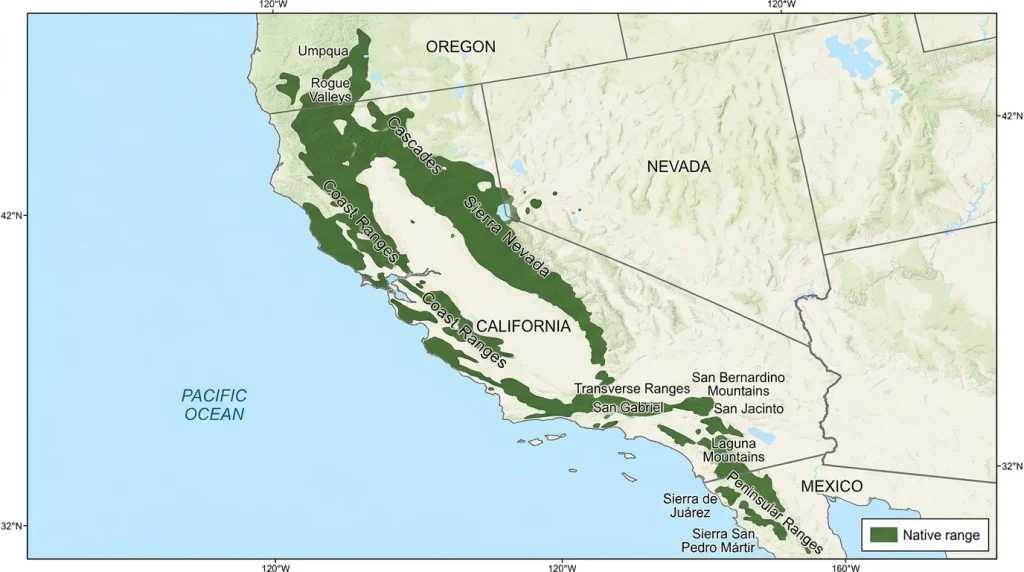
California black oak is native to western North America. Its main range extends from western Oregon through much of California and into northern Baja California. It occurs in the Cascade Range, Sierra Nevada, Coast Ranges, Transverse Ranges, and Peninsular Ranges, with localized populations near the western edge of Nevada. The USDA PLANTS profile for California black oak provides an overview of its regional distribution.
The tree grows in oak woodland, mixed-conifer forest, pine forest, and transitional habitats between woodland and higher-elevation forest. It is common on mountain slopes, benches, ridges, and canyon sides with well-drained soil. Elevation varies with latitude and local climate; in California it can occur from lower foothills to mountain forests above 7,000 feet.
California black oak tolerates summer drought once established but generally performs best where winter precipitation and soil depth provide adequate stored moisture. It may grow with ponderosa pine, sugar pine, incense cedar, Douglas-fir, white fir, canyon live oak, tanoak, and several other oak species.
Wildlife Connections
The acorns are calorie-rich food for black bears, mule deer, wild pigs, squirrels, chipmunks, woodrats, wild turkeys, Band-tailed Pigeons, jays, and woodpeckers. Acorn woodpeckers may store the nuts in communal granary trees, while Steller’s Jays and other animals carry and cache acorns. Forgotten caches can help establish new seedlings away from the parent tree.
Leaves, twigs, bark, flowers, and decaying wood support many insects and other invertebrates. Caterpillars feeding on oak foliage become prey for nesting birds. Large limbs and cavities provide denning or nesting sites, and loose bark shelters small animals. Fallen leaves contribute organic matter and help moderate temperature and moisture at the soil surface.
A large old California black oak is therefore more than an acorn producer. Its cavities, dead branches, canopy structure, and decaying wood create habitat features that younger trees cannot immediately replace.
Seasonal Identification
Spring: Look for reddish or bronzy emerging leaves accompanied by dangling male catkins. Young foliage may appear softly hairy before expanding and turning green.
Summer: The broad crown carries dark green leaves with deep, pointed, bristle-tipped lobes. Developing second-year acorns may be visible, while smaller first-year acorns begin forming on new growth.
Fall: Leaves often change to yellow, gold, orange, reddish brown, or dull brown. Color intensity varies with weather and site conditions. Mature acorns drop during autumn and can accumulate beneath productive trees.
Winter: The tree is leafless, exposing its broad branching framework and dark, furrowed bark. Fallen lobed leaves, empty acorn cups, clustered twig buds, and an open, irregular crown help with identification.
Human Uses and History
California black oak acorns have long been important foods for Indigenous peoples of California and southern Oregon. After careful harvesting, drying, grinding, and leaching to remove bitter tannins, people can prepare the acorn meal in several ways. These traditions remain culturally significant and should not be described only as past practices.
Indigenous land stewardship, including purposeful burning in suitable places and seasons, helped maintain accessible oak stands, stimulate useful understory plants, and reduce competition from young conifers. The details and objectives differ among Tribal nations and landscapes.
The wood is hard and strong but can be difficult to dry without checking or warping. It has been used for furniture, flooring, pallets, fuelwood, and other products, though it has generally been less prominent commercially than some eastern oaks. Mature trees are also valued for shade, wildlife habitat, scenic character, and cultural landscapes.
Conservation and Threats
California black oak is not generally considered rare across its full range, but individual stands face significant pressures. Fire exclusion can allow shade-tolerant conifers to crowd oak crowns, reduce acorn production, and eventually replace oaks. California black oak can resprout from its root crown after top-kill, yet severe fire, repeated short-interval burning, or damage to large old trees may still cause lasting losses.
Drought and warming temperatures can reduce growth, weaken trees, and limit seedling establishment. The goldspotted oak borer has killed California black oaks in parts of southern California. Other insects, decay fungi, browsing, livestock impacts, development, and road construction can also affect local populations. California black oak can be affected by the pathogen associated with sudden oak death, although outcomes vary by host, site, and exposure.
Conservation commonly emphasizes retaining large old oaks, protecting younger age classes, maintaining space around crowns, encouraging successful regeneration, and applying locally appropriate fire or vegetation management. Moving firewood can spread destructive insects and pathogens, so follow regional firewood guidance.
Similar Species
Oregon white oak (Quercus garryana): This deciduous oak has rounded lobes without bristle tips. Its bark is usually paler and blockier, and its acorns mature in one season.
Canyon live oak (Quercus chrysolepis): Canyon live oak overlaps widely with California black oak, but it is evergreen. Its leaves are thick and leathery, often with golden or grayish hairs beneath, and may be entire or spiny rather than consistently deeply lobed.
Interior live oak (Quercus wislizeni): This species is also evergreen and usually has smaller, firmer leaves. Its foliage can be toothed or spiny, but it does not normally produce the large, deeply cut deciduous leaves typical of California black oak.
Eastern black oak (Quercus velutina): Both species are deciduous red oaks with bristle-tipped lobes and dark mature bark. Eastern black oak is native to eastern North America, not California’s mountain forests. Planted trees are best separated using range, buds, inner-bark traits, leaf details, and acorn cups.

Interesting Facts
- California black oak can regenerate both from acorns and from vigorous sprouts arising near the root crown after trunk damage.
- Acorns take two seasons to mature, so a summer branch can sometimes carry small first-year acorns and larger second-year acorns at the same time.
- The species can hybridize with related red oaks where their ranges meet, occasionally producing trees with intermediate traits.
- Open-grown trees may have enormous spreading limbs, while forest-grown individuals can look tall and relatively narrow.
- Old oaks retain exceptional ecological value even after portions of the crown die, as long as the tree does not create an unacceptable safety hazard.
Frequently Asked Questions
Is California black oak evergreen?
No. It is deciduous and normally loses its leaves in fall or early winter. This separates it from canyon live oak and interior live oak, which retain foliage year-round.
Why is it called a black oak?
The name refers mainly to the dark, deeply furrowed bark of mature trees. The leaves and wood are not uniformly black.
Are California black oak acorns edible?
They are edible only after knowledgeable processing. Raw acorns contain substantial tannins and are intensely bitter. Traditional preparation includes drying, grinding, and repeated leaching. Harvesting should respect land ownership, wildlife needs, local regulations, and Indigenous cultural resources.
How quickly does California black oak grow?
Young trees may add roughly 1 to 2 feet of height in a favorable year. Growth slows with age and can be much lower on dry, crowded, damaged, or nutrient-poor sites.
What is the best identification clue?
Use the combined pattern: large deciduous leaves with deep, bristle-tipped lobes; dark, strongly furrowed mature bark; and large acorns held in deep, scaly cups. Mountain or upland woodland habitat within the western native range adds useful context.


