Catalpa Guide
Keep Track of What You See
Create a free Wild Things Guide membership to record this Catalpa in My Sightings and build your personal wildlife list.
Join to Add This SightingTree Name
Catalpa is a deciduous tree best known for its enormous heart-shaped leaves, showy white flowers, and long, dangling seed capsules. In North America, the name usually refers to northern catalpa (Catalpa speciosa) or southern catalpa (Catalpa bignonioides), both members of the trumpet-creeper family (Bignoniaceae).
This guide focuses on northern catalpa, widely planted across temperate North America, and compares it with southern catalpa. Common names include hardy catalpa, cigar tree, and Indian bean tree. Despite the beanlike fruit, catalpas are not legumes.
Quick Identification
- Leaves: Broad, heart-shaped blades, usually 6–12 inches long, with smooth edges and pointed tips; opposite or in whorls of three.
- Flowers: Upright clusters of white, trumpet-shaped blossoms with yellow and purple markings inside.
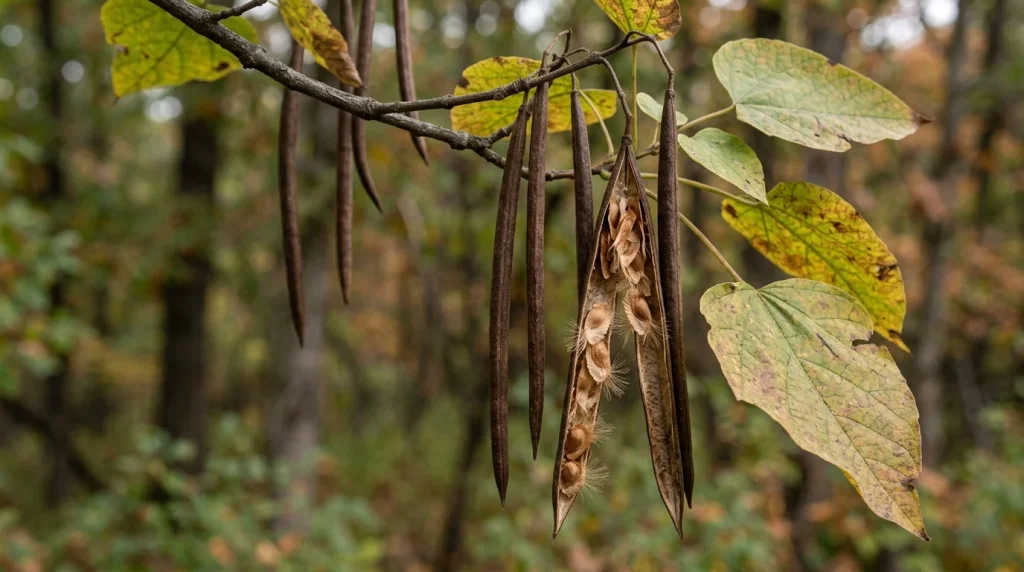
- Fruit: Slender, hanging capsules, commonly 8–20 inches long, turning brown and sometimes persisting through winter.
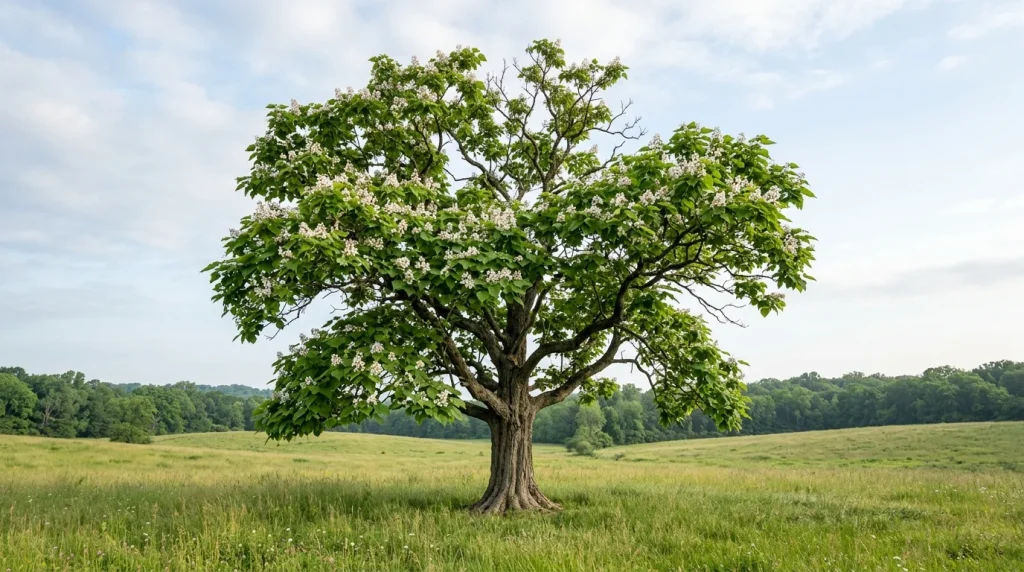
- Form: A medium to large tree with coarse branches and an irregular, rounded-to-upright crown.
- Best combination: Huge heart-shaped leaves plus long, pencil-shaped fruit distinguishes catalpa from most familiar shade trees.
Appearance
Northern catalpa commonly reaches 40–70 feet tall with a crown about 25–50 feet wide. Trees on favorable sites can grow taller. Young specimens may look narrow and strongly upright; older trees often develop a broad, uneven crown with heavy ascending limbs and conspicuous gaps between branches.
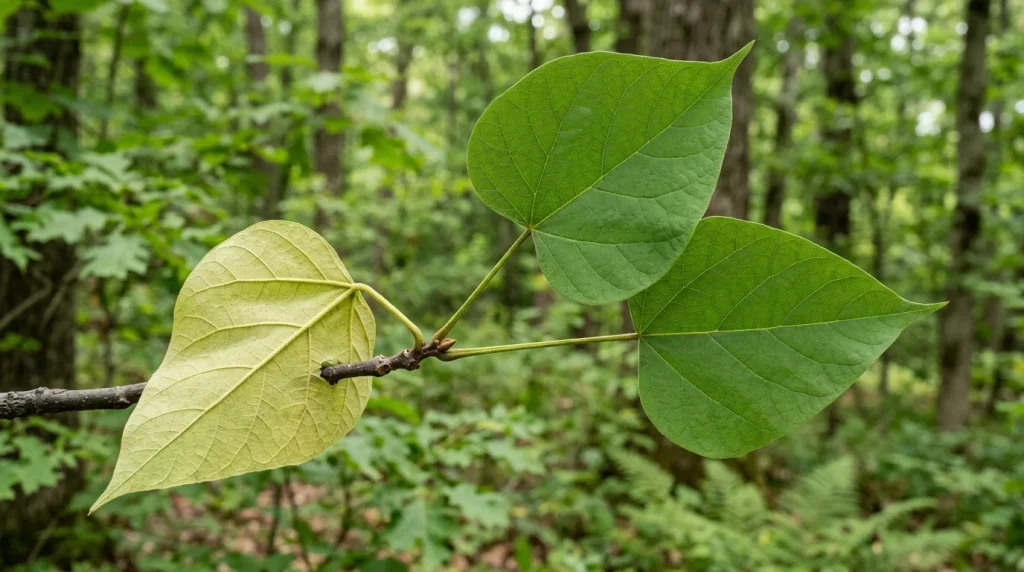
Leaves are simple, not divided into leaflets. Each hangs from a long stalk, with a rounded or heart-shaped base and a pointed tip. The upper surface is green; the underside is paler and usually hairy, particularly along veins. Leaf size varies with growing conditions, and vigorous shoots may carry unusually large blades.
Catalpa leafs out relatively late, so a healthy tree may still appear bare when nearby maples are already green. Autumn color is generally yellow-green to yellow, often brief or muted rather than spectacular.
Bark, Twigs, and Buds
Young bark is relatively smooth and grayish brown. Mature northern catalpa bark develops ridges and furrows, sometimes breaking into scaly plates. Bark alone is not decisive: its appearance changes with age, and several unrelated trees have similar gray-brown ridging.
Twigs are stout and fit the oversized leaves. After leaf fall, look for large, rounded leaf scars arranged opposite one another or in groups of three. Several small vascular bundle scars may be visible within each leaf scar. Buds are small and inconspicuous compared with twig thickness.
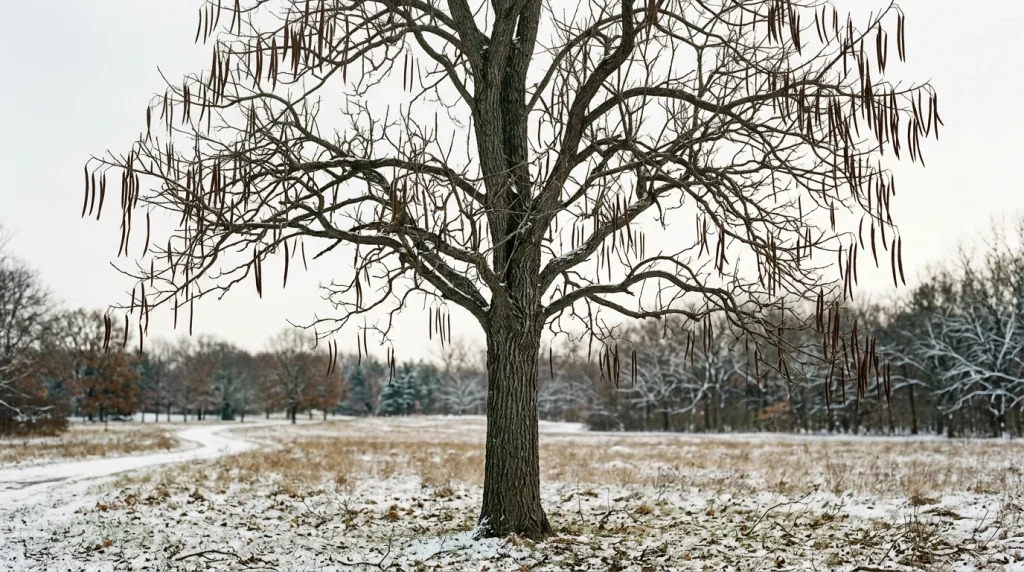
In winter, look for the twig, arrangement, hanging capsule, and coarse branching pattern. A tree without fruit is harder to identify, so inspect several reachable twigs rather than relying on the silhouette alone.

Range and Habitat
Northern catalpa is native to a relatively restricted part of the central United States, associated with the central Mississippi and lower Ohio River valleys. Its historical native limits are difficult to draw precisely because people planted and moved it extensively. It now grows in yards, parks, shelterbelts, and naturalized populations well beyond that original region, including parts of southern Canada.
Native habitats include rich bottomlands and floodplain woods, especially on moist, fertile, well-drained soils. Planted trees tolerate a broader range of soils and urban conditions. Full sun generally produces the strongest growth and flowering; prolonged waterlogging, severe drought, and very exposed sites can reduce performance.
Southern catalpa originated farther south, principally in the Gulf Coastal Plain, and has also been widely planted. The NC State Extension northern catalpa profile provides additional identification and landscape information.

Flowers, Fruit, Nuts, or Cones
Northern catalpa blooms in late spring or early summer, with timing depending on latitude and weather. The flowers appear in branched clusters above the foliage. Individual blossoms are roughly 2 inches across, with ruffled white lobes, yellow guides, and purple spots or streaks within the throat.
After pollination, flowers develop into long, narrow capsules. These begin green, mature brown, and eventually split lengthwise into two valves. Inside are numerous flattened seeds with fringed, hairy ends that aid wind dispersal. Empty capsule halves may remain attached after the seeds have escaped.
The fruits are neither edible beans nor nuts, and the tree produces no cones. Fruit abundance varies by trees and years. A young, shaded, recently pruned, or poorly flowering tree may have few capsules, so their absence does not rule out catalpa.
Wildlife Connections
Catalpa flowers attract bees and other flower-visiting insects. The foliage is especially important to the catalpa sphinx moth, Ceratomia catalpae. Its caterpillars, commonly called catalpa worms, can become abundant enough to strip much of a tree’s foliage.
Caterpillars feed birds and other predators. Parasitic wasps also help regulate their numbers; caterpillars bearing clusters of small white cocoons have been parasitized. Avoid automatically treating these insects as a reason to spray. Healthy established trees often recover from a single defoliation, although repeated damage can stress them.
Branches provide perches and nesting structure, while older trees may develop cavities used by wildlife. Catalpa is not a major fleshy-fruit food source; its strongest wildlife connections involve insects and tree structure.
Seasonal Identification
- Spring: Look for delayed leaf emergence, stout shoots, and expanding heart-shaped leaves. Flower buds develop toward the ends of new growth.
- Late spring and summer: White flower clusters are highly distinctive. Later, inspect the canopy for green, hanging capsules.
- Autumn: Leaves become yellowish or fall after frost. Ripening brown capsules stand out as the crown opens.
- Winter: Search for persistent capsules, thick twigs, large leaf scars, and an irregular framework of heavy limbs.
For a confident winter identification, find fallen capsules beneath the crown and check that they match fruit still attached overhead. Wind can carry leaves and fruit from neighboring trees, so ground litter alone is less reliable.
Human Uses and History
People have long planted catalpas for shade, ornamental flowers, and their unusual foliage. Northern catalpa also attracted interest as a timber and fence-post tree because its heartwood can resist decay in some uses. Its relatively light wood has been used for posts, carving, and smaller woodworking projects.
Some people cultivate catalpas specifically to produce catalpa worms for fishing bait. However, caterpillar outbreaks are not dependable every year or in every region, and planting a tree does not guarantee a supply.
In landscapes, allow room for the mature crown and expect seasonal litter from flowers, large leaves, and capsules. Young trees may add roughly 1–2 feet of height annually, sometimes more on favorable sites. Established trees can live for many decades, but lifespan varies considerably with structure, site conditions, and storm damage.
Conservation and Threats
Northern catalpa is widely cultivated and is not generally regarded as a globally threatened tree. Nevertheless, planted abundance does not tell us how well original native floodplain populations are doing. Protecting natural river-bottom habitats benefits catalpa and the many other species sharing those sites.
Potential problems include catalpa sphinx defoliation, leaf spots, powdery mildew, and Verticillium wilt. Large trees can also develop decay, weak branch attachments, or broken limbs. Have a qualified arborist assess significant cracks, major dead branches, or decay near occupied areas.
Outside its native range, catalpa may seed into disturbed ground. Check local guidance before planting near natural areas, and do not assume every roadside specimen represents a native population.
Similar Species
Southern catalpa (Catalpa bignonioides): The closest common look-alike generally has a lower, broader crown, somewhat smaller flowers in larger clusters, and thinner-walled capsules. Crushed leaves often smell unpleasant; northern catalpa leaves usually lack that strong odor. These tendencies overlap, so use several characters. The NC State Extension southern catalpa profile offers a useful comparison.
Princess tree (Paulownia tomentosa): Also has huge opposite, heart-shaped leaves, but they are often conspicuously velvety. Lavender-purple flowers usually appear before the leaves, and the fruit is an egg-shaped woody capsule, never a long catalpa “bean.” Princess tree is introduced and invasive in parts of North America.
Eastern redbud (Cercis canadensis): Has smaller, alternate heart-shaped leaves, pink spring flowers, and short, flat legume pods. Checking leaf arrangement quickly separates leafy redbud shoots from catalpa.

Interesting Facts
- Catalpa belongs to the same family as trumpet creeper, helping explain its large, tubular flowers.
- The “beans” are dry capsules containing many small seeds, not the large seeds typical of garden beans.
- Opposite leaves and three-leaf whorls may occur on the same tree.
- A defoliated catalpa may produce another flush of leaves, although replacing foliage uses stored energy.
Frequently Asked Questions
Are catalpa pods edible?
Do not treat them as food. They are woody seed capsules, not edible beans. Avoid tasting unknown tree parts while identifying them.
Is catalpa native to North America?
Yes. Northern and southern catalpa are native to different portions of the United States, but both are planted and naturalized far beyond their original ranges.
Why does my catalpa have no flowers or pods?
Possible reasons include youth, shade, pruning, weather damage, or normal year-to-year variation. Identify it by its leaves, twigs, and bark, and watch for flowers in later seasons.
Is catalpa a good yard tree?
It can be an attractive shade tree with ample space. Consider litter, branch structure, local growing conditions, and nearby buildings before planting. It is less suitable for a confined bed or a spot where falling capsules would be troublesome.