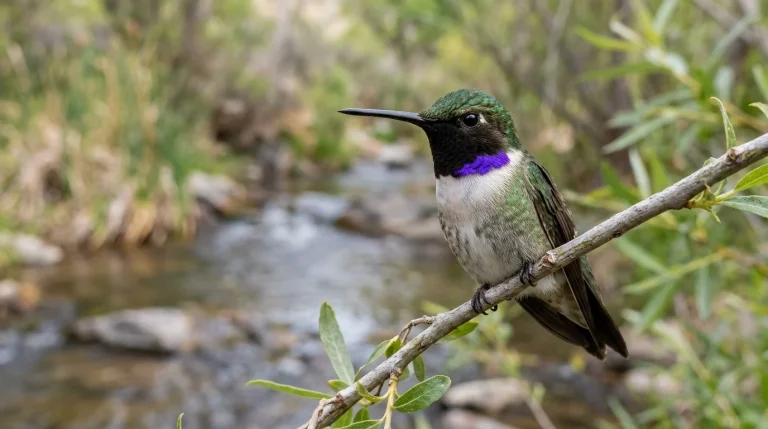
Calliope Hummingbird Guide
Keep Track of What You See
Create a free Wild Things Guide membership to record this Calliope Hummingbird in My Sightings and build your personal wildlife list.
Join to Add This SightingIntroduction
The Calliope Hummingbird (Selasphorus calliope) is North America’s smallest breeding bird, yet it migrates substantially between western mountain country and Mexico. Adult males are distinctive when their streaked magenta throats catch the light. Females and young birds require closer attention to size, proportions, tail pattern, and location. This guide emphasizes features you can actually use at a feeder, meadow, or trailside perch.
Hummingbird at a glance
- Scientific name: Selasphorus calliope
- Family: Trochilidae
- Order: Apodiformes
- Length: About 3.1–3.5 inches (8–9 cm)
- Wingspan: About 4.3 inches (11 cm)
- Weight: About 2.3–3.4 g
- Conservation status: Least Concern globally
- Main range: Western North America during breeding; primarily western and south-central Mexico in winter
- Best field clue: Extremely small size, short tail, and, in adult males, separate magenta throat rays
How to identify it
Begin with proportions rather than color. A Calliope looks compact, with a relatively short, straight black bill and a short tail. On a settled bird, the folded wingtips commonly reach beyond the tail tip. Posture can alter this impression, so use it alongside other marks.
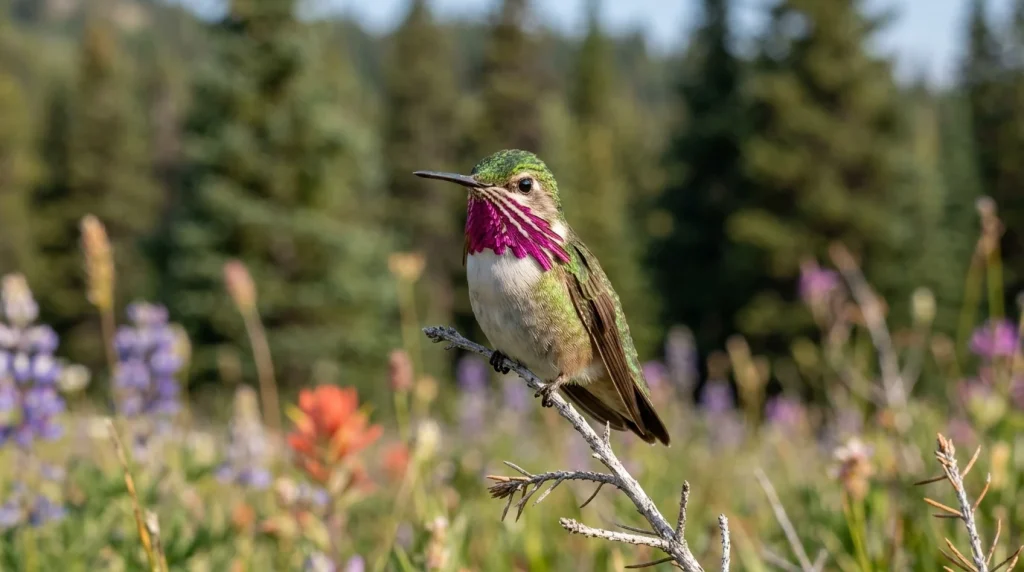
The upperparts are metallic green. Adult males have mostly white underparts, greenish sides, and elongated magenta throat feathers arranged as separate streaks or rays against a pale background. This is unlike the more continuous colored throat patch of many other male hummingbirds. In shade, those iridescent feathers may appear dark rather than pink.
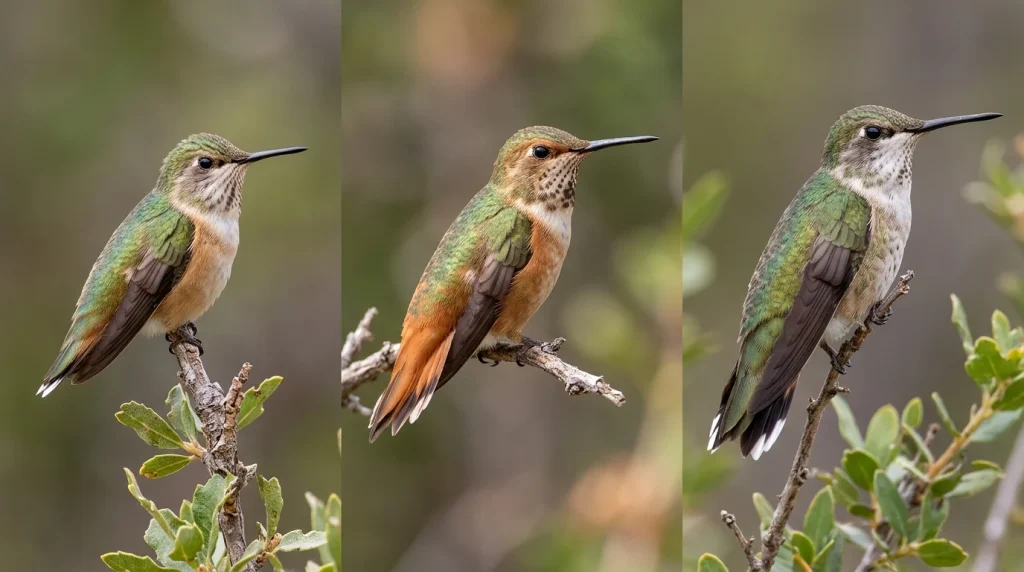
Females and juveniles are pale below, with a whitish throat and warm buff or peach coloring on the sides. Their short tails have dark areas and white tips on the outer feathers. A faint pale mark behind the eye may be visible, but is not diagnostic.
- Compare size directly with another hummingbird whenever possible.
- Check bill length, tail length, and where the folded wings end.
- Look for restrained buff coloration rather than extensive rusty orange.
- Photograph the throat and spread tail if you’re still unsure whether it’s a female.
The Cornell Lab of Ornithology’s Calliope Hummingbird identification guide provides useful photographs showing differences among ages and sexes.
Male, female and juvenile differences
Adult male: The striking feature is the streaked magenta gorget, or throat ornament. Its elongated feathers can be flared outward during display. The short tail is predominantly dark, without the conspicuous white outer tips typical of females. The white breast helps set off the throat pattern.
Adult female: Usually slightly larger than the male, she lacks the developed magenta gorget. Her throat is whitish, sometimes lightly spotted, while her flanks have a buff wash. The outer tail feathers are white-tipped, with some rufous near their bases.
Juvenile: Young birds generally resemble females. Young males may develop scattered iridescent throat feathers before acquiring the adult pattern. Fresh feather edges can give the upperparts a subtly scaled appearance. Do not label every plain-throated bird a female: in late summer and migration, many are juveniles, and reliable sexing may require detailed photographs or specialist examination.

Range and distribution
The breeding range extends from southern British Columbia and southwestern Alberta through the western United States. It includes suitable habitat in the Pacific Northwest, northern Rockies, Sierra Nevada, and portions of the interior West, reaching south into California, Nevada, Utah, and Colorado. Distribution is patchy because flowering habitat and suitable nesting cover are unevenly spread.
During migration, Calliopes occur beyond their nesting areas, including foothills, valleys, gardens, and southwestern mountain corridors. Most winter in western and south-central Mexico.
They do not regularly breed across central or eastern North America. Nevertheless, scattered migrants and occasional winter visitors appear well east of the normal range, including along the Gulf Coast. An out-of-range identification deserves photographs and careful exclusion of similar hummingbirds.

Preferred habitat
Look for a mosaic of open feeding areas and nearby woody cover: mountain meadows, brushy slopes, streamside thickets, forest edges, and regenerating openings. Open conifer woodland with abundant flowers is especially suitable. Dense, unbroken forest is generally less productive for finding them.
Breeding birds often use mountain and foothill habitats, but elevation varies with latitude and local conditions. Migrants may feed in high meadows during late-summer flowering, then appear at lower elevations elsewhere along their route. Winter habitat includes Mexican upland scrub, woodland edges, and other flower-rich openings.
For practical searching, prioritize blooming plants beside shrubs or scattered trees. Watch exposed twig tips nearby: males often return to favored lookout perches.
Behavior and flight
Despite their size, Calliopes can vigorously defend feeding patches and breeding territories. They hover precisely, dart between flowers, and chase rivals. At mixed-species feeders, however, larger hummingbirds may displace them.
Calliopes often feed relatively close to the ground where low flowers are available. A brief glimpse of a tiny, compact hummingbird is suggestive, not conclusive; distance and perspective make size surprisingly difficult to judge.
Diet and feeding
Nectar supplies energy, while small insects and spiders provide protein and other nutrients. Calliopes take arthropods from vegetation, catch them in flight, and sometimes forage around insect concentrations.
They visit many flower types, including penstemons, paintbrushes, columbines, and other locally available nectar plants. The tongue gathers nectar rapidly; the bird does not simply suck through its bill like a straw. Feeders supplement natural food but cannot replace insect-rich habitat.

Calls and sounds
Typical calls are thin, high chips or tsip notes, often repeated during interactions. These are easy to miss outdoors and are not a dependable identification shortcut for beginners.
Male displays include buzzing sounds associated with specialized flight and feather movements. Distinguish these mechanical sounds from vocal calls, and pair anything you hear with a clear view of the bird.
Courtship and reproduction
Males display by hovering, flaring throat feathers, and performing aerial maneuvers, including dives. They may advertise from exposed perches overlooking a territory. A female handles nest construction, incubation, and care of the young without assistance from the male.
The small cup nest is built from soft plant material and spider silk, with camouflage such as lichen on the exterior. It is commonly placed on a branch in woody cover, often a conifer. The usual clutch is two white eggs. Incubation takes roughly two weeks, and the young remain in the nest for about three weeks, with timing varying by conditions. Keep well back from active nests.

Migration
Calliopes are long-distance migrants despite weighing only a few grams. Their movements broadly follow a loop: spring migration tends to be farther west, while many southbound birds use interior mountain routes. This is a general pattern, not a rule for every individual.
Adults, particularly males, may begin leaving breeding areas while females and juveniles remain. Flower availability, weather, latitude, and elevation all affect local timing. Consult recent regional sightings rather than relying on a single continent-wide arrival date.
Predators and other dangers
Potential predators include small raptors and other birds that can catch hummingbirds; nest predators may take eggs or young. Domestic cats are an avoidable danger around homes.
Window collisions, pesticide exposure, severe weather, and flower shortages also pose risks. Migration demands repeated refueling opportunities, so losing small, flower-rich stopovers can matter even far from nesting grounds.
Conservation
The Calliope Hummingbird is classified as Least Concern globally, but that category does not mean every local population is secure. Habitat degradation, altered fire patterns, drought, and shifting flowering seasons may affect breeding and migration resources.
Protecting diverse native vegetation across elevations helps maintain both food and cover. Community-science observations are valuable, especially when unusual records include photographs and clear notes.
How to attract this hummingbird
- Plant locally native flowers: Choose suitable penstemons, columbines, and other nectar plants with overlapping bloom periods.
- Keep insects available: Avoid routine insecticide use.
- Offer safe nectar: Mix one part plain white sugar with four parts water. Do not add dye, honey, or artificial sweeteners.
- Clean frequently: Replace nectar and clean feeders every few days, more often in hot weather or whenever nectar becomes cloudy.
- Reduce competition: Space multiple feeders out of one another’s sight.
- Provide safety: Keep cats indoors and treat hazardous windows.
Similar species
Rufous and Allen’s Hummingbirds: Females and juveniles are the main challenge. They generally look longer-tailed and show more extensive rufous in the tail and flanks, but overlap is considerable. Calliope’s compact shape, short bill, and wings extending past the short tail are useful in combination. Separating Rufous from Allen’s can itself require excellent tail views.
Broad-tailed Hummingbird: Females overlap with Calliope in mountain habitats. Broad-tailed is larger and longer-tailed, with a relatively longer bill. Adult males have a solid rose-colored gorget rather than separate magenta rays; their conspicuous wing trill is another useful clue.
Black-chinned Hummingbird: Females generally appear longer-billed and less compact, with less warm buff on the flanks. Tail pumping while hovering can support an identification, but is not exclusive to this species.
Anna’s Hummingbird: Usually noticeably larger and more robust. Adult males show rose-red color on both crown and throat, unlike Calliope’s green crown. Female Annas are often grayer or greener below and have longer tails. No single fleeting color impression should decide a difficult identification.
Interesting facts
- Calliope is the smallest bird that regularly breeds in North America.
- Its name refers to Calliope, a muse in Greek mythology.
- Older books may place it in the genus Stellula rather than Selasphorus.
- The male’s throat changes dramatically with viewing angle because its color is iridescent.
Frequently asked questions
Is every tiny western hummingbird a Calliope?
No. Apparent size is unreliable without comparison. Check proportions, throat pattern, and tail details.
Can Calliopes occur in eastern gardens?
Yes, as uncommon visitors outside their normal range. Document suspected birds rather than assuming location rules them out.
Will leaving a feeder out prevent migration?
No. Seasonal cues drive migration. A clean feeder can help late migrants, but native flowers and insect habitat remain important.